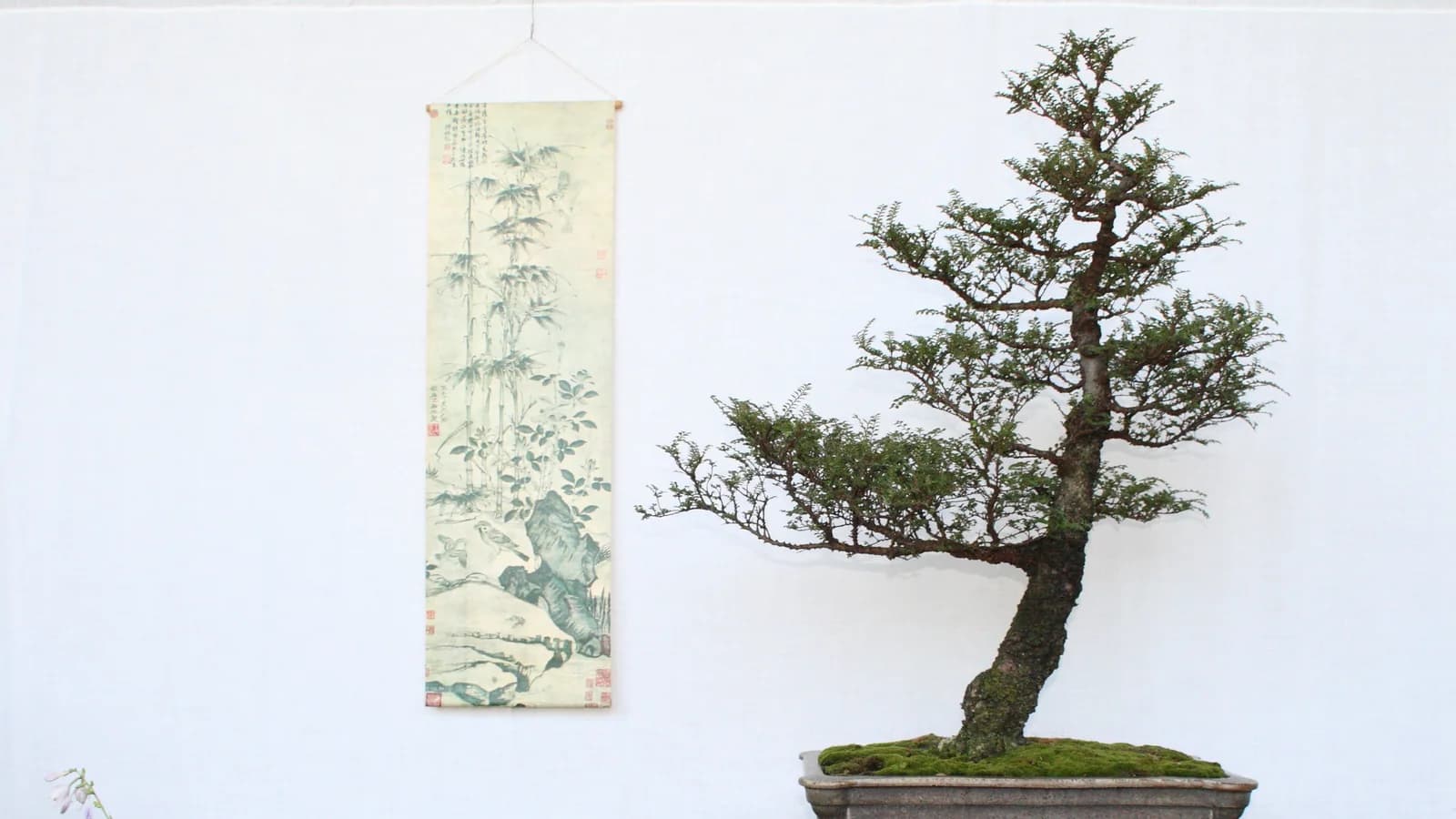
Gardening & growing · Heritage & traditional crafts
Bonsai
Most bonsai trees bought as gifts are dead within a year, and the reason is almost always the same misconception: that bonsai is an indoor hobby. It is not, for most species. Bonsai is horticulture with a shaping practice attached, and the species you have determines nearly everything about how you should treat it.
Also known as bonsai trees, miniature trees.
Bonsai is the practice of growing a tree in a container and shaping it, over years, into a form that suggests a full-sized tree in miniature. The word means, roughly, "planted in a tray"; it names a technique rather than a species, and there is no such thing as a bonsai tree in the way there is such a thing as an oak.
It is worth being blunt about the ratio. Perhaps eighty per cent of bonsai is horticulture — watering, soil, roots, light, feeding, seasonal timing — and twenty per cent is the aesthetic work that makes it look like a photograph. Beginners reverse those, buy wire and cutters first, and lose the tree to a root problem while thinking about branch placement.
The other thing worth saying early is that the timescale is real. A tree responds to a pruning decision over a growing season and to a structural one over years. This is not a hobby that rewards impatience, and that is most of its appeal to the people who stay with it.
Step 1: Start with a nursery tree, not a bonsai
An ordinary £15 garden-centre shrub — a juniper, a cotoneaster, a hornbeam — has a thicker trunk and more material to work with than a cheap finished bonsai, and it costs less. You are buying a subject to develop rather than an object to maintain, and killing one is a £15 lesson rather than a £60 one.
You will know it worked when: You learn on material worth learning on.
Step 2: Identify what you have and learn its calendar
Every meaningful decision in bonsai is species-specific and season-specific. When to repot, when to prune, whether it needs winter protection, how much water — none of these has a general answer. A single species is a manageable thing to learn properly.
You will know it worked when: You stop applying generic advice to a specific tree.
Step 3: Get the soil right before anything else
Bonsai soil is not compost. It is a coarse, free-draining aggregate — akadama, pumice, lava rock, or a commercial mix — that holds some water and a great deal of air. Ordinary potting compost in a shallow pot stays saturated, roots suffocate and rot, and the tree dies from the bottom up over a few months.
You will know it worked when: Roots get oxygen, which is what actually keeps a tree alive in a small container.
Step 4: Learn to water properly
Not on a schedule. Check the soil daily and water thoroughly when the surface is starting to dry, until water runs freely from the drainage holes. In a British summer that can mean twice a day; in winter it can mean once a week. Both overwatering and underwatering kill, and in the free-draining soil above, underwatering is the more likely.
You will know it worked when: The single skill that decides whether the tree survives.
Step 5: Leave it alone for the first year
The hardest instruction. Let the tree establish and observe how it grows before styling it. Beginners prune and wire an unhealthy tree and finish the job. A vigorous tree tolerates work; a struggling one does not.
You will know it worked when: You make your first structural decision on a tree strong enough to survive it.
- Pruning — Two distinct things. Structural pruning removes whole branches to establish the design, and is done when the tree is dormant or before the growth flush depending on species. Maintenance pruning — pinching and trimming new growth through the season — is what builds ramification, the fine twiggy division that makes a small tree read as a large one.
- Wiring — Anodised aluminium or annealed copper wrapped around a branch to hold it in a new position while it lignifies. Applied at roughly 45 degrees, firmly but not tightly. The critical discipline is removal: wire left too long bites into thickening bark and leaves a spiral scar that takes years to grow out, and on a fast-growing species that can happen within a single season.
- Repotting and root work — Every two to five years depending on species, age and vigour, in early spring before the buds move for most temperate trees. The roots are combed out and a proportion trimmed, and the tree goes back into fresh soil. This is what keeps a tree healthy in a small container, and it is also the operation most likely to kill it if done at the wrong time of year.
- Feeding — A container holds very little nutrient and free-draining soil loses what it has quickly. Feed through the growing season and stop or reduce in winter. The idea that bonsai are kept small by starvation is wrong — they are kept small by root and shoot pruning, and a starved tree simply becomes a weak tree.
The aesthetic vocabulary sits on top of this: formal and informal upright, slanting, cascade, semi-cascade, literati, windswept, forest and raft plantings. The styles are conventions rather than rules, and they exist as a shared language for discussing what a tree is doing rather than as templates to force a tree into.
Bonsai has an expensive-looking tool market and a very short genuinely necessary list. The thing that determines whether a tree lives is none of the tools — it is the soil, which is the item most beginners never think about and the one most responsible for dead trees.
In the order it matters:
- Free-draining bonsai soil — Not potting compost. Bonsai substrate is an inorganic or mostly-inorganic mix — akadama, pumice, lava, or a commercial equivalent — with large particles and enormous air space. Ordinary compost in a shallow pot holds water, excludes air and rots roots, which is why so many shop-bought trees die a few months after purchase in soil that looks perfectly normal.
- A pot with real drainage — Large drainage holes, tie-down holes, and mesh over the holes. A decorative pot with one small hole is a display object rather than a growing container.
- Concave branch cutters — The one specialist tool worth buying early. They cut a slight hollow at the branch collar so the wound heals flush rather than leaving a stub. £25–£60 buys a pair that will last decades.
- Sharp scissors — Long-handled bonsai shears for foliage. Ordinary secateurs crush rather than cut and leave a wound that dies back.
- Wire — Anodised aluminium in a few gauges for deciduous work; annealed copper for conifers, where it holds harder. Wire is how a branch is positioned and held while it lignifies, and it is also the most common route to a scarred trunk — it must come off before it bites in.
- A root rake and chopstick — For teasing out roots at repotting and working soil into the gaps. A chopstick costs nothing and does most of it.
- A watering can with a fine rose — Bonsai soil is coarse enough that a hard jet displaces it. Watering is the daily act of the hobby in summer, and often twice daily.
What can wait: a turntable, a jin plier, carving tools, and the full boxed set of eleven implements sold to beginners. Almost all early work is cutting, wiring and repotting, and three tools cover it.
- Go deeper — Choosing a grow light without wasting £200
Most bonsai species are outdoor trees, and keeping them indoors kills them. Pine, juniper, maple, elm, larch, hawthorn, beech — these are temperate trees that need seasonal temperature variation, real light levels and a winter dormancy. A living room provides none of those: light indoors is a small fraction of outdoor light even by a window, the air is dry, and the absence of winter prevents the dormancy the tree’s cycle depends on. A juniper indoors typically looks fine for several months, because conifers hold their colour after death, and is then discovered to have died some time ago.
A limited set of species genuinely tolerate indoor life, and they are tropical or subtropical: ficus (particularly *Ficus retusa* and *ginseng*), Chinese elm at a push, jade, carmona and schefflera. Even these want the brightest position available and benefit from a summer outdoors.
If you were given a bonsai and do not know what it is, identifying the species is the first and most useful thing you can do. Everything else — watering, position, when to prune, whether to protect it in winter — follows from it, and generic bonsai care advice is close to worthless without it.
| Species | Indoors? | Notes |
|---|---|---|
| Ficus (retusa, ginseng) | Yes | The most forgiving indoor bonsai. Tolerates lower light and irregular watering better than most |
| Chinese elm | Either | Sold as indoor, does better outdoors in mild areas. Semi-evergreen, and behaviour varies with provenance |
| Jade / Portulacaria | Yes | A succulent, so it wants far less water than other bonsai. Very forgiving of neglect |
| Juniper | No | Outdoor only. The single most commonly killed indoor "bonsai" |
| Japanese maple | No | Outdoor, needs winter dormancy. Some protection from hard frost and drying wind |
| Pine | No | Outdoor, and among the slowest and most technique-specific |
| Carmona (Fukien tea) | Yes | Indoor, but fussy about consistency — dislikes being moved and dries out fast |
Step 1: Keeping a tree alive for two years
Watering, light and species-appropriate siting. Nothing else matters until this is reliable, and most beginner trees die from watering rather than technique.
You will know it worked when: A tree goes through two winters and pushes strong growth.
Step 2: Basic pruning and wiring
Structural pruning in the right season and wiring without scarring. Shape follows health rather than replacing it.
You will know it worked when: You can set a branch and remove the wire before it bites.
Step 3: Repotting and root work
Root pruning and soil, which is where a tree is most at risk and most improved.
You will know it worked when: A repotted tree recovers vigour within a season.
Step 4: The plateau
Impatience. The hobby's timescale is the hobby, and people stall by styling too hard too early — an over-worked tree takes years to recover.
Step 5: Where it branches
Species specialisation, collecting wild material, growing from seed or cuttings, or display and exhibition.
Step 6: When instruction helps
Early, for species-specific timing. Generic advice kills trees because the calendar differs enormously by species.
- Keeping an outdoor species indoors — The one that kills most beginner trees, usually a juniper, and usually invisibly for months.
- Using ordinary potting compost — Holds too much water in a shallow pot. Roots suffocate and rot.
- Watering on a schedule — A tree’s water demand varies enormously with weather, season and species. Check the soil, not the calendar.
- Styling a weak tree — Pruning and wiring are stresses. Do them to a vigorous tree, not to one you are trying to rescue.
- Leaving wire on too long — Wire bite scars a trunk for years. Check monthly through the growing season.
- Repotting at the wrong time — Root work in mid-summer or late autumn removes a tree’s ability to recover before it needs its roots. Early spring for most temperate species.
- Not feeding — Small trees are not starved small. A container runs out of nutrients fast.
- Buying a "bonsai starter kit" of seeds — Growing a tree from seed to anything resembling bonsai takes ten to twenty years. It is a legitimate long project and it is not a way to have a bonsai.
Bonsai divides in two ways at once, and confusing them is why beginners find the literature contradictory. The first division is horticultural — what the tree is and therefore where it must live. The second is aesthetic — what form you are working the tree towards. The first constrains everything; the second is the design work.
The horticultural division is the one that decides whether a tree lives. Temperate species are outdoor trees that need a genuine dormant winter, and the great majority of what is sold as bonsai is one of them. Tropical and subtropical species can live indoors in Britain because a heated room approximates where they came from. A juniper on a windowsill is not a style choice; it is a tree in the wrong climate, declining slowly.
- Temperate outdoor species — Juniper, pine, Japanese maple, elm, hornbeam, larch, cotoneaster. They need a cold dormancy, real light and moving air. Winter protection means protecting the pot and roots from freezing solid, not bringing the tree inside.
- Indoor-capable species — Ficus above all, then Chinese elm, jade and Carmona. If your requirement is genuinely a tree indoors, this is the whole list worth considering, and ficus is the forgiving one to start with.
- The classical styles — Formal and informal upright, slanting, cascade and semi-cascade, and literati. They describe trunk line and where the apex sits relative to the base, and they exist as a shared vocabulary rather than as rules. Most collected material is already close to one of them, which is the useful way to use the list: identify what your tree already is rather than deciding what to force it into.
- Multi-trunk and group plantings — Twin-trunk, clump, raft and forest. Forgiving for beginners, because a group reads as a landscape and no single trunk carries the whole composition.
- Size classes — From mame and shohin at a few centimetres to large trees that need two people to move. Small is not easier: a tiny pot holds almost no water and dries within hours in summer.
- Yamadori and nursery stock — Collected wild material versus garden-centre plants. Yamadori is where the most striking trees come from and it needs landowner permission and real skill to collect without killing. Nursery stock is the sane starting point and is what most clubs will put in front of a beginner.
One related practice sits close enough to be confused with this: accent plantings and the small companion pots shown alongside a tree are their own tradition, and saikei and penjing are related landscape forms with different conventions again. This page stays with bonsai proper, and a local club is the fastest route into any of the others.
- Still deciding — Bonsai vs houseplants
- Nebari
- The visible surface roots flaring from the base of the trunk. One of the strongest indicators of a well-developed tree and among the slowest things to build.
- Ramification
- The fine division of branches into ever-smaller twigs. What makes a small tree read as a large one, and the product of years of maintenance pruning.
- Akadama
- A granular Japanese clay used as a bonsai soil component, holding water while retaining air spaces.
- Jin
- A deliberately stripped and bleached deadwood branch, suggesting age and weather damage.
- Shari
- A stripped area of deadwood on the trunk, used for the same effect.
- Yamadori
- A tree collected from the wild rather than grown from nursery stock — subject to permission and, in Britain, to real legal and conservation constraints.
- Apex
- The top of the tree, and usually the last part of a design to be resolved.
- Candle pruning
- The pine-specific technique of shortening extending new shoots before the needles open, to control vigour and internode length.
- Defoliation
- Removing leaves in early summer on some deciduous species to reduce leaf size and increase ramification. A technique for healthy trees only.
- Mame and shohin
- Size classifications — mame is very small, roughly under 10cm; shohin under about 20cm.
The practice began in China, where *penjing* — landscape in a pot — is documented from at least the Tang dynasty and probably earlier, and includes miniature landscapes with rock and water as well as single trees. Its transmission to Japan is generally attributed to Buddhist monks from around the Kamakura period, and over subsequent centuries Japanese practice narrowed towards the single, highly refined tree that most people now picture.
Two cautions about the history, because this is a subject where confident stories circulate. The specific dates and routes of transmission are reconstructed from limited evidence and are argued over by specialists; and the popular framing of bonsai as an ancient Zen discipline is largely a twentieth-century Western interpretation, layered onto what was for most of its history an aristocratic and then a merchant-class horticultural pursuit.
Western awareness grew through the international expositions of the late nineteenth century, and the hobby expanded substantially in Europe and America after the Second World War. Its current form — clubs, exhibitions, imported Japanese material and a strong online culture — is a postwar development, and British bonsai has its own emphasis, particularly on native and European species collected or grown locally rather than on imported Japanese stock.
- Can I keep a bonsai indoors?
- Only if it is a tropical or subtropical species — ficus, jade, carmona, and Chinese elm at a push. Most bonsai species are temperate outdoor trees that need real light levels and a winter dormancy, and indoors they die, usually over a few months and often without visibly changing until it is far too late. Identifying your species is the single most useful thing you can do, because everything else follows from it.
- How often should I water?
- Check daily and water when the surface of the soil starts to dry, thoroughly, until it runs from the drainage holes. There is no schedule that survives contact with weather: in a hot British summer a small pot can need water twice a day, and in winter once a week may be plenty. Watering is the skill that decides whether the tree lives, which is why nobody experienced will give you an interval.
- Why did my bonsai die?
- On the probabilities: an outdoor species kept indoors, or roots suffocating in ordinary potting compost, or drying out completely once on a hot day. Those three account for most beginner losses. Conifers in particular hold their green colour for weeks or months after dying, so the moment of death is usually well before the moment of discovery — which is why the cause is so often misidentified as something that happened recently.
- How long does it take to make a bonsai?
- From nursery stock, you can have something recognisably styled in a season or two and something genuinely good in five to ten years. From seed, ten to twenty years before it is a bonsai in any meaningful sense. Trunk thickness in particular cannot be hurried — it is grown, often by letting a tree run unrestricted in the ground for years, which is the opposite of what a beginner expects.
- Do you keep them small by starving them?
- No, and this is a persistent myth worth killing. Bonsai are kept small by pruning roots and shoots, and by the constraint of the container. A starved tree is simply a weak tree that will not tolerate the pruning and repotting the practice requires. Trees in development are fed generously through the growing season.
Guides
Longer answers to questions this page can only summarise.
Within this activity
Disciplines, variants and techniques that sit inside it.
Disciplines
- Yamadori collecting — Collecting stunted wild trees for bonsai, under permission and with a long recovery period.
If you like this
Each of these is here for a stated reason, not because it is also a hobby.
Similar to
- Hydroponics — Indoor growing as a daily attentive practice rather than a seasonal one, where the plant responds to consistency and the interesting part is reading what it is telling you.
- Mycology — Both are slow, seasonal and largely about noticing — and both attract people who like a hobby where the organism sets the timetable rather than the person.
- Topiary — The same practice of shaping a living plant over years, at garden scale and with considerably less risk of killing it.
Easier way in
- Gardening — The same horticulture with far more forgiveness: a border plant that dries out for a day recovers, and a tree in a shallow pot may not.
- Houseplants — For anyone who wants something green indoors — which is what most people buying a bonsai actually wanted, and a great many bonsai species cannot provide.
Indoor alternative
- Terrarium building — A container planting that genuinely does live indoors and mostly looks after itself — which is what a windowsill can actually support.
Substantial
Last reviewed 2026-08-13. Cost, time and difficulty figures on this page are HobbyHQ estimates — see how we work. Something here wrong or out of date? Tell us.