Gardening & growing · Nature & wildlife
Composting
Composting is not really a procedure. Left alone, everything organic rots eventually, and every method on this page is a way of making that happen faster, tidier or in a smaller space. What people actually need is not instructions but diagnosis: a heap that is slimy, a heap that is dry, a heap that never heats up and a heap that has attracted rats are four different problems with the same three underlying causes, and once you can read those you can run any system. This page covers the methods and what each is for, the equipment, what the law says can go in, and — at length, because it is the whole subject — how to tell what a heap is doing wrong.
Also known as hot composting, compost making, garden composting, cold composting.
Composting is decay, managed. Everything organic breaks down eventually, and what a compost heap does is give the organisms responsible the four things they need — food, air, water and warmth — so that it happens in months rather than years and in a corner rather than everywhere.
That framing matters because it changes what you are trying to learn. There is no procedure to get right and almost nothing to buy. The skill is diagnostic: knowing what a heap is telling you when it is slimy, dry, cold or crawling. Every method below is a different way of supplying those four things, and every problem below is a shortage or excess of one of them.
The single most useful thing to hold onto is the balance between greens and browns. Greens are wet and nitrogen-rich — grass, kitchen scraps, soft prunings. Browns are dry and carbon-rich — cardboard, dead leaves, straw, paper. Too much green and a heap goes wet, airless and smelly; too much brown and it sits there doing nothing. Almost every failure in this subject is one of those two sentences.
What this page does not cover is what to do with the compost once you have it. Application rates, soil structure, crop nutrition and whether to dig it in or mulch with it belong to growing rather than to making, and that boundary is deliberate — it is drawn in full in the decision record rather than left to be discovered.
- The actual skill
- Diagnosis, not procedure
- The whole balance
- Greens wet, browns dry
- Cheapest real start
- A pile in a corner
- Commonest problem
- Too wet, too green
- Where this page stops
- Making it, not using it
Step 1: Pick a spot on soil, not on hard standing
Contact with the ground lets worms and other organisms move in on their own, and lets excess water drain. Partial shade is ideal — full sun dries a heap out and deep shade keeps it cold. Convenience matters more than either: a bin at the bottom of the garden is a bin nobody uses in February.
Step 2: Get a bin, or do not
A council-subsidised cone at £10–£20 is the standard answer. A pile in a corner is a legitimate one. Two bays built from pallets is where most people end up, and it is free.
Step 3: Start with a layer of browns at the bottom
Twiggy prunings, torn cardboard, dry leaves. It keeps the base open so air can get in from underneath, which is the single structural thing that prevents the commonest failure.
Step 4: Add roughly equal volumes of greens and browns as you go
Not by weight and not by any precise ratio — by eye, as material arrives. A caddy of kitchen scraps wants a similar volume of torn cardboard on top of it. Getting this approximately right is what the whole subject is.
Step 5: Keep a stock of browns beside the bin
The practical habit that decides whether it works. Greens arrive constantly and browns arrive in autumn, so a bag of dead leaves or flattened cardboard kept next to the bin is what lets you balance the heap at the moment you are adding to it rather than intending to later.
Step 6: Check it in a month
Squeeze a handful. It should feel like a wrung-out cloth — damp, not dripping, not dry. That single test diagnoses most of what can go wrong, and it is worth doing before reading anything else.
Step 7: Leave it alone
The hardest instruction. A heap that is turned constantly and inspected weekly does not work better; it works the same and takes more of your time. The system rewards patience more than attention.
Most of this subject is diagnosis rather than method, which is why this section is short. What follows is the handful of things that genuinely are technique — the ones where doing it one way rather than another changes the result.
- Building a hot heap in one go — The only part of composting with a real procedure. Collect enough material to fill the bay at once, get the greens-and-browns balance roughly even by volume, wet it as you build if the browns are dry, and build it high enough to hold its own heat. A heap assembled over six weeks cannot get hot however well balanced it is, and that is the whole reason hot composting is a separate activity rather than a better habit.
- Mixing beats layering — The layered-lasagne picture is how heaps are drawn and not how they work best. Layers of grass compact into airless mats regardless of what is above them. Adding greens and browns together and disturbing them into each other gives the structure that keeps air in, and it is the single technique change that fixes the commonest failure.
- Turning is about the outside, not the middle — The point of turning is to move the cool, untreated outside of a heap into the hot middle. That is why one thorough turn is worth several half-hearted ones, and why a heap turned by prodding at the top has not been turned.
- Chop, or wait — Surface area decides speed more than anything except moisture. Anything woody, thick or stalky either gets cut up or takes a year. This is where a shredder earns its money and where a pair of secateurs by the bin does most of the same job for nothing.
- Wet as you go, not afterwards — Dry material added to a heap and watered later stays dry in the middle — water runs down channels rather than soaking in. Wetting browns as they go in is the difference between a heap that works and one that sits.
- Let it cure — Compost that has stopped heating is not finished. A few weeks to a couple of months standing, un-turned, lets it mature into something stable and crumbly. Using it straight from a hot heap is the reason people report compost that seems to harm rather than help.
- And the technique of not fussing — Worth stating because it is the one most experienced composters would name. A heap checked weekly and rebuilt monthly does not work better than one left alone; it just takes more of your life.
- A bin, or two — Two small bins beat one large one, because composting is a batch process pretending to be continuous — one fills while the other finishes. This is the single most useful thing to know before buying.
- A garden fork — For turning and emptying. A fork rather than a spade, because compost is fibrous and a spade cuts rather than lifts.
- A kitchen caddy — The thing that decides whether kitchen waste actually reaches the heap. Any lidded container works; the compostable liners are largely unnecessary for a home heap and slow to break down.
- A store of browns — Not equipment exactly, and more important than any of it. A bag of autumn leaves or flattened cardboard kept beside the bin is what makes balancing possible at the moment of adding.
- A compost thermometer — £15–£25 and the cheapest thing here that teaches you something. It turns an invisible process into a readable one, and it is the difference between guessing at a hot heap and running one.
- A shredder — £80–£250, and a luxury. It transforms woody prunings from a two-year problem into usable browns, and it is only worth it if you generate a lot of them.
- A sieve — Home-made from a frame and wire mesh. Separates finished compost from twigs and eggshell for potting use, and the rejects go straight back in.
- What you do not need — Compost accelerators and activators. A heap with the right balance of greens, browns, air and water does not need them, and a heap without it will not be rescued by them. Grass clippings, comfrey and urine all do the same job for nothing.
- Go deeper — Choosing a grow light without wasting £200
Almost every composting question is a diagnostic one, and almost every answer is a shortage or an excess of air, water, nitrogen or volume. What follows reads the symptom backwards. Nothing here is irreversible — this is the rare craft where every failure is recoverable by adding something and mixing.
- Slimy, smelly and matted — Too wet, too much green, no air. The classic grass-clippings failure, where a thick layer compacts into an airless mat. Add dry browns generously and mix them through; if it is soaking, add more than you think and consider a lid or a cover. The smell goes within days.
- Dry, pale and unchanged — Too dry to work. Organisms need moisture and a heap in a sunny spot or a well-ventilated bin loses it fast. Water it — genuinely water it, with a can, until it is damp throughout — and add greens. A heap that has been dry for a year has not composted, it has just sat there.
- Never heats up — Usually volume rather than balance. Under about a cubic metre a heap cannot retain the heat it generates, so it composts cold. That is not a fault unless you were relying on the heat. If the volume is there, check moisture and then nitrogen: a heap of nothing but cardboard and twigs has no fuel.
- Rats — Cooked food, meat, fish or dairy, almost always — or a heap that has stayed dry and undisturbed enough to be a good nest. Stop adding those materials, turn it so it is wet and disturbed, and stand the bin on wire mesh if the problem persists. Rats are the single most common reason people give composting up, and the cause is nearly always identifiable.
- Flies, especially small ones — Exposed fruit and kitchen waste at the surface. Bury each addition under browns or under existing material rather than leaving it on top. Harmless, extremely irritating, and fixed in a day.
- Ants — A reliable sign the heap is too dry. They colonise dry, undisturbed material. Water and turn it and they leave on their own.
- Still recognisable after a year — Either it has been dry throughout, or the material was too woody, or it is simply cold composting and a year is not long. Woody material needs shredding or a great deal more time — twigs and prunings are the usual culprit and are worth sieving out and returning to the next heap.
- Bindweed or couch grass coming back in the compost — Perennial weed roots survive anything a domestic heap does. Do not compost them: drown them in a bucket of water for months, or send them to council collection where the process reaches temperatures a garden heap does not.
- A wormery that has gone sour, or the worms are escaping — Overfeeding and acidity, usually together. Stop adding, add some browns and a little garden lime or crushed eggshell, and check the drainage tap is not blocked and the base flooded. Worms leaving is the clearest signal available that conditions are wrong.
- A white fungal web through it — Not a problem. Fungal mycelium is a normal and welcome part of decomposition, especially in leafmould and woody material, and its presence is a sign the heap is working rather than a sign of anything wrong.
- Add a second bin — The upgrade that changes the most for the least money, because it converts a bin you keep adding to into a batch you can let finish.
- Run a hot heap once — Build one in a single go, at volume, and watch it. Even if you never do it again, it is what makes the balance concrete rather than theoretical — and a thermometer makes it visible.
- Start a leafmould cage — Almost no effort, a completely different material at the end, and it uses the one input a British autumn supplies in quantity.
- Add a wormery or bokashi for the kitchen — The two systems that handle what a garden heap should not, and both work in a flat. This is also where people with no garden enter the subject at all.
- Learn what your own inputs actually are — Every garden has a characteristic surplus — grass in one, leaves in another, hedge prunings in a third. Matching the system to what you actually produce is more useful than any technique.
- And then it becomes gardening — What to do with the compost — where it goes, how much, and when — is the growing side of the question rather than this one. That boundary is deliberate and it is where this page hands over.
- The cold heap — A pile, added to as material arrives, turned rarely or never. Takes six months to two years, needs no equipment and no attention, and produces perfectly good compost. It is what most gardens actually do and it is not a lesser method — it is the one that survives a busy year.
- Hot composting — A heap built in one go at a deliberate greens-to-browns balance, large enough to hold heat, turned regularly to keep it aerobic. Weeks rather than months, and genuinely satisfying to watch. The catch is that it needs a large volume of material available at once, which is the constraint most domestic gardens cannot meet.
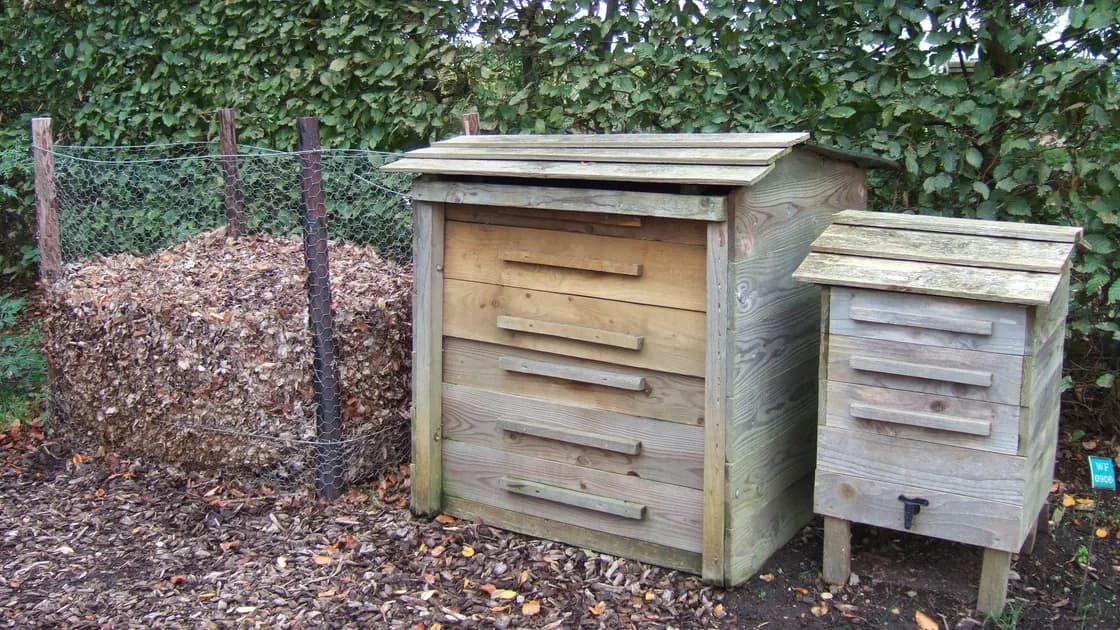
- Bin composting — A plastic cone or a wooden bay. The mainstream compromise: tidier than a heap, retains warmth and moisture better, and limited by capacity. Two bins beat one bigger bin, because one can be finishing while the other fills.
- Tumblers — A drum on a frame that turns by handle. Removes forking entirely, keeps rodents out, and works in a small or paved space. Capacity is small and they work best as a batch rather than as something you add to daily, which is the mismatch that disappoints people.
- Wormeries — Composting worms in a stacked container, working kitchen waste at ambient temperature. Indoors or on a balcony, no garden required, and the output is a richer material plus a liquid feed. It is a small livestock commitment — the worms can be killed by overfeeding, by acidity, by heat and by cold.
- Bokashi — Not composting at all but an anaerobic fermentation in a sealed bucket with an inoculated bran. It handles cooked food, meat and dairy, which nothing else here does, and produces a pickled material that then needs burying or adding to a heap to finish. The usual partner to a small garden system rather than a replacement for one.
- Leafmould — Autumn leaves alone, in a wire cage or a bin bag, left for one to two years. Fungal rather than bacterial, so it does not heat and does not need balancing. The least demanding thing in this subject and the one with the least written about it.
- Trench composting — Waste buried directly in a trench and left to rot in place. No bin, no turning, no heap. A traditional allotment method and the answer for anybody who wants the waste dealt with rather than the compost produced.
- Hot composters and digesters — Insulated proprietary units that hold higher temperatures and accept cooked waste. Expensive, effective, and the reason to buy one is usually the food waste rather than the compost.
- Council collection, which is worth naming — Most British councils collect garden and food waste and compost it industrially at temperatures no domestic system reaches. It is not a failure to use it for the material your heap should not have — pernicious weeds, diseased plants, cooked food — and doing so is what keeps a home heap simple.
- Still deciding — Composting vs a wormery
Composting your own garden and kitchen waste at home is unregulated in any way that affects a gardener. Two things around the edges are worth knowing, and one of them catches people out.
- Catering waste is treated differently from household waste — The rules on animal by-products and catering waste are stricter than domestic composting rules and apply once waste comes from a business, a commercial kitchen or a premises serving the public — including, in some circumstances, a community or allotment setting taking waste from elsewhere. A household composting its own kitchen scraps is outside that. Anybody composting waste generated by anyone else should check the current position with the relevant authority rather than assuming domestic rules apply.
- Compost you give away or sell is a different thing again — Selling growing media or soil improver brings labelling and quality requirements with it. Giving a bag to a neighbour does not. This is the same shape of boundary the balm and cosmetics page describes, and it is worth knowing the line exists.
- Bonfires are not the alternative — There is no general ban on garden bonfires, and there are nuisance and smoke-control provisions that can bite, particularly in smoke control areas. Councils differ. This page does not summarise them, and the practical point is that composting exists partly so that burning is not necessary.
- Japanese knotweed and invasive plants — Controlled waste, not compost material, and the disposal rules are specific and enforced. Do not put it on a heap and do not put it in a garden waste collection. The relevant environment agency is the authority on it.
- Allotment site rules — Frequently stricter than the law — many sites restrict what may be composted, where heaps may sit and whether pallets may be used. The tenancy agreement is the answer and it varies site by site.
- Spring: empty the finished bin — The one job with a season attached, because it is when the garden wants the compost and when emptying a bin creates the space the year needs. Sieve if you want it for potting; do not bother if it is going on beds.
- Summer: watch it dry out — The failure nobody expects. A bin in sun through a dry British summer stops working entirely and looks exactly the same doing it. A can of water and a lid or a cover is the whole fix.
- Autumn: the leaf problem, which is an opportunity — More brown material arrives in six weeks than the rest of the year combined, and most of it gets wasted. Bagging or caging leaves separately for leafmould, and keeping a sack beside the bin as the year’s brown supply, is the single most useful annual habit in the subject.
- Winter: expect nothing — Cold heaps effectively stop and that is normal rather than a fault. Keep adding, keep the balance, and it restarts in spring. A cover keeps rain out, which matters more in a British winter than insulation does.
- The squeeze test, monthly — A handful should feel like a wrung-out cloth. Thirty seconds, diagnoses most of what goes wrong, and almost nobody does it.
- Keep the base open — Material compacts at the bottom of a bin and cuts off air from underneath. Forking the base when you empty, and starting each new fill with twiggy material, keeps it breathing.
- Look after the bin itself — Plastic cones go brittle in UV after some years and pallet bays rot from the ground up. Neither is a crisis and both are worth noticing before the side falls out mid-turn.
- A wormery needs more than this — Worms are livestock and the maintenance is different in kind — feeding rate, moisture, acidity, drainage and temperature, checked regularly. The comparison with a wormery covers what that commitment actually is.
- Greens
- Wet, nitrogen-rich material — grass, kitchen scraps, soft prunings, coffee grounds. The fuel.
- Browns
- Dry, carbon-rich material — cardboard, dead leaves, straw, paper, twigs. The structure and the air.
- Carbon-to-nitrogen ratio
- The formal expression of the greens-and-browns balance. Useful as a concept and unnecessary as a calculation for a domestic heap, where eye and feel are the working tools.
- Hot and cold composting
- Whether the heap generates enough heat to raise its own temperature substantially. A matter of volume, balance and turning rather than of two different processes.
- Aerobic and anaerobic
- With air and without. Aerobic decay is fast and smells of earth; anaerobic decay is slow and smells bad, and the smell is the diagnosis.
- Leachate
- Liquid draining from a heap or wormery. From a wormery it is a useful dilute feed; from a wet heap it is mostly a sign of too much water.
- Vermicomposting
- Composting with worms, in a wormery. A different organism doing the work, at ambient temperature.
- Bokashi
- Anaerobic fermentation using an inoculated bran, in a sealed bucket. Pre-treatment rather than composting, and the only domestic method that takes cooked food.
- Leafmould
- Compost made from leaves alone by fungal breakdown. Slow, undemanding, and a different material from compost — a soil conditioner rather than a feed.
- Activator
- Anything added to speed a heap up. Sold in bottles and entirely replaceable by grass clippings, comfrey or urine.
Returning organic matter to soil is as old as cultivation and needed no theory to work. What changed in the twentieth century was that somebody set out to describe it: Albert Howard, working in India in the 1920s and 1930s, formalised what became the Indore method — layered greens and browns, turned to a schedule — and gave the practice a vocabulary it had never had.
That work fed directly into the organic movement in Britain, which adopted composting as a founding principle rather than a technique, and it is the reason the subject still carries a faint whiff of ideology that surprises newcomers arriving with a bin from the council.
The bin from the council is the other half of the modern story. Municipal subsidised composters from the 1990s onwards, and then kerbside garden and food waste collection, moved composting from something gardeners did to something households do — and simultaneously took the hardest material off the domestic heap. That is why the practical shape of the subject today is a small bin, a caddy, and a council collection for whatever should not go in either.
- Why is my compost slimy and smelly?
- Too wet and too much soft green material, which together exclude air. The rot has gone anaerobic, and that is what the smell is. The fix is the same in every system: add dry brown material — cardboard, shredded paper, dead leaves, straw — and mix it through so air can get in. It is the commonest problem in domestic composting by a wide margin and it is completely recoverable; nothing is ruined and you have not killed anything.
- Why is nothing happening?
- Usually one of three things and it is worth checking them in order. Too dry, which stops everything — a heap should feel like a wrung-out cloth, not like the dry leaves it looks like. Too much brown and not enough green, so there is no nitrogen to work with. Or simply too small: a heap under about a cubic metre cannot hold heat, so it composts cold and slowly, which is not a fault but does explain the lack of drama.
- Do I need to turn it?
- No. Turning adds air, which speeds everything up and is what makes a hot heap hot, and a heap that is never turned still becomes compost — it takes six months to two years instead of two to six months. Turning is a speed control rather than a requirement, which is worth knowing because it is the part most people are put off by and the part most easily dropped.
- Can I put cooked food and meat in?
- In a domestic garden heap, no, and the reason is rats rather than chemistry. Cooked food, meat, fish and dairy are exactly what attracts them, and a rat problem is much harder to solve than a slow heap. There are two systems designed for it: bokashi ferments it in a sealed bucket first, and hot composters reach temperatures that deal with it. There are also legal restrictions on catering waste that this page covers in the rules section, and they are stricter than most people expect.
- How do I know when it is ready?
- It looks like dark crumbly soil, it smells of earth and nothing else, and you cannot identify what it was made from — with the exception of eggshells and twigs, which take far longer and are fine to sieve out and put back. Time is a poor guide because it varies so much with method, season and heap size. Smell is the most reliable single test: finished compost smells like a wood floor after rain, and anything else means it is still working.
- What is the difference between composting and a wormery?
- What does the work. A heap is run by bacteria and fungi and gets hot; a wormery is run by composting worms at ambient temperature and produces a smaller quantity of a richer material plus a liquid. A wormery handles kitchen waste and very little garden waste, works indoors and in a flat, and needs the worms kept alive — which makes it a small livestock commitment rather than a pile. Both are covered here as methods because most people choose between them rather than between composting and nothing.
- Will it get hot enough to kill weed seeds and disease?
- A well-managed hot heap can, and a domestic heap usually does not, at least not throughout. The outside of any heap is always cooler than the middle, so material at the edge is not treated even when the centre is. This page publishes no temperature or duration as a treatment standard, because the assurance you would be relying on depends on measurement you almost certainly are not doing. The practical answer used by most gardeners is simply not to compost pernicious weed roots or diseased material at home.
Within this activity
Disciplines, variants and techniques that sit inside it.
Variants
- Wormery keeping — Composting kitchen waste with worms, which works indoors and in a flat.
- Bokashi composting — Fermenting food waste in a sealed bucket with inoculated bran before burying it.
If you like this
Each of these is here for a stated reason, not because it is also a hobby.
Similar to
- Mycology — Both are really about fungal and bacterial decay, approached from opposite ends — one manages it and the other identifies what turns up.
Goes well with
- Goat keeping — Livestock produce a great deal of bedding and manure, and a heap is what turns the disposal problem into the thing the garden wanted anyway.
- Horticultural showing — Exhibition growers are among the few people for whom the quality of their own compost is a competitive question rather than a background one.
- Hydroponics — Opposite approaches to the same question of where a plant’s nutrition comes from — one builds soil, the other replaces it — and a grower who has done both understands what the ground was actually doing.
- Smallholding — A holding generates the material and needs the output, and composting at that scale stops being a bin and becomes an operation.
Substantial
Last reviewed 2026-08-19. Cost, time and difficulty figures on this page are HobbyHQ estimates — see how we work. Something here wrong or out of date? Tell us.