Textiles & fibre · Art & drawing
Embroidery
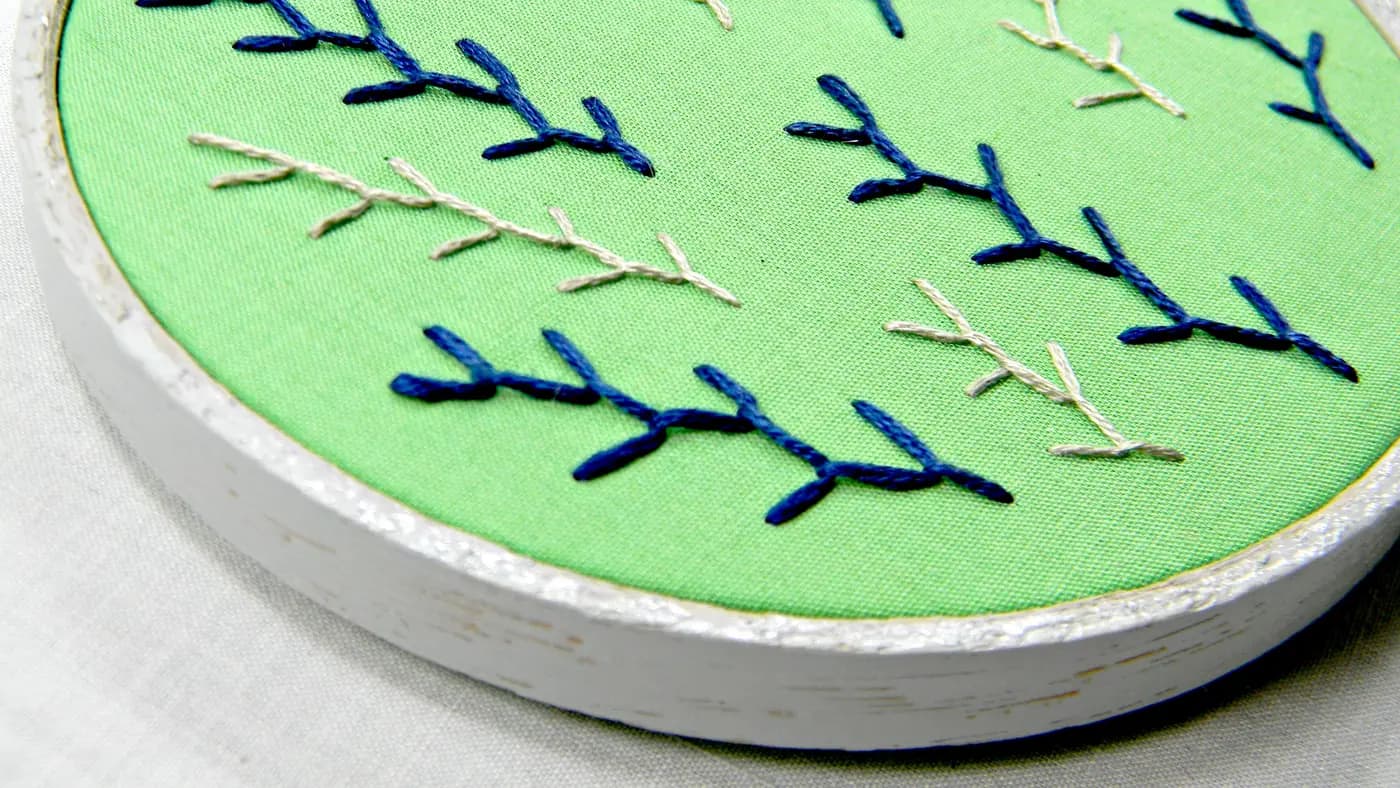
Embroidery has the lowest equipment barrier of any craft on this site — a hoop, a needle, some thread and a piece of cotton, for under £15 — and an almost unlimited ceiling. Six stitches will carry you through your first year, and the difference between beginner work and good work is almost entirely about fabric tension and thread management rather than about knowing more stitches.
Also known as hand embroidery, needlework, stitching.
Embroidery means decorating fabric with stitches. That covers an enormous range: freestyle surface embroidery worked to a drawn design, counted work like cross stitch and blackwork where stitches are placed by counting fabric threads, whitework where texture and cut spaces do the work, goldwork with metal threads couched to the surface, and a long list of regional traditions each with their own materials and rules.
For a beginner it splits usefully in two. Counted work — cross stitch, blackwork — requires evenweave or aida fabric and a chart, and is the more predictable and forgiving. Surface embroidery works on any fabric to any design and is where the creative range is, but requires you to make more decisions.
The craft rewards patience in a very direct way. There is no shortcut and no machine involved, an hour of stitching produces roughly an hour of visible progress, and the work is entirely portable. That combination is why it has become one of the most-taken-up crafts of the last decade.
Step 1: Learn six stitches, and no more
Backstitch, running stitch, stem stitch, satin stitch, French knot and lazy daisy. These cover outlines, fills, texture and flowers — which is most of what a beginner design contains. Learning thirty stitches badly is far less useful than six well.
You will know it worked when: You can stitch almost any simple design.
Step 2: Get the fabric drum-tight in the hoop
The single biggest determinant of whether beginner work looks good. Slack fabric puckers, distorts stitches and makes tension impossible to control. Tighten the screw, pull the fabric evenly all round, and re-tighten as you go.
You will know it worked when: Flat, even stitches and no puckering.
Step 3: Use two strands, not six
Stranded cotton comes as six strands loosely twisted together and is meant to be separated. Most beginner work uses two or three. Stitching with all six produces a coarse, rope-like line that hides all the detail.
You will know it worked when: Fine, controlled lines instead of thick ones.
Step 4: Work with a short thread
About 45cm — roughly elbow to fingertips. Longer thread tangles, knots and wears thin as it is dragged repeatedly through the fabric.
You will know it worked when: Fewer knots, smoother stitches.
Step 5: Finish something small
A hoop-mounted design 10–15cm across. Frame it in the hoop it was worked in, which is the standard modern finish and takes five minutes.
You will know it worked when: A finished object on the wall within a fortnight.
Sources for this section
- Royal School of Needlework (opens in a new tab) — Royal School of Needlework · Institutional · corroborated indirectly
- Stranded cotton — The default thread — six divisible strands, enormous colour range, cheap. Sometimes called floss.
- Perle cotton — A non-divisible twisted thread with a visible sheen and texture, sized by number (higher number, finer thread). Excellent for texture and for stitchers who find separating strands fiddly.
- Crewel wool — Fine wool for crewelwork, traditionally on linen twill. Warmer and softer in appearance than cotton.
- Even-weave and aida — Fabrics with a regular, countable thread grid, used for counted work. Aida has visible blocks and holes, which makes it much the easiest starting fabric for cross stitch.
- Cotton and linen — For surface embroidery. Quilting cotton is cheap and perfectly good to learn on; linen is the traditional ground and handles better as work gets finer.
- Needles — Embroidery (crewel) needles have a long eye and a sharp point for surface work. Tapestry needles are blunt with a large eye, for counted work where you pass between threads rather than through them. Using the wrong one makes everything harder.
- Hoop or frame — A hoop for small work; a slate frame or stretcher bars for large or fine work, where consistent tension across the whole piece matters and a hoop would crush completed stitching.
Sources for this section
- Royal School of Needlework (opens in a new tab) — Royal School of Needlework · Institutional · corroborated indirectly
- Work it out — Dye bath calculator
- Running stitch — In and out along a line, evenly spaced. The simplest stitch there is, the basis of sashiko and quilting, and far more versatile than it looks — rows of it build texture and shading.
- Backstitch — A continuous solid line, worked by taking each stitch backwards into the end of the last. The default for outlines and lettering, and the stitch to reach for whenever a line must be unbroken.
- Stem stitch — Overlapping slanted stitches producing a slightly ropelike line that follows curves better than backstitch. Traditionally used for stems, and the right choice for anything organic.
- Satin stitch — Parallel stitches worked side by side to fill a shape with a smooth, lustrous surface. The hardest of the six to do well: it pulls the fabric, so it wants a small shape, an underlying outline to work over, and consistent tension.
- French knot — Thread wrapped around the needle and taken back through close to where it came out, producing a raised dot. Used for eyes, centres and texture. The two things that make them work are keeping the wrapped thread taut and going back down beside the entry point rather than into it.
- Lazy daisy — A single anchored loop, worked in groups to make petals and leaves. It is a detached chain stitch, so learning it also teaches chain stitch.
The two things that determine whether these look good are tension and stitch length, not stitch choice. Even, unhurried stitches of a consistent length in an ordinary stitch read as skilled work; uneven ones in an elaborate stitch do not.
Step 1: A clean sampler
Six or eight stitches worked evenly, with the back tidy enough not to embarrass you.
You will know it worked when: Tension is even and the fabric is not distorted in the hoop.
Step 2: Working from a transferred design
Transfer methods, thread choice, and stitch selection for a given line or fill.
You will know it worked when: A finished piece that matches the design you started from.
Step 3: Designing your own
Drawing for stitch rather than for pencil, which is a different skill and the point at which embroidery becomes personal.
You will know it worked when: You can look at an image and know how you would stitch it.
Step 4: The plateau
Fills. Outlines are quick and satisfying; large filled areas are slow and where people abandon pieces.
Step 5: Where it branches
Goldwork, stumpwork, blackwork, canvas work, or free-motion machine embroidery. Each has its own materials and its own society.
Step 6: When a class helps
For goldwork and any technique using metal threads, where materials are expensive and mistakes are not reversible.
- Loose fabric in the hoop — Causes puckering, uneven tension and distortion. Fabric should sound like a drum when tapped.
- Using all six strands — Produces coarse, clumsy lines. Separate the strands and recombine the number you want — this also makes the thread lie flatter.
- Too long a thread — Tangles, knots, and abrades as it passes through the fabric hundreds of times.
- Knots on the back — They create lumps that show through when the work is framed or worn, and they can pull through loose weaves. Anchor with a few tiny stitches or a waste-knot technique instead.
- Carrying dark threads across pale fabric — A long float of dark thread on the back shows through from the front. Finish off and restart rather than carrying more than a couple of centimetres.
- Leaving the work in the hoop between sessions — A hoop left tightened for weeks leaves a permanent ring mark and crushes stitches. Loosen it when you put the work down.
- Poor light — Not a technique problem but the commonest reason people say their eyes are not up to it. A daylight lamp fixes most of it.
- Surface embroidery — Stitching freely onto a fabric surface rather than counting threads — the broad family that most modern hoop work belongs to. The one with the widest stitch vocabulary and the fewest rules, and the usual way in.
- Counted-thread work — Stitches placed by counting the fabric’s own threads, on evenweave or aida. Cross stitch is the best-known member. The discipline is arithmetic rather than draughtsmanship, which suits a very different maker and is why people who dislike one often love the other.
- Blackwork — Counted geometric fills in a single colour, traditionally black on white, building tone through pattern density. Tudor in origin, strikingly graphic, and unusually forgiving because the repeat carries the design rather than the stitching hand.
- Goldwork — Metal threads couched onto the surface rather than passed through it, over padding. Expensive, slow, technically distinct from everything else here, and still the summit of the ecclesiastical and military traditions.
- Crewelwork — Wool on linen twill, with the Jacobean plant-and-creature vocabulary. Worth separating because the wool changes the stitch behaviour entirely and much surface-embroidery advice does not transfer to it.
- Whitework — White on white — pulled and drawn thread, cutwork, broderie anglaise, Ayrshire. The tradition where the technique is the ground fabric being altered rather than a picture placed on it.
- Sashiko — Japanese running-stitch work, originally for reinforcement and repair, now widely practised for its own sake. Has its own page here, and it is the tradition that most directly connects embroidery to mending.
- Canvas work and needlepoint — Stitching that covers the ground entirely, on canvas, producing a firm fabric for upholstery and cushions rather than a decorated cloth. Frequently and confusingly called tapestry, which it is not.
- Machine embroidery — Free-motion on a domestic machine, or digitised designs on an embroidery machine. A genuinely separate craft sharing a name, with its own equipment and its own software, named here so a reader searching finds the right half.
- Still deciding — Embroidery vs cross stitch
- Flossalso: stranded cotton
- Stranded embroidery cotton, made of six divisible strands.
- Ground fabric
- The fabric being embroidered on.
- Couching
- Laying a thread on the surface and stitching over it with a finer thread. The basis of goldwork, where the metal thread is too valuable or too stiff to pass through the fabric.
- Crewelwork
- Surface embroidery in wool, traditionally on linen twill, with a long English tradition of stylised plant designs.
- Blackwork
- Counted geometric filling patterns worked in a single colour, historically black silk on white linen.
- Whitework
- White thread on white fabric, where texture, pulled threads and cut spaces create the design rather than colour.
- Goldwork
- Embroidery using metal threads, almost always couched, used in ecclesiastical and ceremonial work.
- Sampler
- A worked record of stitches and patterns, historically both a reference and a demonstration of skill.
- Waste knot
- A temporary knot placed on the front of the work, later cut away once the thread has been secured by stitching.
- Aida
- A stiff fabric woven in visible blocks with clear holes, sized by count. The standard beginner fabric for cross stitch.
Embroidery is ancient and close to universal, which makes any single history partial. In the English tradition the high point is Opus Anglicanum — "English work" — the ecclesiastical embroidery of roughly the thirteenth and fourteenth centuries, which was exported across Europe and recorded in papal inventories as the finest available. It was professional, workshop-produced and predominantly worked in silk and gold on linen.
The Bayeux Tapestry, despite its name, is embroidery rather than tapestry: worked in wool on linen in stem stitch and laid-and-couched work, probably in England in the eleventh century. The distinction matters because tapestry is woven and embroidery is applied to finished cloth, and the two crafts are unrelated in method.
By the nineteenth century, hand embroidery in Britain had shifted substantially towards domestic and amateur practice as machine embroidery took over commercial production. The Royal School of Needlework, founded in 1872, was established specifically to preserve hand technique and to provide employment for women, and it remains the recognised authority on English hand embroidery technique and its teaching.
The craft’s recent growth is well documented by participation research, and is often attributed to the same qualities that made it useful historically: it is portable, it needs almost nothing, and it produces something visible from an hour of attention.
Sources for this section
- Royal School of Needlework (opens in a new tab) — Royal School of Needlework · Institutional · corroborated indirectly
- Crafts Council (opens in a new tab) — Crafts Council · Institutional · could not be reached
- What is the difference between embroidery and cross stitch?
- Cross stitch is one form of embroidery — counted work, using a single stitch on a regular grid, following a chart. "Embroidery" more usually means freestyle surface embroidery: any stitch, any fabric, worked to a drawn design. Cross stitch is more predictable and easier to start; surface embroidery has far more range.
- How many stitches do I need to learn?
- Six will carry you a long way: backstitch, running stitch, stem stitch, satin stitch, French knot and lazy daisy. Beginners often collect stitches instead of practising them, and a design worked well in three stitches looks better than one worked badly in fifteen.
- Why does my fabric pucker?
- Almost always fabric tension in the hoop, occasionally thread pulled too tight. The fabric should be drum-tight and re-tightened as you work. Satin stitch over a large area also pulls; working it over a padded outline, or splitting it into smaller shapes, prevents the distortion.
- Can I embroider on clothes?
- Yes, and it is one of the most satisfying uses of the craft. Stretchy fabrics need a stabiliser behind the design to stop them distorting, and knits need a stitch choice that can move with the fabric. Denim and woven cotton are the easiest garments to start on.
- Is it expensive?
- No — it is the cheapest craft on this site to enter and among the cheapest to continue. Threads are one to two pounds a skein and one skein goes a long way. The main costs are optional: good linen, a floor stand and a daylight lamp, in roughly that order of usefulness.
Guides
Longer answers to questions this page can only summarise.
- What to buy for embroidery, and what to ignoreThe five things that actually matter, the four the shops push that do not, and why the single most common beginner purchase is the one that makes the stitching harder.
- Fixing the things that go wrong in embroideryPuckering, twisted thread, uneven satin stitch, fabric marks and a messy back — causes and fixes for the faults that make a first hoop look homemade.
- Finishing embroidery: washing, blocking and framing without ruining itThe last hour of an embroidery project destroys more work than the first twenty. Washing, blocking and mounting each have one step that is not reversible, and this is where they are.
If you like this
Each of these is here for a stated reason, not because it is also a hobby.
Goes well with
- Dressmaking — A finished garment is a surface, and hand embroidery is the cheapest way to make a plain one yours. Shares the fabric, the hoop and most of the tools.
- Natural dyeing — Hand-dyed thread is where a lot of the appeal of both crafts meets: small quantities, subtle colour variation, and a finished piece that could not be bought.
- Visible mending — The same stitches applied to clothes you already own, which gives an ornamental craft an immediate practical use.
Shares equipment with
- Sewing — Needles, thread, fabric and the same fundamental handling — sewing adds construction to decoration.
Easier way in
- Cross stitch — Counted work on a printed chart removes every design decision, which makes it much easier to start and much more predictable.
Progresses to
- Quilting — Hand stitchers who want to work at a larger scale and produce something used rather than framed.
Similar to
- Sashiko — A single running stitch, a strong tradition and a repairing purpose — the most meditative and least equipment-heavy corner of hand stitching.
Sources for this section
- Royal School of Needlework (opens in a new tab) — Royal School of Needlework · Institutional · corroborated indirectly
- Crafts Council (opens in a new tab) — Crafts Council · Institutional · could not be reached
Substantial
Last reviewed 2026-08-13. Cost, time and difficulty figures on this page are HobbyHQ estimates — see how we work. Something here wrong or out of date? Tell us.