Games & puzzles · Social & community · Heritage & traditional crafts
Mahjong
Mahjong is not one game. It is a family of four-player tile games that share a set of tiles and almost nothing else, and the reason beginners bounce off it is that every answer they find is written for a different one. Learn which version the people near you play before you learn any rules at all — that single decision saves more time than any amount of study, and nobody tells you to make it.
Also known as mah-jongg, majiang, riichi.
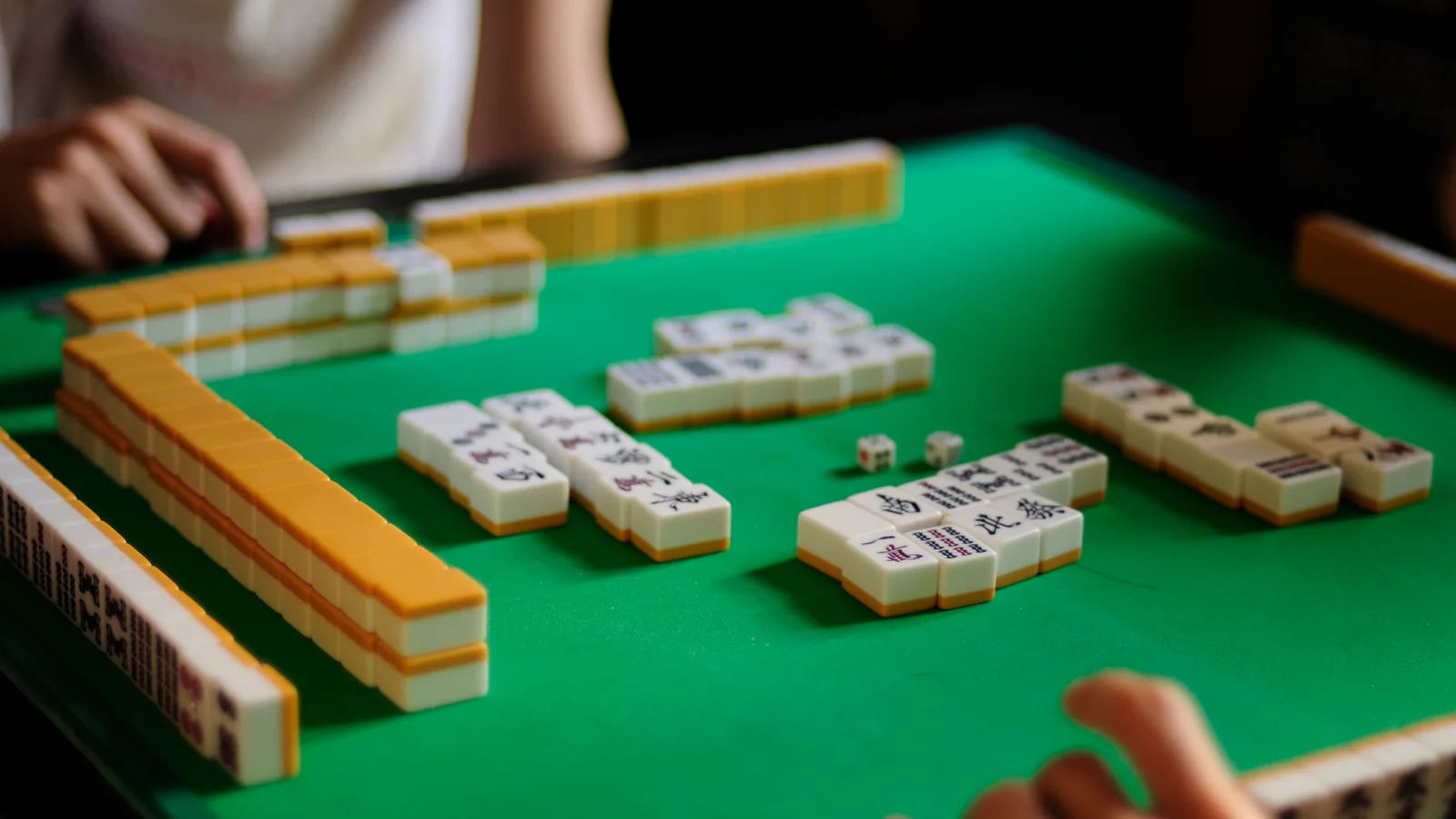
Mahjong is a four-player game played with 136 or 144 tiles, in which players draw and discard in turn, trying to assemble a hand of four sets and a pair. That sentence describes every version of the game and is where the agreement ends. What counts as a valid hand, how it scores, whether you may claim another player’s discard, and how a match is structured all differ between rule families to the point of mutual unintelligibility.
The four you will actually meet are these. Riichi, the Japanese game, is the most played competitively outside China and has the best English-language material by a wide margin. Hong Kong old style is the most common Chinese variant in Britain and the simplest of the serious rule sets. Mahjong Competition Rules, the modern Chinese standard, has 81 defined scoring patterns and is the version most international tournaments use. American mahjong is a genuinely different game with jokers and an annually published card of legal hands, and it is not interchangeable with any of the others.
Then there is the thing that dominates English search results and is not this game at all: mahjong solitaire, the single-player tile-matching puzzle that shipped with Windows. It shares the tile artwork and nothing else. A beginner who does not know that the two exist separately will spend a long time confused, and almost nothing published tells them.
- Decide this first
- Which variant your local players use
- Best documented in English
- Japanese riichi
- Simplest serious rule set
- Hong Kong old style
- Not this game
- Mahjong solitaireSame tiles, different pastime entirely.
Step 1: Find the players before you find the rules
A club, a family, a university society, an online platform. Whichever variant they play is the variant you should learn, and learning a different one first is the commonest and most wasteful mistake in the hobby.
You will know it worked when: A rule set chosen for a reason.
Step 2: Learn the tiles and the shape of a winning hand
Three suits numbered one to nine, plus winds and dragons. Four sets and a pair. That much is shared by nearly every variant and takes about twenty minutes, and it is enough to start playing badly.
You will know it worked when: You can follow a game.
Step 3: Play a dozen hands without scoring
Ignore points entirely at first and just complete hands. Scoring is where every variant becomes complicated, and it is far easier to learn once the flow of drawing, discarding and claiming is automatic.
You will know it worked when: The mechanics stop taking attention.
Step 4: Then learn the scoring, from one source
Pick a single reference for your variant and stay with it. Mixing sources is how beginners end up with rules that contradict each other, because the sources are describing different games without saying so.
You will know it worked when: A coherent understanding rather than a patchwork.
Step 5: Play a great deal, badly, with patient people
Defence, tile efficiency and reading discards are learned at the table and essentially nowhere else. Every club has beginners and every club is used to slowing down for them.
You will know it worked when: The part of the game that is actually the game.
Mahjong is loud, fast and physical in a way its reputation does not convey. Tiles are shuffled by hand on a hard table, hands are claimed by calling out, and a full session runs for hours with a rhythm closer to a card room than a board game night. The first thing that surprises new players is the noise; the second is the pace once everybody knows what they are doing.
Its social meaning varies enormously by community. In much of East Asia it is a family game with a New Year association and a mild gambling tradition; in Britain it is largely a club and society activity; in the United States the American variant carries a distinct twentieth-century Jewish-American history that is genuinely its own culture rather than a footnote to the Chinese one. Any of these is a legitimate way in, and they do not mix much.
Money is worth mentioning honestly. Many traditional forms are played for small stakes and many clubs play for none at all, and the two coexist without much friction. Nothing on this page is about gambling, and a beginner should be aware that some of the strategy material they find assumes stakes and is written accordingly.
This is the section that a mahjong page exists to provide. Almost every question a beginner asks has a different answer in each of these, and the material they find rarely states which one it is written for.
- Japanese riichi — Uses 136 tiles, a discard-based declaration of a ready hand, and a scoring system built on han and fu. Deep defensive play, an enormous strategy literature, the best English-language material of any variant, and the standard on most international online platforms.
- Hong Kong old style — The most widely played Chinese variant in Britain, and the usual family game. Simpler scoring than the others, faster hands, and the easiest place to learn the mechanics of the game itself.
- Mahjong Competition Rules — The modern Chinese standard, with 81 defined scoring patterns and a minimum point requirement to declare a win. Used by most international federations and tournaments, and considerably more demanding to learn than it looks.
- American mahjong — Played with jokers and an annually published card of permitted hands, which changes the game fundamentally: you are assembling one of a fixed list of patterns rather than any valid structure. Distinct enough that skill does not transfer cleanly in either direction.
- Taiwanese sixteen-tile — Hands of sixteen tiles rather than thirteen, producing longer hands and different pacing. Widely played and rarely covered in English.
- Three-player variants — Several rule families have a well-developed three-handed form — sanma in Japan is the best known. Faster, sharper and not merely a fallback when somebody cannot make it.
- Mahjong solitaire — Not mahjong. A single-player tile-matching puzzle using the same tile faces, popularised by its inclusion in Windows. Included here only because it is what most English search results are about.
Step 1: Completing hands without help
The tiles, the turn order, the claims, and a valid hand shape. A few evenings.
You will know it worked when: You can play.
Step 2: Scoring your own hands
The point at which the variant’s real complexity arrives, and where a single consistent reference matters most.
You will know it worked when: You can play without a scorer.
Step 3: Tile efficiency
Choosing discards that keep the hand fastest rather than prettiest. The first genuinely strategic skill and the one with the largest measurable effect.
You will know it worked when: You reach ready hands faster than the table.
Step 4: Defence and reading discards
Recognising when an opponent is ready, folding, and discarding safely. The skill that separates club players from casual ones.
You will know it worked when: You stop losing matches you were winning.
Step 5: Club and tournament play
Ranked online play, national clubs, and international tournaments — all four major rule families have them. A long, deep game with no ceiling worth speaking of.
You will know it worked when: A lifetime pursuit.
- Tile weight, before anything else — Heavy tiles stack, stand and shuffle properly; light ones slide and topple. This is the single difference a player notices every session and the one most listings do not mention.
- The right tile count for your variant — Riichi needs red fives and does not use flowers and seasons; Chinese variants generally do use them. A set sold for one is usable for the other but the spare tiles will confuse a beginner.
- Tile size — Larger tiles are easier to read and harder to handle in a full hand of thirteen. Somewhere around 30mm is the common compromise, and anybody with vision or dexterity considerations should go larger deliberately.
- Arabic numerals on the suit tiles — Many sets print them in a corner. Purists dislike them and beginners find them enormously helpful, and there is no reason to prioritise the purists in your first year.
- Racks and pushers — Essential for American mahjong, optional elsewhere, and a genuine accessibility aid for anyone who cannot comfortably hold a wall of tiles upright.
- What can wait — An automatic shuffling table, a bone-and-bamboo antique set, and a dedicated mahjong table. All lovely, none of them make anybody play better.
- Learning a variant nobody near you plays — The defining beginner error. Rule knowledge transfers far less than people expect, and the time spent is largely lost.
- Reading four sources at once — They contradict each other because they are describing different games. Pick one reference for your variant and finish it before reading a second.
- Playing only for the big hand — Cheap fast hands win matches. Chasing spectacular scoring patterns is the most common way for a competent beginner to lose consistently to a cautious one.
- No defence at all — Most variants reward folding a hopeless hand and discarding safely far more than the beginner literature suggests. Learning when to stop attacking is the largest single improvement available.
- Discarding without watching the table — The discards are the information. A player who never looks at what others have thrown is playing a solitaire game at a table of four.
- Treating the scoring as the hard part — It is the tedious part. The hard part is tile efficiency and knowing when to change direction, and that takes hundreds of hands rather than memorisation.
- Suits, winds and dragons
- The three numbered suits — characters, bamboo, circles — plus four wind tiles and three dragon tiles. Shared across essentially all variants.
- Pung, kong, chowalso: pon, kan, chi
- A set of three identical tiles, four identical tiles, and a run of three in one suit. The Japanese and Chinese names differ; the structures do not.
- Readyalso: tenpai, waiting
- One tile away from a complete hand. The state most strategic decisions in the game are about reaching or denying.
- Riichi
- In the Japanese game, a declaration made on reaching a ready hand with no exposed sets, staking a deposit and locking the hand. The mechanic the variant is named after.
- Han and fu
- The two scoring quantities in riichi — roughly, how many scoring patterns a hand contains and how much structural value it has. The reason riichi scoring is learned with a table rather than arithmetic.
- Flowers and seasons
- Eight bonus tiles present in Chinese sets and unused in Japanese play. The commonest source of confusion when a set and a rule set come from different traditions.
- Dealeralso: east
- The player who scores and pays extra, and who continues as dealer on winning. Structures the round in every variant and does so slightly differently in each.
- Furiten
- A Japanese rule preventing a player from winning on a tile they have themselves discarded. The single most-forgotten rule among riichi beginners.
The game emerged in nineteenth-century China from earlier card and tile games, and its early history is documented well enough to be interesting and thinly enough that confident origin stories should be treated with suspicion. What is clear is that it spread rapidly and locally, which is precisely why the rule families diverged: each region standardised on what it had, long before anybody attempted an international standard.
It reached the West in the 1920s as a full commercial craze, and the sets sold then are why so many bone-and-bamboo sets circulate in British attics today. The American variant took shape shortly afterwards, formalised around a published card of hands, and became a distinct game maintained by its own organisation rather than a dialect of the Chinese one.
The modern picture has two important features. The Japanese riichi tradition developed independently across the twentieth century into the most strategically documented form of the game, and its online platforms have made it the default competitive version for players outside Asia. Meanwhile the Chinese standard rule set was created deliberately in the 1990s as an attempt at an international competition standard — which succeeded in tournaments and did not displace any of the traditional variants at home. The result is that mahjong now has a competition standard and no common language, which is the situation a beginner walks into.
- Two sources contradict each other — They are almost certainly describing different variants. Check which rule family each is written for before assuming either is wrong — this accounts for the large majority of beginner confusion.
- You keep completing hands that score almost nothing — In most variants a hand must meet a minimum value to be declared at all, and beginners routinely build hands that cannot legally win. Check your variant’s minimum before rebuilding your approach.
- You reach ready and never win — Usually waiting on the wrong tiles. Check whether your waits are on tiles that are already visible or that nobody would ever discard; changing the shape of the wait is often worth more than changing the hand.
- You win hands and still lose matches — Almost always dealing into opponents. Check how many of your losses are on your own discard rather than a self-draw — if most are, the missing skill is defence.
- Your set does not match the rules you learned — Flowers and seasons present with a Japanese rule set, or missing red fives with one. Not a fault; set them aside or buy the four tiles separately.
- The table is too fast to follow — Say so. Every club has this conversation weekly and every experienced player has been on your side of it, and a table that will not slow down is not one worth joining.
- Which version of mahjong should I learn?
- Whichever the people you will actually play with use. If that does not settle it: Japanese riichi has by far the best English-language learning material and the most active online play, Hong Kong old style is the easiest serious rule set and the most common Chinese variant in Britain, and American mahjong is worth choosing only if there is a group near you playing it, because it is a genuinely different game. The one decision that reliably wastes a year is learning a variant nobody around you plays.
- Is this the same as the tile-matching game on my computer?
- No, and this is the most useful thing on the page for a lot of readers. Mahjong solitaire is a single-player puzzle in which you clear a layout by matching free pairs. It uses the same tile artwork and has essentially nothing else in common with mahjong, which is a four-player game of drawing and discarding. Search results in English are dominated by the solitaire game, which is why so many people believe mahjong is a patience game.
- How hard is it to learn?
- The mechanics take an evening; the scoring takes weeks; the game takes years. That distribution catches people out, because the initial barrier feels low and the second one arrives immediately afterwards. The most effective route is to play a dozen hands ignoring scoring altogether, then learn the scoring for one variant from one source. Play with people who already know the game if you possibly can — it is enormously easier learned at a table than from a book.
- What should I look for in a set?
- Weight first. Heavy tiles stack, stand and shuffle properly and light ones do not, and it is the difference you notice in every session. After that, check the tile count matches the variant you intend to play — Chinese sets include flowers and seasons that Japanese play does not use, and riichi sets include red fives that Chinese variants do not. A perfectly good set is £25–£60 new, and enormous numbers of sound second-hand sets circulate for less.
- Do you have to play for money?
- No. Some traditional forms carry a small-stakes tradition and many clubs and tournaments play for none at all, and both are entirely normal. It is worth being aware that a fair amount of strategy writing assumes stakes and shapes its risk advice accordingly, so advice about when to push and when to fold may be calibrated for a game you are not playing.
Guides
Longer answers to questions this page can only summarise.
If you like this
Each of these is here for a stated reason, not because it is also a hobby.
Easier way in
- Modern board gaming — If the appeal is a table of four and a game with real depth, modern board games get you there in one evening rather than one term — no rule-family decision to make and no scoring system to learn before you can play.
Similar to
- Contract bridge — Both are four-player games with a hard scoring layer, a club culture that will teach you, and a reputation for difficulty that comes almost entirely from the scoring rather than the play.
- Go — Two East Asian games with enormous strategic depth, a strong online scene and a British club network, differing in the thing that matters most to a beginner: mahjong is social and partly luck, go is solitary concentration and none.
Substantial
Last reviewed 2026-08-16. Cost, time and difficulty figures on this page are HobbyHQ estimates — see how we work. Something here wrong or out of date? Tell us.