Animals & keeping · Learning & intellectual
Dog training
Training a dog is a hobby in the way that learning an instrument is: a long, structured, occasionally frustrating skill with clubs, competitions and a large body of technique. It is also the one hobby in this catalogue where the main disagreement is ethical rather than practical, where the profession that would normally settle it is unregulated, and where the law is different in each nation of the United Kingdom. This page covers all three honestly, and says which of them we have taken a side on.
Also known as puppy training, obedience training, dog obedience, clicker training, gundog training, dog behaviour.
There are two quite different things called by this name. One is the practical business of getting a dog to a state where it can live in a house, walk down a street and meet other dogs without anybody having a bad time. The other is a hobby in the full sense: clubs, syllabuses, competitive disciplines, a technical literature, and people who have been doing it for thirty years and are still learning.
Almost everybody arrives at the first and a substantial minority discover the second. What connects them is that both are built on the same small set of ideas about how animals learn, and that those ideas are considerably less obvious than they look. The single most common realisation among people who get seriously interested is that they had spent years accidentally training the opposite of what they intended.
The other thing worth knowing at the outset is that this is a field with a genuine, unresolved and quite bitter methodological argument running through it, and that the argument is about ethics rather than about what works. A page that presented the technique without naming that would be misleading by omission, so this one names it early.
- Session length
- Five to ten minutesShort and frequent beats long and occasional, by a wide margin.
- What decides success
- Consistency across the householdMore than method, more than talent, more than the dog.
- The legal frame
- A statutory duty of careFive welfare needs under the Animal Welfare Act 2006.
- The profession
- Not a protected titleAnybody may call themselves a dog trainer. This matters more than it sounds.
What actually matters, in rough order:
Step 1: Get the household to agree the rules first
Written down, before the dog arrives if possible. Is the sofa allowed? Who feeds? What is the recall word? Inconsistency between people is a bigger obstacle than any training problem.
You will know it worked when: One set of rules rather than four.
Step 2: Start with the name and a marker
A name that reliably gets attention, and a marker word or click that predicts food. These two underpin everything else and take a few days.
You will know it worked when: You can get the dog’s attention and mark a moment.
Step 3: Spend the socialisation window on experience, not obedience
For a puppy, controlled positive exposure to people, surfaces, sounds, traffic and other dogs is time-limited and far more consequential than whether it can sit. Sit can be taught at any age; a fear acquired at fourteen weeks can take years.
You will know it worked when: A dog that finds the world unremarkable.
Step 4: Train recall as the priority behaviour
More effort than anything else, on a long line, and never punished on return. It is the behaviour with legal consequences, the one that keeps a dog safe, and the one most reliably destroyed by handlers who call their dog and then do something the dog dislikes.
You will know it worked when: A recall that works at distance and under distraction.
Step 5: Find a class, and watch one before booking
A good class is calm, uses food or toys, and has an instructor who adjusts to individual dogs. Walk out of one where dogs are being physically corrected or where a struggling dog is being pushed through.
You will know it worked when: A class you and the dog both leave in a good mood.
Step 6: Train in short sessions, several times a day
Five minutes before a meal, two minutes in the garden, one minute in the hall. The total matters far less than the frequency, and long sessions actively make things worse.
You will know it worked when: Training as a habit rather than an event.
Three legal points bear directly on training, and the first of them frames everything else.
The third point, and some related duties worth knowing:
- Control in public — Separate legislation makes it an offence to allow a dog to be dangerously out of control, including on private property. This is the legal backdrop to recall training, and it is why recall is the one behaviour worth spending disproportionate effort on.
- Livestock — Worrying livestock is a specific offence and farmers have particular rights in relation to dogs among their animals. This is a countryside-access matter as much as a training one.
- The trainer is not regulated — There is no protected title and no licensing requirement for a dog trainer or behaviourist in the United Kingdom. Voluntary registers of assessed practitioners exist and are the practical answer, but nothing prevents anybody from advertising.
The genuinely useful list is short:
- A well-fitted harness and a plain lead — A harness that does not restrict the shoulder, and a fixed-length lead of about two metres. This is most of the equipment question answered.
- A long line — Five to ten metres, attached to the harness rather than the collar. The single most useful training tool there is: it makes recall training possible in real environments without risking the dog.
- A marker — A clicker at £3, or a word, or a visual signal. The device does not matter; the precision does.
- Food worth working for — Small, soft, quick to eat. The commonest reason a dog "is not food motivated" is that the food on offer is dry kibble in a distracting environment.
- A treat pouch — Unfashionable and genuinely useful. Reinforcement that takes ten seconds to get out of a pocket arrives too late to mean anything.
- Something to work on — A mat or bed used as a target. Teaching a dog to settle on a mat is the single most transferable behaviour in domestic life.
What is worth naming explicitly is the category of equipment sold to stop behaviour rather than to teach it: devices that tighten, pinch, spray, vibrate or shock. Our position on the shock end of that range is stated above and is the veterinary profession’s. On the rest, the more useful observation is structural — every one of them is marketed as a solution to a problem that training addresses at the cause, and buying one is usually a decision to manage a symptom for the life of the dog.
Retractable leads deserve a specific mention because they are ubiquitous and they work against training rather than merely being neutral: they teach a dog that pulling extends the lead, which is precisely the behaviour most owners are trying to remove.
Nearly all of the technique reduces to a small number of principles, and understanding them is what turns training from a set of tricks into something you can reason about when the tricks stop working.
- Behaviour that is reinforced increases — Anything the dog does that produces something good happens more. This is doing work every waking minute, not only during training — a dog that barks and gets attention has been trained to bark, by you, on a schedule you did not design.
- Timing is almost everything — Reinforcement has to arrive close enough to the behaviour for the dog to connect the two. A second late and you have reinforced whatever came next, which is why markers exist.
- A marker buys you time — A click or a spoken word delivered at the exact moment of the behaviour, followed by food. The marker says "that, there" and lets the food arrive a few seconds later without confusing the message.
- Behaviour is context-specific — A dog that sits perfectly in the kitchen has learned to sit in the kitchen. Generalising a behaviour to the garden, the street and a park full of other dogs is a separate piece of work and is the step people skip.
- Arousal and stress break everything — A dog over threshold — too excited, too frightened, too close to whatever it is reacting to — cannot learn. Most training failures at the difficult end are not failures of technique but of distance and timing.
- You cannot train an unmet need away — A dog without adequate exercise, mental stimulation, sleep or company will produce behaviour that no amount of training removes, because the training is fighting the need rather than addressing it.
The practical technique that follows from all of that is unglamorous. Break the goal into pieces small enough that the dog succeeds almost every time. Reinforce the piece until it is fluent. Add difficulty in one dimension at a time — duration, distance or distraction, never two together. And when it falls apart, go back two steps rather than repeating the failed one, which is the single most useful habit in the hobby and the one that feels most like giving up.
Broadly, one tradition trains by arranging for good things to follow behaviour you want, and by managing the environment so unwanted behaviour is not rehearsed. Another tradition also uses aversive consequences — physical corrections, pressure, or devices that deliver a shock, spray or sound — to suppress unwanted behaviour. A great deal of practice sits somewhere between.
It is important to be clear about what the disagreement is and is not. It is not primarily an argument about whether aversive methods change behaviour; they can. It is an argument about what else they do — to the animal’s welfare, to its stress, and to its relationship with the handler — and about whether an effect on behaviour justifies that. That is an ethical question, and the reason it is not settled by evidence alone is that people weigh the ethics differently.
One further practical point, separate from the ethics. Aversive methods suppress behaviour without necessarily changing the emotion underneath it, and a dog that has learned not to growl has not learned not to be frightened — it has learned not to warn you. That is a specific and well-known risk with corrections applied to fear-based behaviour, and it is the reason the professional advice on aggression and reactivity is so consistently to work with somebody qualified rather than to follow anything found online, including this.
- Repeating a cue — "Sit, sit, SIT." The dog learns that the cue is the third one. Say it once, wait, and if nothing happens make the exercise easier rather than louder.
- Punishing a dog that comes back — Calling a dog and then putting the lead on to go home, or telling it off for having run away. Two or three repetitions and the recall is gone.
- Training only in the kitchen — And concluding the dog is stubborn when it does not work in a park. Behaviour is context-specific and generalising it is a separate piece of work.
- Adding difficulty in two dimensions at once — More distance and more distraction in the same repetition. Change one thing at a time or you cannot tell what broke.
- Working over threshold — Trying to train a dog that is already frightened or over-excited. Increase distance until the dog can think, then work there.
- Sessions that are far too long — Twenty minutes of drilling, usually ending on a failure because both parties are tired. Five minutes ending on a success is worth more.
- Inconsistency between people — One person enforcing a rule and three ignoring it. The dog is not confused; it has correctly learned that the rule is unreliable.
- Treating a behaviour problem as a training problem — Separation distress, reactivity and resource guarding are emotional problems, and obedience training does not touch them. That is a qualified-help situation, and often a veterinary one first.
Because "dog trainer" and "behaviourist" are not protected titles in the United Kingdom, the qualification question is genuinely difficult and is the practical problem most owners face at the point they need help most. Anybody may advertise, and confident marketing correlates poorly with competence.
What actually helps:
- Look for an assessed register rather than a certificate — Several voluntary bodies assess practitioners against published standards and maintain registers. Membership of one is a meaningful signal; a certificate from a course somebody paid for is not.
- Ask what happens when a dog gets it wrong — The most revealing single question. An answer about making the exercise easier is a good sign; an answer about corrections tells you which tradition you are in.
- Go through your vet for anything behavioural — Pain and illness produce behaviour changes that look like training problems, and a great many behaviour cases turn out to have a medical component. A vet referral is also how you reach a clinical behaviourist.
- Watch a class before booking a course — Reputable trainers expect this. Watch the dogs rather than the instructor: relaxed dogs and loose leads tell you more than any qualification list.
- Be wary of guarantees and of speed — Behaviour change is not a service that can be guaranteed, and anybody promising a fixed outcome in a fixed number of sessions is describing suppression rather than learning.
The competitive and club side is the part most people do not know exists, and it is where training stops being a chore and becomes a pursuit. Nearly all of it is open to crossbreeds as well as pedigrees, and a great deal of it is run by volunteers at village-hall scale.
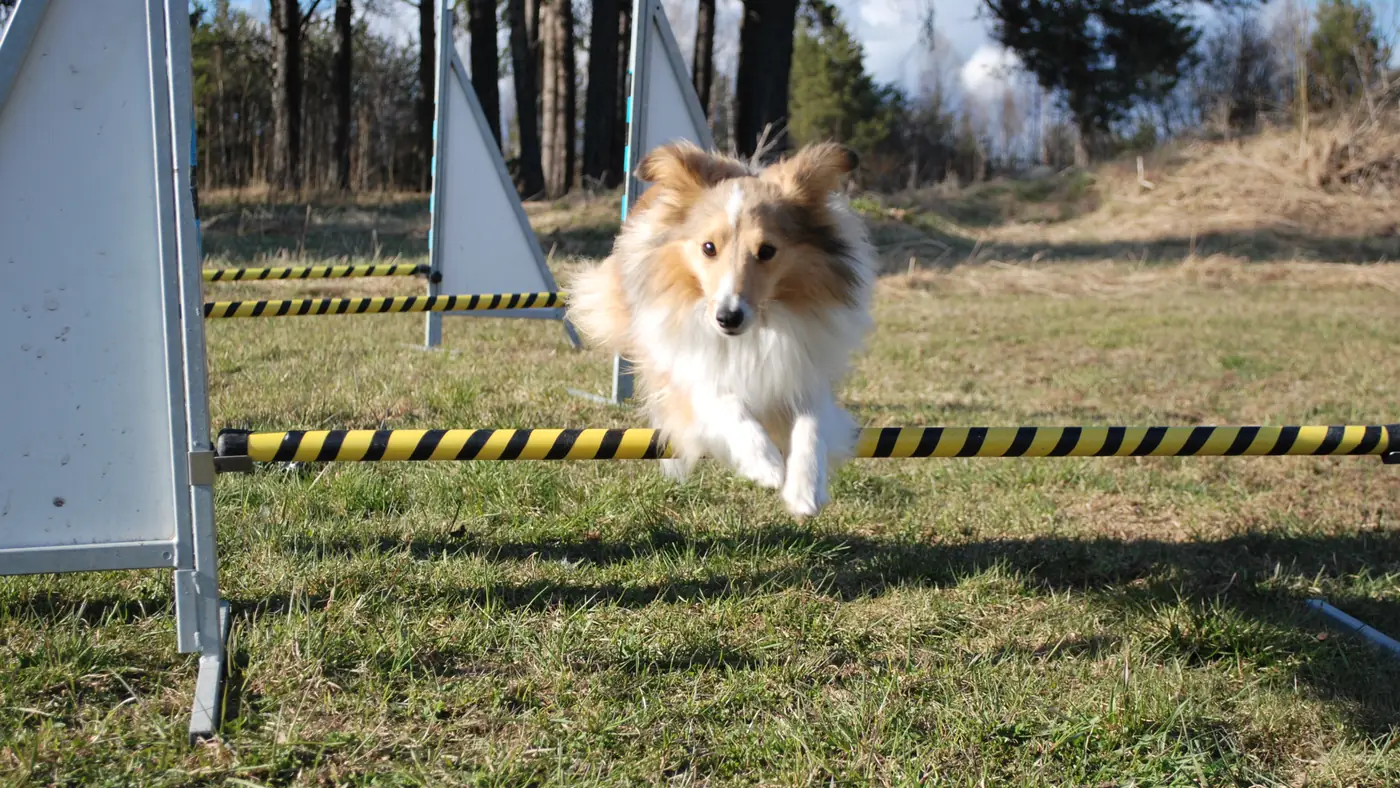
- Agility — Timed runs over jumps, tunnels and contact equipment, handled at a distance. The most visible dog sport and the most physically demanding for both ends of the lead.
- Obedience — Precision heelwork, retrieves, stays and scent discrimination, judged against a standard. Technically the deepest of the disciplines and the least forgiving of sloppy foundations.
- Rally — A course of numbered signs each specifying a manoeuvre, worked as a continuous run. Widely regarded as the friendliest competitive entry point.
- Scentwork and tracking — Searching for a target odour or following a laid trail. Low-impact, suits older and less mobile dogs and handlers, and unusually satisfying for both.
- Working trials and gundog work — Longer-established disciplines combining control, agility and nosework, with their own traditions and their own long-running arguments about method.
- Canicross and dog-powered sport — Running, biking or scootering with a dog in harness. A sport for the handler as much as the dog, and one of the fastest-growing.
- Trick training and freestyle — The purest expression of the training skill itself, with no equipment and no venue, and a good deal of it done indoors on a wet afternoon.
- Still deciding — Dog training vs dog agility
Almost every training problem an ordinary owner meets is one of a small number of things, and almost none of them is the dog being stubborn. The useful reframe is that a cue is not a command the dog has agreed to obey; it is a piece of information whose meaning the dog has learned in a particular context, at a particular level of difficulty, for a particular consequence. When it stops working, one of those four has usually changed.
- It works at home and falls apart outside — The commonest problem in the sport and not a failure of obedience. Dogs learn contextually, so a cue trained in a quiet kitchen has genuinely not been trained in a park with other dogs in it. The fix is to rebuild the same behaviour in progressively harder places, starting far easier than feels necessary — an empty car park before a quiet field before a busy one — and paying much better for it in the harder places than in the easy ones.
- The dog disengages and will not look at you — Usually the environment is winning, which means you are working too close to whatever is interesting. Increase the distance until the dog can notice the distraction and still respond, work there, and close the gap slowly. A dog that cannot take food it would normally take is over threshold, and that is information rather than defiance.
- The response has become slow and unreliable — Frequently a reward that has stopped meaning anything. Kibble that was interesting in week one is wallpaper by week six. Vary what you use, keep the best things for the hardest work, and remember that food is not the only currency — a thrown toy, a sniff, or being released to do the thing the dog wanted anyway are all payment.
- It was going well and it has got worse — Regression is normal and is usually one of three things: the criteria went up too fast, the behaviour was only ever solid in one context, or something has changed in the dog’s life. Drop back to a level that works, rebuild, and raise one thing at a time rather than distance, duration and distraction together.
- Different people get different results — Almost always inconsistent cues rather than inconsistent dogs. Households routinely use three words for one behaviour, and hand signals that differ between people. Agree the exact words and gestures, write them on the fridge, and agree what happens when the dog does not respond — because that is the part people diverge on most.
- The dog seems to have stopped trying part-way through — Sessions are usually far too long. Several very short sessions beat one long one, and ending while the dog is still keen is a technique rather than a courtesy. If a session is going badly, ask for something easy, pay it, and stop.
- The recall works except when it matters — Recall trained only in low-value situations and then tested against a squirrel is being asked to win a competition it has never practised for. It also degrades quickly if the only consequence of coming back is the end of the walk. Recall, pay well, and release the dog again most of the time.
The general diagnostic that covers most of the above: when something stops working, do not add pressure — reduce difficulty. Ask for the behaviour somewhere easier, with a better payment, for a shorter time, and confirm it still exists. If it does, the problem was difficulty rather than understanding, and you know exactly what to rebuild. If it does not, the behaviour was never as solid as it looked, which is also worth knowing.
Sources for this section
- Animal Welfare Act 2006, section 9 (opens in a new tab) — UK Government (legislation.gov.uk) · Governing body · read — supports the claim
- Markeralso: clicker, bridge
- A sound or signal delivered at the exact instant of a behaviour, which predicts reinforcement and lets the reward arrive slightly later without confusing the message.
- Reinforcement
- Anything following a behaviour that makes it more likely to happen again. Food, play, attention and access to something the dog wants all qualify.
- Cue
- The signal that a particular behaviour is now available for reinforcement. Preferred to "command", which describes a relationship the training does not actually rely on.
- Threshold
- The point at which a dog becomes too aroused or too frightened to learn. Working under threshold is the central skill in dealing with reactivity.
- Generalisation
- Transferring a learned behaviour to new places, people and contexts. Not automatic, and the step most training plans underestimate.
- Shaping
- Building a complex behaviour by reinforcing successive approximations of it rather than by luring or positioning the dog.
- The three Ds
- Duration, distance and distraction — the three dimensions along which a behaviour is made harder, changed one at a time.
- Counter-conditioning
- Changing how a dog feels about something by pairing it with something good, rather than changing what the dog does about it.
- Desensitisation
- Exposing a dog to something at an intensity low enough to produce no fear response, and increasing it gradually. Almost always paired with counter-conditioning.
- Socialisation window
- The developmental period in puppyhood during which new experiences are accepted unusually readily. Time-limited, and consequential out of proportion to its length.
- Management
- Arranging the environment so an unwanted behaviour cannot be rehearsed — a baby gate, a closed curtain, a different route. Not a failure of training but half of it.
- Resource guarding
- Defending food, objects or places. A normal behaviour with an emotional basis, and a qualified-help situation rather than an obedience problem.
Dogs have been trained for work for a very long time, and the specifics of how are poorly documented before the modern period. What is reasonably clear is that the organised hobby in Britain grew out of two roots in the nineteenth and twentieth centuries: the working traditions of herding, gundog and guarding work, and the club and show culture that developed alongside pedigree registration.
The methodological argument is more recent and its shape is usually attributed to two influences pulling in opposite directions. Military and police training in the mid-twentieth century established a compulsion-based tradition that then spread into civilian practice; and the application of operant learning principles from behavioural psychology, from roughly the same period onwards, established a reinforcement-based one. The marine mammal training world is conventionally credited with demonstrating the second at scale, for the straightforward reason that you cannot apply a leash correction to a dolphin.
Popular accounts of the argument frequently invoke wolf-pack dominance as the basis for compulsion-based methods. That framing rests on older observations of captive wolves that their own researchers subsequently revised, and it is worth knowing that the received version circulating in dog training outlived the science it came from by a considerable margin. The current professional direction of travel in Britain, insofar as it can be summarised, is towards reward-based practice and towards voluntary regulation of an unregulated profession.
- How long should a training session be?
- Five to ten minutes, several times a day, and this is one of the few genuinely universal answers in the field. Long sessions produce a tired dog and a frustrated handler, and they almost always end on a failure because both parties have run out of patience — which means the last thing the dog practised was getting it wrong. Short sessions slotted into ordinary life, before a meal or while the kettle boils, add up to far more total training than a scheduled half-hour ever does, and they end while the dog still wants more.
- My dog ignores me outside. Is it being stubborn?
- Almost certainly not. Behaviour is context-specific: a dog that sits reliably in the kitchen has learned to sit in the kitchen, and transferring that to a park with other dogs, smells and space is a separate piece of training rather than a matter of willingness. The fix is to go back several steps in the new environment — reduce the distraction, shorten the distance, use better food — and rebuild there. If the dog cannot respond at all in a given place, it is usually too close to whatever is exciting or worrying it, and more distance solves more problems than more insistence.
- Are electric shock collars legal in the UK?
- It depends which nation you are in, and the position has changed more than once. In Wales it is an offence to attach an electronic collar to a cat or dog, to cause one to be attached, or to be responsible for an animal wearing one, under regulations made in 2010. Elsewhere in the United Kingdom the position is less settled: proposals for a ban in England have been brought forward without completing their passage, Scotland has proceeded by guidance rather than by a specific prohibition, and Northern Ireland has no equivalent instrument. We deliberately do not state the current position outside Wales — check with your national government or a veterinary body. Separately from legality, the British Veterinary Association calls for a complete ban across the UK, and this site does not publish instruction in their use.
- How do I find a good trainer when anybody can call themselves one?
- This is a real problem rather than a failure of your research: neither "dog trainer" nor "behaviourist" is a protected title in the United Kingdom, and there is no licensing requirement. The practical answer is to look for membership of a voluntary body that assesses practitioners against published standards and maintains a register, rather than for a certificate from a course. Then watch a class before booking, and watch the dogs rather than the instructor — relaxed dogs on loose leads tell you more than any qualification. Ask what happens when a dog gets something wrong; the answer places the trainer immediately. For anything involving fear or aggression, go through your vet, both because pain frequently underlies behaviour change and because that is the route to a clinical behaviourist.
- What is the single most important thing to train?
- Recall, by a wide margin, and it deserves disproportionate effort. It is the behaviour with legal consequences — separate legislation makes allowing a dog to be dangerously out of control an offence — it is what keeps a dog away from roads and livestock, and it is the one that most determines how much freedom the dog gets for the rest of its life. It is also the behaviour handlers most reliably destroy, by calling the dog and then doing something it dislikes: ending the walk, putting the lead on, or telling it off for having run off in the first place. Train it on a long line, make coming back the best thing that happens all day, and never let it predict something bad.
- Is my dog too old to train?
- No. The socialisation window in puppyhood is genuinely time-limited and matters enormously for how a dog feels about the world, but learning itself continues throughout life and older dogs frequently train better than puppies because they concentrate for longer. What is harder with an older dog is not learning new behaviour but changing well-rehearsed old behaviour, which has had years of reinforcement history behind it — that takes longer and benefits from management alongside training. Scentwork and trick training are particularly well suited to older dogs, being low-impact and mentally demanding.
- Is dog training really a hobby?
- For a substantial number of people, yes, and in the full sense. There are clubs, weekly classes, graded syllabuses, and a set of competitive disciplines — agility, obedience, rally, scentwork, tracking, working trials, canicross and freestyle among them — most of which are open to crossbreeds and run by volunteers at local scale. People compete for decades, and the technical literature is deep enough to sustain that. What distinguishes it from most hobbies in this catalogue is the second participant: your progress is limited by a partner who has their own opinions, their own bad days and a lifespan considerably shorter than yours.
Guides
Longer answers to questions this page can only summarise.
If you like this
Each of these is here for a stated reason, not because it is also a hobby.
Similar to
- Goat keeping — Both are daily animal-keeping hobbies framed by the same statutory duty to meet an animal’s needs, and both reward reading behaviour over applying method.
- Horse riding — The nearest thing in this catalogue to the same skill: reading an animal that is making its own decisions, and learning that most of what looks like disobedience is confusion or discomfort. It is also enormously cheaper, which makes it a real way to find out whether that kind of attention suits you.
Goes well with
- Hiking — The reason recall matters, and the setting that tests it — livestock, other walkers and open country are where a trained dog and an untrained one become obviously different animals.
- Canicross — Turns the dog’s exercise requirement into the handler’s sport rather than a chore fitted around it, and a dog that already has a reliable directional cue starts a long way ahead.
Progresses to
- Dog agility — The most visible place foundation training leads: the same recall, focus and impulse control, now under speed and at a distance, with a club night and a competition calendar attached.
- Flyball — A team sport for dogs that love a ball and noise, and one of the easier competitive routes for a crossbreed with more enthusiasm than precision.
Sources for this section
- Animal Welfare Act 2006, section 9 (opens in a new tab) — UK Government (legislation.gov.uk) · Governing body · read — supports the claim
- The Animal Welfare (Electronic Collars) (Wales) Regulations 2010, regulation 2 (opens in a new tab) — Welsh Government (legislation.gov.uk) · Governing body · read — supports the claim
- Electric shock collars and training aids (opens in a new tab) — British Veterinary Association · Specialist publisher · read — supports the claim
Comprehensive
Last reviewed 2026-08-14. Cost, time and difficulty figures on this page are HobbyHQ estimates — see how we work. Something here wrong or out of date? Tell us.