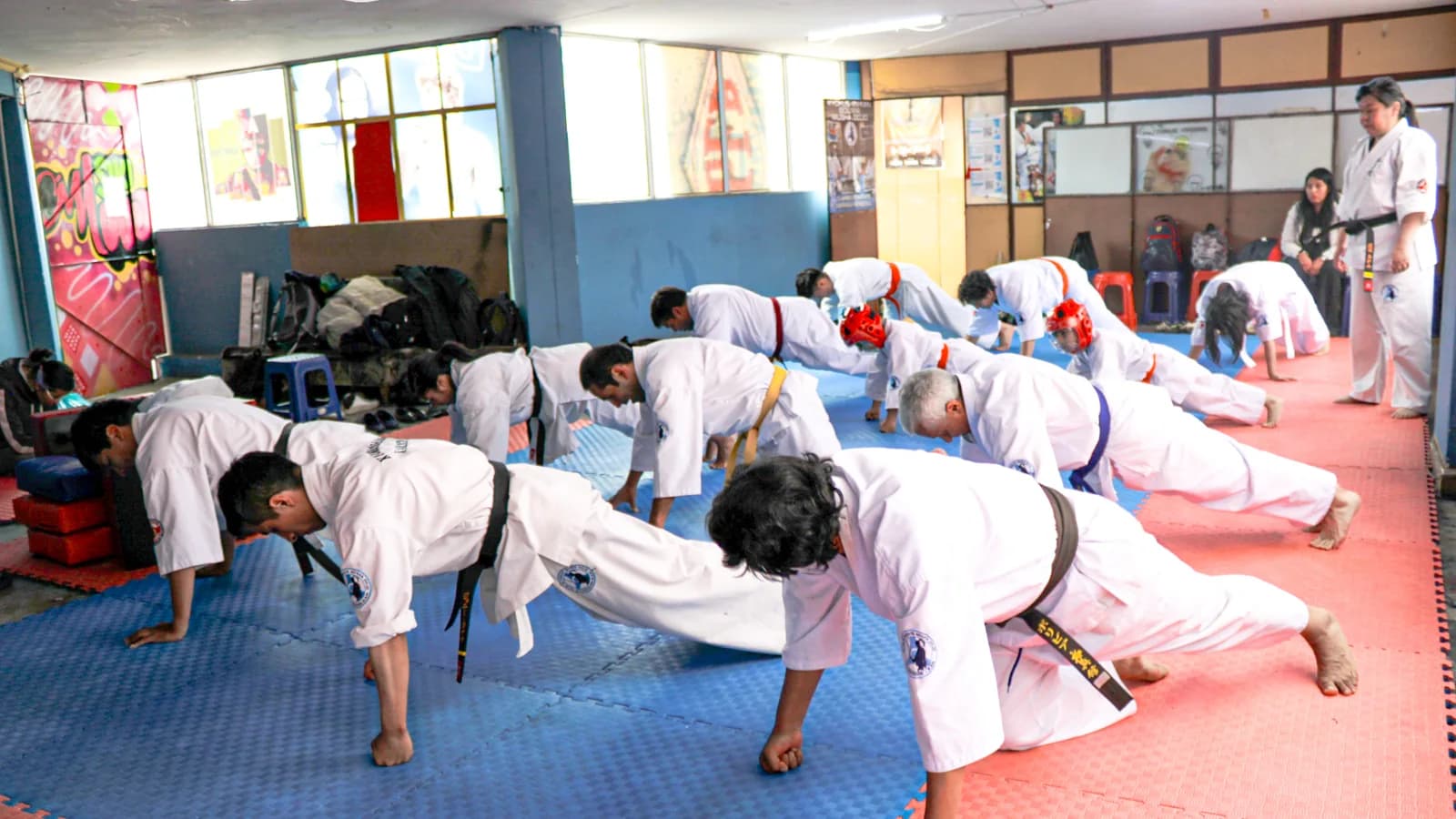
Combat sports & martial arts
Karate
The hardest thing about starting is not the training. It is that four clubs within reach may teach four visibly different things under the same word, all of them legitimate, and every explanation of the difference is written by somebody inside one of them. This page is the neutral orientation: what the style families actually are, what a grading syllabus is for, how competition differs from traditional practice, and what a first year looks like. It teaches no strike application, because that is a coach’s job in a room.
Also known as karate-do, shotokan, wado ryu, goju ryu, shito ryu, kyokushin, martial arts karate.
At its simplest it is a striking art: punches, strikes, kicks and blocks, trained through repetition, patterned solo forms and partner work, and organised into a graded syllabus that takes a student from beginner to black belt over several years. That much is common to every version of it.
What is not common is almost everything else. The art reached the Japanese mainland from Okinawa in the early twentieth century and fragmented as it spread, and the resulting style families differ in stance depth, in how power is generated, in how much contact is normal, in which forms are taught and in what the training is understood to be for. Those are not cosmetic differences. A student moving between two clubs in different families will find much of their technical detail contradicted, in good faith, by an equally qualified instructor.
On top of that sits an organisational landscape that is genuinely confusing. Styles have their own international bodies; the sport has a separate international federation with its own competition rules; and national governance has been repeatedly reorganised. A beginner who cannot work out which body their club belongs to has not misunderstood something — the picture really is like that.
- What a session contains
- Kihon, kata, kumiteBasics, forms and partner work, in varying proportions by club.
- Time to black belt
- Commonly four to six yearsVaries substantially by style and association. It marks competence, not mastery.
- Contact level
- From light to fullThe single biggest difference between clubs, and the thing to ask about first.
- What you need to start
- Loose clothing and a trial sessionNearly every club will let you try before buying a gi.
What actually happens, in order:
Step 1: Watch a class before you join one
Any club worth joining will let you. What you are looking for is how beginners are treated when they get something wrong, and whether the sparring looks like something you want to do in six months.
You will know it worked when: You have seen the thing rather than a description of it.
Step 2: Train in what you own for the first few weeks
Loose trousers and a t-shirt. Buying a gi before you know you will stay is the classic beginner overspend, and clubs expect you not to.
You will know it worked when: No money committed while you decide.
Step 3: Expect the first month to be basics and etiquette
Stances, a small number of strikes and blocks, how to bow in and out, where to stand. It is repetitive on purpose — the repetition is the training method, not a preamble to it.
You will know it worked when: You can join in a class without being lost.
Step 4: Take out a licence and insurance
Nearly every club requires an association licence with insurance before you grade or spar. It is a routine annual cost and it is also your first clue about which organisation your club belongs to.
You will know it worked when: You are covered, and you know who governs your club.
Step 5: Grade when the instructor says, not when you want to
The first grading usually comes after three to four months. Gradings are not tests you can revise for; they are the instructor confirming what they have already watched you do for months.
You will know it worked when: A first coloured belt, and a syllabus for the next one.
Step 6: Start sparring lightly, with kit
Mitts, gum shield, and whatever else the club requires. Controlled contact with a cooperative partner is a skill of its own and is where most of the real learning about distance happens.
You will know it worked when: Sparring is a normal part of the week rather than an ordeal.
The thing nobody warns beginners about is how much of the first year is spent on a very small number of movements. This is genuinely how the art is taught, and it separates people fairly quickly: those who find the repetition meditative stay, and those who wanted variety usually do not. Neither response is wrong, and it is worth knowing which you are before paying for a year.
Competitive karate under the World Karate Federation is contested in two separate disciplines with separate rulebooks: kata, judged on the performance of a form, and kumite, a point-scoring bout with controlled contact. The federation publishes each set of rules as its own document and revises them regularly, which is why any figure quoted second-hand should be checked against the current version.
The important thing for a beginner to understand is that the competitive sport is one expression of the art rather than its definition. Scoring rules reward what the rules reward, and a club training for competition will train differently from one that is not. Neither is training incorrectly; they are training for different assessments.
The broad shape of competition, without quoting figures that change:
- Kata competition — Performed solo or as a synchronised team, judged against criteria covering technical performance and athletic performance. Which forms are permitted, and how the scoring works, are set by the federation and revised periodically.
- Kumite competition — A bout between two competitors in weight categories, scoring for techniques delivered to defined target areas with control. Different scoring values attach to different techniques, and excessive contact is penalised — control is a scoring requirement rather than a courtesy.
- Para karate — Contested in kata, with categories covering visual impairment, intellectual impairment and wheelchair users, under its own published competition rules.
- Other rulesets — Full-contact styles run their own competitions under entirely different rules, and several style associations hold their own championships. A club’s competition calendar tells you a great deal about which world it belongs to.
In the order you will need it:
- Nothing, for the first few weeks — Loose trousers and a t-shirt. Clubs expect this and it is not a mark against you.
- A gi — The uniform. A student-weight gi at £20–£40 is entirely adequate for years; heavier competition-weight ones at £60–£120 hold their shape better and are what people buy second. Buy generously long — cotton shrinks noticeably in the first few washes, and every club has somebody whose trousers no longer reach.
- A licence book — Association membership with insurance, usually renewed annually, and usually required before you can grade or compete.
- Gum shield — The first safety item and the one nobody should economise on. A boil-and-bite is fine to start with.
- Mitts, shin and instep pads — Required for sparring in most clubs. Federation-approved kit is only necessary if you intend to enter competition under those rules, and buying it before then is a common waste.
- Body protector and headgear — Style- and age-dependent. Junior and full-contact competition generally require more; check what your specific club and association mandate rather than buying on general advice.
The single most common purchasing error is buying competition-grade equipment in the first month. It is expensive, it is specified against a rulebook the buyer has not yet read, and it is usually the wrong colour for their association. Wait until the club tells you what it needs.
Almost every class is built from the same three components, and understanding what each is trying to achieve makes the whole thing far less mysterious than it looks from the doorway.
- Kihon — basics — Individual techniques drilled in isolation, usually in lines, usually to a count. The purpose is to make a movement automatic and correct under no pressure, so that it survives being put under some. It is the least interesting part to watch and the part most instructors regard as the foundation of everything else.
- Kata — forms — Fixed sequences performed solo against imagined opponents, each one a compressed record of a set of techniques and principles. Kata are the memory of the art: they are how the syllabus is transmitted, they are what most gradings are assessed on, and they are a competitive discipline in their own right. The interpretation of what a given movement is actually for — bunkai — is a substantial study on its own and varies between styles.
- Kumite — sparring — Partner work, ranging from entirely prearranged sequences at beginner level through semi-free drills to free sparring. The prearranged forms are not a watered-down version of the free one; they exist to build distance and timing safely, and every style uses them.
The proportion between the three is one of the clearest differences between clubs, and it maps roughly onto what the club is for. A club oriented towards competition will spend more time on free sparring and on competition kata; a traditional club will spend more on basics and on the older forms and their applications. Both are common, both are legitimate, and a beginner who wants one and joins the other will be quietly frustrated without quite knowing why.
The coloured belt system is a nineteenth- and twentieth-century Japanese administrative invention rather than an ancient tradition, and it does a specific job well: it breaks a very long learning process into visible steps a few months apart, which is why almost every martial art adopted something like it.
Grades below black belt are kyu grades, counting downwards, and the colours attached to each number are not standardised — a green belt in one association is a different level of experience from a green belt in another. Black belt grades are dan grades, counting upwards. First dan is best understood as the point at which a student has covered the basic syllabus competently and can begin to learn properly, which is very nearly the opposite of how the public understands it.
Roughly what to expect, with the caveat that associations differ:
- First grading
- Three to four months inAssessed on a small syllabus: a handful of basics, one kata, some prearranged partner work.
- Interval between kyu grades
- Three to six months, lengtheningMinimum training periods between grades are usually mandated by the association.
- First dan
- Commonly four to six yearsFaster is possible and is regarded with suspicion by most of the sport.
- What a grading costs
- £25–£50 at lower gradesRising substantially towards black belt, and typically payable per attempt.
One caution worth stating plainly. Because no single body owns the meaning of a karate grade, a black belt is only as meaningful as the organisation that issued it, and there is a genuine market in cheap and rapid certification. The signals of a serious club are unglamorous: mandated minimum training periods between grades, gradings conducted by somebody other than the person who taught you, and an association with a published syllabus and a complaints process.
The four families usually described as the main Japanese lineages, plus the full-contact tradition that separated from them, cover most of what a British beginner will encounter. Every one of these has internal factions, and the descriptions below are the broad tendencies rather than definitions anybody inside them would fully accept.
What you are likely to find within reach:
- Shotokan — Long, deep stances, linear power, large committed movements. The most widespread family in Britain by a distance, so it is the default a beginner meets. Emphasises precision and strong basics, and is often criticised from outside for stances that are longer than anything used in a fight — a criticism its practitioners answer by saying that is not what they are for.
- Wado-ryu — Lighter, more mobile, with a visible influence from Japanese jujutsu. Evasion and body-shifting matter more than meeting force head-on, stances are shorter, and partner work tends to feature earlier and more prominently.
- Goju-ryu — Hard and soft together, as the name suggests. Closer range, circular movement, notable breathing forms, and a strong Okinawan lineage. Feels markedly different from the linear families from the first session.
- Shito-ryu — The family with the largest catalogue of forms, drawing on both the Shuri and Naha Okinawan traditions. Technically broad, and disproportionately successful in kata competition for that reason.
- Kyokushin and full-contact styles — A separate tradition in practice as well as name. Sparring is bare-knuckle to the body with no head punches, contact is heavy, and conditioning is a central part of training rather than a by-product. A different sport from point-scoring competition, and a beginner should know which one they are walking into.
- Okinawan styles — Several traditions that stayed closer to the pre-Japanese practice, generally smaller in Britain, often with more emphasis on close-range application and on the older weapons forms as a related discipline.
The practical advice that follows from this is simple and is worth more than any comparison table. Visit three clubs. Watch a full class rather than a demonstration, notice how the instructor corrects a beginner and how the students treat each other, and ask directly what the contact level is in sparring. The club — the instructor, the people, the fifteen-minute journey — will decide whether you continue far more than the style will.
- Still deciding — Karate vs judo
- Still deciding — HEMA vs karate
Most people who leave karate leave in the second year, and almost none of them leave because it was too hard physically. The reasons below are the common ones, and four of the six are about expectations rather than about ability.
- I have stopped improving and everything feels the same — Usually the point at which the syllabus stops giving you new things and starts asking for the same things better. The first year is a stream of new techniques; after that the work is refinement, which is much less visibly rewarding. Check whether a video of you now and a year ago actually look the same — they very rarely do. Next, ask an instructor for one specific thing to work on rather than for general feedback, because the plateau is usually a lack of a target rather than a lack of progress.
- I failed a grading — Almost always one named element rather than a general verdict, and clubs differ enormously in how they handle it. Check what specifically was not to standard — a grading that gives no such answer has failed you rather than the reverse. Next, expect to re-grade rather than to be held back a year; in most clubs the gap is a matter of months and the fail is an assessment of readiness rather than a judgement.
- Sparring frightens me and I am avoiding the sessions — Extremely common and rarely discussed. Kumite introduces a stranger moving at you with intent, and the physiological response to that is not something willpower fixes. Check whether the club runs graded contact levels — most do, and light or no-contact practice is a legitimate stage rather than a concession. Next, say so to the instructor. A club that cannot accommodate this is telling you something about the club.
- What I am taught contradicts what I read online — Probably a style difference rather than an error. The four main styles genuinely disagree about stance depth, hip mechanics and the interpretation of the same kata, and material written from inside one style reads like a correction of another. Check which style the source is from before treating it as a correction. Next, learn your club’s version properly first; comparing styles is interesting and is a much later activity.
- My knees or hips hurt after training — Often the stances, which load joints in positions ordinary life does not. Check whether it arrives during a particular exercise, and tell your instructor — stance depth is adjustable and no legitimate instructor wants an injured student. Next, this page publishes no diagnosis, no rehabilitation and no judgement about training through pain. Persistent joint pain is a question for a clinician, and it is a bad idea to answer it from a syllabus.
- I cannot remember the kata — Normal, and it is a recall problem rather than a karate problem. Kata are long sequences learnt by repetition and they decay quickly without it. Check whether you can do the first few movements confidently and lose it at a specific point — that point is usually a transition you never learnt cleanly. Next, work backwards from the end rather than always starting at the beginning, which is why everybody’s opening is strong and everybody’s middle is vague.
The bowing, the lining up by grade, the formal opening and closing of class — these are the parts that most often put people off from the doorway, and they are worth understanding rather than tolerating. They do two practical jobs. They mark the training space as somewhere with different rules from the corridor outside, which matters in an activity where people hit each other on purpose. And they make the hierarchy legible, so that everybody in a room of forty knows who is responsible for whom.
How much of it a club keeps varies enormously, and it is one of the better signals of what a club is like. Some maintain a formal Japanese-language structure throughout; others are considerably more relaxed and use English for most instruction. Neither is more serious than the other, but the mismatch between what somebody expects and what they find is a common reason people leave in the first month.
The conventions that genuinely matter are the safety ones. Do not train with an injury without telling the instructor, do not escalate contact because you are losing, stop instantly when told to, and look after the person you are training with — in partner work their safety is in your hands and yours is in theirs. A club that is casual about those is a club to leave.
Practised in a well-run club, this is a moderate-risk activity of a fairly ordinary kind: the common injuries are bruises, jammed fingers and toes, sprained ankles from turning in stances, and the occasional strain from the explosive movements. Most of it is unremarkable and most of it is preventable by warming up properly and not going harder than the class is going.
What sensible practice looks like:
- Nails short, jewellery off — The commonest cause of a cut face in a partner drill, and entirely avoidable.
- Gum shield from the first session of sparring — Cheap, and the injury it prevents is expensive and permanent.
- Tell the instructor about injuries — Before class, not after something has been made worse. A good instructor will adapt the session.
- Head contact is a separate question — Policies vary and the differences are meaningful, particularly for children. Ask what the specific policy is rather than assuming a norm.
- Stop means stop — Instantly, from anybody. This is the one convention with no flexibility in it at all.
- Choosing the style before the club — Reading about the families online and then travelling past two good clubs to reach the "right" one. The instructor and the journey decide whether you keep going; the style barely registers in year one.
- Buying a gi and competition kit in week one — Before knowing what the club requires, what colour the association uses, or whether you will still be there at Christmas.
- Treating gradings as exams — They are confirmations of what the instructor has already watched. Trying to revise for one usually produces a worse performance than turning up as normal.
- Powering through the basics to get to sparring — The distance and timing that make sparring work are built in the prearranged drills that beginners find boring. Skipping them produces somebody who is enthusiastic and easy to hit.
- Escalating contact when losing — The single fastest way to acquire a bad reputation in a club, and the commonest cause of injury between training partners.
- Assuming a black belt means the same everywhere — It does not. Grades are issued by associations and mean what that association’s standards mean.
- Expecting self-defence to be the syllabus — Some clubs teach applications explicitly and some are almost entirely a sport. Ask, rather than inferring it from the word.
Most instruction is called in Japanese, and the vocabulary is small enough to pick up quickly.
- Dojo
- The training hall. Often a hired sports hall rather than a dedicated space, which changes nothing about how it is treated.
- Gialso: karategi, dogi
- The training uniform — jacket, trousers and belt. Strictly karategi, and universally shortened.
- Sensei
- The instructor. A term of respect for the role rather than a rank in itself.
- Kihon
- Basics — individual techniques drilled in isolation, usually in lines and usually to a count.
- Kataalso: form, forms
- A fixed solo sequence of techniques performed against imagined opponents. The vehicle by which the syllabus is transmitted and the basis of most gradings.
- Bunkai
- The analysis and application of what the movements in a kata are actually for. Interpretations differ substantially between styles.
- Kumitealso: sparring
- Partner work, from entirely prearranged sequences through to free sparring.
- Kyu
- A grade below black belt, counting downwards towards first kyu. Belt colours attached to each number are not standardised between associations.
- Dan
- A black belt grade, counting upwards from first dan. First dan marks competence in the basic syllabus rather than mastery.
- Seiza
- The formal kneeling position used at the opening and closing of class. Every reasonable club has a standing alternative.
- Kiai
- The shout accompanying a committed technique. It has a physical function in breathing and bracing as well as a conventional one.
- Zanshin
- Remaining aware and ready after a technique has finished rather than relaxing. Assessed in kata competition and taught throughout.
The art is conventionally traced to Okinawa, and the Okinawan prefectural government’s own account is notably more careful than most enthusiast histories: it records that there are various theories about the origin, and that the art is believed to derive from an older Ryukyu practice called "te", which developed through contact with neighbouring regions. Three regional traditions are usually named, after Shuri, Naha and Tomari. Much of what circulates as detailed early history is oral tradition recorded long afterwards, and accounts differ on almost every specific.
The twentieth-century part is better attested. The practice was taken into school education in the Meiji period, conventionally credited to Ankō Itosu and his students, and Gichin Funakoshi gave a demonstration in Tokyo in 1922 before establishing university teaching there, with Kenwa Mabuni and Chojun Miyagi promoting the art in the Kansai region. It was reshaped in the process: adapted for group instruction, given the uniform and grading structure borrowed from judo, and organised into named styles under identified teachers — the Funakoshi and Mabuni lineages becoming Shotokan and Shito-ryu. That reorganisation is why styles exist as discrete things at all, and it is recent enough that most of the founding figures are within living memory of their students’ students.
The spread beyond Japan is usually dated to the period after the Second World War and is commonly attributed to a combination of Japanese instructors travelling to teach and servicemen returning with an interest. Britain acquired clubs from the 1950s and 1960s onwards, style by style, which is precisely why the British landscape is a set of parallel style associations rather than a single national tradition — and why national governance has needed repeated reorganisation since. The current position is that England Karate describes itself as the English governing body, bringing together several of the largest existing bodies under one organisation.
Sources for this section
- Okinawa Karate (opens in a new tab) — Okinawa Prefectural Government · Institutional · read — supports the claim
- England Karate (opens in a new tab) — England Karate · Governing body · read — supports the claim
- Which style should I start with?
- The question most beginners ask, and the one that matters least in the first two years. Visit the three clubs nearest you, watch a full class at each, and pick the one where the instructor teaches beginners well and the people seem like people you would spend two evenings a week with. The style differences are real — stance depth, contact level, how much sparring versus forms — but a good instructor in any of the main families will teach you more than a mediocre one in your theoretically preferred style. The exception worth flagging is contact level: if you know you do not want heavy contact, ask before joining a full-contact club, because that difference is not a matter of taste.
- How long does a black belt take?
- Commonly four to six years of consistent training, with the exact figure set by your association’s mandated minimum periods between grades rather than by ability alone. Substantially faster is possible and is treated with suspicion across most of the sport, for the reasonable reason that the syllabus takes time to embody regardless of talent. It is also worth resetting what the grade means: first dan indicates that a student has covered the basic syllabus competently and is ready to begin learning seriously, which is close to the opposite of the public understanding of it.
- Is it good for self-defence?
- It depends almost entirely on the club, and asking directly is the only reliable way to find out. Some clubs teach the applications of the forms explicitly and drill them under pressure; others are essentially a technical sport, training for competition rules that reward specific things. Both are legitimate and they produce different capabilities. What no honest page can tell you is how any particular training transfers to a real situation, because that is neither testable nor generalisable, and anybody promising you it does is selling something.
- Am I too old to start?
- Almost certainly not, and this is one of the genuinely multi-generational sports — plenty of clubs have adults who began in their fifties and sixties, and the technical half of the art is entirely open at any age. Two practical points. Ask about the contact level, because that, rather than age, determines whether a club suits you. And ask whether there is a standing alternative to the kneeling elements of etiquette, which many clubs have as a matter of course and which nobody should feel awkward about needing.
- What does it cost to keep going?
- Modest by sporting standards and lumpier than people expect. Training fees are typically £5–£10 a session or £30–£50 a month; annual association membership, licence and insurance add £30–£60. The cost that surprises people is grading: £25–£50 per attempt at lower grades, recurring every three to six months, and rising steeply towards black belt. Add £60–£150 of sparring equipment once you reach that stage, and a gi at £20–£40 to start. Nothing here is expensive, but the grading fees are a genuine ongoing commitment rather than a one-off.
- Do I have to compete?
- No, and most people never do. Competition is one path through the art rather than the point of it, and a great many clubs contain long-standing members who train, grade and teach without ever entering a tournament. What is worth knowing is that a club oriented towards competition will structure its training around it, spending more time on free sparring and competition forms — so if you have no interest in competing, a club whose calendar is full of tournaments may not be the best fit even though nobody will make you enter one.
- Why do different clubs teach the same kata differently?
- Because they genuinely do differ, and both are usually correct within their own lineage. The forms were transmitted through named teachers who taught them as they understood them, and the styles diverged as they were codified in the early twentieth century — stance depth, hand positions, timing and even the number of movements can vary between families for the same named form. There is no central authority that owns the correct version, which is why moving between clubs in different families involves relearning detail. It is not a sign that either instructor is wrong.
If you like this
Each of these is here for a stated reason, not because it is also a hobby.
Similar to
- Historical European martial arts — The other martial art in the catalogue, and the contrast is the point: karate has an unbroken teaching lineage and a grading system, HEMA has manuscripts and arguments about what they mean.
- Aikido — Shares the dojo etiquette, the grading structure and the emphasis on form, and drops the striking almost entirely — a common landing place for people who want the practice without the contact.
- Judo — The same Japanese club structure, grading ladder and etiquette, pointed at throwing and groundwork instead of striking — which makes it the obvious complement for somebody who wants what happens after the distance closes.
- Kickboxing — Much the same striking vocabulary with the traditional apparatus removed — no forms, no Japanese terminology, no grading in most clubs — which suits people who found the syllabus a distraction from the sparring.
- Taekwondo — The nearest neighbour by shape: a striking art with forms, a coloured-belt syllabus and an Olympic sport attached, differing mainly in how much of the scoring is decided by the legs.
Goes well with
- Kendo — The same Japanese budo framing applied to the sword, with an unusually direct overlap in footwork, distance and the role of the shout, and enough clubs share halls that the crossover is easy to arrange.
Sources for this section
- WKF competition rules documents (opens in a new tab) — World Karate Federation · Governing body · read — supports the claim
- England Karate (opens in a new tab) — England Karate · Governing body · read — supports the claim
- Okinawa Karate (opens in a new tab) — Okinawa Prefectural Government · Institutional · read — supports the claim
Comprehensive
Last reviewed 2026-08-14. Cost, time and difficulty figures on this page are HobbyHQ estimates — see how we work. Something here wrong or out of date? Tell us.