Textiles & fibre · Crafts & making
Pattern drafting
Commercial patterns are drafted for a body that does not exist: a set of averages, graded up and down from a fit model. Pattern drafting is the craft of starting from a real body instead. It is more mathematical than sewing and less mysterious than it looks, and the honest headline is that your first block will take longer than a garment and produce nothing wearable — which is the point, because everything after it comes fast.
Also known as patternmaking, pattern cutting, flat pattern.
Pattern drafting is a discipline of Dressmaking — Making the pattern rather than using one — the step before dressmaking, and the one that decides whether anything fits.
Pattern drafting is the step before sewing: producing the flat paper shapes that, when cut from cloth and joined, become a garment that fits a particular body. Commercial patterns are drafted to standardised measurement tables and graded across sizes, which works reasonably for bodies close to the table and poorly for everybody else — and "everybody else" is most people.
The craft has two main approaches. Flat pattern drafting builds shapes from measurements using rules and formulas, starting from a block — a fitted, styleless master pattern for one body — which is then manipulated into designs. Draping works in three dimensions instead, pinning fabric onto a form and transferring the result to paper. Most people use both, and the flat method is where beginners start because it is systematic and repeatable.
What surprises people is the ratio of work. Drafting and fitting a first block is slow, fiddly and produces nothing you can wear. Once it exists, turning it into a shirt, a dress or a jacket is comparatively quick, and every subsequent garment inherits the fit. That front-loading is the whole shape of the craft and it is why people abandon it in week two.
- First thing you make
- A block, not a garmentAnd it will not be wearable. That is correct.
- What decides fit
- Measurements, then ease
- Cost to equip
- £30–£60, once
- The bit nobody mentions
- You need somebody to measure you
- Still deciding — Pattern drafting vs dressmaking
Step 1: Learn to sew first, at least a little
Drafting is upstream of sewing and it is very hard to judge whether a pattern is right if you cannot construct it. A couple of garments from commercial patterns teaches what a seam allowance, a dart and an armhole actually do, and that vocabulary makes drafting comprehensible rather than abstract.
You will know it worked when: The language the drafting books assume.
Step 2: Get measured properly, by somebody else
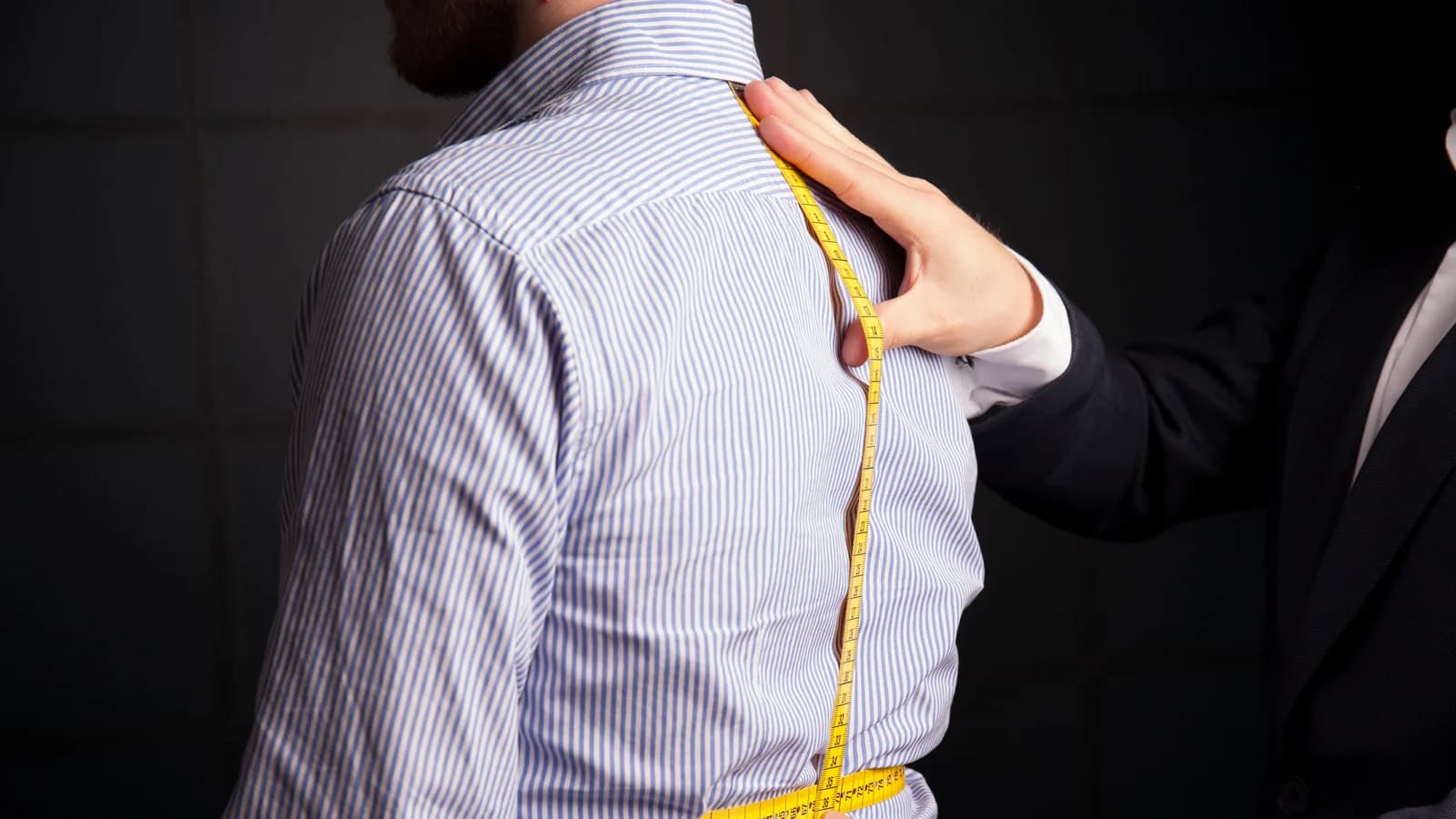
Around thirty measurements for a full bodice and sleeve block, taken over close-fitting clothes, with the tape level and not pulled tight. Several of them — back width, nape to waist, shoulder slope — cannot be taken accurately on yourself, and small errors here propagate through everything.
You will know it worked when: The input the whole craft rests on.
Step 3: Draft one block and expect it to be wrong
A close-fitting bodice block, or a trouser block, using one system from one book. Every author drafts slightly differently and mixing systems mid-draft produces incoherent results.
You will know it worked when: A first attempt, which is not the same as a block.
Step 4: Make a toile and fit it
Sew it in calico, put it on, and mark what is wrong. This is where the craft actually happens, and it typically takes two or three rounds before the block is right. Photographing yourself in the toile from four sides is far more useful than a mirror.
You will know it worked when: A block that fits your body rather than the book’s.
Step 5: Then manipulate it
Dart rotation, adding fullness, changing necklines, drafting facings and sleeves. This is the fast, satisfying part, and it is all mechanical once a good block exists.
You will know it worked when: Designs rather than reproductions.
A small number of concepts carry most of pattern drafting. They are worth naming because they are what turns a set of instructions into an understandable craft rather than a recipe to follow.
- The block — A styleless master pattern fitted to one body with minimal ease. Everything else is derived from it. Drafting a block is slow; using it is not, and the whole economics of the craft follow from that.
- Ease — The difference between body measurement and garment measurement. Wearing ease is what lets you move; design ease is how loose the thing is meant to look. Confusing the two produces garments that are either unwearable or shapeless, and it is the commonest conceptual error.
- Dart rotation — A dart is a wedge of fabric removed to turn flat cloth into a three-dimensional shape, and it can be moved almost anywhere around the piece without changing the fit. Understanding this single idea is what makes design manipulation possible.
- Grain — The direction of the woven threads. It governs how a piece hangs and stretches, and a piece placed off-grain will twist on the body regardless of how well it was drafted.
- Truing — Checking that seams which will be joined are the same length and that lines meet cleanly at the corners. Unglamorous, mechanical, and the difference between a pattern that sews together and one that fights you.
- Walking the seams — Physically stepping one pattern piece along its partner to confirm they match. The check that catches errors before fabric is cut, and the habit beginners skip.
- Grading — Scaling a pattern between sizes by distributing change across specific points rather than uniformly. Relevant if you draft for other people; irrelevant if you draft for yourself, which is a useful thing to know before buying a book about it.
- Go deeper — Taking body measurements for a pattern
- Pattern paper — Plain, dotted or spot-and-cross. Cheap in a roll, and worth having plenty of because early drafts are disposable.
- A metre rule and a set square — Straight lines and true right angles. Most drafting errors are accumulated small inaccuracies rather than conceptual mistakes.
- A French curve and a hip curve — For armholes, necklines and side seams. You can draft freehand and the curves make the difference between a smooth line and a lumpy one.
- Tracing wheel and carbon — For transferring a draft to a fresh sheet or onto a toile. The fastest way to iterate without redrawing.
- A good tape measure — Fibreglass rather than cloth, because cloth stretches with age and a tape that has grown by a centimetre quietly ruins everything downstream.
- Calico for toiles — Cheap woven cotton in a weight near your final fabric. The consumable of the craft, and buying it in bulk is the main way to keep costs down.
- Optional: a dress form — Padded to your own measurements it removes the need for a helper and makes draping possible. Genuinely useful and genuinely not necessary to start.
- Work it out — Pattern ease calculator
- Horizontal wrinkles across the back or chest — Too little width or the garment is riding up. Check whether the wrinkles point towards the tight spot — they usually do. Add width at the point they converge on rather than everywhere.
- Diagonal drag lines from a point — The classic fitting signal, and the point they radiate from is where the problem is. Check what sits at that origin — usually a dart in the wrong place or insufficient length over a curve.
- The neckline gapes — Too much length around the neck for the shape of the shoulder and chest. Check by pinching out the excess and measuring it; that amount usually needs rotating into a dart rather than simply cutting away.
- Sleeves that pull when you reach forward — Armhole too small, sleeve head wrong, or both. Check the armhole depth first because it is the more common culprit, and remember that a garment that fits perfectly standing still may be unwearable.
- The two halves do not match when sewn — Seams were never walked. Check by stepping one pattern piece along its partner before cutting fabric — thirty seconds on paper against an hour of unpicking.
- Everything comes out slightly too small — Seam allowance added twice, or not at all, or inconsistently. Check whether your blocks carry allowance and write the answer on the pattern. This single ambiguity accounts for a remarkable share of failures.
Step 1: One fitted block, properly
A bodice or trouser block through two or three toiles until it genuinely fits. Slow, and everything else depends on it.
You will know it worked when: A master pattern for your own body.
Step 2: Simple manipulations
Dart rotation, neckline changes, adding flare. Mechanical once the block exists, and the first time the craft feels fast.
You will know it worked when: Designs of your own from a fit you trust.
Step 3: Sleeves, collars and the awkward parts
Sleeve heads, cuffs, collar stands. These are the pieces with real geometry in them and where drafting starts to feel like engineering.
You will know it worked when: Shirts and jackets rather than simple shapes.
Step 4: Tailoring or draping
Two different directions. Tailoring adds structure, canvas and shaping through pressing; draping works in three dimensions from the start and suits soft, flowing designs.
You will know it worked when: A specialism.
Step 5: Drafting for other people
Different bodies, grading, and the discovery that your own block taught you less about other people than you assumed.
You will know it worked when: The skill that turns into commissions if you want it to.
- Expecting the first block to work — It will not, and this is not a sign of incompetence — professional patternmakers fit blocks over several toiles. Treating round one as a draft rather than a failure is the difference between continuing and giving up.
- Measuring yourself — Several key measurements are unreliable taken alone, and errors compound through the whole draft. Get a helper, or pad a form.
- Mixing drafting systems — Different books use different formulas, proportions and landmarks. Half a draft from one and half from another produces something that cannot be diagnosed when it goes wrong.
- Forgetting seam allowance, or adding it twice — Decide whether your blocks carry allowance or not, write it on the pattern, and be consistent. This single ambiguity accounts for a remarkable proportion of garments that come out too small.
- Confusing wearing ease with design ease — A close-fitting block needs enough ease to move in; a loose shirt needs much more. Drafting a shirt from a block without adding design ease produces something that fits like a bodice.
- Not walking the seams — Two edges that should join and do not are discoverable on paper in thirty seconds or in fabric after an hour of sewing.
- Blockalso: sloper, foundation pattern
- A styleless master pattern fitted to one body, from which designs are derived. The central object of the craft. "Sloper" is the American term for the same thing.
- Toilealso: muslin
- A trial garment in cheap fabric, made to test and correct fit before cutting the real cloth. "Muslin" is the American term.
- Ease
- The difference between body and garment measurement. Wearing ease allows movement; design ease creates the intended silhouette. Two different things sharing one word.
- Dart
- A folded-out wedge that turns flat cloth into a shaped surface. Can be rotated to almost any position without changing fit, which is the basis of design manipulation.
- Grainline
- The marked direction on a pattern piece that must align with the fabric’s warp. Ignore it and the finished piece twists on the body.
- Notch
- A small mark showing where two pieces align when sewn. The difference between a sleeve that sets in cleanly and one that does not.
- Truing
- Correcting a draft so that joining seams are equal in length and lines meet cleanly. The tidying step that makes a pattern actually sewable.
- Grading
- Producing a range of sizes from one pattern by distributing increments across specific points. A production skill rather than a personal-sewing one.
Before the nineteenth century clothes were cut to individuals by eye and by experience, and the knowledge lived in workshops rather than in books. Systematic drafting — the idea that a pattern could be derived from measurements by rule — emerged with tailoring systems in the 1800s, and it is genuinely a technology: it made skill transferable and it made scale possible.
Standardised sizing followed and it is younger than most people assume. Mass-produced clothing needed size tables, and those tables were built from surveys of particular populations at particular moments — which is precisely why commercial patterns fit some bodies well and others badly. The sizes are not arbitrary, but they are averages, and an average is not a person.
The craft has been revived twice in recent memory: once through home dressmaking’s postwar peak, and again through the online sewing community of the last fifteen years, which put drafting systems, fitting diagnostics and pattern manipulation within reach of people with no access to a college course. Digital drafting is the current change, and it has altered the tooling without altering the underlying geometry at all.
- Do I need to be good at maths?
- No, but you need to be comfortable being precise. The arithmetic is division and simple proportion — nothing beyond school level — and the real demand is geometric intuition and accuracy: right angles that are actually right, measurements taken consistently, and lines that meet where they should. People who enjoy puzzles tend to enjoy this; people who find fiddly precision draining tend not to, and that is a better predictor than mathematical confidence.
- How long does a first block take?
- Longer than a garment, which is the fact worth knowing in advance. Expect several hours for the initial draft and then two or three fitting rounds with toiles in between, spread over a few weeks. It will produce nothing wearable. Everything after it is fast, because every future garment inherits that fit — but the front-loading is real and it is where most people give up.
- Is this better than using commercial patterns?
- Different rather than better, and it depends entirely on your body and your patience. Commercial patterns are quicker, come with instructions, and fit well if your proportions are close to the size table. Drafting wins decisively when they do not — unusual proportions, asymmetry, a body that changed, or simply wanting a garment nobody sells. Many people do both: commercial patterns for speed, their own blocks when fit matters.
- Can I do this without someone to measure me?
- Partly, and it is the craft’s one real dependency. Several measurements — back width, nape to waist, shoulder slope — are unreliable when taken on yourself, and errors there propagate through the whole draft. The permanent solution is a dress form padded to your own measurements, which also makes draping possible and removes the helper from every future project. Failing that, one careful measuring session with a friend gets you a long way.
- Do I need software?
- No. The craft was done on paper for two centuries and paper remains the normal way to learn it, because seeing the whole draft at full size teaches proportion in a way a screen does not. Software becomes genuinely useful once you are iterating a lot, grading across sizes, or want to store and reuse blocks without a cupboard of paper — and it is a real accessibility improvement for anybody who finds large-format paper handling difficult.
If you like this
Each of these is here for a stated reason, not because it is also a hobby.
Progresses to
- Dressmaking — The point at which altering somebody else’s pattern becomes more work than drawing your own. Dressmakers who have made the same fitting adjustments a dozen times tend to arrive here.
- Sewing — Where the craft goes when commercial patterns stop fitting: making the pattern from measurements rather than buying and altering one.
Goes well with
- Corsetry — Corset fitting is pattern alteration by another name, and drafting to measure is where makers go once altering somebody else’s pattern stops being enough.
- Machine knitting — Machine knitting calculates its shaping from a tension swatch and a set of measurements rather than following a written pattern, which is drafting by another name.
Substantial
Last reviewed 2026-08-15. Cost, time and difficulty figures on this page are HobbyHQ estimates — see how we work. Something here wrong or out of date? Tell us.