Target & precision sports
Archery
Archery is one of the very few sports you cannot sensibly teach yourself, and that is a feature rather than an obstacle: the standard route in is a six-week beginners’ course at an affiliated club, which supplies the equipment, the safety training and — crucially — the knowledge of what draw length and bow weight you actually need before you spend any money.
Also known as bow shooting, bow and arrow, archery club.
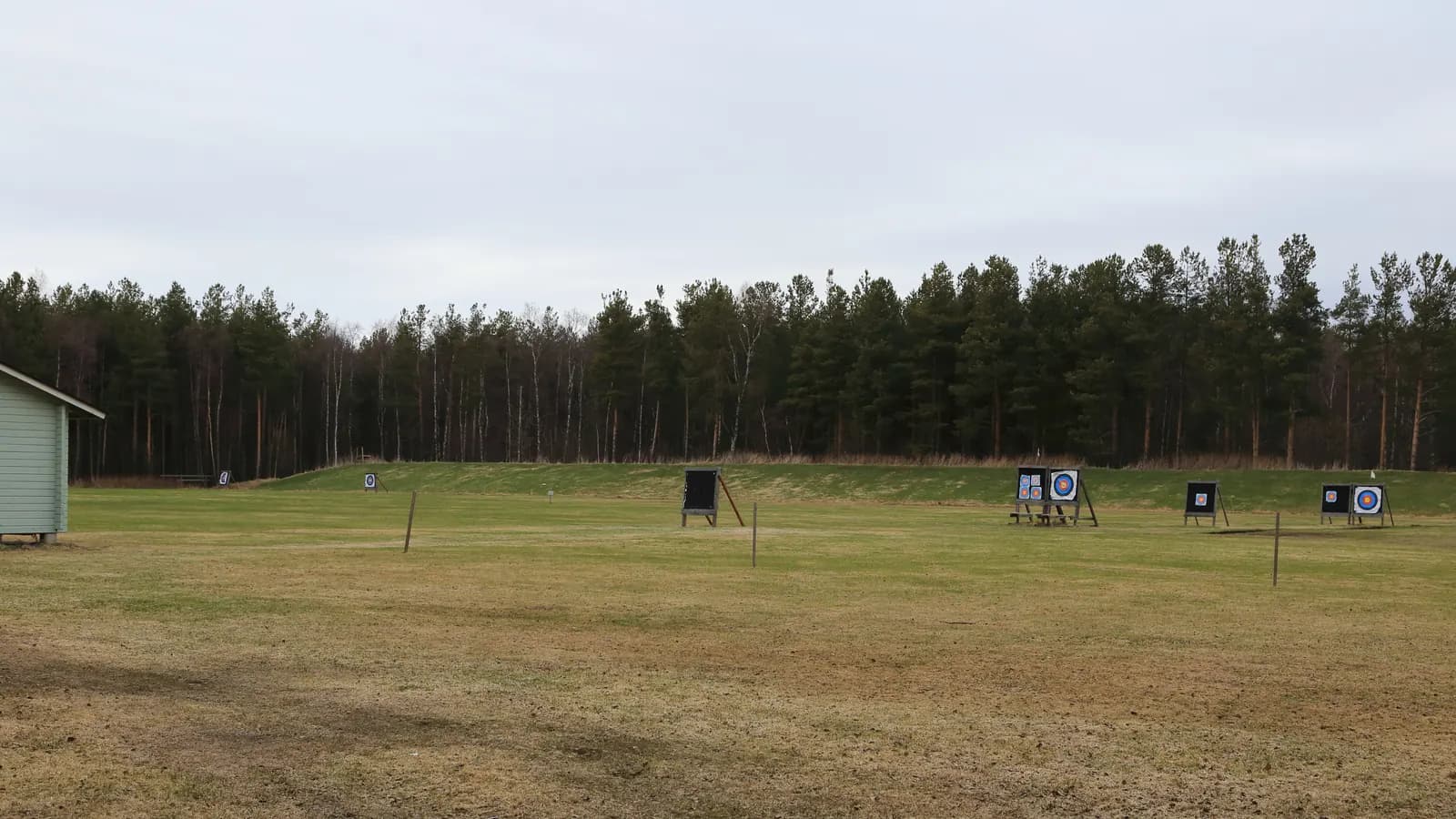
Target archery means shooting a set number of arrows at a marked distance at a standard face and adding up the scores. It is a precision sport in the same family as rifle shooting: the physical demand is real but modest, and the difficulty lies almost entirely in repeatability — doing the same thing seventy-two times.
There are several bow styles, and they are effectively different sports sharing a field. Recurve is the Olympic discipline, with a takedown riser, limbs, a sight and a stabiliser system. Compound uses a cam system that reduces the weight you hold at full draw, a release aid and a magnifying scope, and is substantially more accurate. Barebow is a recurve shot without sights or stabilisers, aimed by string-walking or instinct. Longbow and traditional classes shoot wooden bows to historical patterns.
Beyond target archery, field archery shoots courses of unmarked distances through woodland, and clout, flight and popinjay survive as distinct historical forms.
Step 1: Book a beginners’ course at an affiliated club
Six sessions is typical. It is the standard route and effectively a prerequisite for club membership, because insurance and range safety depend on it. Clubs are listed by the national governing body.
You will know it worked when: You can shoot safely, and you know your draw length and a sensible starting draw weight.
Step 2: Do not buy a bow first
Draw length is measured, not guessed, and starting draw weight is lower than almost every beginner expects — commonly 18–24lb for an adult on the fingers. Too much weight destroys form permanently and is the most common reason people plateau.
You will know it worked when: You buy equipment that fits you.
Step 3: Join the club and shoot weekly
Archery is a repetition sport. Two hours a week beats a long session once a month by a wide margin.
You will know it worked when: Form becomes consistent rather than occasional.
Step 4: Buy in this order
Tab or release aid and bracer first (personal fit, cheap), then arrows matched to your bow and draw, then riser and limbs, then sight, then stabilisers. Arrows matched to your setup matter more to your score than any other single purchase.
You will know it worked when: Money goes where accuracy comes from.
Step 5: Learn a shot process and keep it
A fixed sequence — stance, nock, set, draw, anchor, transfer, expand, release, follow through — repeated identically. Archery coaching is almost entirely about making this sequence unconscious.
You will know it worked when: Your groups tighten even when the score does not yet.
Sources for this section
- Archery GB (opens in a new tab) — Grand National Archery Society (Archery GB) · Governing body · could not be reached
- Go deeper — Starting archery: what to buy, and in what order
A round is a defined number of arrows at defined distances at a defined face. Under the international system, the standard outdoor recurve round shoots 72 arrows at 70 metres at a 122cm face, and compound shoots at 50 metres at an 80cm face with the inner rings used for scoring. Indoor rounds are commonly shot at 18 metres at a 40cm face.
The British system also uses a long list of named imperial rounds — Portsmouth, Western, York, Hereford, National, Warwick — each with its own distances and arrow counts, shot at 122cm or 60cm faces and scored on the five-zone imperial system (9, 7, 5, 3, 1) rather than the ten-zone metric one. A new archer will meet the imperial names at club level and the metric ones in national competition.
Handicap and classification schemes let archers of very different abilities compete meaningfully, which is one of the sport’s better features. Exact distances, face sizes and round definitions are set by the governing bodies and revised periodically — check the current rulebook before entering anything.
Sources for this section
- Book 2: Events (version 2026-01-27) (opens in a new tab) — World Archery Federation · Governing body · read — supports the claim
- Archery GB (opens in a new tab) — Grand National Archery Society (Archery GB) · Governing body · could not be reached
- Draw weight — The force needed to hold the bow at full draw, measured in pounds at a reference draw length of 28 inches. It varies with your actual draw length, which is why a "30lb" limb is not 30lb for everybody. Start low.
- Draw length — How far you draw, measured from the throat of the grip to the string at anchor. It determines arrow length and effective draw weight, and it is measured during a beginners’ course.
- Arrow spine — How much an arrow bends. It must be matched to your draw weight, draw length and point weight, because an arrow flexes around the bow on release — the archer’s paradox. Mismatched spine produces erratic arrows no amount of technique will fix.
- Riser and limbs — A recurve bow separates into a handle (riser) and two limbs, so limbs can be replaced as draw weight increases without buying a new bow. This is why recurve is a sensible long-term purchase.
- Tab or release aid — Fingers on the string need a leather tab; compound archers use a mechanical release. Both are personal-fit items and cheap.
- Bracer and chestguard — Forearm and chest protection, preventing string contact with skin or clothing.
Sources for this section
- Book 3: Target Archery (version 2026-01-27) (opens in a new tab) — World Archery Federation · Governing body · read — supports the claim
- Work it out — Hobby startup cost estimator
- Work it out — Archery score and round projection
Step 1: A repeatable shot process
The same sequence every arrow, at short distance. Accuracy follows consistency rather than the other way round.
You will know it worked when: Arrows group, even if the group is not centred.
Step 2: Moving the group
Sight adjustment and understanding that a tight group in the wrong place is a good problem.
You will know it worked when: You can move a group deliberately rather than hoping.
Step 3: Longer distances
Where form errors amplify and where equipment tuning starts to matter.
You will know it worked when: Groups stay together as distance increases.
Step 4: The plateau
Target panic — the involuntary anticipation of release. Extremely common, rarely discussed with beginners, and a coaching problem rather than an equipment one.
Step 5: Where it branches
Target, field, clout, traditional and barebow. Barebow strips the equipment back and is a different sport in the same building.
Step 6: When to upgrade equipment
When your grouping is consistently tighter than your equipment allows, which is later than most archers believe. Club bows outlast most beginners' patience with them.
Ordinary hazards worth knowing:
- String slap — The string catching the inside of the forearm. Painful, avoidable with a bracer and correct bow-arm rotation.
- Damaged arrows — A cracked carbon arrow can shatter on release and drive splinters into the bow hand. Flex-test carbon arrows before every use and discard any that creak.
- Shoulder injury — Almost always caused by too much draw weight, too early. It is the sport’s characteristic overuse injury and it is entirely preventable.
- Buying a bow before the beginners’ course — The expensive one. Draw length and a sensible starting draw weight are both measured during the course, and a bow bought on a guess fits nobody.
- Too much draw weight — The most damaging error in the sport. Excess weight forces compensations — a collapsing bow arm, a short draw, a snatched release — that become habits within weeks and take months to remove. It is also the leading cause of shoulder injury.
- Aiming instead of shooting — Beginners fixate on the sight pin and freeze at full draw, which drains the shot and makes the release worse. The pin will float; the skill is executing a clean release while it does, not holding it still.
- Plucking the release — Pulling the string hand away sideways rather than letting it relax back along the face. Produces arrows that group horizontally and is visible to anybody standing behind you.
- Mismatched or damaged arrows — Arrows of the wrong spine cannot be made accurate by technique, and a cracked carbon shaft can shatter on release. Flex-test carbon arrows before every session.
- Chasing equipment instead of form — A better sight, a longer stabiliser and a new plunger will not tighten the groups of an archer whose anchor point moves. Equipment refines a consistent shot; it does not create one.
- Shooting too many arrows too soon — Form degrades with fatigue and the last poor ends of a session are what get practised. Stop when the shot stops feeling the same.
Archery divides twice over, and the two divisions are independent: what you shoot with, and what you shoot at. A club will ask you both questions in your first week, and the answers determine equipment, governing body and which competitions you are eligible for.
- Recurve — The Olympic bow: a takedown riser with limbs, sight, stabilisers and a clicker. The most widely taught, the most coached, and the one most beginner courses put in your hand.
- Compound — Cams and a let-off that holds most of the draw weight for you, with a release aid, magnified sight and much higher precision. Mechanically complex, and adjustment is a specialist job rather than a home one.
- Barebow — A recurve with no sight or stabilisers, aimed by string walking or instinct. Growing quickly, cheaper to equip, and unusually satisfying because the archer does the work the sight would.
- Traditional and longbow — Wooden longbows, horsebows and flatbows shot without modern aids, with their own rounds and their own culture. The English longbow has a distinct competitive scene of its own.
- Target archery — Known distances at a round target face, indoors in winter and outdoors in summer. The format of most club nights and the backbone of the sport.
- Field archery — A course through woodland at varied and sometimes unmarked distances, uphill and down. Judging distance becomes a skill in itself, and it is published here as its own subject.
- Clout, flight and popinjay — Long-distance shooting at a ground marker, pure distance shooting, and shooting vertically at targets on a mast. Minority formats with long histories, and a good deal of fun.
- 3D archery — Foam animal targets on a woodland course, popular with traditional and compound archers alike, and the closest common format to hunting practice in a country where bow hunting is not lawful.
The practical order for a beginner: shoot whatever the beginners’ course provides, which is nearly always recurve, and do not buy anything for at least a few weeks. Bow type is much easier to choose once you have drawn one, and clubs routinely have members shooting all four who will let you try.
- Still deciding — Recurve vs compound archery
- Anchor point
- The fixed point on the face or jaw the drawing hand returns to on every shot. Consistency here is consistency everywhere.
- Nock
- Both the slotted fitting at the back of an arrow, and the act of placing an arrow on the string.
- Spine
- An arrow’s stiffness, matched to the bow’s draw weight and the archer’s draw length.
- Archer’s paradox
- The bending of the arrow around the bow on release, which is why spine matching matters at all.
- Clicker
- A thin blade that clicks when the arrow is drawn to a set length, used by recurve archers to make draw length identical every shot.
- Dry loose
- Releasing the string with no arrow nocked. It can destroy the bow and injure the archer, and is the one unforgivable range error.
- End
- A group of arrows — usually three or six — shot before scoring and collection.
- Barebow
- A recurve shot without sights, stabilisers or a clicker, aimed using the string or point of the arrow.
- Brace height
- The distance from the string to the pivot point of the grip on an unstrung-tension bow. It affects forgiveness and speed and is tuned.
- Robin Hood
- An arrow that splits and lodges in the shaft of one already in the target. Expensive.
A club night, and why nobody explains the whistle
Archery carries more etiquette than almost anything else in this catalogue, and all of it is downstream of one fact: everybody has to be behind the line at the same time.
You cannot simply walk into archery. Essentially every club in Britain runs a beginners’ course and requires it before you shoot unsupervised, and that is not gatekeeping — it is the only way a field full of people stays safe without a marshal standing over each of them. What the course teaches, beyond how to shoot, is the choreography. The choreography is the culture.
The signals are the same at every club, because they come from the rulebook:
- Two blasts — come to the line — Occupy the shooting line. You stand astride it with the arrow not yet nocked.
- One blast — shoot — Nock and shoot. Ten seconds after the two, in competition; when the line is ready, at a club.
- Three blasts — go and collect — Shooting has finished and scoring begins. Nobody walks forward until this, and then everybody walks forward together.
- Five or more — stop, immediately — The emergency signal, and the rule has no discretion in it: all shooting must cease. If you are at full draw, come down without loosing. Anybody on the line may call it and nobody will ever ask you to justify having called it.
And the conventions nothing signals at all:
- Never draw off the line — The rule is explicit — no archer draws a bow except standing on the shooting line, and the bow "should always point towards their own target". Drawing in the car park to test a new string is the fastest way to be spoken to that this sport offers.
- Do not touch anyone else’s bow — Not to admire it, not to move it out of your way. A bow is set up to a person, and dry-firing somebody else’s can destroy it. Ask instead, and the owner will hand it to you with obvious pleasure.
- Walk to the target, and look down — Arrows that missed are in the grass short of the boss, pointing up at shin height. Approach from the side rather than the front, and pull arrows with whoever is behind you standing clear.
- Call your scores in threes, highest first — "Nine, seven, five" — and whoever is writing repeats them back. It sounds fussy until the first time a disputed end costs somebody a place.
- Nobody comments on your shooting unless you ask — A strong convention and a kind one. Coaching an archer who has not asked for it is considered rude at every level of the sport, which makes a first evening far less exposing than it feels walking in.
The other thing a first-timer notices is how mixed a shooting line is. On an ordinary club night there is no separation by age, sex or ability — a fourteen-year-old, somebody’s grandmother and a county archer shoot the same ends at the same targets, and the handicap system means they can compete against one another honestly. Very few sports manage that, and it is the reason a lot of people stay for decades.
Sources for this section
- Book 3: Target Archery (version 2026-01-27) (opens in a new tab) — World Archery Federation · Governing body · read — supports the claim
Archery moved from military necessity to sport in Britain earlier than almost anywhere, largely because the bow was superseded by firearms while the legal and social apparatus around practice remained. Compulsory practice at the butts had been a statutory obligation for English commoners for centuries; when it stopped being militarily useful it survived as recreation, and organised shooting societies existed from the seventeenth century.
The Grand National Archery Meeting from 1844 standardised the imperial rounds that British clubs still shoot, which is why a Portsmouth or a York is a name rather than a specification. Archery appeared at the Olympic Games from 1900, disappeared after 1920 because of the absence of agreed international rules, and returned in 1972 once the international federation had established them — a direct illustration of why governing-body rules matter to a sport at all.
The modern equipment landscape dates from the 1960s and 70s: aluminium and then carbon arrows, takedown risers, stabilisers, and the compound bow, patented in the 1960s, which changed precision archery more than any development since the introduction of the sight.
Sources for this section
- Archery GB (opens in a new tab) — Grand National Archery Society (Archery GB) · Governing body · could not be reached
- World Archery rulebook (opens in a new tab) — World Archery Federation · Governing body · read — supports the claim
- Can I teach myself archery in the garden?
- Realistically, no. Beyond the space and backstop problem — you need a very substantial overshoot area to be safe — an untrained archer builds form errors that are much harder to remove than to prevent, and buys equipment that does not fit. A beginners’ course costs less than one wrong bow purchase.
- What draw weight should I start at?
- Lower than you think. For an adult beginner shooting recurve on the fingers, commonly 18–24lb; many clubs start people lower still. Draw weight is about how many arrows you can shoot with identical form, not how many you can pull once. Excess weight is the leading cause of shoulder injury and of plateaued technique.
- Recurve or compound?
- Recurve if you want the Olympic discipline, a lower entry cost and a longer skill curve; compound if you want mechanical precision, a lower holding weight at full draw, and to shoot tighter groups sooner. Compound costs more to enter and its tuning is more technical. Most clubs let you try both during or after a beginners’ course, which is the sensible way to decide.
- Do I need a licence?
- No licence is required for a bow in the UK. What you do need is somewhere lawful and safe to shoot, which in practice means an affiliated club with an insured range. Crossbows are regulated separately, including on age and sale.
- Is archery expensive?
- The course is cheap and the first proper setup is the expense — £300–£600 for recurve, more for compound. After that, running costs are low: club membership, occasional arrows and strings. It is comparable to buying a decent bicycle once and then riding it for years.
Within this activity
Disciplines, variants and techniques that sit inside it.
Disciplines
- Field archery — Shooting a course of targets at unmarked distances through woodland.
- Target archery — The Olympic form: fixed distances, round faces, scored ends.
Variants
- Popinjay archery — Shooting blunts vertically at wooden targets on a mast, a surviving medieval form.
Techniques
- Arrow making — Building arrows to a spine and length, which is a precision craft archery clubs still teach.
If you like this
Each of these is here for a stated reason, not because it is also a hobby.
Similar to
- Target shooting — The same precision sport structure — club, range discipline, repeatable technique — with a different projectile and tighter legal framework.
Goes well with
- Historical European martial arts — Overlapping historical interest and community, and a large proportion of reenactors and HEMA practitioners shoot as well.
Cheaper alternative
- Darts — The same repeatable-precision satisfaction for under £20, indoors, with no club membership and no range.
Progresses to
- Field archery — Target archers who prefer woodland to a flat field move to unmarked distances, where judging range becomes the skill.
Sources for this section
- Archery GB (opens in a new tab) — Grand National Archery Society (Archery GB) · Governing body · could not be reached
- World Archery rulebook (opens in a new tab) — World Archery Federation · Governing body · read — supports the claim
Comprehensive
Last reviewed 2026-08-13. Cost, time and difficulty figures on this page are HobbyHQ estimates — see how we work. Something here wrong or out of date? Tell us.