Target & precision sports · Outdoor & adventure
Disc golf
Disc golf is the cheapest outdoor sport with a real competitive structure: most British courses are free to play, three discs cost about £35, and a round takes ninety minutes. The one genuinely confusing thing about it is the four-number flight rating printed on every disc, which is why this page explains it properly.
Also known as frisbee golf, frolf.
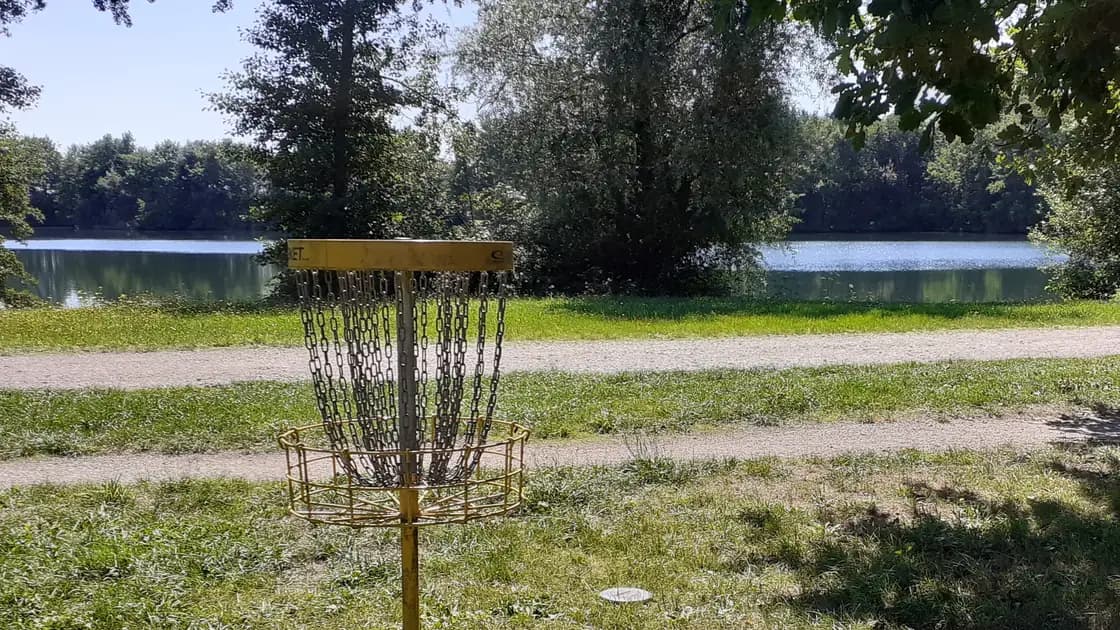
The structure is golf’s. Each hole has a tee, a fairway and a target — an elevated metal basket hung with chains that catch the disc. You throw from where your last throw landed, you count throws, and the lowest total wins. Courses are usually 9 or 18 holes and typically laid out through parkland or woodland.
What differs is the projectile. A golf ball goes broadly where you hit it; a disc flies a curved path determined by its shape, its speed and its spin, and the same throw with two different discs produces two very different results. Learning disc golf is largely learning to predict and use those curves.
It is one of very few sports where the competitive infrastructure is genuinely mature — a world tour, ratings, sanctioned events — while the participation cost is close to zero.
Step 1: Buy three discs, not a distance driver
A putter (speed 2–3), a midrange (speed 4–5) and a fairway driver (speed 6–7). This covers every shot on a beginner course and each disc will actually fly properly for you.
You will know it worked when: Your throws go where the disc is designed to go.
Step 2: Choose lighter weights
150–165g rather than the maximum 175g. Lighter discs need less arm speed to reach their design flight and go further for most beginners.
You will know it worked when: More distance, less strain.
Step 3: Learn to putt first
Putting is where strokes are actually lost, it needs no space, and you can practise it in a garden with a basket or even a bucket. Most beginners spend all their practice throwing far and none throwing accurately from ten metres.
You will know it worked when: You stop taking three putts from close range.
Step 4: Throw flat
The commonest beginner fault is releasing with the outside edge tilted up, which makes the disc climb, stall and turn over. A flat release does more for distance than strength.
You will know it worked when: The disc flies its rated flight.
Step 5: Play a free public course with someone who knows it
British courses are often unsigned and the tee-to-basket line is not obvious. One round with an experienced player saves an hour of confusion.
You will know it worked when: You understand course etiquette and how the hole is meant to be played.
- The lie — You throw from where the disc came to rest. A marker disc may be placed directly in front of it, and your supporting point must be within 30cm behind the marker.
- Falling putt — Inside 10 metres of the basket you must demonstrate balance after releasing — stepping past your marker towards the basket before showing balance is a fault. This prevents a running jump-putt from close range.
- Holed out — The disc must come to rest supported by the chains or in the basket. A disc that passes through the chains and out is not holed.
- Out of bounds — One penalty throw, and you play from within one metre of where the disc last crossed the boundary.
- Order of play — Furthest from the basket throws first, as in golf.
- Courtesy — Nobody throws while a person or group is within range. This is a rule, not merely manners, and it is enforced in competition.
These follow the published rules of the international governing body, which are revised periodically. Anything competition-critical should be checked against the current edition.
Sources for this section
- Official Rules of Disc Golf (opens in a new tab) — Professional Disc Golf Association · Governing body · corroborated indirectly
The four flight numbers, explained
Every disc carries four numbers. They are the most useful and most misunderstood information in the sport.
| Number | Range | What it describes |
|---|---|---|
| Speed | 1–14 | How fast the disc must be thrown to fly as designed. High-speed drivers need arm speed most beginners do not have. |
| Glide | 1–7 | How long the disc stays aloft. Higher glide means more distance for the same power, and less control in wind. |
| Turn | +1 to −5 | How much the disc curves right (for a right-handed backhand) during the fast early part of the flight. More negative turns more. |
| Fade | 0–5 | How hard the disc hooks left at the end of the flight as it slows. Higher fade means a sharper finish. |
The numbers describe a right-handed backhand throw; for a left-handed backhand or a right-handed forehand, the left–right directions mirror.
The single most useful consequence for a beginner: high-speed discs do not work without high arm speed. Thrown slowly, a speed 12 driver never reaches the part of its flight where turn happens, so it simply fades hard left and lands short — which feels like a failure of technique and is actually a failure of equipment choice. A speed 6–7 fairway driver thrown by a beginner will go further than a speed 12 distance driver.
A useful shorthand: turn and fade together describe the shape. A disc rated −3 turn / 1 fade is *understable* and will curve right then finish gently — good for beginners and for long right-turning shots. A disc rated 0 turn / 3 fade is *overstable* and will hold a line then hook hard left — good in wind and for shots that must finish left.
Flight numbers are manufacturer figures, not a certified standard, and they are not perfectly comparable between brands. What the sport’s governing body does certify is which discs are approved for competition and the physical specification they must meet.
Sources for this section
- Technical Standards (opens in a new tab) — Professional Disc Golf Association · Standards body · corroborated indirectly
- Go deeper — Understanding disc golf flight numbers
- Work it out — Disc golf flight helper
- Work it out — Hobby startup cost estimator
Step 1: Throwing straight, with one disc
A midrange, thrown flat, repeatedly. Beginners carry too many discs and throw none of them consistently.
You will know it worked when: You can put a midrange where you aimed, most of the time.
Step 2: Understanding flight
Why a disc turns and fades, and how to use it deliberately rather than fighting it.
You will know it worked when: You can shape a shot rather than only throw one shape.
Step 3: Putting
The part that decides scores and the part everybody practises least.
You will know it worked when: Inside ten metres stops being a gamble.
Step 4: The plateau
Distance obsession. Almost every player stalls by chasing drivers they cannot control, when the strokes are being lost inside twenty metres.
Step 5: Where it branches
Competitive tournament play, course design, or forehand as a second shot shape.
Step 6: When to add discs
One at a time, when a specific shot is missing from your bag rather than because a disc is recommended.
- Starting with a high-speed distance driver — The defining beginner mistake. It will go shorter than a midrange and behave unpredictably, and it is why many people conclude they cannot throw.
- Throwing with the arm — Distance comes from rotation, weight transfer and a late, snappy release, not from arm strength. Trying to muscle it produces a nose-up release and a stall.
- Nose-up release — Angling the front edge upward makes the disc climb and fall short. Keep the flight plate flat and the nose down.
- Buying max weight — 175g is the standard maximum and is heavier than most beginners can throw efficiently.
- Neglecting putting — Half your strokes on a round happen within 20 metres of the basket.
- Throwing towards people — A 175g disc at speed causes serious injury. Wait.
- Casual round play — Turning up at a public course with a few discs and playing a round. The overwhelming majority of the sport, free at most British courses, and the format everything else is built on.
- Sanctioned tournament play — Rounds played under the PDGA rules and rating system, in divisions by age, gender and rating. What changes is not the throwing but the procedure — marking a lie, calling a violation, playing a provisional — and it is the part newcomers find unexpectedly formal.
- Doubles — Two players, both throwing each shot, the better lie taken. Best-shot doubles is the standard club-night format across Britain because it hides a weak player’s bad drives and makes an evening sociable rather than exposing.
- Singles match play — Hole by hole rather than by total strokes, which rewards recovery and changes what a bad hole costs. Rarer than stroke play and worth knowing because it makes an aggressive line rational where stroke play would not.
- Distance and field events — Throwing for maximum distance or accuracy without a course. A separate skill set with its own records, and the branch most likely to injure someone, because a maximal throw is where the shoulder and elbow problems come from.
- Putting leagues and practice formats — Structured putting competition, indoors in winter, on portable baskets. Britain’s weather makes this a substantial part of the year for club players, and putting is the part of the sport that improves fastest for the time spent.
- Still deciding — Disc golf vs Ultimate
- Overstable
- A disc that resists turning right and finishes hard left (for a right-handed backhand). Reliable in wind.
- Understable
- A disc that turns right easily during flight. Easier for beginners and used for right-curving shots.
- Hyzer
- A throw released with the outer edge angled downward, curving the disc in the direction of its natural fade.
- Anhyzeralso: anny
- A throw released with the outer edge angled upward, curving the disc against its natural fade.
- Forehandalso: flick, sidearm
- A throw released palm-up from the side of the body, curving opposite to a backhand.
- Ace
- A hole in one.
- Turnover
- A shot deliberately thrown to turn over and finish in the opposite direction to normal fade.
- Circle 1
- The 10-metre radius around the basket inside which the falling-putt rule applies.
- Mando
- A mandatory — a marker the disc must pass on a specified side, used to route play away from hazards or the public.
- Beat in
- A disc that has become more understable through repeated impacts, changing its flight over time.
Etiquette that is actually a rule
Most sports keep manners in an appendix. Disc golf put them in rule 812 with penalty throws attached, and that tells you most of what you need to know about how a round feels.
Disc golf is played on public land, usually in a park somebody else is also using, mostly without officials, and almost entirely on trust. The courtesy rule is how a sport with no referee polices itself: a violation "may be called or confirmed by any affected player", the first one is a warning, and every one after that in the same round costs a throw.
What the rule actually forbids:
- Throwing when it might hit or distract somebody — The first clause, and the one that matters in a public park. If a dog walker is anywhere near the fairway, you wait. A disc at speed will badly hurt somebody who never agreed to be there.
- Moving or talking while another player is throwing — Named explicitly. The convention that follows is that the group goes quiet and still from the moment somebody steps on to the tee pad, and nobody minds waiting.
- Advancing beyond the away player — The away player — whoever is furthest from the basket — throws first, and nobody walks past them. It is the throwing order and the safety rule in one, and it is the thing new players get wrong most often.
- Shouting, unless it is a warning — With the exception written into the rule: shouting is permitted "unless warning someone at risk of being struck by a disc". In practice that shout is "Fore!", it is loud, and nobody has ever been embarrassed for using it.
- Littering, "including cigarette butts" — Spelled out in the rule, which tells you it had to be. Courses exist on the goodwill of whoever owns the park, and that goodwill is lost by litter far more often than by anything else.
And what it requires, which is the part that makes the culture:
- Help find a lost disc — A positive duty. Three minutes of four people quartering the undergrowth for somebody else’s midrange is a completely normal part of a round.
- Watch everybody else throw — Required "to ensure rules compliance and to help find discs". A group that all look away as somebody throws into the trees will spend the next ten minutes searching. Watching the flight is the courtesy.
- Keep score properly — One person calls, everybody confirms. There are no officials on the course, so the score is whatever the group agrees it was.
The other cultural fact worth knowing before your first round is how open it is. Almost every course is free, most clubs run a weekly informal doubles round that anybody can turn up to, and the standard response to a newcomer with two discs from a supermarket is to lend them three better ones for the afternoon. Discs are cheap, they get lost, and the community’s reflex towards a beginner is generosity — partly because everybody remembers being the person throwing a driver into a hedge.
Sources for this section
- Official Rules of Disc Golf, 812 Courtesy (opens in a new tab) — Professional Disc Golf Association · Governing body · read — supports the claim
People have thrown flying discs at targets — trees, bins, posts — for as long as there have been flying discs. The sport became formal in the 1970s in California, largely through the work of Ed Headrick, who had been central to the development of the modern plastic disc and who patented the chain-and-basket target that made scoring unambiguous. Before the basket, disagreement about whether a tree had been hit was the sport’s main problem.
The Professional Disc Golf Association was founded in the mid-1970s and remains the governing body, running the rules, the approved-disc list and a worldwide ratings system. Course numbers grew steadily for decades and then very sharply from around 2020.
British growth has followed, driven by the same economics that drove it elsewhere: a course can be installed on existing parkland for a small fraction of the cost of any other sports facility, and needs almost no maintenance.
Sources for this section
- Official Rules of Disc Golf (opens in a new tab) — Professional Disc Golf Association · Governing body · corroborated indirectly
- Is it just throwing a frisbee?
- The discs are quite different — smaller, denser and with a sharper edge profile than a recreational catch disc, and designed to fly a specific curve rather than to be caught. A catch frisbee thrown at a disc golf course will fly perhaps a third of the distance.
- How many discs do I actually need?
- Three. A putter, a midrange and a fairway driver covers every shot on a beginner course. Experienced players carry fifteen or twenty, but those are refinements — a player with three discs they understand will beat a player with twenty they do not.
- What do the numbers on the disc mean?
- Speed, glide, turn and fade, in that order. Speed is how fast you must throw it for it to fly as designed; glide is how long it stays up; turn is the early right-curve; fade is the late left-hook, both for a right-handed backhand. The key beginner insight is that a high speed number makes a disc worse, not better, until you can throw hard enough for it.
- Is it free to play?
- Most British courses are on public land and free. A minority are pay-to-play, usually a few pounds. Competition entry costs money and a governing-body membership is needed for rated events, but casual play is genuinely free.
- How far should I expect to throw?
- A new player typically throws 30–50 metres; a competent amateur 90–120; touring professionals well beyond 150. Distance improves far more from technique — flat release, timing, rotation — than from strength, and most beginners gain 20 metres in their first month without getting any stronger.
Guides
Longer answers to questions this page can only summarise.
- Which disc to throw for the hole in front of youA decision route from what the hole looks like to which disc comes out of the bag — the part of disc golf that is genuinely learnable from a page, unlike the throw itself.
- Reading the flight: what your disc just told youA diagnostic reference for throws that went wrong — worked backwards from the shape the disc flew to the cause, and honest about where the answer stops being something a page can give you.
If you like this
Each of these is here for a stated reason, not because it is also a hobby.
Similar to
- Hiking — A round is a two-hour walk in parkland with something to think about, which is most of what a walk is for.
Goes well with
- Ultimate — Same discipline of throwing accurately, opposite physical demand — one is a walk, the other is a sprint sport.
Sources for this section
- Official Rules of Disc Golf (opens in a new tab) — Professional Disc Golf Association · Governing body · corroborated indirectly
- Technical Standards (opens in a new tab) — Professional Disc Golf Association · Standards body · corroborated indirectly
Comprehensive
Last reviewed 2026-08-13. Cost, time and difficulty figures on this page are HobbyHQ estimates — see how we work. Something here wrong or out of date? Tell us.