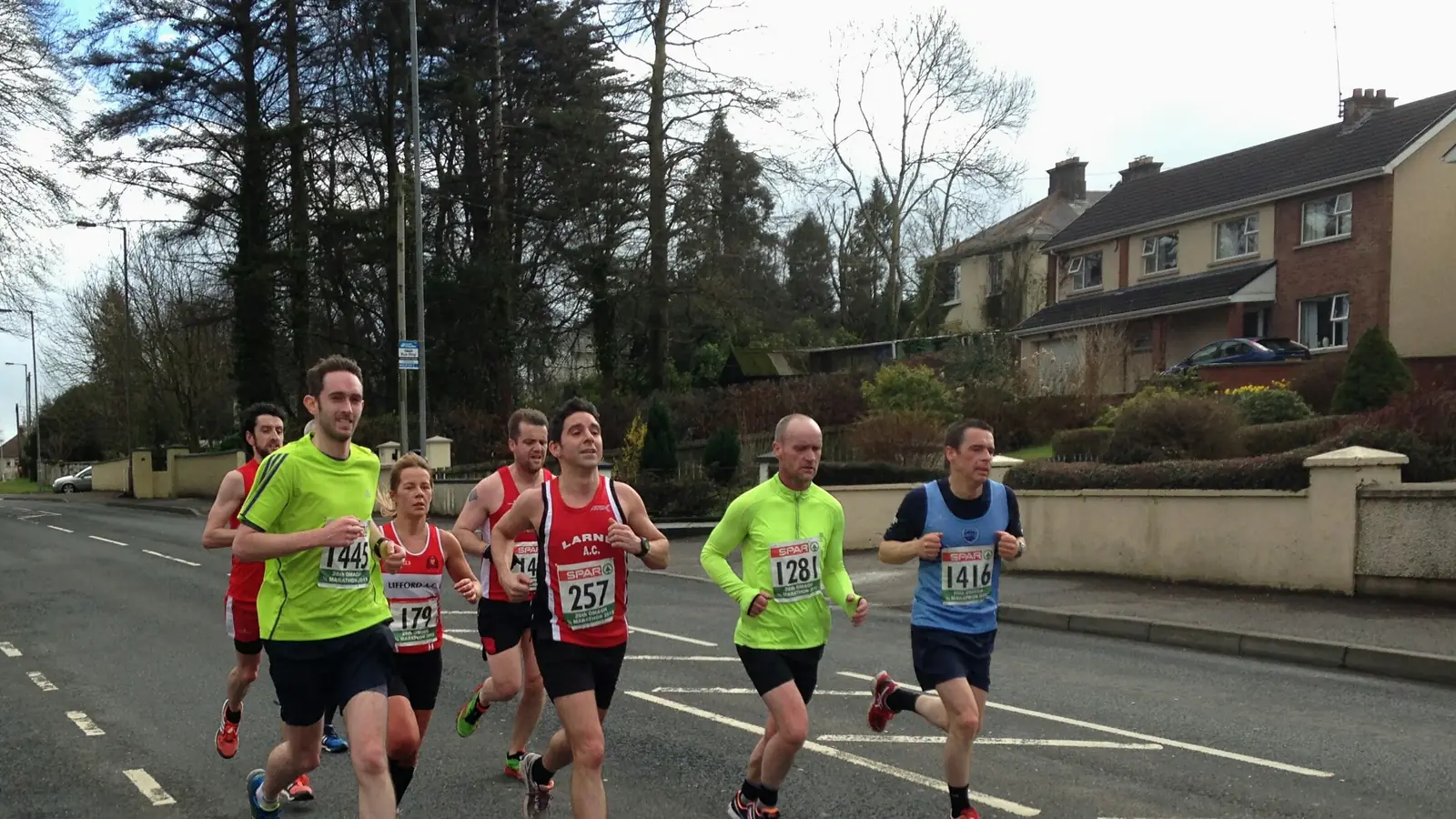
Endurance & fitness
Half marathon
The half marathon is treated by almost all the available material as a step on the way to a marathon, and for most people it is the destination. It is the longest distance you can genuinely race rather than merely complete, the pacing problem is the opposite of the marathon’s, and recovering from a bad one takes a fortnight rather than a season. This page is about the half as its own event: what the distance asks, how the pacing works, and what actually goes wrong on the day.
Also known as half marathon training, 13.1, half marathon race, 21k, running a half marathon.
Half marathon is a discipline of Running — Running is the habit and the sport; this is the distance most runners settle at — long enough to need real preparation, short enough that a bad one costs a fortnight rather than a season.
A half marathon is 21.0975 kilometres, or 13.1094 miles — exactly half the marathon distance, which is where the name comes from and very nearly where the resemblance ends. World Athletics recognises it as a road running discipline in its own right with its own championship history, and it is by a wide margin the most popular serious race distance in Britain.
The reason it is not simply a shorter marathon is that the limiting factor changes. A marathon is decided by whether you can keep going at all, which is why fuelling and pacing discipline dominate it. A half is short enough that a reasonably prepared runner will finish, and long enough that how fast is a real question — so it is a race you run rather than an event you complete, and the tactical problem is much closer to a 10k than to a marathon.
That has a practical consequence people find liberating once it is stated. A bad half costs you a fortnight; a bad marathon costs a season. You can race two or three halves a year without the whole calendar bending round them, and you can afford to get one wrong and learn something. Most runners who try both end up here.
- The distance
- 21.0975km / 13.1094 milesExactly half the marathon distance.
- What decides it
- Pacing, mostlyFitness gets you round; pacing decides whether it was any good.
- Recovery
- Days rather than weeksThe reason it can be raced several times a year.
- Sensible prerequisite
- Comfortably running 8–10kmRather than "beginner", which most plans mean as beginner at the distance.
- Still deciding — Marathon vs half marathon
Almost every published plan assumes a starting point it does not state: that you already run comfortably three times a week and can cover 8–10km without it being an event. Plans described as "beginner" usually mean beginner at the distance. Starting from a lower base is the commonest reason a block falls apart, and it falls apart through injury or simply through the sessions not being completable.
The order that works, without a schedule attached:
Step 1: Build a habit before building distance
Three runs a week for a couple of months, comfortably. This is the base every plan assumes and none provides, and it is where the injury risk is actually managed.
You will know it worked when: Running is routine rather than a project.
Step 2: Race something shorter first
A parkrun or a 10k. You learn pacing, race-morning logistics and what your stomach does under pressure at a distance where getting it wrong costs twenty minutes.
You will know it worked when: The half is not also your first race.
Step 3: Choose the event before worrying about the training
Date, terrain, likely weather, cut-off, and how you get there. A flat local race in spring is materially easier than a hilly destination one in August, and no amount of preparation compensates for that choice.
You will know it worked when: You are preparing for a specific day.
Step 4: Extend one run a week, gradually
The long run is where the adaptation happens. Most approaches build it towards but not beyond race distance, and most cap it somewhere between 16 and 20km — which surprises people and is close to universal.
You will know it worked when: A long run that makes the distance unremarkable.
Step 5: Keep most of the rest easy
The majority of weekly mileage run slower than feels productive. Running easy runs too fast is the most common training error in the sport and it is invisible until the block collapses.
You will know it worked when: Enough recovery to absorb the long run.
Step 6: Rehearse the race in training
The shoes, the socks, the kit, the breakfast, and any drink you intend to take. Nothing on race day should be new — the phrase every runner learns eventually is that nothing new happens on race day.
You will know it worked when: No unknowns left for the morning.
If there is one thing to take from this page, it is that the half is decided in the first three kilometres and almost nobody believes that until it has happened to them twice.
The mechanism is straightforward. At half marathon effort you are running close to a pace you can sustain for around ninety minutes to two hours, and the margin between "sustainable" and "not sustainable" is narrow. Starting fifteen seconds a kilometre too fast feels almost free for twenty minutes and is unrecoverable by fifteen kilometres — you do not simply slow down to the correct pace, you slow down well below it. The time lost in the second half is several times the time gained in the first.
The opposite error is much cheaper. Starting slightly conservatively costs a few seconds and buys the ability to run the last five kilometres, which is where a good half is actually made. This asymmetry is why nearly every experienced runner’s advice reduces to the same sentence: go out slower than you want to.
How the splits usually work:
- Even splits — Running each half of the race in roughly the same time. The default target and what most well-executed halves look like.
- Negative splits — Second half faster than the first. Widely regarded as the ideal and considerably rarer than people claim, because it requires real restraint early.
- Positive splits — Second half slower. Extremely common, usually by a large margin, and almost always caused by the first three kilometres rather than by the last three.
- The crowd effect — Everybody around you is also going too fast at the start, and the pace feels correct because it is the pace of the field. This is why watching your own watch in the first two kilometres matters more than at any other point.
- Course profile — A pace target set on flat ground does not survive a hill. Run the effort rather than the number on climbs, and let the pace come back on the descent.
Pace measurement itself has a wrinkle worth knowing. A GPS watch will nearly always record a half marathon course as slightly long, because it samples a path that cuts fewer corners than the measured line does, and because signal in a city drifts. Do not conclude the course was mismeasured — see the section on how courses are certified — and do not chase the watch’s pace over the official markers.
The half is unusual among race distances in being a genuine destination rather than a staging post, and a great many runners spend a decade here quite deliberately. The reasons are practical: the training fits around a life, the recovery is measured in days, and there is a race somewhere near you most months of the year.
The usual directions:
- Race it properly — Most first halves are completions. The second and third are where pacing gets learned, and the improvement between them is usually larger than any training change produces later.
- Get faster rather than longer — Adding structured faster running — intervals, tempo work — is what moves a half time, and it is a smaller time commitment than adding distance.
- Go off-road — Trail halves, multi-terrain events and fell races, where the clock stops meaning anything and the terrain decides everything. A common and happy landing place.
- Step up to the marathon — The obvious progression and a much larger commitment — a training block that reorganises the calendar and a recovery measured in weeks. Worth doing knowingly rather than by default.
- Sideways into triathlon — Where the running is one third of the problem and the equipment bill is an order of magnitude larger.
- Join a club — The single biggest improvement available to most runners, and the cheapest. Structured sessions with other people beat self-directed training for almost everybody.
- Shoes — The only purchase that genuinely matters, and the one most over-theorised. A pair that fits, feels good on a long run and has not done several hundred kilometres already. Gait analysis at a running shop is a reasonable free service and its recommendations are not a science.
- Socks — Technical rather than cotton, and worn in. Blisters over two hours are a genuine race-ruiner and cost £8 to prevent.
- Something that does not chafe — Whatever you have run in repeatedly. Two hours finds every seam, and the fix is anti-chafe balm, not a new garment on the day.
- A watch, optionally — £80–£300, and useful mainly for the first three kilometres when your judgement is worst. A plain stopwatch and the kilometre markers do the same job.
- A discardable layer — An old jumper or a bin bag for the start pen. The single highest-value item on race morning in a British winter.
- A hydration carrier, rarely — Most road halves have aid stations often enough that carrying a bottle is unnecessary. Trail events are a different matter and often mandate kit.
The thing not to buy is anything new in the fortnight before the race. That includes the shoes you have been meaning to replace, the vest from the expo, and any product somebody at the start line recommends. Nothing new on race day is a cliché because it is a rule.
- Work it out — Race pace and split planner
More halves are spoiled by admin than by fitness. The failures are boring and entirely preventable, and they cluster in the two hours before the start.
What actually goes wrong:
- Arriving late — Parking at a large event takes far longer than the website implies, and road closures start earlier than you expect. The runners jogging to the start line have already lost the race they wanted.
- Starting in the wrong pen — Too far forward and you get dragged out fast; too far back and you spend three kilometres weaving. Enter the honest predicted time rather than the aspirational one.
- New kit — A race t-shirt worn on the day, new socks, a different sports bra. Chafing over two hours is a genuine injury and it is entirely self-inflicted.
- Breakfast roulette — Eating something you have never eaten before a run. Whatever you have practised is the right answer, including nothing if that is what you practised.
- Toilet queues — The single most underestimated element of race morning. Budget twice as long as seems reasonable.
- Dressing for the start — Standing around cold, then overdressing for it. The convention is to dress for about ten degrees warmer than it is, with an old layer to discard at the start.
Aid stations are worth understanding before you meet one at speed. They are typically placed every three to five kilometres, they are crowded, and the ground around them is wet and littered with cups and bottles. The conventions are simple: take the drink from a volunteer’s hand as you pass rather than reaching across people, move to the outside if you are going to walk, and drop your cup at the end of the station rather than in the middle of the crowd. Over this distance most runners need considerably less than they take — but the decision about what and how much is individual, and this page gives no figures.
A personal best only means something if the course was the distance it claimed, and the machinery that guarantees that is genuinely interesting and almost never explained to the people relying on it.
In the United Kingdom, a licensed road race advertised over a specific distance must hold a certificate of course measurement, issued through the Association of UK Course Measurers, and the certificate is submitted with the event licence application — a licence is not granted without one. Measurement is done by riding the course on a bicycle fitted with a counter that records front-wheel revolutions, calibrated before and after against an accurately surveyed calibration course. Certificates typically remain valid for a number of years provided the course is unchanged.
What follows from that, practically:
- Check the race is licensed and measured — Most are, and the good ones say so on the entry page. An uncertified "half marathon" may be any distance at all, which matters if you care about the time.
- Your watch will read long, and that is normal — The measured line follows the shortest legal route round every bend. You do not run that line, and GPS drifts in cities. A watch reading 21.3km on a certified course is measuring you, not the course.
- Multi-terrain events are measured differently — Trail and off-road events often cannot be measured by the standard method and carry a statement rather than a certificate. Comparing a trail half to a road half is comparing two different things.
- Chip time and gun time are not the same — Gun time runs from the start signal; chip time from when you crossed the line. In a large field the difference can be several minutes, and results usually publish both.
- Course records and personal bests need certified courses — This is what the whole system exists for. It is also why a spectacularly fast time on an unlicensed race means very little.
- Going out too fast — The cause of most disappointing halves, by a very wide margin. Fifteen seconds a kilometre too quick for the first three kilometres costs several minutes over the last five.
- Racing the training — Running the easy runs too hard so there is nothing left for the long run. The most common training error in distance running and the hardest to notice.
- Treating it as a small marathon — Carrying gels, planning fuelling stops and pacing conservatively throughout, for a race that is short enough to be raced. The tactics are closer to a 10k.
- Skipping the shorter race — Making the half your first ever event, and learning about start pens, chip timing and race-morning nerves while also running the furthest you ever have.
- New anything on the day — Shoes, socks, breakfast, a gel from the goody bag. Every one of these has ruined somebody’s race this month.
- Chasing the GPS pace — Speeding up because the watch says you are behind, when the watch is reading the course long. Run to the kilometre markers.
- Dressing for the finish — Or for the start. Dress for about ten degrees warmer than it is, and use a throwaway layer while waiting.
- Entering the wrong pen — An optimistic predicted time puts you in front of people who will run away from you, which is the most reliable way of triggering the first mistake on this list.
- Split
- The time taken for a segment of the race — usually each kilometre or mile, or each half of the distance.
- Negative split
- Running the second half of a race faster than the first. Widely held as the ideal execution and considerably rarer than claimed.
- Chip time and gun timealso: net time, official time
- Chip time runs from when you cross the start line; gun time from the start signal. In a large field the difference can be minutes.
- Penalso: start wave, corral
- The starting enclosure allocated by predicted finishing time, used to sort a large field so that faster runners are not stuck behind slower ones.
- Certified course
- A course measured by an accredited measurer using a calibrated bicycle and issued with a certificate, which a licensed race must hold to advertise a specific distance.
- Aid stationalso: water station, feed station
- A staffed point on the course offering water and sometimes other drinks, typically every three to five kilometres on a road race.
- Taper
- The reduction in training volume in the final week or two before a race, intended to arrive rested without losing fitness.
- Long run
- The single longest run of the week, where most of the endurance adaptation happens. Usually capped below race distance for this event.
- Easy pacealso: conversational pace
- Running slow enough to hold a conversation. The majority of most runners’ weekly mileage, and the pace most often run too fast.
- PBalso: personal best, PR
- Personal best — your fastest time at the distance. Only meaningful on a certified course.
- DNF
- Did not finish. Recorded rather than hidden in results, and a normal part of racing rather than a disgrace.
- Multi-terrain
- An event on mixed surfaces that cannot be measured by the standard road method, and which therefore carries a statement of distance rather than a certificate.
The distance is derived rather than historical: it exists because it is half of the marathon, and the marathon distance is itself a twentieth-century artefact rather than a measured original. So there is no founding half marathon in the way there is a founding marathon story, and any account presenting one should be treated with caution.
What is better attested is that the distance became a mass-participation event comparatively recently, growing alongside the road-running boom of the later twentieth century, and that it acquired international championship status in its own right — World Athletics recognises it as a road running discipline, and a standalone world half marathon championship ran for some decades before being folded into a combined road running championship in 2023.
In Britain the distance now dominates the racing calendar by volume, and the reasons usually given are practical rather than cultural: it is achievable on training that fits round a job, it is cheap to stage on closed roads for a single morning, and the recovery lets a club runner race several a year. Whatever the causes, the effect is that there is a half marathon within reach of almost anywhere in the country most months of the year, which is not true of any other serious distance.
Sources for this section
- Half marathon (opens in a new tab) — World Athletics · Governing body · read — supports the claim
- How far is a half marathon exactly?
- 21.0975 kilometres, or 13.1094 miles — exactly half the marathon distance, which is where the name comes from. The decimals matter more than they look: they are what course certification is measured against, and they are why a race advertised at a specific distance must hold a measurement certificate. Expect your GPS watch to record slightly more than this on a properly measured course, because the certified measurement follows the shortest legal route round every bend and you will not run that line.
- How long do I need to train for one?
- We deliberately publish no figure, because the honest answer depends on where you are starting from and the variation between individuals is large. What can be said usefully is what the plans assume but rarely state: nearly all of them expect you already run three times a week and can cover 8–10km comfortably. Starting from a lower base is the commonest reason a block falls apart. If you are not there yet, the useful sequence is to build a running habit first, then build distance, then aim at a specific race — and to choose a race far enough away that you are not compressing that.
- What pace should I start at?
- Slower than you want to, and this is close to the only universal advice in the sport. The half is run near the edge of a sustainable pace, so the margin for going out too fast is narrow: fifteen seconds a kilometre too quick in the first three kilometres feels almost free at the time and typically costs several minutes over the last five, because you do not simply return to the correct pace — you drop well below it. The asymmetry runs one way. Starting slightly conservatively costs seconds and buys the ability to run the finish, which is where a good half is made.
- Do I need gels or energy drinks?
- Probably less than the marketing suggests, and we give no figures because both directions of that advice have harmed people and individual variation is large. What is worth saying is structural: this distance is short enough that many runners complete it well on water alone, which is not true of a marathon, and the fuelling anxiety around halves is largely imported from marathon material. Whatever you decide, practise it in training — the single reliable rule is that nothing new happens on race day, and a gel tried for the first time at 15km is a genuinely common way to ruin a race.
- Why does my watch say the course was too long?
- Because it is measuring you rather than the course. A certified course is measured along the shortest legal route, hugging every bend, by a measurer riding a calibrated bicycle with a counter on the front wheel — and you do not run that line, you run wide round corners and weave between people. GPS also drifts, particularly among tall buildings. In the United Kingdom a licensed race advertised over a specific distance must hold a measurement certificate issued through the Association of UK Course Measurers, submitted with the event licence application. A watch reading 21.3km on such a course is normal, and the practical advice is to pace off the kilometre markers rather than the watch.
- Should I do a half marathon before a marathon?
- It is a genuinely useful thing to do, though not compulsory. A half teaches pacing discipline, race-morning logistics, start pens, chip timing and what your stomach does under pressure — all at a distance where getting it wrong costs a fortnight rather than a season. That said, the two are different events rather than one being a rehearsal for the other, and a large number of runners try both and conclude the half is where they want to stay. The training fits around a life, the recovery is days, and there is a race near you most months.
- What should I wear if it is cold and wet?
- Dress for roughly ten degrees warmer than the actual temperature, because you will warm up substantially within two kilometres, and wear an old jumper or a bin bag to the start that you can discard. The real hazard at British halves is not the running but the waiting: standing in a start pen in the rain for forty minutes and then running for two hours in wet kit is how people get genuinely cold. Take the foil blanket at the finish rather than declining it, get into dry clothes quickly, and treat shivering, confusion or clumsiness in yourself or somebody near you as a reason to find a marshal rather than to press on.
Guides
Longer answers to questions this page can only summarise.
If you like this
Each of these is here for a stated reason, not because it is also a hobby.
Progresses to
- Marathon running — The obvious step up and a much larger commitment — a block that reorganises the calendar and a recovery measured in weeks rather than days. Worth taking knowingly rather than by default.
- Triathlon — Where the running becomes one third of the problem, with a fourth skill in the transitions and an equipment bill an order of magnitude larger.
Similar to
- Trail running — The same endurance base on ground where the clock stops meaning anything, and a common landing place for runners who have finished chasing a number on the road.
Easier way in
- Parkrun — Free, weekly, five kilometres and timed, which makes it the natural place to learn pacing and race-morning nerves at a distance where getting it wrong costs twenty minutes.
Sources for this section
- Half marathon (opens in a new tab) — World Athletics · Governing body · read — supports the claim
- Course measurement (opens in a new tab) — scottishathletics · Governing body · read — supports the claim
- Hypothermia (opens in a new tab) — National Health Service · Institutional · read — supports the claim
Comprehensive
Last reviewed 2026-08-14. Cost, time and difficulty figures on this page are HobbyHQ estimates — see how we work. Something here wrong or out of date? Tell us.