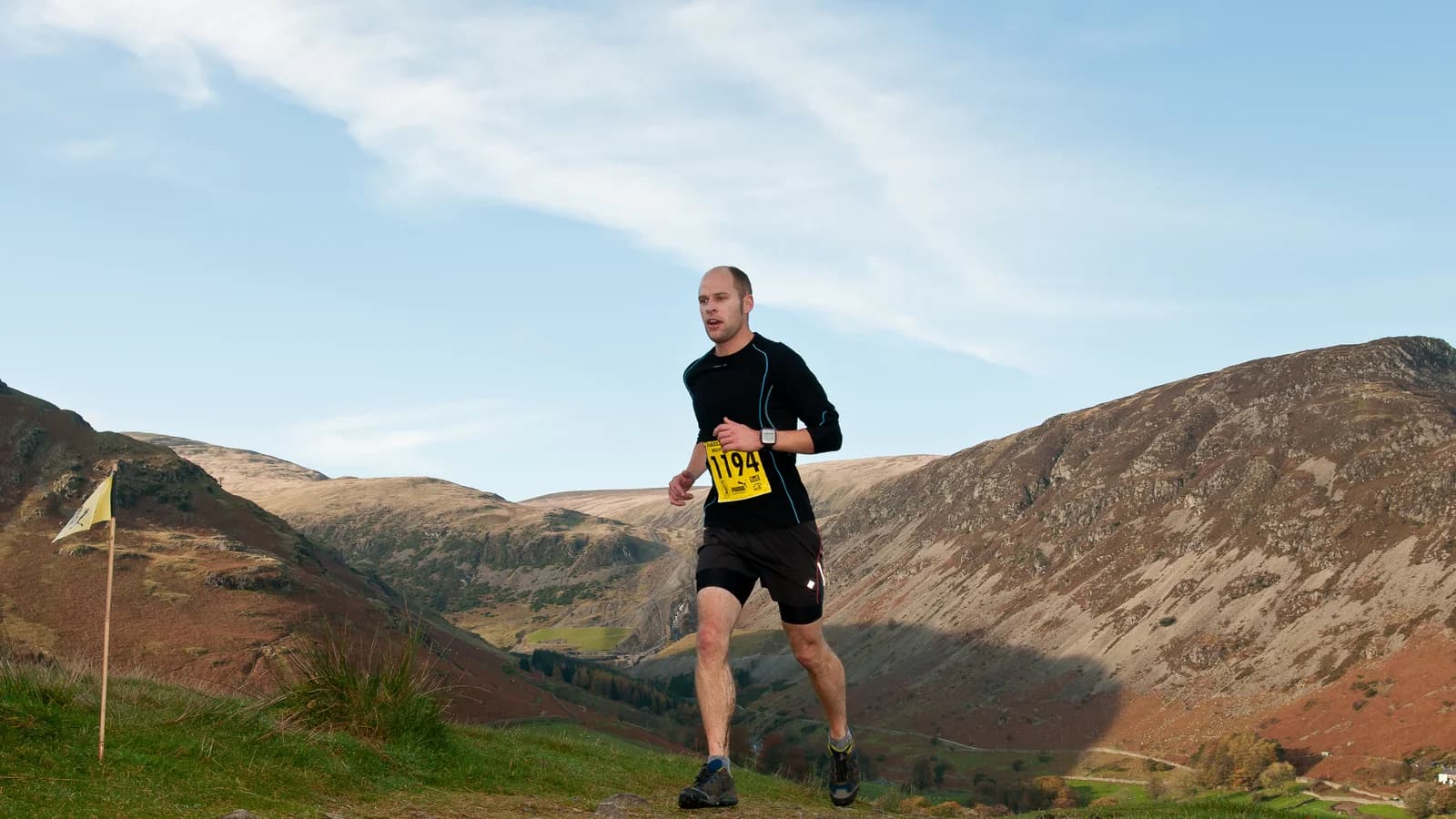
Endurance & fitness · Outdoor & adventure
Trail running
Trail running is usually explained as running on trails, which is true and useless. What defines it is that the ground stops being predictable, and the consequences of that are larger than they sound: pace becomes meaningless as a measure, footing becomes a continuous task that costs attention as well as effort, and almost everything a road runner has learned about judging effort stops transferring. This page is about that shift — what changes and what does not, what the surfaces actually demand, how the sport divides, and where the line sits with fell running, which is a different thing that this catalogue publishes separately. It carries no training programme and no route.
Also known as off-road running, ultra running, trail racing, running off-road.
Trail running is running where the ground is not predictable. That definition does more work than the usual one — running on trails — because the unpredictability is what changes the sport rather than the scenery.
The first consequence is that pace stops being the measure. On a road, minutes per kilometre describe effort well enough to train by. Off-road they describe the ground instead: the same effort produces wildly different numbers on a towpath, a rooty wood and a boggy moor, and a runner who keeps checking their watch is reading a number about the terrain and mistaking it for a number about themselves. Trail runners talk in hours and in effort, and it is the first habit to break.
The second is that footing is a task. Choosing where each foot lands, continuously, for hours, costs attention as well as energy, and it is why a trail run leaves people tired in a way the distance does not explain. It also improves markedly with practice, which is the part beginners do not expect — most of the early gain in this sport is in confidence over ground rather than in fitness.
The third is that walking is technique rather than failure. Above a certain gradient, walking is faster and cheaper than running for almost everybody, including the people winning. Arriving from road running, where walking means the wheels came off, is the mental adjustment that takes longest.
- What defines it
- Unpredictable ground
- Not the measure
- Pace
- Not failure
- Walking the climbs
- Cheapest real start
- The shoes you own
- Where it stops
- Fell running has its own page
- More technical, before longer — Confidence over difficult ground is the skill that unlocks everything and it improves with exposure rather than with fitness. Adding technicality to short runs beats adding distance to easy ones.
- A first marked race — Short. It teaches the format, the etiquette and the checkpoint system with the navigation handled, and it is where most people meet the community.
- Learn to navigate — The step that converts waymarked routes into open country, and the point at which the map stops being ballast. Orienteering is where this catalogue sends people for it.
- Then distance, and eating — Beyond about three hours the limiting problem stops being legs and starts being fuelling and problem-solving. It is a genuinely different skill and it is learnt by doing long slow days.
- Or sideways rather than longer — Fastpacking, fell running, orienteering, swimrun. The sport branches as readily as it extends, and treating an ultra as the only progression is how people burn out of it.
- Volunteer at a race — Marshalling one event teaches more about how the sport works — and about what runners actually look like at hour six — than a season of running them.
- Go deeper — Easy running, and why almost everyone does it too fast
- Go deeper — The long run: what it is actually for
- Go deeper — Intervals, reps and threshold: reading a session
- Go deeper — Pacing: why going out fast fails
Step 1: Go in the shoes you own, on easy ground
A towpath, a railway path or a park trail. The point is to find out what changes about running off-road before spending anything, and on firm ground the answer is: less than you expect.
Step 2: Put the watch away, or at least stop reading it
The single most useful adjustment. Run for time rather than distance and judge by effort, because pace off-road is a number about the ground. This is also what stops the first technical run feeling like a failure.
Step 3: Walk the climbs deliberately, from the first run
Practise it as a technique rather than resorting to it. Learning to switch cleanly between running and walking without treating it as a defeat is what makes longer and hillier runs possible.
Step 4: Find a group
Trail groups run at the pace of the slowest far more readily than road clubs, because pace is incomparable anyway. It is also how you learn local routes, which is the knowledge that takes longest to acquire alone.
Step 5: Add technical ground gradually
Roots, rocks and mud, on shorter runs, when you are fresh. Confidence over ground improves quickly with exposure and badly with fatigue, so the worst time to meet difficult terrain is at the end of a long run.
Step 6: Buy trail shoes when you slip
Not before. The moment you are sliding on wet grass or losing your footing in mud, they will fix it. Until then they are solving a problem you do not have.
Step 7: Enter a marked race
A short trail race handles navigation, marshalling and safety for you, introduces the whole scene in one morning, and removes the intimidation. It is the standard route in and it is genuinely friendly.
- Go deeper — Your first weeks of running
- Shoes — The one thing that matters, and only for the ground you are on. Aggressive lugs grip mud and feel awful on hard surfaces; a light trail shoe covers most British running. Rock plates protect against stones underfoot, which is the thing people discover they wanted after a long stony descent.
- A waterproof that a race organiser would accept — Taped seams and a hood. Events specify this precisely and it is a good specification to buy against, because it is the one designed for standing still in weather rather than for looking outdoorsy.
- A running vest — Necessary somewhere around two hours, because there are no taps. Soft flasks over a bladder for most people, and the fit matters more than the capacity — a vest that bounces will end a run.
- A head torch — The item most often bought too cheap. On technical ground in the dark, brightness and beam shape decide whether you can run at all, and it is what opens the British winter.
- Gaiters — Small, cheap and disproportionately effective at keeping grit and mud out of shoes on rough ground. Almost nobody buys them early and almost everybody eventually does.
- Poles — Genuinely useful on sustained steep ascent and on long descents, and normal at ultra distance. Banned or restricted in some races, so worth checking rather than assuming.
- A map and the ability to use it — Equipment on unmarked ground and dead weight on a waymarked route. Knowing which situation you are in is the actual skill.
- What to ignore — Compression everything, and a watch with more metrics. Neither addresses what makes trail running hard, and the second actively encourages the habit this page is trying to break.
- Go deeper — Choosing running shoes
- Go deeper — What to wear to run in heat, cold and rain
- Work it out — Race pace and split planner
- Work it out — Running pace calculator
- Work it out — Run/walk session planner
- Tell somebody, and be specific — Route and expected return time, to a person rather than to a social feed. The cheapest and most effective single thing available, and the one most often skipped precisely on the runs where it matters.
- Carry more than you think you need, once it is remote — A layer, a charged phone, something to eat, and enough water for the fact that there are no taps. The threshold at which this stops being fussy is lower than it feels — a stopped runner in wet British hill weather cools very fast.
- Daylight is a planning constraint, not a preference — Technical ground in the dark is a different proposition and a dim torch makes it worse. Budget for finishing before dark, and carry a torch anyway if it is close.
- Ankles, and looking ahead — The characteristic injury, caused by uneven ground and tired feet late in a run. The habit that helps most is scanning several strides ahead rather than watching your feet, because you cannot react to what you are already on.
- Navigation, where routes are not marked — Much of British trail running is on waymarked routes and needs none. Once it is not, navigation is a real skill with its own learning, and orienteering is where this catalogue says to learn it — the same pointer the fell running page makes.
- Livestock, dogs and gates — The mundane hazards that actually cause incidents. Cattle with calves are the serious one; slow down, give space, and do not run through a field of them because a route says to.
- Where this becomes fell running — Unmarked ground, serious ascent, mountain weather. That is a different discipline with its own governing body, its own mandatory kit rules and its own page here — and its safety guidance is written for it rather than adapted from this.
- Technical
- Ground that demands foot placement — roots, rocks, steps, loose surface. Nothing to do with difficulty of navigation or of effort, and the word beginners most often misread.
- Runnable
- A section you can actually run rather than walk. Used as the practical unit of a route description, because distance alone says nothing.
- Vert
- Total ascent over a route. The number that predicts how long something takes far better than distance does.
- Power hiking
- Walking climbs deliberately and efficiently, often with hands on knees. A trained technique rather than a fallback.
- Ultra
- Anything beyond marathon distance; in practice 50km upwards. A distance category, not a level of skill.
- Mandatory kit
- Equipment a race requires you to carry and may check. Common in longer and hillier events and enforced seriously.
- Checkpoint and cut-off
- Points on a course with a time by which you must pass. The structure that makes long races safe to run.
- Lugs
- The raised studs on a trail shoe sole. Deep for mud, shallow for firm ground, and the main thing that differentiates trail shoes from each other.
- Rock plate
- A stiff insert protecting the foot from stones underfoot. Invisible until the first long stony descent, then obvious.
- FKT
- Fastest known time — an unofficial record on a named route, self-reported to a public register. The sport’s alternative to racing.
- Go deeper — The words runners use
What the rules actually are, and who sets them
Almost nobody trail runs under rules until they enter a race. When they do, the rules are mostly the organiser’s — and one of them is the reason trail is not simply fell running for beginners.
- The course is marked, and that is a rule rather than a courtesy — UK Athletics Rule 7.1 is unambiguous: "All courses must be marked in such a way that no navigation skills are required by the athlete, and that the route is easy to follow at all times by the fastest runners." That single sentence is the formal difference between trail and fell, whose governing body takes the opposite position on the same question and says that finding the route is part of the sport. Neither is an easier version of the other; they are two disciplines that have decided the navigation question differently.
- Mandatory kit is set per race, not by the sport — There is no standing kit list in trail running as there is in fell. Rule 7.3 gives the organiser the power instead: they "may recommend or impose mandatory equipment, such as minimum clothing, wind jackets, headlamps, water, food, etc., due to the conditions expected to be encountered during the race". So the kit list arrives with the race instructions and varies between two events on the same weekend, and the only reliable habit is to read the specific regulations for the specific race.
- What a race must publish before you enter — Rule 7.4 lists it: who is responsible and how to reach them in an emergency, start times and "any cut off times", total distance and ascent, a map and profile, the course marking criteria, where the aid stations are and what is at them, the rules on outside help "including personal support at aid stations and via running pacers", the safety rules, and the penalties. A race that publishes none of this is not necessarily a bad race, but it is one you are entering on trust rather than on information.
- The three ways to be disqualified — Rule 7.6: leaving the marked course "thereby shortening the distance to be covered"; receiving "any form of assistance such as pacing (unless the race explicitly allows this), or refreshments outside of the official aid stations"; and failing to comply with the race’s own published regulations. The middle one catches well-meaning friends and family more often than it catches cheats.
- A licence, and what it does and does not mean — Under UK Athletics rules the management of trail running is delegated to the Trail Running Association, and a race organiser "must obtain a UK Athletics race licence". But the TRA states plainly that "there is no legal requirement for a race to have a licence" — what a licence does is demonstrate "to competitors and insurers that the race is promoted to governing body standards". Plenty of good unlicensed trail races exist. The thing worth knowing is that at one of them, the rules above are not automatically in force.
- Two rules that surprise people arriving from informal running — Age limits apply by race distance and the TRA requires them to be on the event website. And UK Athletics rules do not permit running with dogs — which is a genuine shock at a licensed race for anybody whose entire trail running life so far has been with one.
- How races are compared: km-effort — Distance alone describes a trail race badly, so the sport uses a combined figure. The rules reproduce the ITRA calculation: each kilometre counts as one km-effort and each 100m of ascent counts as one more, so "a race of 65km and 3500m of elevation gain is: 65 + 3500/100 = 100 km effort". Races are then banded into difficulty points from 0 to 6. It is the most useful single number for working out whether a race you have not run is like one you have.
- The 25% tarmac limit, and where it does not apply — The international rule allows paved sections only "as a way to reach or link the trails of the course", capped at 25% of the total length. UK Athletics attaches a note to it saying it "does not apply to UK Domestic Trail Competitions". So the figure is real, it is quotable, and it is not a promise about the local race you are looking at.
Sources for this section
- UK Athletics Competition and Technical Rules for use in the UK, 1 April 2026 (opens in a new tab) — UK Athletics · Governing body · read — supports the claim
- Trail Running Association — Race organisers’ FAQ (opens in a new tab) — Trail Running Association · Governing body · read — supports the claim
- Towpaths, railway paths and park trails — Flat, firm, often surfaced, frequently step-free. The most accessible end of the sport and the largest by participation. Road shoes work, navigation is unnecessary, and this is where almost everybody should start.
- Woodland and bridleway — The British default. Roots, mud, gates and seasonal transformation — the same route is a different run in February. Where trail shoes start to earn their place.
- Coastal paths — Relentless small ascent, exposure to weather, and views that make people forget how far they have gone. Often waymarked, frequently more demanding than the profile suggests.
- Moor and open hill — Where trail running meets fell running. Ground stops being a path, navigation becomes real, and the FRA-governed racing sits here rather than in trail running proper.
- Trail racing — Marked and marshalled events from 10km upwards, with checkpoints and often mandatory kit. A big and welcoming British scene, and the easiest route into the sport because the navigation and the safety are handled.
- Ultra distance — Beyond marathon, in practice 50km and up. Strongly associated with trail running and genuinely a different problem — eating, walking, and managing hours rather than running faster. Not a ladder every trail runner is on.
- Skyrunning and mountain running — The steep, high, technical end, with its own international structures. Small in Britain and mostly reached through fell running.
- Fastpacking and multi-day — Carrying what you need and running between nights out. Published here as its own subject, because the weight problem changes the activity rather than extending it.
- Backyard and timed formats — Looped events run to a clock rather than a distance. A curious and growing branch where the challenge is attritional and psychological rather than terrain-based.
- Still deciding — Trail running vs fell running
Most trail running problems in the first year are a road habit meeting different ground, and they present as fitness problems rather than as what they are. The symptoms below separate the ones that are a surface, the ones that are kit, and the two that are a boundary this page does not cross.
- My pace has collapsed and I feel unfit — Almost always the surface rather than you. Soft ground, climbing, descending and route-finding all cost time, and none of it shows up as effort you can feel. Check the elevation and the surface of the run against a road run of the same distance. Next, stop comparing pace between surfaces at all — time on feet is the number that transfers, and pace on trails is a comparison with yourself on the same route.
- I am trashed after a run that should have been easy — Likely the descents. Downhill running is eccentric loading and it produces soreness out of proportion to how easy it felt at the time. Check whether the soreness is quads rather than calves, and whether it arrived a day late. Next, treat descending as training load rather than as the free part of the run, and build it in gradually the way you would build mileage.
- I keep tripping — Likely where you are looking. Watching your feet feels safer and removes your ability to react, because you are reading ground you are already on. Check where your eyes are on rough ground — the fix is several strides ahead, and it is uncomfortable at first. Next, practise deliberately on ground that is rough but not consequential. If tripping continues on easy ground, that is worth a conversation with somebody about gait rather than more practice.
- My feet are wrecked and my shoes feel wrong — Likely the shoe against the ground rather than the shoe. Aggressive lugs on hard-packed trail are uncomfortable and do nothing; a road-ish shoe in mud is a different problem entirely. Check what you actually run on most weeks rather than what you aspire to run on. Next, match the shoe to that. If the problem is hot spots and blisters rather than grip, the variable is usually sock and fit, and it is cheaper to change first.
- I keep getting cold on longer runs — Likely pace variation rather than temperature. Trail running alternates hard climbing with slow, wet descending and walking, and the clothing that works at road pace does not work when your pace halves. Check whether you get cold on the descents and in the last hour. Next, carry a layer you do not intend to wear. On exposed ground this stops being comfort and starts being the reason races have compulsory kit.
- I got lost, or ran much longer than planned — A planning problem, and the one with real consequences. Trail navigation errors compound: an extra hour is also an extra hour of light, food and weather. Check whether you left with a route you could follow without a phone. Next, plan for the run taking substantially longer than the distance suggests, and carry the means to navigate if the phone dies. This page publishes no route and makes no judgement about any particular ground.
- Something hurts in a specific place, run after run — A boundary rather than a symptom. Repeated, localised pain that turns up in the same spot is not something a hobby page can diagnose, and the honest advice is not to keep running through it while reading about it. Next, a physiotherapist or a GP. Nothing on this page is a substitute for that.
- Go deeper — The things that go wrong when you start running
- Expecting road paces to transfer — They do not, and the shortfall feels like a loss of fitness rather than a change of surface. It is the commonest reason people conclude they are bad at this after one run.
- Refusing to walk — Running a climb that everybody faster than you is walking. Expensive, slower overall, and the habit that most limits progress to longer distances.
- Watching your feet — It feels safer and causes more trips, because you cannot react to ground you are already standing on. Looking several strides ahead is the fix and it takes deliberate practice.
- Buying aggressive shoes for firm trails — Big lugs on hard-packed ground are uncomfortable and pointless. Match the shoe to the ground you actually run on rather than to the ground in the photographs.
- Underestimating time — A ten-mile trail run is not a ten-mile road run plus a bit. Planning by distance rather than by expected time is how people end up finishing in the dark.
- Carrying nothing because it is only an hour — Fine on a towpath, and the reasoning does not survive being applied unchanged to a hill.
- Jumping straight to an ultra — The sport is marketed at its extreme end and most of it is not that. A 10km trail race teaches everything about the surface; the distance is a separate problem to add later if you want it.
- Assuming trail means fell — Turning up to an unmarked mountain race with a waymarked-trail mindset and no navigation. Different discipline, different rules, and its own page here.
Trail courtesy, and what a race expects of you
Trail running borrows its etiquette from two places at once — the hills, where you are a guest, and racing, where you are one of several hundred people using a single path.
On an ordinary run:
- You are the fastest thing on the path and it is your problem — Walkers, dogs and horses do not hear you coming and should not have to. Slow down, call out early and gently from a distance, thank people, and pass wide. A runner appearing silently at somebody’s shoulder is the single commonest complaint about the sport.
- Horses get special treatment — Slow to a walk, speak so the horse hears a human voice rather than seeing a moving shape, and wait to be waved past. A startled horse is a genuine danger to its rider.
- Stay on the line, even when it is a puddle — Running round a wet or eroded section widens the path permanently. The convention on any maintained trail is straight through the middle, and the shoes exist for exactly this.
- Gates as you found them, gels in your pocket — The two things that lose access. A gel wrapper on a hillside is the most recognisable litter in the outdoors and it is unmistakably a runner’s.
In a race, where the conventions are firmer:
- Kit checks are not bureaucracy and nobody argues at the start line — Mandatory kit lists exist because the weather on a hill changes faster than a field of runners can get off it. Arriving without something on the list means not starting, and the marshal doing the checking will not negotiate. Carry it, do not just own it.
- Say your number at every checkpoint, clearly — Checkpoints are how a race knows who is still on the hill. Running through without being recorded starts a search.
- Retiring is something you do formally — If you stop, you tell the organisers — at a checkpoint, at the finish, by whatever number is on the race instructions. Going back to your car and driving home is how mountain rescue ends up out at midnight.
- You help, and the clock does not matter — The strongest norm in the sport. A runner who stops for somebody in trouble is doing the right thing, every race’s rules say so, and no result is worth more than that. Nobody has ever been thought less of for a slow time explained by an hour spent with an injured stranger.
- Yield to the faster runner on a single track, and say so — "Runner behind" from them, a step aside and a "go on" from you. Both halves are the convention; neither is an insult.
People have run off-road for as long as people have run, and Britain in particular has an unbroken tradition of it: fell racing has been contested in the north of England and in Scotland for well over a century, and cross country has been a codified competitive sport since the nineteenth century. Neither called itself trail running.
The name arrived from elsewhere, largely from the United States and continental Europe, and with it came a different emphasis — long distances on waymarked routes, an ultra culture, and a commercial apparatus of events and equipment that British off-road running had never had. That is why the vocabulary of the sport feels imported even though the activity does not.
What actually changed the shape of it in Britain was the growth of organised trail events from the 2000s onwards. Marked, marshalled races on rights of way made off-road running accessible to people who would never have entered a fell race and did not want to learn navigation first, and that is the sport most people now mean by the term. The older traditions did not go anywhere, which is why the boundary between trail running and fell running is a genuine question here rather than a marketing one.
- How is this different from road running?
- The surface is unpredictable, and everything follows from that. Pace stops being a useful measure — a nine-minute mile on a towpath and a nine-minute mile up a rooty climb are not comparable efforts, so trail runners talk in time and effort rather than in pace. Footing takes continuous attention, which is tiring in a way that does not show up in any metric. And the pace variation is enforced rather than chosen: you walk the steep bits, and walking is not failure but technique.
- Is trail running the same as fell running?
- No, and this catalogue publishes them separately. Fell running is defined by ascent and by largely unmarked ground where navigation is the runner’s responsibility — it has its own governing body, its own race categories and its own mandatory kit rules. Trail running is defined by surface, and a great deal of it happens on marked, waymarked or fully signed routes with no navigation demand at all. The two overlap in the middle, and the useful rule is that if the route is unmarked and the ascent is the point, you are in fell running’s territory and its page is the one to read.
- Do I need trail shoes?
- Only when the ground demands them. On firm, dry, well-surfaced trails, road shoes are fine and many people run happily in them for years. What trail shoes buy is grip in mud and on wet rock, some protection from stones underfoot, and a more secure fit on cambered ground. If you are slipping, they will fix it; if you are not, they will not make you faster. Buying them before you have found out which is the commonest early purchase in this sport.
- How do I pace an off-road race?
- By effort and by feel rather than by the watch, which is the hardest adjustment for anybody arriving from the road. A trail race has no consistent pace to hold, so the useful discipline is running the climbs conservatively — walking them without guilt — and spending the effort on the descents and the runnable sections. This page publishes no target paces, no heart-rate zones and no training plan, for the same reason no other endurance subject here does: those are individual and belong with a coach.
- What is an ultra, and do I need to want one?
- Conventionally anything beyond marathon distance, which in practice means 50km upwards. Trail running and ultra running are heavily associated, and it is worth saying plainly that they are not the same thing — most trail runners never run one, and the sport is not a ladder with an ultra at the top. If you do want one, the transition is far more about eating, walking and problem-solving over many hours than about running faster.
- Is it safe to run alone?
- It depends entirely on where, and the honest answer is that the risk changes enormously across the same sport. A towpath loop from your door is unremarkable. A solo run in remote hill country in winter is a different activity with a different set of consequences, and the things that make it manageable are ordinary rather than heroic: tell somebody your route and return time, carry a charged phone and a layer, and be conservative about weather and daylight. There is no route-specific advice on this page and no judgement about whether any particular run is a reasonable one.
- What happens when I turn an ankle?
- It is the characteristic injury of the sport and it is worth being unromantic about. Uneven ground and tired feet late in a run are the combination, and the single most useful preventive habit is looking further ahead rather than at your feet — you cannot react to what you are already standing on. Anything beyond a mild twist is a medical question rather than something a page can assess, and continuing to run on an ankle that will not take weight is how a week becomes a season.
Guides
Longer answers to questions this page can only summarise.
If you like this
Each of these is here for a stated reason, not because it is also a hobby.
Easier way in
- Fastpacking — The pace half without the overnight, on marked courses with aid stations. Where most fastpackers come from.
Progresses to
- Hiking — The same ground, covered faster and with far less in the pack. Navigation and route judgement transfer completely; the descending technique does not.
- Orienteering — Orienteers who want to race harder over the same ground without the navigation load; the fitness transfers completely.
- Running — The same aerobic base taken off-road, where pace stops mattering and effort takes over. The commonest destination for road runners who plateau.
Similar to
- Fell running — The near neighbour and the commonest route in. Trail races are marked and fell races are largely not, which is the whole difference.
- Half marathon — The same endurance base on ground where the clock stops meaning anything, and a common landing place for runners who have finished chasing a number on the road.
- Marathon running — The same endurance base pointed at ground where pace stops meaning anything. Marathoners who tire of chasing a number tend to end up here, and the transition costs nothing but a pair of shoes.
Goes well with
- Wild camping — The natural pairing once runs get long enough to want a night out in the middle, and the step before fastpacking proper.
Substantial
Last reviewed 2026-08-19. Cost, time and difficulty figures on this page are HobbyHQ estimates — see how we work. Something here wrong or out of date? Tell us.