Outdoor & adventure · Endurance & fitness
Wild camping
Most writing about wild camping is about equipment. The equipment is the easy part: the questions that actually decide whether a night out works are where you are allowed to be, where the water is, and what happens if the weather turns at two in the morning. The legal position in particular is genuinely different in Scotland, in England and Wales, and on Dartmoor, and a great deal of published advice treats Britain as one place.
Also known as backpacking, bivvying, stealth camping, camping wild, backcountry camping.
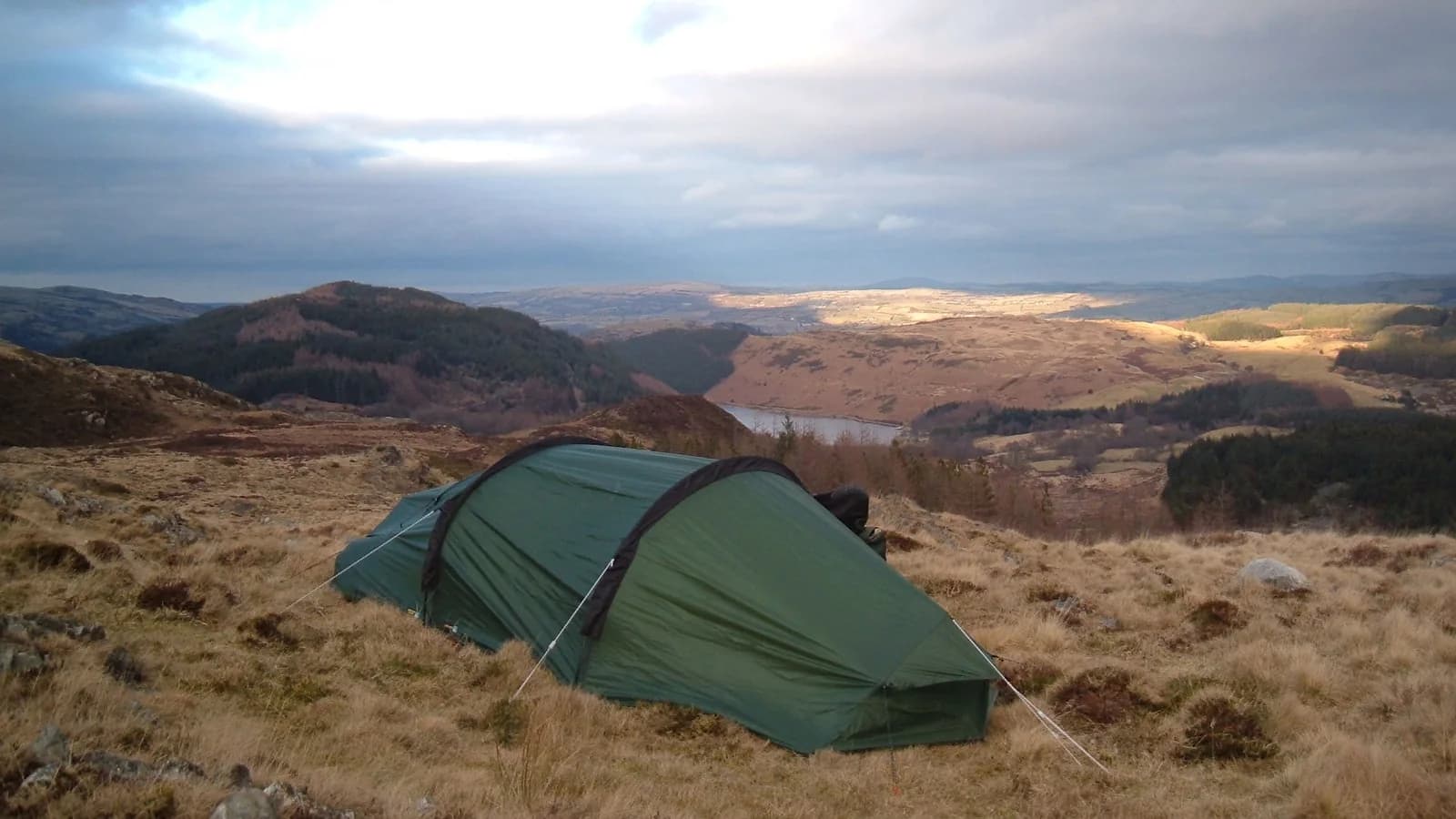
Wild camping means pitching for a night in open country rather than at a site — no facilities, no booking, no neighbours, and nothing left behind in the morning. In practice it is usually an adjunct to walking: it turns a day route into a two-day one, puts you on a summit at sunrise, and removes the drive home from the end of a long day.
It is worth separating from two things it is confused with. Campsite camping is a different activity with the same equipment and almost none of the same considerations. Bivvying — sleeping in a waterproof bag with no tent — is a distinct discipline with a much smaller pack, a much better view and a considerably worse night in rain. The middle ground, a tarp, has enthusiasts who will explain at length that it is the best of both.
What people are usually surprised by is how much of the skill is site selection rather than equipment. A sheltered, level, well-drained pitch with water nearby makes an ordinary tent comfortable; an exposed, sloping, boggy one makes an expensive tent miserable. That judgement takes a few nights to acquire and no amount of reading substitutes for it.
- Where it is a statutory right
- Scotland, under access legislation
- Where it is a right in England
- Dartmoor commons, and there aloneConfirmed by the Supreme Court in May 2025.
- The purchase that matters most
- The sleeping matThe ground takes more heat out of you than the air does.
- What decides the night
- Where you pitch, not what you pitch
- Still deciding — Bikepacking vs wild camping
- One night, close to the car, in summer — The whole activity in miniature, and enough to tell you whether you like it.
- A two-day route with a camp in the middle — Where wild camping stops being an end in itself and becomes the thing that makes a route possible.
- Multi-day, with resupply — Long-distance walking with the accommodation problem solved. Food planning becomes the constraint rather than fitness.
- Shoulder-season and winter — A different activity in the same clothes. Longer nights, a much larger equipment requirement, and consequences that scale accordingly.
- Bothies and bivvies — Sideways moves rather than upward ones — less equipment, more exposure, and for a lot of people the version they end up preferring.
Step 1: Pick somewhere with an escape route
A first pitch within an hour of a car, in settled summer weather, on ground you have walked before. The point of the first night is to find out what your equipment does, not to have an adventure.
You will know it worked when: A bad night ends in the car rather than at three in the morning on a hill.
Step 2: Sleep in the tent in a garden first
Genuinely. You will discover the missing peg, the mat that deflates and the bag that is colder than advertised somewhere it does not matter.
You will know it worked when: The equipment failures happen at home.
Step 3: Check the forecast, and then the mountain forecast
The general forecast is for the valley. Wind speed at height is the number that decides whether a pitch is survivable, and it is routinely double what the lowland figure suggests.
You will know it worked when: You know what the night will actually be.
Step 4: Walk in with time to choose a pitch in daylight
Level, drained, sheltered from the prevailing wind, near water, away from the path. Finding all five in the dark is much harder, and the compromise you accept at dusk is one you sleep on all night.
You will know it worked when: A good pitch rather than the first flat thing.
Step 5: Tell somebody where you are going and when you are back
Route, pitch area, expected return. In Britain this is the single most useful safety measure available and it costs one message.
You will know it worked when: Somebody knows where to start looking.
Step 6: Get up and go
Pack at first light, check the ground for anything dropped, and leave nothing at all. The pitch should not be identifiable an hour later.
You will know it worked when: The access other people rely on survives your visit.
- Go deeper — Planning a first bikepacking overnighter
- Sleeping mat — First, and it surprises everybody. Conduction into the ground removes far more heat than the air does, and a warm bag on a thin mat will still be a cold night. Mats carry an R-value; higher is warmer, and anything below about 3 is a summer mat.
- Sleeping bag — Rated for the season you will actually use, not the season you aspire to. Down is lighter and warmer for its weight and useless when wet; synthetic is heavier and forgiving. Ratings are optimistic, and the "comfort" figure is the honest one rather than the "limit".
- Tent — Wind resistance matters more than waterproofing in British hills — everything sold is waterproof and not everything sold stays up. A freestanding or semi-freestanding design pitches on ground where pegs will not hold.
- Stove and pot — Gas is simplest and loses performance in cold. A meal and a hot drink at the end of a wet day is worth more than its weight, and the psychological effect is not a small thing.
- Water and a means of treating it — Hill water is usually fine and is not guaranteed to be. A filter or tablets weigh almost nothing. Check upstream for livestock, and prefer moving water to standing.
- Head torch, plus a spare light — Pitching in the dark is normal. Doing it while holding a phone is not.
- Warm layer that is not your walking layer — You stop moving, you get cold, and the layer you walked in is damp. A dry insulated jacket kept in the pack is the difference between an evening and an endurance.
- Map and compass, and the ability to use them — A phone is an excellent navigation tool and a poor sole one — cold flattens batteries fast, and it is a single point of failure in the one situation where you need it.
Weight compounds in a way that is easy to underestimate. Ten kilograms is a pleasant walk in; fifteen is work; twenty turns a good route into an endurance event and is how people conclude they dislike an activity they would enjoy. The usual advice is to weigh everything once and be honest about what earned its place, and the usual result is that the savings come from the things you brought in case rather than from buying lighter versions of the things you use.
- Work it out — Base weight calculator
Britain has three different answers to this question and they are genuinely different, not variations in enforcement. Almost every article that says "wild camping is technically illegal but nobody minds" is describing one of the three and generalising it to the others.
What "responsibly" means in practice, everywhere, and what the Countryside Code asks:
- Arrive late, leave early — Pitch at dusk and be gone soon after dawn. A tent that is up all afternoon is a camp rather than a night out, and it is what generates complaints and byelaws.
- Small groups, small tents — One or two tents. A group of eight is a different proposition and is where tolerance ends.
- Well away from buildings and roads — Out of sight of houses and off the enclosed farmland. High ground and open country, not a field with a gate.
- No fires — Fire damages the ground for years and on peat can burn underground for weeks. Use a stove, and be careful with it in dry conditions.
- Take everything out — Everything, including food waste, which does not decompose usefully on a hillside and does attract animals.
- Toilet properly — Well away from water and paths, buried, and paper carried out. This is the single commonest failure and the one most likely to lose access for everybody.
- If asked to move, move — Politely and immediately. Almost every access restriction in Britain exists because enough people did not.
Sources for this section
- The Countryside Code (opens in a new tab) — Natural England and Natural Resources Wales · Governing body · read — supports the claim
The other things that go wrong, in rough order of how often:
- The wind gets up — Wind, not rain, is what destroys tents and nights in Britain. A pitch that is fine at nine is untenable at two, and the judgement to make is whether to re-pitch lower or to walk out — both at night, both unpleasant, and the second is often correct.
- Water where you pitched — Flat ground in hills is usually flat because water collects there. A dry hollow in the evening is a puddle after four hours of rain.
- The phone is dead — Cold drains batteries far faster than expected. Keep it warm, carry a battery pack, and do not let it be the only map or the only torch.
- Livestock and dogs — Cattle are the genuine hazard in British open country, particularly with a dog present. Give them room, and let a dog off the lead rather than being pulled through a herd.
- Ticks — Widespread in bracken and long grass, and worth a check morning and evening. Remove promptly with a proper tool rather than fingers.
- Getting the forecast wrong by a day — The commonest planning failure. Settled weather that arrives on Sunday is no use to a Saturday night, and the willingness to postpone is the most underrated skill in the activity.
- Bivvyalso: bivi, bivouac
- Sleeping in a waterproof bag without a tent. Lighter, faster, better view, considerably worse in rain.
- Bothy
- A simple unlocked shelter, mostly in Scotland and northern England, maintained by volunteers and free to use.
- R-value
- A sleeping mat’s resistance to heat loss into the ground. Higher is warmer; below about 3 is a summer mat.
- Comfort rating
- The temperature at which a sleeping bag is comfortable, as opposed to the "limit" rating, which means survivable.
- Pitch
- Both the act of putting the tent up and the piece of ground you put it on. Choosing one well is the central skill.
- Leave no trace
- The principle that the site should be indistinguishable from unvisited ground after you go.
- Wild pitch
- A camp away from any site or facility. The activity, in two words.
- Base weight
- Pack weight excluding food, water and fuel — the figure that is actually comparable between trips.
- Escape route
- A planned way off the hill that is shorter or lower than the route in. Decided before you need it.
Wild camping fails in a small number of predictable ways, and almost all of them are decided before dark. Where you pitch, when you stop, and what you put between yourself and the ground account for most bad nights; the weather usually gets the blame.
- You are cold from below rather than above — The commonest first-night discovery, and it is the mat rather than the sleeping bag. Ground conducts heat away far faster than air does, and a warm bag on a thin mat is cold. If you are cold and have spare clothing, putting it under you does more than wearing it.
- Everything inside is wet and it did not rain — Condensation. A person puts out a surprising amount of moisture overnight and a sealed tent has nowhere to send it. Ventilation is the answer even when it feels wrong to open a vent in the cold, and pitching away from the bottom of a hollow or the edge of water helps a great deal.
- You are still looking for a pitch at dusk — The decision that spoils most nights. Flat, dry, sheltered ground is much rarer than a map suggests, and by the time you can no longer see you will take whatever you are standing on. Start looking a full hour before you need to and accept the second-best option early.
- The tent is being flattened by wind — Almost always the pitch rather than the tent. A slight dip, the lee of a wall, or simply turning the low end into the wind changes the loading enormously. If it is getting worse rather than gusting, taking the tent down and moving in the dark is unpleasant and is better than the alternative.
- Water is coming under the groundsheet — You are in a watercourse that is not obvious when dry. Slight hollows, flattened grass in lines, and any ground with rushes on it are all telling you where water goes. Moving a few metres to a convex rather than a concave piece of ground fixes it.
- Midges make the evening unbearable — Seasonal, regional and genuinely serious in the Scottish Highlands from about June. Wind and altitude both help, still damp air near water is the worst case, and a head net weighs almost nothing. This is a reason to choose a pitch rather than a reason to abandon a trip.
- You did not sleep at all — Very normal on a first wild camp and it improves. Unfamiliar noise, being cold, and being alert to being somewhere you feel you should not be all contribute. Plan the following day as though you have not slept, because you may not have.
- Somebody has asked you to move — It happens, and the answer is to be polite and to move. Arriving late, leaving early and being out of sight prevent nearly all of these conversations, and the position on where wild camping is and is not permitted differs across the UK — the access section on this page covers it and it is worth knowing before you go rather than while somebody is standing over you.
- You cannot find water — Plan the pitch around water rather than hoping. Streams marked on a map are seasonal on high ground and can be dry in summer, and carrying an extra litre up the last climb is easier than descending in the evening to look.
- Buying the tent first — The mat and the bag decide whether you sleep. The tent decides whether you stay dry, which matters less than people expect on a first night in settled weather.
- Carrying far too much — The first pack is always heaviest. Almost all of the excess is contingency equipment for scenarios that a sensible choice of night removes entirely.
- Pitching too high and too exposed — The summit view costs you the wind. Fifty metres down and behind something is a different night.
- Trusting a sleeping bag’s headline rating — The number on the packaging is usually the "limit" figure, which means survivable rather than comfortable. Look for the comfort rating and assume you sleep colder than the average.
- Arriving in the dark on the first attempt — Site selection is the skill, and you cannot exercise it without light.
- Assuming the Scottish position applies everywhere — It does not, and this is the misunderstanding most likely to result in an awkward conversation with a landowner.
- A fire — Almost always the wrong call, frequently damaging, and the single fastest way to turn tolerated access into a byelaw.
The access position in Britain is unusually contingent, and the etiquette exists because of that rather than out of politeness. In England and Wales most wild camping happens on a tolerance rather than a right, and a tolerance is withdrawn when it is abused. In Scotland the right is statutory, and the seasonal byelaws that now cover some popular areas are a direct response to what happened when large numbers of people arrived and behaved badly. The pattern is the same in both: the reason a rule exists is almost always a specific place where the informal version stopped working.
That is worth stating plainly because it changes what the advice is for. "Arrive late, leave early, take everything out" is not a code of personal virtue — it is the maintenance cost of an arrangement that the next person also depends on. The photograph of a tent pitched at midday beside a loch, with a fire, is doing measurable damage to something the person taking it wants to keep.
The counterpart is that the culture is unusually welcoming to newcomers who ask. Access campaigning organisations, mountaineering councils and the online communities are all consistently generous about where is reasonable, what the local position is, and what a first night should look like — considerably more so than the equipment forums are about equipment.
Sleeping outdoors is not a hobby that was invented; what has a history is the legal apparatus that made it a question. British open country was progressively enclosed into private ownership over several centuries, and the twentieth-century access movement — of which the 1932 mass trespass on Kinder Scout is the most cited episode — was a response to that. The subsequent legislation created national parks and, eventually, rights of access on foot.
The pattern worth noticing is that those rights were consistently written as rights to *walk*. Scotland took a different route in 2003, establishing a broad right of responsible access rather than a schedule of permitted activities, which is why the Scottish position on camping is different in kind and not merely in degree. England and Wales kept the narrower framing, which is what leaves wild camping there as a trespass that is usually tolerated.
Dartmoor is the anomaly and the recent one. The Dartmoor Commons Act 1985 granted a right of access to the commons "for the purpose of open-air recreation", and whether that phrase reaches an overnight stay was contested through three courts between 2023 and 2025 before the Supreme Court held that it does. It is a genuinely unusual thing to be able to date a piece of access law to a specific judgment, and it is why anything written about Dartmoor in the intervening two years needs checking rather than trusting.
- Is wild camping legal in the UK?
- The question has three answers, which is the main reason it is asked so often. In Scotland, access legislation creates a statutory right of responsible access that is understood to include lightweight camping — a right, not a tolerance, subject to the access code and to local byelaws in a few popular areas. In England and Wales there is no general right: the open-access legislation grants a right to walk rather than to sleep, so camping without permission is a civil trespass, which in practice usually means being asked to move. Dartmoor is the exception, and the Supreme Court confirmed in May 2025 that the right of access to the Dartmoor commons does include camping. Anything that answers this question for "the UK" in one sentence is wrong about at least one of the three.
- What is the single most important piece of equipment?
- The sleeping mat, which surprises almost everybody who expects the answer to be the tent or the bag. Heat leaves your body into the ground by conduction much faster than it leaves into the air, so a very warm sleeping bag on a thin mat is still a cold night, while a modest bag on a well-insulated mat is a comfortable one. Mats are rated by R-value; higher is warmer, and anything under about 3 is a summer-only mat. If the budget is tight, spend it here before the tent.
- Can I have a campfire?
- Almost never, and it is worth being blunt about why rather than treating it as a rule to be worked around. A fire scars the ground for years, sterilises the soil beneath it, and on peat can ignite material underground that burns for weeks and is extremely difficult to extinguish. In dry conditions the wildfire risk is real and the consequences are not proportionate to a pleasant evening. Beyond the damage, visible fires are the single most reliable way to convert tolerated access into a byelaw, which affects everybody afterwards. Use a stove; it boils water faster anyway.
- What do I do about going to the toilet?
- Well away from water, paths and any pitch — at least thirty metres from a stream and considerably further if you can — dug into the soil rather than left on the surface, and covered properly afterwards. Paper and anything else comes out with you in a bag; it does not decompose usefully on a hillside and it is what people find. This is the least glamorous part of the etiquette and by some distance the most important: it is the specific failure most often cited when access restrictions are introduced, and it is entirely avoidable with a trowel weighing forty grams.
- Is it safe to do this on my own?
- A great many people do, and solo is how a lot of the appeal works. What changes when you are alone is not the probability of something going wrong but who is available to notice — and hypothermia in particular impairs judgement as a symptom, so the person who most needs to make a good decision is the least able to. The mitigations are the ordinary ones and they matter more solo: tell somebody your route and your expected return, choose a first solo night with a short escape route, carry a means of calling for help and know whether you have signal, and set the bar for turning back lower than you would in company.
- How do I find a good pitch?
- Five things, and rarely all five: level, well-drained, sheltered from the prevailing wind, near water, and out of sight of paths and houses. Level and drained conflict more often than you would think, because flat ground in hills is usually flat because water sits there — so look at the vegetation rather than the ground, since rushes and bright green moss mean wet. Give yourself an hour of daylight to look, be willing to walk past the first flat thing, and accept that the pitch you settle for at dusk is the one you sleep on all night.
Guides
Longer answers to questions this page can only summarise.
- Looking after a packraftDrying, storing, repairing and decontaminating a boat that costs more than the rest of your kit put together — and the biosecurity routine that is an obligation rather than a nicety.
- Pitching, sleeping and leaving: the craft of a wild campWhere the law lets you camp is settled elsewhere. This is the other half — how to choose ground, pitch on it, sleep warm and leave nothing, which is a set of skills rather than a set of permissions.
Where people actually do this
Area character, access and how to arrive. No routes and no distances — see the page for why.
If you like this
Each of these is here for a stated reason, not because it is also a hobby.
Progresses to
- Hiking — Carrying the accommodation changes pack weight, planning and the whole rhythm of a walk. The natural next step for anybody who has started wishing the day were longer.
- Bushcraft — Where staying out overnight turns into an interest in the skills themselves. Shares the same access and fire questions, and answers them the same way.
Goes well with
- Astronomy — A night on a hill is a night under the darkest sky most people in Britain ever stand under, and the equipment overlap is a warm coat and a red torch.
- Bikepacking — The sleeping half of a bikepacking trip is wild camping with a bicycle parked next to it, and the legal position on where you may sleep is identical — which is why getting it wrong spoils the same evening in both.
- Campervan conversion — The van is a way of reaching the places and staying warm afterwards, and the access and overnight-parking questions are the same ones in a different vehicle.
- Fastpacking — The overnight half, learned separately and much better learned separately — including where it is actually lawful.
- Fly fishing — The best fishing is at dawn and dusk on water a long way from anywhere, which is a logistics problem camping solves neatly.
- Kayaking — What the hatches in a touring boat are for. A kayak carries far more than a rucksack and does not care what it weighs, which makes it the most comfortable way to camp wild that this catalogue contains.
- Mycology — The best fruiting follows rain and happens at dawn in October, which is an argument for already being in the wood rather than driving to it.
- Packrafting — Most trips include a night out, and the boat reaches shores that are otherwise a long way from anywhere — which is much of the appeal.
- Ski touring — Multi-day touring is camping in winter with skis, and hut-to-hut travel is what a good many tourers consider the point of the whole sport.
- Thru-hiking — Carrying the accommodation is most of what a long trail involves, and where you may lawfully sleep differs by nation.
- Trail running — The natural pairing once runs get long enough to want a night out in the middle, and the step before fastpacking proper.
- Wild swimming — A camp beside water makes a swim at dawn possible, and the two share both the access questions and the habit of checking conditions rather than assuming them.
Shares equipment with
- Live action roleplay — Fest LARP is camping with a plot, and the hidden cost of a first weekend is a tent, a mat and a sleeping bag rated for a British field in April. Somebody who already camps has removed the thing that most often makes a first event miserable.
Sources for this section
- Land Reform (Scotland) Act 2003, section 32 (opens in a new tab) — The National Archives (legislation.gov.uk) · Governing body · read — supports the claim
- Darwall v Dartmoor National Park Authority [2025] UKSC 20 (opens in a new tab) — The Supreme Court of the United Kingdom · Governing body · read — supports the claim
- The Countryside Code (opens in a new tab) — Natural England and Natural Resources Wales · Governing body · read — supports the claim
- Hypothermia (opens in a new tab) — National Health Service · Institutional · read — supports the claim
Comprehensive
Last reviewed 2026-08-14. Cost, time and difficulty figures on this page are HobbyHQ estimates — see how we work. Something here wrong or out of date? Tell us.