Games & puzzles · Social & community · Music & performance
Live action roleplay
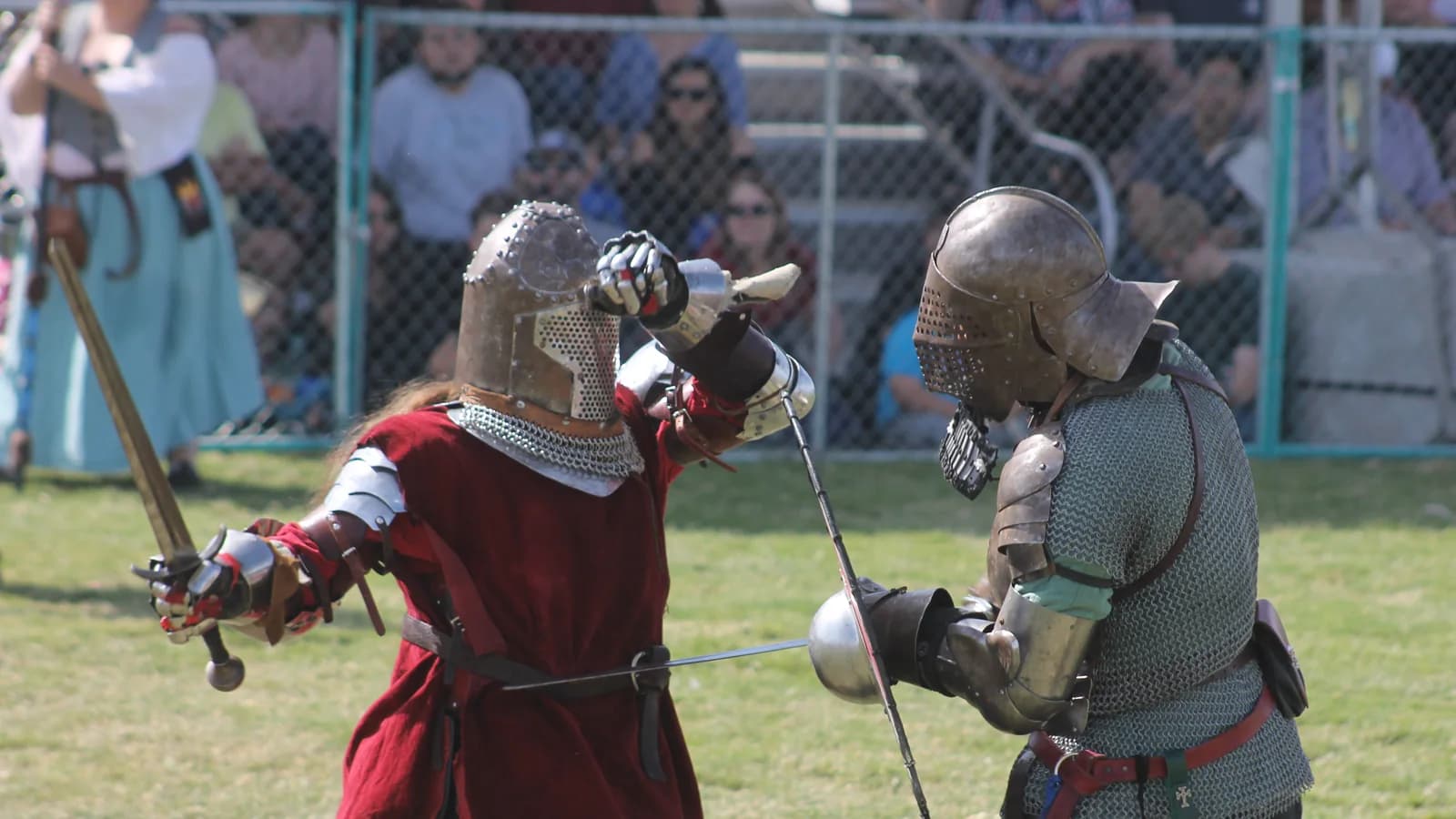
Live action roleplay is a tabletop game with the table removed: you are your character, in a field or a hall, for a weekend. It is one of the most welcoming hobbies in this catalogue and one of the worst-documented for outsiders, because everything written about it is written by a system for people already playing that system. This page is the other thing — what a first event is actually like, what the different kinds of LARP are and why they barely resemble each other, what you genuinely need to bring, what it costs, and the etiquette that is obvious to everybody there and to nobody else. It publishes no system rules, no combat technique and nothing at all about making weapons.
Also known as larp, live roleplay, live action role play, larping.
Live action roleplay is roleplaying with your body instead of a character sheet. You have a character, you wear their clothes, and for the duration of an event you are them — talking to other people who are also their characters, inside a fiction everybody has agreed to maintain. There is no audience. That is the single most important difference from theatre and the one that takes newcomers longest to believe: nobody is watching, because everybody is in it.
The reason it is hard to find out about is structural rather than secretive. Everything written about LARP is written by a system, for players of that system — rulebooks, event pages, world lore, kit standards. There is very little that explains the hobby from outside, because the people who could write it have no reason to and the people who need it have not arrived yet. That gap is what this page is for.
The other thing worth establishing immediately: it is not one hobby. A weekend fest event with two thousand people in a field, a twelve-person murder mystery in a hotel, and a Nordic-tradition piece about grief with no combat at all are all called LARP and share almost nothing except the word. Working out which one you are looking at is the first useful skill.
- What you are doing
- Being a character, not playing one
- Who is watching
- Nobody. Everyone is in it
- What varies most
- Which kind — they barely resemble each other
- What a first event costs
- £15–£150, and kit can be £20
There is no such thing as the rules of LARP. Every system has its own, they are genuinely different in structure rather than in detail, and a general summary would be wrong at every specific event somebody attended.
What is worth knowing is the shape most systems share. There is a way of resolving whether an attack worked, usually a call and a number rather than a dice roll. There is a way of representing skills your character has and you do not, usually a card, a card-and-call, or a physical token. There is a way of representing things that cannot happen physically — magic, poison, disease, locks — usually a phrase spoken aloud that everybody has agreed to obey. And there is a distinction between what your character knows and what you know, which every system takes seriously and which is the hardest discipline for a new player.
Learning a specific system takes an evening with its rulebook and one event of getting it wrong. Nobody expects a newcomer to have it right, and getting it wrong is not the faux pas — pretending you have not is.
Step 1: Find one event, near you, that is running in the next three months
Not a system to commit to — one event. Most systems list events publicly and most have an obvious "new players" page. Geography matters more than genre at this stage, because the thing that stops people is travel rather than interest.
You will know it worked when: A specific date rather than a vague intention.
Step 2: Go as a monster or crew for the first one, if the system offers it
Most fest and campaign systems let you play the opposition — creatures, NPCs, the other side — for a much reduced fee or free. You get costume provided, you are told exactly what to do, you see the whole event from inside, and you owe nobody a character. It is by a distance the best first experience available and it is chronically under-advertised.
You will know it worked when: A whole event experienced, for almost nothing.
Step 3: Email the organisers and say you are new
This hobby is unusually good at this. Most systems have somebody whose actual job is new players, and saying "I have never done this, what do I need" reliably produces a helpful answer, often including an offer to lend you things.
You will know it worked when: A person expecting you.
Step 4: Assemble the cheapest kit that meets the standard
Charity shops and your own wardrobe. Plain linen-look shirt, plain trousers or a plain skirt, boots, a belt, no visible modern logos. Nearly every system publishes a minimum standard and it is deliberately low for newcomers.
You will know it worked when: £20–£60, and you look like you belong.
Step 5: Write the simplest possible character
One motivation, one thing you are good at, one reason to talk to strangers. Elaborate backstories are the classic beginner mistake — nobody else will ever learn it, and a complicated character is harder to play, not easier.
You will know it worked when: Somebody you can actually be for a weekend.
Step 6: Arrive early and find the new player briefing
Every system runs one and it covers exactly the things this page cannot: the safety calls, the specific etiquette, where the out-of-character area is, and what to do if something goes wrong.
You will know it worked when: The local rules, from the people who own them.
- In character and out of character are real states — There is a way of signalling each — a hand gesture, a headband, a designated area — and the boundary is respected absolutely. A player who is out of character is not there, and is not spoken to as their character.
- What your character knows is not what you know — You will overhear plots, you will see people die and come back, you will know who the traitor is. Acting on that is the single worst thing you can do in this hobby, and everybody is watching for it much less than you fear.
- Losing is content — The largest adjustment from tabletop and from video games. Being defeated, robbed, deceived or killed is not a failure — it is the story working, and a player who cannot lose gracefully has a bad time and gives one.
- Play to lift, not to win — A widely-held principle: your job is to make the people around you have a good time, and theirs is to do the same for you. It is why an obviously unwinnable scene is often the best one of a weekend.
- Nobody cares how good your kit is — Everybody worries about this and nobody else is looking. The player in a charity-shop shirt who talks to people has a far better weekend than the one in £600 of leather who stands at the edge.
- Talk to strangers, because that is the game — A LARP where you stay with the people you arrived with is a camping trip. The whole mechanism depends on characters meeting characters, and the awkwardness of the first approach is universal and lasts about an hour.
- Volunteers run all of it — The people organising, refereeing, cooking and monstering are almost always unpaid players. Thanking them, and crewing an event yourself eventually, is the economy the hobby runs on.
Almost every bad first experience in this hobby is somebody turning up to the wrong kind. These are the distinctions that actually change the day.
- Fest LARP — Hundreds to thousands of players camping in a field for a long weekend, in a persistent world with factions, politics and battles. The image most people have of LARP. Enormously social, physically demanding in the ordinary camping sense, and the version where kit standards are most visible.
- Campaign or chapter LARP — The same characters meeting regularly at a smaller scale — a weekend every couple of months, tens rather than thousands of players. Deeper relationships, easier to keep up with, and much the easiest thing to start with.
- One-shot and freeform — A single self-contained event with characters written for it, often indoors and often in a day. No commitment, no world lore to learn, and the best possible first taste. If you are not sure whether you like this at all, this is the answer.
- Nordic-tradition LARP — A distinct movement, largely Scandinavian in origin, more interested in emotional and thematic experience than in winning or in combat. Frequently has no rules system at all in the usual sense. Some of it is closer to participatory art than to a game, and people arriving expecting swords are startled.
- Combat-heavy against combat-light — A dimension rather than a category, and the one to check first. Some systems are built around large battles; others have players who have never fought once in five years. Both are normal and the event listing usually says.
- Boffer, latex and airsoft-adjacent — How the fighting works, where there is fighting. Most UK fantasy LARP uses latex-over-foam weapons with a strike-and-pull convention; some systems use different technologies entirely. This affects safety standards and what you may bring.
- Genre — Fantasy dominates, and post-apocalyptic, historical, science-fiction, horror and modern-day systems all exist and are all healthy. Genre matters far less to your enjoyment than scale and combat level do, which is the opposite of what newcomers assume.
- Still deciding — Live action roleplay vs tabletop roleplaying
- A second event with the same system — The step that decides whether this becomes a hobby. The first event is disorienting for everybody; the second is when the world and the people start being familiar and it clicks.
- A character with connections rather than a backstory — The real progression in play. A character who owes somebody something, wants something from somebody, and belongs to a group has stories arriving; one with a beautifully written past has none.
- Making or commissioning kit — Where a large share of players end up, and where LARP overlaps with half this catalogue: leatherwork, sewing, prop making, mould making, costume. Many people arrive as players and leave as makers.
- Crewing and monstering — Playing the other side, on purpose, for the fun of it. Experienced players do this regularly and it is where a great deal of the hobby’s goodwill comes from.
- Refereeing and organising — Running events, writing plot, handling the logistics. Unpaid, substantial, and the reason the hobby exists.
- Writing and running your own — A one-shot for twelve friends in a hall is an achievable first attempt and a completely different craft from playing — closer to game mastering and to theatre production than to acting.
- Travelling to other traditions — UK fest players going to Nordic events and vice versa, which is usually a considerable shock and frequently changes what somebody wants from the hobby.
LARP looks more dangerous than it is. The risk level in practice sits well below most outdoor sports in this catalogue, and that is not luck — it is the product of a strong and explicit safety culture that newcomers meet in the first ten minutes.
The rest of the safety culture, which is worth knowing before you arrive:
- Safety calls stop everything, immediately — Every system has words that pause the fiction — commonly one for a real emergency and one for stepping out of an interaction you are not comfortable in. They are not negotiable, nobody asks why, and using one carries no social cost. Learn your system’s at the briefing; they differ.
- Combat is pulled, and this page does not teach it — LARP fighting is delivered at a fraction of real force, judged continuously against the person in front of you, and the skill is restraint rather than power. That is a continuously modulated physical judgement made against somebody who is also playing, and it is taught in person at the event, in a briefing, by people who then watch you do it.
- Head, neck, groin and hands are off — Universal, and among the first things any briefing covers. The specific target rules vary by system and the exclusions do not.
- The field is a field — The commonest injuries at fest LARP are not combat at all — they are trips in the dark on uneven ground, guy ropes, tent pegs and cold. A head torch with a red filter, sensible boots and knowing where your tent is are the actual precautions.
- Consent tools exist and are used — Beyond the safety calls, many systems use explicit mechanisms for negotiating intense content in advance — what your character can be subjected to, what you would rather avoid. Using them is normal and experienced players use them most.
- Alcohol and the fiction — Policies vary sharply between systems and some are strict about it. Worth reading rather than assuming, particularly at camping events.
- Clothing that reads as the setting — Plain, unbranded, natural-looking. Charity shops are the standard source and nobody minds. £20–£60 covers a first event comfortably.
- Boots you can stand up in for twelve hours — More important than anything else on this list. Fest LARP is a walking activity that occasionally involves a sword, and blisters end a weekend faster than anything.
- A weapon, if the system uses them — bought or borrowed — £60–£150 from an established maker, or borrowed for a first event, which most systems will arrange. Never homemade for a first event.
- Camping kit, for fest events — The hidden cost, and the one that decides whether the weekend is good. A tent, a proper mat and a sleeping bag rated for a British field in April: £100–£250 if you do not already camp.
- A head torch with a red filter — Cheap, and the difference between navigating a field at night and falling over a guy rope. Red because white light destroys everybody’s night vision and the atmosphere at once.
- Water, food and something warm — People consistently underestimate all three. LARP is more physically demanding than it looks and British weather does what it does.
- Armour, later or never — Leather and metal armour is £150–£600, heavy, and entirely optional. Plenty of long-standing players never own any.
- Going to the wrong kind first — The commonest bad experience. A two-thousand-player camping fest is a poor introduction for somebody who would have loved a twelve-person one-shot in a hall.
- Writing an elaborate backstory — Nobody will ever learn it, and it makes the character harder to play. One motivation and one connection beats four pages.
- Spending on kit before the first event — You do not yet know what you need, what the system expects, or whether you like it. Charity shop first, commission later.
- Making your own weapon for a first event — It will not pass inspection, and inspection is there for a reason. Borrow or buy.
- Staying with the people you came with — Understandable and it is the thing that produces a flat weekend. The game is meeting strangers.
- Playing to win — Losing is content, and a player who cannot be defeated gracefully is difficult to play with. This is the hardest adjustment for people coming from competitive games.
- Underestimating the camping — A bad sleeping bag in a British field in April is how an otherwise good weekend becomes a miserable one, and it has nothing to do with the LARP.
- Not asking — This hobby answers questions generously and newcomers consistently do not ask them. The new-player contact exists and would like to hear from you.
Live action roleplay has no single origin and this page does not claim one — it arrived from several directions at once, out of tabletop roleplaying, historical re-enactment, improvised theatre and children’s games, and the various national traditions were barely aware of each other for years. What *does* have a documented origin is the reason a lot of modern larp looks the way it does, and it is unusually well recorded because the people involved were writing manifestos at the time.
From 1997 the Knutepunkt conference began meeting annually, moving between the Nordic countries and renaming itself into the host language each year, and from 2001 it published books of theory alongside it. Very few hobbies have an annual academic conference. This one built its identity through one.
The document that did the most work was Dogma 99, subtitled "A programme for the liberation of larp", published online in December 1999. Modelled on the film manifesto whose name it borrowed, it set out a "Vow of Chastity" of ten prohibitions: no game mechanics, no main plot, no secrecy, no organiser interfering once play had started, no borrowing from tabletop roleplaying — and, most consequentially, "No object shall be used to represent another object."
That last rule is why a Nordic-influenced larp has no foam weapons standing in for swords and no cards standing in for spells. If a thing must be in the fiction, it must be in the room. The pursuit of that — a space in which everything the players can see, touch and hear belongs to the story — became known as the 360-degree illusion, and it is the single most recognisable feature of the style.
The rest of the vow explains the social design. No mechanics means conflicts are resolved by acting rather than by rolling; no secrecy means players are told what is going on and play it anyway; no plot means the game is, in the manifesto’s own definition, "a meeting of players who, through their roles, relate to each other in a fictional world" rather than a story being administered to them.
Almost nobody now runs a strictly Dogma-compliant game, and it was arguably never meant to be obeyed so much as argued with. But the argument settled the vocabulary. Transparency, bleed, immersion, the debrief, the deliberate absence of a win condition — the things that make a Nordic larp confusing to somebody arriving from a fantasy boffer background — all descend from a manifesto written by two people in Norway at the end of 1999.
Sources for this section
- Dogma 99 — Nordic Larp Wiki (opens in a new tab) — Nordic Larp (nordiclarp.org) · Specialist publisher · read — supports the claim
When an event does not work for you
The failure modes of a larp are almost all social rather than practical, which makes them harder to admit to and much easier to fix than people expect.
- You could not get into it, and everyone else clearly did — The commonest first-event experience and much less visible from outside than it feels from inside — a lot of the people who look immersed are also waiting to be. Immersion is a skill and it usually arrives somewhere in the second act. The practical lever is to play smaller: a specific, immediate, physical objective beats trying to feel like somebody else.
- Your character had nothing to do — Usually a network problem rather than a writing problem. Larp plots travel through relationships, so a character with no strong ties has nothing arriving at them. The fix is available during the game and is completely normal: go and make a claim on somebody. Owe them something, accuse them of something, need something from them. Almost every organiser would rather you did that than stand at the edge.
- You are stuck on the outside of a group who all know each other — Real, and worth naming rather than enduring. Larp communities are dense and long-established and can be genuinely hard to enter. What works is the in-character route — having a reason to talk to somebody — and what works better is telling an organiser at signup that it is your first event, because most will attach you to a group deliberately.
- It got more intense than you wanted and you did not use the mechanic — Everybody does this once. The safety mechanics exist for exactly this and they are not a judgement on anybody — not on you for calling one and not on the other player for having gone there. The reason to use them early rather than late is that they are much harder to reach for once you are already overwhelmed.
- You feel flat and strange for days afterwards — Well recognised in the community, discussed openly, and not a sign that anything went wrong. After several days of heightened emotion and constant company, ordinary life is quiet. What people find helps is the same thing every time: stay in contact with the people who were there, talk about it, and do not make decisions about whether you enjoyed the event in the first 48 hours. If low mood persists beyond a few days or is severe, that is a matter for a doctor rather than for a hobby page.
- Something happened that was not okay — Distinct from all of the above and treated differently. Every organiser of a well-run event has a route for reporting conduct, and the community norm — stated far more clearly in the last decade than before it — is that you report it to them rather than deciding privately not to make a fuss. It is their event and their responsibility.
- IC and OC
- In character and out of character. The two states, signalled explicitly, and the boundary everybody respects.
- Bleed
- When a character’s feelings leak into the player’s, or the reverse. Discussed openly and taken seriously, and one reason debriefs exist.
- Monstering / crewing
- Playing the opposition or the supporting cast rather than your own character, usually at reduced cost. The best possible first event.
- Fest
- A large camping event, hundreds to thousands of players, usually a long weekend.
- One-shot
- A self-contained event with characters written for it. No world lore, no commitment.
- Boffer / latex
- Weapon construction technologies. Which a system uses affects its safety standards and what you may bring.
- Calls
- Words spoken aloud to make something happen that cannot happen physically — an effect, a state, or a safety stop. Every system has its own.
- Play to lift
- The principle that your job is to make the people around you have a good time. The nearest thing the hobby has to a shared ethic.
- Debrief
- A structured conversation after an event, particularly after intense play, to separate the character’s experience from yours.
- Do I need to be good at acting?
- No, and the assumption is the single biggest thing keeping people away. There is no audience — everybody present is doing it too, nobody is assessing your performance, and the skill that actually matters is being willing to talk to strangers rather than being able to act. Plenty of long-standing players are visibly just themselves in a costume.
- How much does it cost to try?
- Less than most people expect. A one-day or indoor event is £15–£50 and a weekend fest is £60–£150 including camping, and most systems offer a much cheaper first-time or monster ticket where you play the opposition. Kit for a first event can be £20–£60 from charity shops and your own wardrobe, because nearly every system sets a deliberately low minimum standard for newcomers.
- What should my first event be?
- A one-shot, or a weekend spent monstering for a larger system. Both remove the two things that make a first event hard: needing a character you have thought about, and needing to know how anything works. Monstering in particular gives you costume, direction, the whole event from inside, and no obligation to anybody — and it is chronically under-advertised.
- Can I make my own weapon?
- Not for a first event, and this page does not describe how. A LARP weapon is safety equipment rather than a prop — foam and latex over a flexible core — every system inspects them and every system has its own written standard covering core stiffness, tip construction and thrust safety. A weapon built from a general description fails inspection at best. Buy from an established maker or borrow, which most systems will arrange, and if you take up making them later, learn your system's standard rather than a general one.
- Is it dangerous?
- Less than it looks, and less than most outdoor sports in this catalogue. Combat is deliberately pulled, weapons are inspected, head and neck are off, and every system runs safety calls that stop everything instantly with no social cost for using them. The injuries that actually happen at camping events are trips in the dark, guy ropes and cold — which is why boots and a head torch matter more than anything about fighting.
- What if I want to stop mid-event?
- Every system has a way to step out, and using it is unremarkable. There is a safety call for leaving an interaction you are not comfortable in, an out-of-character area you can go to, and organisers who would far rather somebody stepped out than endured. Knowing where that area is before you need it is worth doing on arrival.
Guides
Longer answers to questions this page can only summarise.
If you like this
Each of these is here for a stated reason, not because it is also a hobby.
Similar to
- Game mastering — The same craft with the table removed, and the skills transfer almost completely in one direction: a game master already knows how to hold a fiction together, read a group and let players have the good idea. What LARP adds is that everybody is doing it at once and nobody is narrating.
Goes well with
- Historical European martial arts — Adjacent and frequently confused, and worth separating: HEMA is a martial art reconstructing how people actually fought, and LARP combat is a pulled, cooperative convention designed to be safe and to look good. People do both, and the crossover is a source of some of the better LARP fight choreography.
- Prop making — Where a large share of LARP players end up, and the reason so many of them own a heat gun. Everything a character carries is a prop somebody made, and the hobby is one of the few places an amateur prop maker gets their work used hard by people who are pleased to see it.
- Sewing — Costume is the largest ongoing cost and the largest source of satisfaction, and commissioning it is expensive enough that many players learn to sew instead. Plain, hard-wearing, historically-vague garments are also an unusually forgiving place to learn.
Shares equipment with
- Wild camping — Fest LARP is camping with a plot, and the hidden cost of a first weekend is a tent, a mat and a sleeping bag rated for a British field in April. Somebody who already camps has removed the thing that most often makes a first event miserable.
Substantial
Last reviewed 2026-08-19. Cost, time and difficulty figures on this page are HobbyHQ estimates — see how we work. Something here wrong or out of date? Tell us.