Outdoor & adventure
Ski touring
Ski touring is what skiing looks like once the lift is removed: you climb on skins, take them off at the top, and descend terrain nobody has groomed. It is a genuinely different sport from piste skiing, and the difference is not the descending — it is that you are now responsible for judging snow that nobody has assessed for you. This page covers the equipment, the transitions, the progression and the training, and it deliberately makes no judgement about any terrain or any conditions.
Also known as ski mountaineering, backcountry skiing, randonnée, skinning.
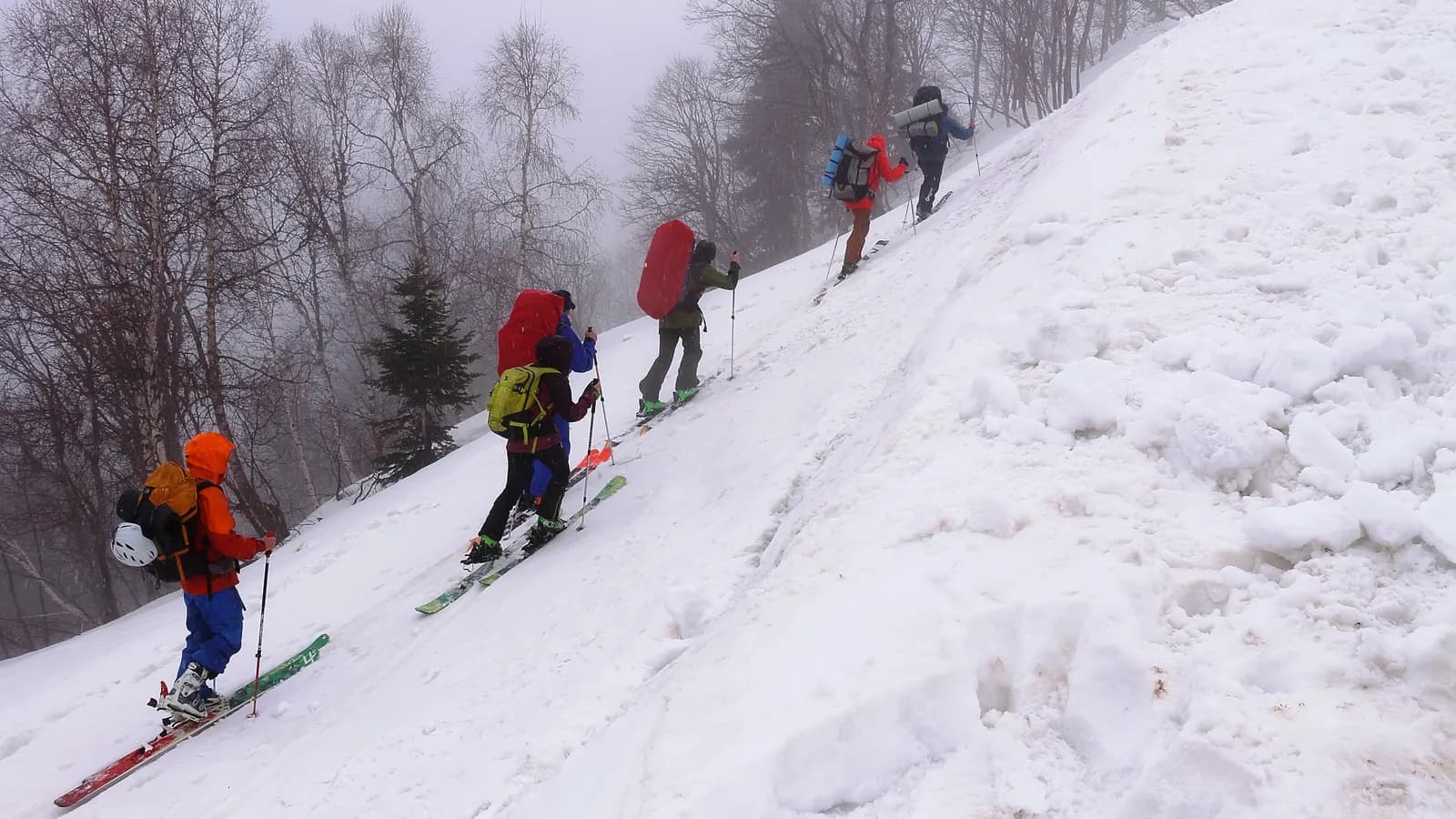
Ski touring is climbing on skis and skiing back down, away from lifts and pisted runs. The mechanism is the skin: a strip of fabric fixed to the base of the ski whose fibres slide forwards and grip backwards, so you can walk uphill on the skis you will descend on. At the top you pull the skins off, lock the bindings into downhill mode, and ski.
The distinction that matters is not the climbing and it is not the descending. It is that nobody has assessed the snow for you. A piste has been controlled, checked and often explosively triggered before it opened; a touring line has not. Everything that makes this sport different from resort skiing follows from that one fact — the equipment you carry, the training that is not optional, the fact that you cannot do it alone, and the habit of reading a forecast every morning.
The other thing worth saying early is that the ratio is not what people expect. A touring day is mostly uphill: four hours of climbing for forty minutes of descent is entirely normal. People who love the sport tend to love the climbing, the quiet and being somewhere with nobody in it. People who came for the descent alone are often disappointed, and that is worth knowing before spending anything.
- What makes it possible
- Skins
- What makes it different
- Nobody has assessed the snow
- Typical ratio
- Hours up, minutes down
- Never done
- Alone
The first season is about the machinery: transitions that do not take fifteen minutes, skins that stay on, a pack that works, and a fitness base for four hours of climbing. Nearly all of it can be built on gentle, low-consequence terrain, and that is exactly where it should be built.
The second stage is judgement, and it is a much longer project. Reading the forecast, watching how a snowpack evolves across a season, and — the hard part — noticing when the group is talking itself into something. This is where courses beyond the introductory level pay for themselves, and where touring with more experienced people is worth more than any amount of solo mileage would be, if solo mileage were an option.
Beyond that the sport branches. Ski mountaineering adds rope, axe and crampons and objectives where the skiing is part of a climb. Hut-to-hut touring is multi-day travel across a range and is what a great many people consider the point of the whole thing. Racing is a distinct discipline on very light kit. And a good many people simply keep doing day tours in good conditions for decades, which is a complete answer.
Step 1: Be a confident off-piste skier first
This is a prerequisite rather than a stage. Touring adds a pack, unpredictable snow and consequences to skiing you already need to be able to do. If descending ungroomed snow is still work, spend the season on that instead — it is cheaper and it is the actual bottleneck.
You will know it worked when: You can ski variable off-piste snow comfortably, with a pack.
Step 2: Do an avalanche awareness course before buying anything
Before the skis, before the transceiver, before the first tour. £150–£400 and it is the purchase with the highest return in the sport, because everything else is equipment for a decision you have not yet learned how to make.
You will know it worked when: You can read a forecast and say what it means for a day out.
Step 3: Rent a setup and go with a guide or a club
£40–£60 a day for kit and a guided day split between a party. You find out whether you like walking uphill for four hours before spending four figures on finding out, and you tour with somebody whose judgement you are not yet expected to have.
You will know it worked when: You have completed a tour without being responsible for the route.
Step 4: Practise the transceiver until it is boring
In a park, with a friend burying a pack. Owning a transceiver and being able to run a search under time pressure are entirely different things, and the gap between them is where the sport's worst outcomes live. Most clubs run practice sessions and they are free.
You will know it worked when: You can locate and dig out a buried transceiver quickly, more than once.
Step 5: Buy boots first, then bindings, then skis
In that order and with that priority on spend. Get the boots fitted by somebody who fits touring boots. The skis matter least and beginners always buy them first.
You will know it worked when: You own boots that climb comfortably and ski adequately.
Step 6: Build a habit of reading the forecast on days you are not going
The skill is pattern recognition over a season, and it is free. Reading the area forecast on ten days you stay at home teaches you more about how the hazard evolves than reading it on the one day you go.
You will know it worked when: The forecast tells you something rather than just giving you a number.
- Touring bindings, which are the defining component — A binding that releases the heel for climbing and locks it for descending. Pin bindings — small metal pins engaging fittings in the boot toe — are much the lightest and are what most touring setups use; frame bindings are heavier, ski more like an alpine binding and are a reasonable choice for somebody touring occasionally off resort gear. The choice constrains the boots, so it is made first.
- Boots, which is where the money should go — A touring boot has a walk mode that frees the cuff and a ski mode that stiffens it, and it has to do both jobs adequately. Fit matters more than in any other ski discipline because you are walking uphill in them for hours; a boot that skis beautifully and blisters at hour three is the wrong boot. Get them fitted by somebody who fits touring boots specifically.
- Skins — Mohair, synthetic, or a mix. Mohair glides better and wears faster, synthetic grips better and drags more, mixes split the difference — and every tourer has opinions. They are consumable, they need trimming to the ski, and keeping the glue alive is an actual maintenance task rather than an afterthought.
- The avalanche set: transceiver, shovel, probe — Not three items but one system, and it is useless without practice. A transceiver locates a buried companion, the probe pinpoints them and the shovel gets them out — and the digging is the slow part that nobody rehearses. Buy the current generation of transceiver: search performance and battery behaviour have both moved, and this is not the place for second-hand economy.
- The skis themselves, which matter least — Lighter climbs better and skis worse; heavier is the reverse. Beginners consistently over-prioritise this and under-prioritise boots. Any reasonable touring ski in a sensible width will do everything a first two seasons require.
- Layers, and the transition problem — You will be too hot climbing and cold within two minutes of stopping. The system has to allow a full change of state in the few minutes a transition takes, which means layers that come on and off over a harness and gloves, not a single warm jacket.
- Navigation you can use in a whiteout — Map, compass and the ability to use them, plus whatever electronics you like as well rather than instead. This is standard mountain practice and touring does not exempt you from it.
The hazards that are not avalanche, which get less attention and cause plenty of incidents:
- Weather closing in — You are hours from anywhere on foot, and a whiteout removes navigation and the ability to see terrain at the same moment. The mountain weather forecast is a separate read from the avalanche forecast and both matter.
- Being benighted — Touring days run long and the climbing is slower than people plan for. A head torch and a turnaround time decided in advance are the two cheapest pieces of safety equipment in the sport.
- Cold injury while stationary — Transitions happen at the top, in wind, while wet with sweat from the climb. This is when hands and feet are lost, and it is why the layering system is a skill rather than a shopping list.
- Ordinary skiing injury, in an extraordinary place — A knee that would be a lift-served inconvenience is a rescue in the backcountry. Ski well within yourself is a safety instruction here rather than a style note.
- Terrain traps and glacier travel — Gullies, crevasses and cornices are their own bodies of knowledge, and glacier travel in particular requires rope skills this sport does not teach by itself. Both are guide or course territory.
Almost nothing about descending is new — if you can ski off-piste, you can ski a tour. What is new is the transition, and it is the skill that separates a party that moves efficiently from one that stands in the wind losing heat.
A transition is the changeover at the top: skins off, bindings from walk to ski mode, boots from walk to ski mode, layers adjusted, pack repacked, goggles on. There are perhaps a dozen small actions and every one of them is easy in a warm room and awkward in wind with cold hands. The whole craft is in doing them in a fixed order, with everything reachable, so that nothing is put down on snow and nothing is forgotten. Experienced tourers transition in a couple of minutes; beginners take fifteen and get cold doing it.
The climbing movement itself is a shuffle rather than a step — the ski stays on the snow and slides forward, because lifting it wastes energy and breaks the skin's grip. The one manoeuvre worth naming is the kick turn, which is how you reverse direction on a steep skin track, and it is genuinely awkward to learn. It is also the single most useful thing to practise on a gentle slope before you need it on an exposed one.
What this page does not describe is how to choose the line the skin track takes, because that is a terrain judgement and it belongs to the training rather than to a page. The order of the transition is a sequence and is written down here; where to put the track is not.
- Skinning
- Climbing on skis with skins fitted. The verb for most of what a touring day consists of.
- Skins
- Fabric strips on the ski bases whose fibres slide forwards and grip backwards. Mohair, synthetic or a mix, consumable, and dependent on their glue staying alive.
- Transition
- The changeover between climbing and descending mode, and back. A dozen small actions done in wind with cold hands; the skill that most separates an efficient party from a cold one.
- Pin bindingalso: tech binding
- A binding engaging fittings in the boot toe with metal pins. Much lighter than a frame binding and what most dedicated touring setups use.
- Kick turn
- Reversing direction on a steep skin track by stepping one ski through 180 degrees. Awkward to learn and best practised somewhere it does not matter.
- Transceiveralso: beacon, avalanche transceiver
- The device every member of a party wears, transmitting so it can be found and switchable to search. One third of a system that only works with a probe, a shovel and practice.
- Skin track
- The ascending route itself. Where it is placed is a terrain judgement and is training territory rather than something a page can prescribe.
- Ski mountaineeringalso: skimo
- Touring that includes mountaineering — rope, axe, crampons, and objectives where the skiing is one part of a climb. Also the name of the racing discipline.
- Avalanche forecast
- A daily, area-specific assessment of hazard. In Scotland issued by the Scottish Avalanche Information Service across six mountain areas for the winter season. Something to read every day you go out.
- Classic ski touring — Skinning uphill and skiing down, on terrain that needs no mountaineering equipment. The centre of the activity and what the rest of this page is written about.
- Ski mountaineering — Where the route requires alpine skills as well as skiing — crampons, an axe, rope work, glacier travel. A different commitment with a different training path, and the equipment list stops being a preference at this point.
- Skimo racing — Timed ascent-and-descent racing on very light equipment, on marked and controlled courses. Worth separating clearly: the hazard management that dominates the rest of this subject is handled by the organisers, which is exactly why the equipment choices do not transfer back to touring.
- Splitboarding — The same activity on a snowboard that separates into skis for the ascent. Identical terrain and hazard questions, meaningfully different transitions and a different set of limitations on flat ground.
- Nordic and backcountry cross-country — Lighter, free-heeled equipment on rolling terrain rather than steep descents. The Scandinavian tradition, and much closer to walking in winter than to alpine skiing.
- Resort and slackcountry touring — Using lifts to reach touring terrain, or skinning within a resort boundary. Popular and worth naming carefully, because leaving a patrolled boundary changes who is responsible for the hazard even when the walk is short and the car park is visible.
- Hut-to-hut touring — Multi-day routes between mountain huts, which is the form the activity takes across the Alps and Scandinavia. The logistics rather than the skiing are the skill, and it is the version most British tourers travel for.
- Still deciding — Ski touring vs snowshoeing
- Buying kit before doing a course — The equipment is for executing a decision you have not learned to make. The course is the first purchase and it is not close.
- Owning a transceiver without practising with it — The most dangerous item in the sport, because it produces confidence without capability. Rescue happens in the first fifteen minutes and by the people present.
- Buying skis first and boots last — Backwards on every count. Boots do the hardest job, are the hardest to fit, and are what you will be walking uphill in for four hours.
- Touring alone — Not a risk tolerance question. Companion rescue is the entire rescue plan, and there is no version of it that works solo.
- Treating off-piste ability as touring ability — It is a prerequisite, not a qualification. The additional skills are judgement, transitions and self-sufficiency, and none of them are on a piste.
- Planning a day with no turnaround time — Touring days overrun because the climbing is slower than expected. A time agreed before setting out is what stops a party pressing on into the dark.
- Neglecting the skin glue — The unglamorous failure. A skin that stops sticking mid-climb turns a good day into a long walk, and the maintenance is ten minutes at home.
This section covers equipment and transitions and nothing else, and the boundary is deliberate. Anything involving the snow, the slope or whether a day is a reasonable one is outside it. Those are judgements about specific terrain in specific conditions, they are taught in person and read from a forecast, and a page that offered them would be doing the most dangerous possible impression of usefulness. What a page can do is stop a day ending because a skin fell off.
Read each entry as symptom → likely class → what you can safely check → what to do next. Every one of these is a problem you can fix or work around at the side of a track, which is why they are here — and every one of them is also a problem that turns a manageable day into a long one if you have never met it before.
- Class 1
- Skins and glue — yours, and preventable
- Class 2
- Bindings and boots — yours, in the field
- Class 3
- Ice and cold — yours, and mostly technique-free
- Class 4
- Terrain, snowpack and conditions — not this page’s, at all
- A skin peels off halfway up — Glue, and usually water. Skin glue fails when the skin is wet, when it is dirty, or when it has been stored badly. In the field: dry the ski base with a glove or a sleeve before reapplying, warm the glue against your body or inside your jacket for a few minutes, and press it on firmly from tip to tail. A skin strap or a couple of ski straps carried in a pack will hold a failing skin for a descent’s worth of walking, which is why experienced tourers carry them.
- The skins will not stick at all, from the start — Glue, and it has reached the end. Glue has a life and it is contaminated by pine needles, grit and repeated wet packing. This is a re-glue or a replacement rather than a field fix. Check it at home before a trip rather than at the trailhead, which is the single most effective piece of preparation in the sport.
- Snow balls up under the skins and you are walking on stilts — Conditions meeting cold equipment. It happens when the snow is near freezing and the ski is colder. Skin wax exists for exactly this and it is cheap, small and worth carrying. Tapping the ski hard with a pole clears it temporarily. This is a nuisance rather than a hazard, but it is exhausting and it is the commonest reason a party arrives at the top slower than planned.
- The binding will not switch to descent mode — Ice in the mechanism. The commonest field failure with every binding type, and it is almost always packed snow rather than breakage. Clear the heel unit and the toe with a pole basket, a ski edge or a gloved finger, and knock the boot sole clean before stepping in. Ice under the boot sole is the reason a binding will not close far more often than the binding is.
- Your boot will not go into walk mode, or will not lock — Ice, then the mechanism. Same check: clear the walk-mode lever and the area around it. If it is genuinely broken, a boot locked in walk mode can be skied down gently and a boot locked in ski mode can be walked on with a lot of effort — knowing which one you have is what decides how you get down.
- You are cold every time you stop and boiling every time you move — Layering, and it is the defining thermal problem of the sport. Uphill generates a great deal of heat and transitions are stationary at altitude in wind. The answer is to start cold and to put a layer on at the transition before you are cold rather than after, which is a habit rather than a purchase.
- Your transceiver did not appear in a group check — Stop the day until it is resolved. Batteries, the wrong mode, or a phone or a heated glove too close to it are the ordinary causes and all three are checkable in a minute. A party where one transceiver is not working is a party that cannot perform a rescue, and that is a reason to go home rather than a reason to be careful.
- You are unsure about the slope, the snow, or whether to continue — This page has nothing to offer and will not pretend otherwise. Slope angle, snowpack, aspect, recent weather and the day’s forecast are the whole of the judgement that keeps people alive in this sport, they are specific to where you are standing, and they are taught on avalanche courses with an instructor and read from the national avalanche forecast. If the question has occurred to you, the answer is to turn round, which is always available and is never the wrong call on a day you were unsure about.
The habit worth building is to fix the kit at home. Skin glue, binding function, boot mode and transceiver batteries all fail in ways that are trivial in a warm room and miserable in a col in the wind, and every one of them is checkable the night before. The failures that end days are almost never the dramatic ones.
Ski touring has an unusually serious culture for a recreational sport, and it comes directly from the consequence structure. Parties talk about decisions out loud, turning back is respected rather than mocked, and somebody voicing doubt is treated as information rather than as weakness — the safety literature calls the alternative a heuristic trap, and the culture has absorbed the point.
The social unit is the party, and finding one is genuinely the barrier to entry for many people. Clubs, guided groups and course cohorts are how most people find partners, and touring with people whose judgement you do not know is itself a recognised hazard. This makes the sport slower to get into than its equipment cost alone suggests.
There is a competitive discipline — ski mountaineering racing, on light kit and set courses — which is a different sport wearing the same skis and now has an Olympic presence. Most tourers never touch it. The mainstream of the sport is a small group, an early start, and being somewhere with nobody in it.
- Do I need to be a good skier first?
- Yes, and this is a prerequisite rather than something you develop alongside. Touring adds a pack, unpredictable ungroomed snow and real consequences to skiing you must already be able to do comfortably. If off-piste descending is still work, another season on that is cheaper and more useful than any touring kit. The climbing, by contrast, is aerobic and self-paced and much more forgiving than people expect.
- What should I buy first?
- An avalanche awareness course, before any equipment at all. Everything you would otherwise buy is kit for executing a decision you have not yet learned how to make. After the course, rent a setup for a few days before buying, and when you do buy, the order is boots, then bindings, then skis — the reverse of what most people do. The avalanche set of transceiver, shovel and probe is a fixed cost of participation rather than an upgrade, and the transceiver should be current-generation.
- How dangerous is it?
- Genuinely dangerous and genuinely reducible, and the second half is the important one. Mountaineering Scotland states that people are injured or killed by avalanche in the Scottish mountains every year, that "avalanches can happen to you", and that experience "in itself is no antidote" — but also that many such accidents "would have been avoidable, given greater awareness of the hazards". What reduces the risk is training, reading the area forecast every day you go out, carrying and being practised with the rescue equipment, never going alone, and being willing to turn round.
- What slope angles are safe?
- This page will not answer that, and it is worth being clear that the refusal is deliberate. Terrain judgement is the output of a course and of a forecast read on the day for a specific area, and a number taken off an encyclopaedia page and applied to a slope is precisely the failure mode that kills people. The governing body's own position is that experience alone is not protective. Take an avalanche course, read the Scottish Avalanche Information Service forecast for your area or its equivalent wherever you are touring, and work with people who have the training.
- Can I tour alone?
- No, and this is not a risk-tolerance question like soloing a climb. Avalanche rescue is companion rescue: burial survival falls away sharply with time, and the people who dig you out are the people standing next to you, not a helicopter. A party is part of the equipment. The practical consequence is that finding partners is a real barrier to entry, and clubs, guided groups and course cohorts are how most people solve it.
- Is it worth it for forty minutes of descent?
- That is the honest question and the answer decides whether you will enjoy the sport. A typical day is hours of climbing for a short descent, and people who love touring generally love the climbing, the quiet, and being somewhere unpeopled — the descent is the reward rather than the point. Anybody whose interest is purely in the skiing is usually better served by lift-served off-piste, and finding that out on a rented setup is much cheaper than finding it out on a bought one.
Within this activity
Disciplines, variants and techniques that sit inside it.
Disciplines
- Cross-country ski touring — Travelling on skis over rolling country rather than descending pistes.
If you like this
Each of these is here for a stated reason, not because it is also a hobby.
Easier way in
- Hiking — The same terrain and the same navigation without the avalanche layer, the four-figure kit bill or the requirement to have a party. Where most tourers came from.
Similar to
- Downhill mountain biking — A day shaped by lifts and descents rather than by a single outing, with equipment states to manage between runs and a hard dependency on conditions and a season.
- Mountaineering — The same mountains, the same planning, the same avalanche problem, reached on skis instead of on foot. Covers far more ground in a day, and makes avalanche terrain judgement non-optional rather than situational.
- Scrambling — The same mountains, the same weather judgement and the same habit of turning round — and both are the point at which walking becomes mountaineering by degrees rather than by decision.
- Triathlon — Both are endurance sports with a genuinely large equipment bill, and both make a trained skill of the transition — changing state quickly, in the cold, without dropping anything.
Goes well with
- Wild camping — Multi-day touring is camping in winter with skis, and hut-to-hut travel is what a good many tourers consider the point of the whole sport.
Sources for this section
- Avalanches (opens in a new tab) — Mountaineering Scotland · Governing body · read — supports the claim
- Scottish Avalanche Information Service (opens in a new tab) — Scottish Avalanche Information Service (sportscotland) · Institutional · read — supports the claim
Substantial
Last reviewed 2026-08-16. Cost, time and difficulty figures on this page are HobbyHQ estimates — see how we work. Something here wrong or out of date? Tell us.