Outdoor & adventure · Endurance & fitness
Downhill mountain biking
Downhill is not mountain biking done faster. It is a separate sport with its own bikes, its own venues and its own injury profile: a machine you cannot pedal up anything, a chairlift or a van to get you to the top, and a graded track you descend against a clock. It is enormous fun and it hurts people, and both of those need saying in the same breath. This page covers what the sport is, how the venues and the grading work, the protective equipment that is not optional, what the whole thing genuinely costs, and where the sport sits relative to the rest of mountain biking. What it does not cover is how to ride, and the reason is set out plainly rather than buried.
Also known as downhill mtb, dh mountain biking, gravity mountain biking, bike park riding.
Downhill mountain biking is a discipline of Mountain biking — Mountain biking with the climbing removed and something else — an uplift van, a chairlift, a push — taking you to the top, which changes the bike, the protective equipment and the shape of a day rather than merely the gradient.
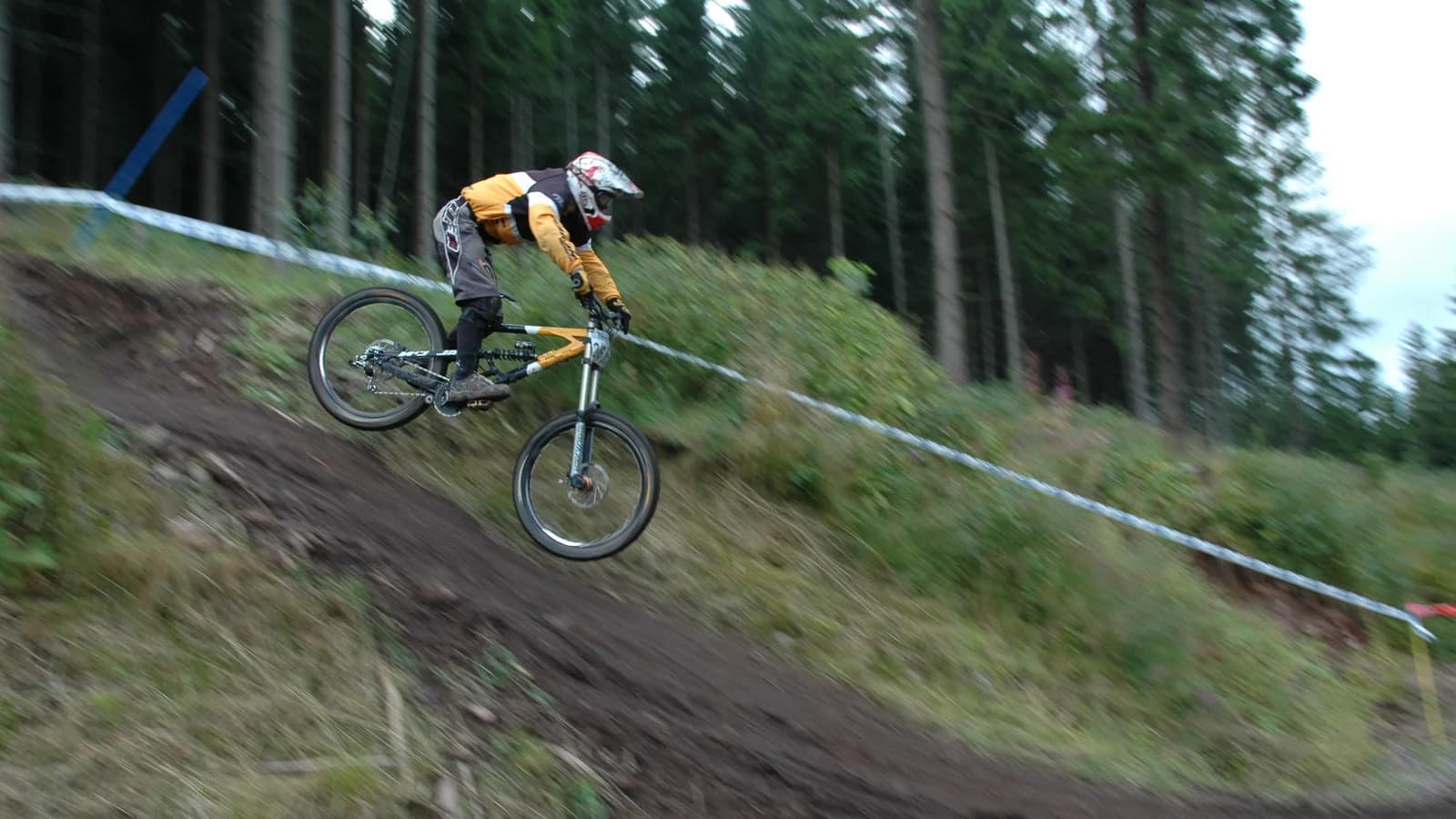
Downhill is the gravity end of mountain biking. The bike has long-travel suspension at both ends, a single low gear range, enormous brakes and geometry built entirely around descending — it is close to unrideable uphill and nobody tries. You get to the top by chairlift, by uplift van, or occasionally by pushing, and then you descend a marked track that has been built and maintained for the purpose.
The comparison people reach for is trail riding, and it is misleading. Trail riding is a ride: you go out, you climb, you descend, you come back. Downhill is a series of runs, each a few minutes long, separated by a lift queue — much closer in shape to a day’s skiing, or to motocross, than to a bike ride. A day might be six hours long and contain forty minutes of riding.
It is also, and this needs saying in the same paragraph rather than in a footnote, the most consequential form of mountain biking. Speeds are high, the ground is rough by design, and the features are built to be jumped. Riders wear full-face helmets and body armour because the sport requires them, not because they are cautious. Injuries are not rare and they are not minor.
- What the day is
- Six hours, forty minutes of riding
- How you get up
- A lift or a van
- What the kit is for
- Impact, and it is not optional
- What this page will not teach
- How to ride it
Progression in gravity riding is unusually well structured, because the venues did the structuring. Graded trails at a bike park mean you can step up one increment at a time and know what you are stepping into, which is a luxury most outdoor sports do not have.
- A first uplift day on a hire bike — The single best first step, and it costs a day rather than a bike. Hire the right bike, ride the easiest graded trails repeatedly, and find out whether you like it before spending thousands. A great many people discover here that what they actually want is enduro.
- Repeating the same trail until it is boring — The thing that separates riders who improve from riders who accumulate days. A trail ridden six times teaches line choice; six different trails ridden once each teach survival. This is the most useful and least followed advice in the sport.
- Coaching, earlier than feels necessary — Bike parks have coaches on site and a session is £60–£150. It is the fastest progression available by a distance, because the errors that limit a rider are invisible from the inside and obvious from ten metres away. Riders who book coaching in year one routinely overtake riders who booked it in year four.
- Moving up a grade deliberately — Blue to red to black, one at a time, on a day when conditions are good rather than on a day when your friends are keen. Grading is per venue rather than national, so a red at one park is not a red at another — which is worth checking rather than assuming.
- Jumps, which are their own ladder — Tabletops before gaps, and a progression line or airbag session before either. The commonest serious injuries in this sport come from committing to a jump that is a size too big, and the venues that built progression lines did so precisely because the natural learning route was so bad.
- Racing, if you want it — Regional and national downhill series run through the season and are far more approachable than the World Cup coverage suggests — most fields are full of amateurs having a weekend. Racing also improves riding faster than free riding does, because it forces repetition of one track.
- Bigger venues, and eventually the Alps — A week of lift-served riding in the Alps or the Pyrenees is where a lot of British riders end up, and it is a step change in vertical descent rather than in difficulty. Fitness and hand fatigue become the limit rather than nerve.
Step 1: Book a bike park day with hire and coaching
Do not buy anything. A hire bike, hire protective kit, an uplift pass and a beginner coaching session is £150–£280 all in, and it answers every question you have — including whether you enjoy it, which a lot of people find they do not once the ground is actually moving.
You will know it worked when: You know whether this is your sport, for the price of a component.
Step 2: Do the coaching properly rather than as an add-on
The instruction is the thing being bought. A coached first day teaches more than a season of riding badly, and it also establishes what "within your grade" means for you specifically — which is the safety decision the whole sport rests on.
You will know it worked when: A realistic sense of your own level.
Step 3: Go back several times before buying a bike
Hire again. Ride different tracks and different parks. The bike is the most expensive object in this hobby and the requirements you would specify after one day are not the ones you would specify after six.
You will know it worked when: An informed purchase rather than a hopeful one.
Step 4: Buy protective equipment before you buy a bike
It is yours, it fits you, it travels, and it is what you will keep when the bike changes. A full-face helmet fitted in a shop is the single most worthwhile purchase in the sport.
You will know it worked when: The kit that matters, bought first.
Step 5: Buy the bike second-hand, and expect to service it
The gravity market has plenty of good used bikes because riders upgrade often. Budget for a suspension service on arrival regardless of what you are told, because a neglected damper is both the commonest fault and the least visible one.
You will know it worked when: A bike that does what it is supposed to.
- The bike — Long-travel suspension front and rear, slack geometry, powerful brakes, a narrow gear range. Built to descend and effectively unrideable uphill, which is why the uplift is part of the sport rather than a convenience. Modern "enduro" bikes overlap with this and can be ridden at parks, which is what many people actually use.
- A full-face helmet — Not a trail helmet with more coverage — a different item with a fixed chin bar. Replaced after any significant impact rather than inspected. Fitted in person.
- Goggles — Because you are travelling fast through dust, mud and branches with a chin bar in front of your face. Sunglasses do not work under a full-face.
- Knee pads, and usually elbow — The joints that hit the ground first and the ones that end seasons. Fit matters more than price because a pad that moves in a slide is not there.
- Body armour or a spine protector — Standard for park riding, and increasingly a lightweight vest rather than the old motocross-style shells.
- Gloves and flat-soled shoes — Grip and skin. Whether to run flat pedals or clipped in is a genuine and much-argued question, and most coaching starts on flats.
- Tyres, pads and a service schedule — The consumables, and they go far faster than any other cycling discipline. Budgeting for them separately is the difference between a sport you can afford and one you cannot.
Most pages in this catalogue can treat safety as a section. This one cannot, because the risk is not incidental to the activity — it is a property of what the sport is. Descending rough ground at speed over built features carries a real chance of injury that no amount of equipment removes, and the sport’s own culture is unusually honest about that.
The rest of it, in the order it matters:
- Ride within the grade, and treat the grading as the authority — Bike parks grade their tracks and the grades are set by people who built and inspect them. Riding a track above your level is the commonest route to a serious crash, and the grading exists precisely so that decision does not have to be made at speed.
- Walk a track before you ride it — Universal practice at every level of the sport including the professional one. Every rider at a World Cup walks the course. It is not a beginner’s precaution.
- Features are inspected before they are ridden — Jumps and drops have landings that have to be found before they are used. Rolling in blind is how people get hurt on features that hundreds of riders clear safely every day.
- The bike is checked before the first run — Brakes, wheels, headset, suspension. A brake failure on a descent is a different event from a brake failure on a road, and the check takes two minutes.
- Fatigue is when it happens — The last run of the day is the one riders get hurt on, and it is a well-known enough pattern in the sport to be a cliché. Stopping while you still want another run is the discipline.
- Not alone, and with a phone — Bike parks are patrolled and open country is not. Uplift-served venues have first aid on site, which is a large part of why they are the right place to learn.
What is worth knowing without a coach, because it is orientation rather than instruction: the sport is far more about looking further ahead than about strength, the bike does substantially more of the work than a beginner expects, and almost everybody’s first day is spent riding much slower than they imagined and finding it much harder than they imagined. All three are near-universal and none of them is a technique.
- Uplift
- The lift, gondola or van that takes you and the bike to the top. Sold by the day and the thing that makes the sport what it is.
- Travel
- How far the suspension moves. Downhill bikes run around 200mm at both ends, which is roughly double a trail bike.
- Sag
- How far the suspension settles under your weight when you sit on the bike. The one setup number a rider is expected to know and set.
- Berm
- A banked corner. Built so that the bank rather than the tyres does the work of turning.
- Rock garden
- A section of loose or embedded rock. The feature that most separates the grades at a British bike park.
- Case
- Landing short on a jump, on the flat between the take-off and the landing. The impact that breaks wheels and riders.
- Pro line
- An alternative harder route around a section, usually with a bigger feature. Signed, and skippable.
- Enduro
- The neighbouring discipline: timed descents linked by climbs you ride yourself, on a lighter bike.
Downhill in Britain is overwhelmingly a bike-park sport. The parks are commercial or trust-run venues with built and maintained tracks, an uplift, a graded trail map and, importantly, staff who inspect the trails and patrol them. That structure is why the sport is far safer to learn at a park than in open country, and it is why almost all coaching happens there.
What a first-timer meets:
- The grading system — Trails are graded much as ski runs are, from easy through to expert and pro-line, and the grading is specific to that venue rather than national. A red at one park is not a red at another, which is why riders drop a grade at an unfamiliar venue as a matter of routine.
- The uplift — A chairlift, a gondola or a van with a trailer. Sold by the day, and the number of runs it buys is what actually determines the cost of a day.
- Protective kit requirements — Most venues require a full-face helmet to use the uplift and many require pads. This is a condition of entry rather than advice.
- Trail etiquette — Do not stop in a landing or blind spot; move off the track if you do stop; let faster riders past at a sensible place. The etiquette exists because the sight lines are short and the closing speeds are high.
- Racing, if you want it — A structured national scene running up to World Cup level, with regional series that genuinely welcome beginners in the entry categories. Racing is a small minority of participation and a large share of the sport’s visible culture.
- Downhill — Timed descents on the most specialised bikes, uplift-served. The subject of this page.
- Enduro — Timed descents linked by untimed climbs you ride yourself. The fastest-growing branch, a lighter bike, and a middle ground a lot of downhill riders move to.
- Bike park and freeride — The same venues and bikes without a clock, riding for the sake of it. The overwhelming majority of participation, and where most people stay.
- Dirt jump and slopestyle — Small hardtail bikes, built jumps, tricks. A different skill set again and the branch with the highest consequence for the smallest bike.
- Trail and cross-country — The rest of mountain biking, where you climb what you descend. Far cheaper, far less consequential, and where nearly everybody starts.
- Still deciding — Downhill vs enduro mountain biking
Gravity riding is unusually hard on a bike, and the reason is not speed — it is that every impact goes through the same handful of components over and over. A day at a park is the equivalent of a great deal of ordinary riding, and the maintenance rhythm follows from that rather than from a calendar.
Two of these matter far more than the rest, and the first is the one riders skip for years.
- Suspension setup, which is not maintenance but is where to start — Sag — how far the suspension settles under your weight — is the single adjustment that changes how a bike rides more than any purchase, and most bikes are ridden badly set up. Measuring it takes five minutes with a tape and a friend. The target figure is the manufacturer’s, it is printed in the fork and shock documentation and often on the frame itself, and it differs by bike and by shock, so no number appears here. What is worth saying is that riders consistently run too much air because a firm bike feels fast, and that changing one thing at a time and writing down what you changed is the whole method.
- Suspension servicing, which is real maintenance — Forks and shocks need lower-leg servicing regularly and a full service periodically, both quoted in riding hours by the manufacturer rather than in months. Park riding accumulates those hours fast. Neglected suspension does not fail dramatically — it gets progressively worse in a way you adapt to without noticing, which is why people are startled by how a serviced fork feels.
- Brakes — The component doing the most work on a gravity bike, and the one whose failure matters most. Pads wear far faster than on any other kind of riding, rotors warp, and fluid needs replacing periodically. Check pad thickness before every park day and carry a spare set — running out mid-day is the classic wasted uplift ticket.
- Tyres and pressure — Tyre pressure is the free adjustment that changes grip more than anything else, and the right pressure depends on your weight, the tyre, the rim width, whether it is tubeless and how wet the ground is. It is found by experiment rather than looked up, which is why this page publishes no figure. What is worth knowing is that most riders run too high, and that a few sessions of deliberately going lower until it feels vague teaches more than any chart.
- Bolts, bearings and pivots — A full-suspension frame has a lot of pivots and they loosen. A torque wrench and the manufacturer’s figures — again, theirs, printed on or near the parts — is the difference between a check and a stripped thread. Suspension bearings are a consumable on a bike ridden in British winters.
- The post-ride wash, and its trap — Park mud is abrasive and gets everywhere, so the bike gets washed. The trap is the pressure washer, which drives water and grit straight past the seals in every bearing and suspension part on the bike. A hose, a brush and patience; not a jet.
- The chain and drivetrain — Cheap to maintain and expensive to neglect, because a worn chain wears the cassette and chainring rather than just itself. The same rule as any bike, arriving faster.
The honest position on doing it yourself: pads, tyres, bolt checks and washing are entirely reasonable home jobs and are covered in far more depth on the bicycle maintenance pages. Suspension internals and brake bleeding are where most riders draw the line, and a shop service before a trip is money well spent.
Gravity riding has a strong and unusually welcoming club and park culture, built around the fact that everybody in the queue has crashed and everybody is happy to talk about it. Uplift days are social by construction — you spend more time in the queue than on the track, and that is where the sport’s community actually lives.
It is also a culture that is straightforward about the risk in a way that outsiders sometimes find startling. Riders discuss injuries openly, "have a good one" means something specific, and nobody pretends the sport is safe. That honesty is a genuine safety feature: a beginner is far more likely to be told to drop a grade at a bike park than to be egged on, which is the opposite of the impression the video footage gives.
The video footage is worth naming separately. The sport’s public face is a two-minute edit of the fastest riders in the world on the best day of their year, and it is a poor guide to what a Tuesday at a British bike park looks like. Almost every beginner arrives with expectations set by that footage and finds the reality slower, harder and considerably more fun than they expected.
- Buying a bike before riding a hire one — The most expensive mistake available, and the parks exist to prevent it. Hire, several times.
- Skipping the coaching — The instruction is the thing worth paying for. Riding badly for a season costs more, in every sense.
- Riding above the grade — The commonest route to a serious injury, and the reason the grading exists. Dropping a grade at an unfamiliar park is standard practice rather than caution.
- Rolling into a feature blind — Walk it first. Every professional does, on every track, every time.
- Treating armour as permission — It reduces the severity of an impact. It does not make one less likely, and riding as though it does is the misunderstanding that hurts people.
- One more run — The last run of the day is the one people get hurt on. It is enough of a pattern in the sport to be a joke, which is usually a sign that something is true.
- Learning from edits — A two-minute video of the best riders in the world on their best day is a poor guide to anything you are about to do.
- Do I need a downhill bike to start?
- No, and you should not buy one. Every bike park hires them, along with the protective kit, and hiring several times before buying is standard advice rather than a compromise. A modern enduro bike also rides most park tracks perfectly well, which is what a lot of regular riders actually use.
- How dangerous is it really?
- Genuinely risky, and the sport is honest about it. Speeds are high, the ground is rough by design and the features are built to be jumped, so injuries are neither rare nor trivial. What reduces the risk is real and specific: riding within the graded trail, walking a track first, taking coaching, wearing the protective equipment properly, and stopping before you are tired. What does not reduce it is buying better armour and riding harder.
- Do I need to be fit?
- Fitter than people expect, and in a different way from cross-country. The uplift removes the climbing, so this is not an aerobic sport — but holding a bike on rough ground at speed loads your grip, arms and legs continuously, and most beginners are surprised by how tired they are after four runs. Arm pump is the sensation everybody discovers on their first day.
- Why will this page not tell me how to ride?
- Because it cannot do it honestly. Downhill riding is a continuously modulated set of inputs made at speed on terrain that changes under you, and the feedback that teaches it is not available from a page. A written description of how to take a jump describes a quantity it cannot transmit, and a reader who has read one feels taught — which on a track at speed is worse than knowing nothing. Every bike park runs coaching, and it is the answer.
- What does a day actually cost?
- A hire day with a bike, protective kit and an uplift pass is typically £90–£160, with coaching another £50–£120 on top. Once you own a bike, an uplift pass alone is £35–£55 a day. The costs people underestimate are the consumables and the servicing: tyres and brake pads go faster than in any other cycling discipline, and a suspension service is £150–£300 a year.
- Is it the same as regular mountain biking?
- No, and treating it as the same sport faster is how people get hurt. Trail riding is a ride — you climb, you descend, you come back. Downhill is a series of short runs separated by a lift queue, on a bike you cannot pedal uphill, at speeds and on features that need a full-face helmet. It is closer in shape to a day’s skiing than to a bike ride.
If you like this
Each of these is here for a stated reason, not because it is also a hobby.
Similar to
- Bouldering — Both are graded, consequence-carrying sports practised at built venues where the grading is set by the people who built the thing, and where reading the grade honestly is the safety decision the whole activity rests on.
- Ski touring — A day shaped by lifts and descents rather than by a single outing, with equipment states to manage between runs and a hard dependency on conditions and a season.
Goes well with
- Bicycle maintenance — Gravity riding eats consumables faster than any other cycling discipline, and a rider who can service their own brakes and suspension rides more days and spends less.
Substantial
Last reviewed 2026-08-19. Cost, time and difficulty figures on this page are HobbyHQ estimates — see how we work. Something here wrong or out of date? Tell us.