Outdoor & adventure · Endurance & fitness
Bouldering
Bouldering is the only form of climbing you can start alone, on a whim, with hired shoes and no induction. That accessibility is genuine and it hides two things worth knowing on day one: the grading systems are a mess, and the injuries that end climbing careers are usually caused by beginners who were strong enough to pull hard before their tendons were ready.
Also known as boulder climbing, problems.
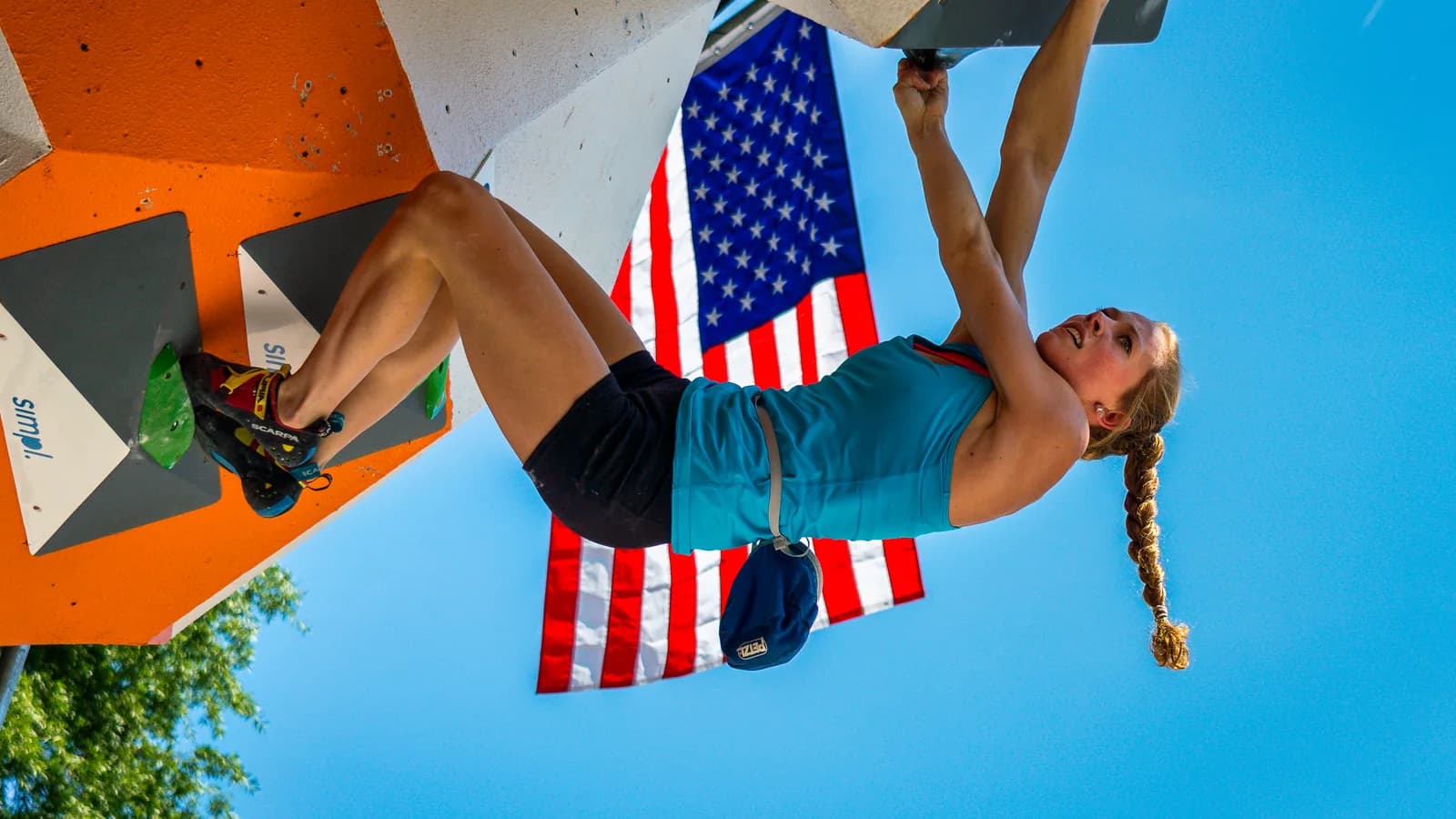
Bouldering is climbing without ropes on walls or rocks low enough that falling off is expected rather than catastrophic. Indoors that means four to five metres over thick matting; outdoors it means a rock a few metres high with portable pads underneath and somebody watching your landing.
A single climb is called a problem rather than a route, and the word is exact: a boulder problem is a puzzle with a physical answer. Working out the sequence — which foot, which hand, where the weight goes — is most of the activity, and it is why bouldering appeals so strongly to people who did not think of themselves as sporty. Strength helps and technique helps more.
The difference from roped climbing is not only equipment. Bouldering is short and maximal, closer to gymnastics than to endurance; sessions are 45 to 90 minutes because that is how long you can pull hard; and you can turn up alone, which is the single biggest reason it has grown faster than the rest of the sport.
Step 1: Turn up at a wall and hire shoes
No induction is required for bouldering at most walls — you sign a form, watch a short safety video and start. Go on a weekday evening if you would rather it were quiet.
You will know it worked when: You are climbing within twenty minutes of arriving.
Step 2: Start on the easiest circuit and stay there longer than you want to
The easy problems are where the movement is learnable, because they are not asking for strength you do not have. Climbing ten easy problems well teaches more than failing on one hard one.
You will know it worked when: You start moving rather than hauling.
Step 3: Learn to fall before you need to
Land on both feet with bent knees and roll backwards onto your back. Do not put a hand down to catch yourself — wrists break that way. Do not land stiff-legged. Practise dropping from low on the wall until it is automatic.
You will know it worked when: Falling stops being an event.
Step 4: Use your feet
The universal beginner fault is climbing with the arms and treating feet as passive. Legs are stronger and do not tire in the same way. Watch where you put your feet, weight them properly, and let your arms hold position rather than pull.
You will know it worked when: You last more than twenty minutes.
Step 5: Stop before your fingers are tired, for the first six months
This is the most important thing on the page and the hardest to obey. Muscles adapt in weeks; finger tendons and pulleys take many months to a year. Almost everyone who takes up climbing enthusiastically at 30 has a finger injury by month four because they got strong faster than their connective tissue did.
You will know it worked when: You are still climbing in a year.
Bouldering has the shortest equipment list of any climbing discipline, and that is most of why people start with it. Indoors you need two things, one of which you can hire. The list only grows if you go outside.
Indoors, in the order you will buy it:
- Climbing shoes — £60–£120, or hired for a few pounds a session. Buy a flat, comfortable, neutral pair — not the downturned aggressive shape a strong climber wears. They should be snug with no dead space at the toe, but a first pair that hurts is a first pair you will stop wearing. Leather stretches up to about half a size; synthetic barely does.
- Chalk and a bag — £15 for both. Loose chalk, a block, or a ball inside a bag. Some walls require a ball or liquid chalk to keep airborne dust down, and increasingly some require liquid chalk only. Chalk dries the hands; it does not improve grip on a hold you cannot hold.
- A brush — £4. Boar bristle. Chalk builds up on holds and makes them worse for everybody, and brushing the holds you have just used is both practical and the main piece of gym etiquette that costs money.
- Skin care — A nail file and a balm. Skin is a beginner’s actual limit far more often than strength is: torn flappers end sessions and take a week to heal. Filing calluses flat before they catch prevents most of it.
- Tape — For splits and tweaked fingers. Worth knowing that taping a painful finger to keep climbing on it is how a minor pulley strain becomes a long one.
Outdoors the list changes completely, and the added items are the ones that keep you uninjured rather than the ones that help you climb. A crash pad (£120–£250) is not optional on anything above head height; two pads and somebody to move them is the normal arrangement. A stiff brush on a pole, a towel to clean your shoes before you step on, and a guidebook or topo complete it.
What you will not need for a long time: a hangboard, a weight belt, or anything designed to train finger strength. Fingers are the tissue that adapts slowest and is injured most, and hangboarding inside the first year is the most reliable way to acquire a long-term injury from a hobby you have just started.
Outdoors, the additional considerations the BMC sets out:
- Pads and where they go — Pads reduce landing impact and protect the ground from erosion. Pad the landing as well as you can, and be aware of where you will land before you commit to a move.
- Spotting is not catching — A spotter’s job is to cushion the falling climber’s back with both hands and stop them going over backwards — steering the fall onto the pad, not arresting it. An inattentive spotter is worse than none, because the climber is relying on them.
- Go with somebody — The BMC is explicit that bouldering with others is safer: more pads, mutual spotting, and somebody to get help. Outdoor bouldering alone with one pad is how a twisted ankle becomes a serious problem.
- Rock and conditions — Wet or damp rock is dramatically less grippy and some rock types — sandstone especially — are damaged by being climbed on when wet. Check conditions and local access notes before travelling.
- Problem
- A single boulder climb. Called a problem rather than a route because working out the sequence is the substance of it.
- Beta
- Information about how a problem is climbed — the sequence of moves. Unsolicited beta is a minor social offence.
- Send
- To complete a problem cleanly from start to finish without falling off.
- Flash
- To send a problem on the first attempt, having had beta. Doing it first try with no information is an onsight.
- Project
- A problem you cannot yet do and are working on across sessions.
- Crimp
- A small edge, and the grip used on it with fingers bent sharply. A full crimp with the thumb over the index finger is the highest-force and highest-risk grip.
- Sloper
- A rounded hold with no positive edge, held by friction and body position rather than by grip.
- Heel hook
- Using the heel as a third point of contact to pull with the leg rather than the arms.
- Dyno
- A dynamic move where both hands leave the wall — a jump between holds.
- Spotting
- Standing behind a boulderer to steer their fall onto the pad and stop them going over backwards. Not catching them.
- Top out
- Finishing an outdoor problem by climbing over the top of the boulder rather than stopping at the last hold.
- Font grade
- The Fontainebleau grading scale — 4, 5, 6A, 6B+, 7A and upwards — used across most of Britain and Europe.
Bouldering has at least three grading systems in common use and British walls frequently use a fourth of their own invention. This is the thing beginners find hardest to get a grip on, and no wall explains it.
| System | Looks like | Where you meet it | Notes |
|---|---|---|---|
| Font (Fontainebleau) | 4, 5, 6A, 6B+, 7A… | Most British and European walls and crags | The default in the UK. Open-ended upwards; letters and + signs subdivide each number |
| V-scale (Hueco) | V0, V1, V2… V17 | American walls, and some UK walls | Roughly V0 ≈ Font 4, V4 ≈ Font 6B, V8 ≈ Font 7B — but conversions are approximate and argued about |
| British technical | 5a, 5b, 6c… | Older British guidebooks, mostly for routes | Describes the hardest single move rather than the whole problem |
| Wall colour circuits | Green → yellow → orange → red… | Very many UK walls | Entirely local. A "red" at one wall may be two Font grades from a "red" at another |
Three things worth knowing. Grades are consensus, not measurement — they are argued into existence by the people who climb the problem, and they drift. Indoor and outdoor grades are not comparable; the same number outdoors is almost always harder, because outdoor holds do not have a colour telling you they exist. And colour circuits are internal to one wall, so comparing your grade between venues is meaningless and comparing it to somebody else’s is worse.
The practical advice is to ignore grades for the first few months. They matter for choosing what to try next at your own wall and for very little else, and beginners who chase a number climb badly and get hurt.
- Do not walk under a climber — The single rule. The matted area under somebody on the wall is theirs until they are down.
- Do not sit on the mats — They are a landing zone, not seating. Every wall has benches.
- Take turns, and do not hog a problem — If somebody is working a problem, let them have their attempts and take yours between. Sessions are shared.
- Beta is offered, not imposed — "Beta" is information about how a problem is done. Telling somebody the sequence when they did not ask removes the part they came for. Ask first.
- Brush the holds — Chalk and skin build up and make holds slippery for the next person. Brushes are provided and using one takes ten seconds.
- Chalk sparingly — Loose chalk fills the air and the lungs of everybody in the room. Many walls now require chalk balls or liquid chalk for exactly this reason.
- Indoor bouldering — Where nearly everybody starts and where most people stay. Set problems on colour-coded holds, reset every few weeks, graded by the setters rather than by consensus. The reset cycle is the thing that makes it sustainable as a weekly habit and is invisible from outside.
- Outdoor bouldering — The same movement on real rock, with no marked holds, no grade painted on the wall and a pad you carry in. The grades are harsher, the landings are the problem rather than an afterthought, and the skill that transfers least well from indoors is reading a blank piece of rock.
- Circuit bouldering — The Fontainebleau tradition: numbered circuits of many easy-to-moderate problems linked as a day out, rather than a handful of hard ones. A different sport in effect — volume and endurance rather than maximal moves — and the most approachable way into outdoor bouldering.
- Highball — Problems tall enough that the fall is the defining feature. It sits on the boundary with roped climbing and the risk is not the same as the rest of the discipline; it is named here so that a reader understands it is a separate decision rather than simply a bigger version of the same thing.
- Board climbing — Steep adjustable training boards with app-shared problem sets, standardised so a problem climbs identically in another country. Enormously popular, extremely specific, and a compressed, high-intensity form that rewards people who already climb rather than people starting.
- Competition bouldering — Timed rounds on unseen problems, with modern setting that favours coordination and jumping as much as strength. Has its own youth structure through the national federations, and it is the version most people have seen on television without knowing it is a specialism.
- Still deciding — Bouldering vs roped indoor climbing
- Climbing three or four times a week from a standing start — The characteristic beginner error, and the reason for the characteristic beginner injury. Muscle adapts in weeks; tendon and pulley tissue takes months, and enthusiasm arrives long before either. Two sessions a week for the first few months is not caution, it is the schedule that keeps you climbing in year two.
- Pulling with the arms — Almost everybody climbs with their arms at first and gets tired in fifteen minutes. Bouldering is a legs-and-feet activity with hands for balance: watch where good climbers put their feet rather than what their hands are doing.
- Full-crimping everything — The strongest grip and the one that loads the finger pulleys hardest. An open-handed grip feels weaker and is far kinder, and building the habit early is worth more than a grade.
- Treating grades as a scale of ability — Wall colour circuits are set by one person for one wall and are not comparable between venues, let alone with outdoor grades. Chasing a number across gyms measures the setter, not you.
- Jumping down instead of climbing down — Ankles and wrists are the injuries that actually happen, and most of them happen on the descent, from a controlled top-out that turned into a jump. Downclimbing is also the cheapest training available.
- Landing badly — Falling is part of the activity and there is a way to do it: land on both feet, let the knees bend, roll back, keep the hands off the mat. Sticking an arm out to break a fall is how wrists break.
- Standing under somebody — Mats are shared and falls are unannounced. Look up before you walk across a landing zone, and do not sit at the base of a wall somebody is on.
- Skipping the warm-up — Cold fingers on small holds is the other route to a pulley injury. Ten minutes of easy climbing before anything hard, every time.
Bouldering began as training. Climbers practised moves on low rocks to prepare for real routes, and treated it as a means rather than an end — the sandstone of Fontainebleau, south of Paris, was being used this way from the late nineteenth century by climbers preparing for the Alps.
It became a sport in its own right largely through John Gill, an American gymnast-turned-climber who from the late 1950s argued that difficulty on short problems was worth pursuing for itself, brought gymnastic movement and chalk to climbing, and is generally credited with establishing bouldering as a discipline rather than an exercise.
The growth since has been driven by infrastructure rather than by mountains. Dedicated indoor bouldering centres — no ropes, no partners, no induction, open late — appeared in numbers from the 2000s, and they made climbing an activity you could do after work on your own. Sport climbing’s Olympic debut in 2020, with bouldering as one of its three components, arrived after that growth rather than causing it.
- Do I need to be strong to start?
- No, and the belief that you do keeps a lot of people away. Every wall sets problems at the bottom of its range specifically for people with no climbing strength, and technique — where your feet go, where your weight is — makes far more difference than pulling power for the first year. What is true is that you will discover muscles in your forearms and back that you had not previously been introduced to.
- Is it dangerous?
- Less than its reputation and not negligible. Indoors, the injuries are overwhelmingly ankles and wrists from bad landings, which learning to fall largely prevents. The more insidious risk is finger pulley injury from climbing too hard too early — extremely common in the first two years and the reason to hold back when you feel able to pull more. Outdoors adds real landing hazards and is where a spotter and adequate pads matter.
- What do the colours at my wall mean?
- Whatever that wall decided. Colour circuits are entirely local: a red at one centre may be two Font grades away from a red at another, and neither maps reliably onto the Font or V scales. Use them to pick your next problem at your own wall and do not try to convert them into anything.
- Can I go on my own?
- Indoors, yes — this is the main practical advantage bouldering has over roped climbing, and turning up alone is completely normal. Outdoors, the British Mountaineering Council recommends going with others: more pads, mutual spotting and somebody to get help, which matters a great deal when you are a mile from a road.
- How often should I climb?
- Two or three sessions a week with rest days between, for at least the first six months. The limiting factor is not fitness or motivation but tendon adaptation, which happens over months rather than weeks. Climbing four or five days a week as a beginner is the single most reliable route to a finger injury that stops you climbing at all.
Guides
Longer answers to questions this page can only summarise.
Within this activity
Disciplines, variants and techniques that sit inside it.
Variants
- Outdoor bouldering — Bouldering on real rock, where pad placement, spotting and reading the landing are the new skills.
If you like this
Each of these is here for a stated reason, not because it is also a hobby.
Progresses to
- Indoor climbing — Roped climbing at the same wall. Adds a partner, a belay qualification and endurance over power — the natural move for boulderers who want longer routes.
- Sport climbing — Outdoor bolted routes, where the movement transfers directly and the rope work is the new skill.
Similar to
- Downhill mountain biking — Both are graded, consequence-carrying sports practised at built venues where the grading is set by the people who built the thing, and where reading the grade honestly is the safety decision the whole activity rests on.
- Wing foiling — Both concentrate the whole difficulty into a short, repeated, failure-heavy learning period, and both reward people who are comfortable being visibly bad in public for a fortnight.
Goes well with
- Calisthenics — The standard off-wall training for climbers, and the one that builds the pulling strength bouldering demands without the finger load.
- Yoga — Climbers take up yoga for hip mobility and shoulder stability more than for anything else, and the two load the body in almost opposite ways.
Indoor alternative
- Mountaineering — Not a substitute for the mountain, and useful for the thing it genuinely trains: movement on rock, in a place where failing costs nothing and you can go twice a week in February. The strength transfers less than people hope and the comfort on holds transfers more.
Outdoor alternative
- Scrambling — The same hands-on-rock movement in the mountains, with far less equipment and much more consequence to a fall.
Sources for this section
- Bouldering outdoors for the first time (opens in a new tab) — British Mountaineering Council · Governing body · read — supports the claim
- The Countryside Code (opens in a new tab) — Natural England and Natural Resources Wales · Governing body · read — supports the claim
Comprehensive
Last reviewed 2026-08-13. Cost, time and difficulty figures on this page are HobbyHQ estimates — see how we work. Something here wrong or out of date? Tell us.