Water sports
Wing foiling
Wing foiling arrived properly around 2019 and grew faster than any wind sport before it, because it needs less space than kitesurfing, less wind than windsurfing, and no fixed rig at all. What it does need is a fortnight of falling in. This page covers what the three objects do, the order the skills come in, and the judgement about conditions that separates the sport from a rescue — and it stops short of tactics, because the honest answer to "can I teach myself" is no.
Also known as wingfoiling, wing surfing, winging, wing foil.
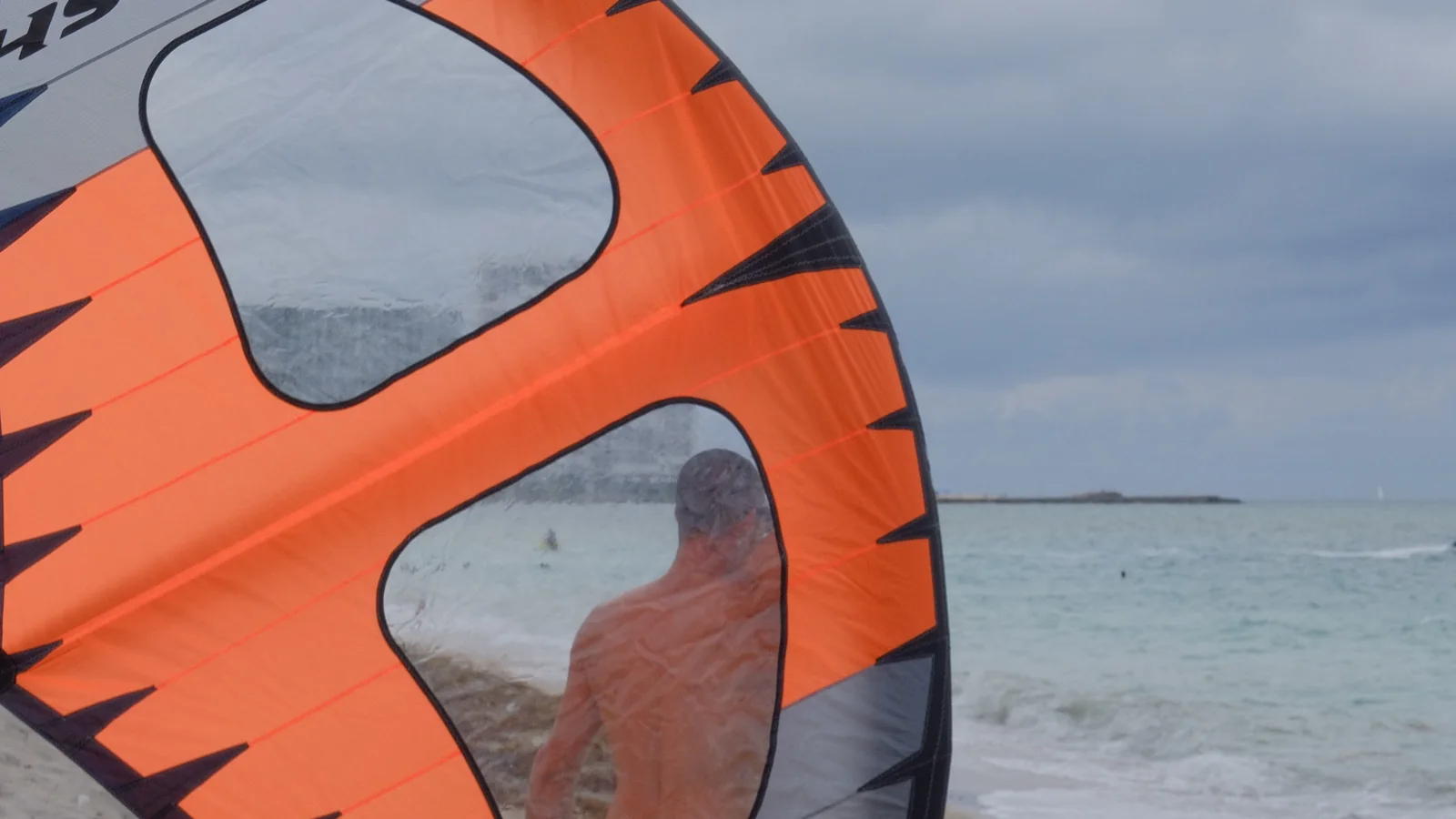
Wing foiling is three separate objects that only make sense together. You hold an inflatable wing in your hands — not attached to the board at all — and stand on a board with a hydrofoil bolted underneath it. Below a certain speed the board floats and behaves like a very thick paddleboard. Above it the foil generates enough lift to raise the whole board clear of the water, and the sport becomes what people watch it for: near-silent, almost frictionless, and unnervingly smooth.
The reason it spread so fast is that it removed the things that made the older wind sports hard to arrange. There is no rig to assemble and no lines to lay out, so launching is a matter of carrying two objects to the water. It works in a smaller space than kitesurfing and in lighter wind than windsurfing, because the foil does the work that wind speed used to. And because the wing is simply held, it can be depowered by letting go of one hand — which is the single most important thing about it for a beginner.
The cost is concentrated in the learning. There is a period, usually reckoned in sessions rather than weeks, where you are managing a wing, a board and a foil simultaneously and failing at all three. Almost everybody describes the same shape: frustrating, then abruptly not.
- What is attached to the board
- Nothing but the foil and your leash
- Typical learning wind
- Steady cross-shore, moderate
- The first purchase
- A lesson, not a board
- The hard part
- The first fortnight, and then it stops
The first milestone is a sustained flight, and everything before it feels like failure. The second is the jibe — turning without coming off the foil — which typically takes considerably longer than the first flight and is where people plateau.
After that the sport branches. Some riders go towards waves, using the wing to get onto a swell and then depowering to surf it, which is where wing foiling becomes something the older sports cannot do. Some go towards distance and speed, with smaller front wings and downwind runs. Some go towards freestyle and jumping. A distinct branch is downwinding, which is closer to an expedition than a session and is where the sport is currently developing fastest.
The kit follows the branch rather than leading it, and the sensible pattern is to change one component at a time — usually the front wing first, since it changes the character of the ride more than anything else on the setup.
Step 1: Book a lesson before you buy anything
Two or three days at a school, kit included. Besides being the safe route, it is the cheap one: you will discover what board volume and wing size suit you before spending four figures on guesses, and schools sell ex-demo kit to people who have just learned on it.
You will know it worked when: You have flown a wing on land and been in the water with the kit.
Step 2: Learn the wing on the beach, without the board
Standing on sand, feeling how sheeting in and out changes the pull, learning that one hand off means the power goes away. This is dull and it is the foundation of everything; people who skip it spend their first water session fighting the wing instead of learning the board.
You will know it worked when: You can hold the wing neutral and power it on demand without thinking.
Step 3: Ride the board without the foil, or with the foil and no wing
Schools split the problem in two because three unfamiliar things at once is not a learnable situation. Kneeling and standing on a big board with a wing, or towing/paddling onto a foil without one — either way, one variable at a time.
You will know it worked when: You can stand and steer with the wing, on the water, off the foil.
Step 4: Get up on the foil, briefly, and fall off
The first flights last a second or two and end abruptly. This is the fortnight everybody talks about. The skill being learned is pitch control — the foil pitches up and breaches or pitches down and stalls, and the correction is with your feet and your weight, earlier and smaller than instinct suggests.
You will know it worked when: You have flown, however briefly, and know what breaching feels like.
Step 5: Sustain a flight, then turn
Holding height is the moment the sport becomes what you came for. Turning while foiling — the jibe — is the next plateau and is a considerably longer project than the first flight was.
You will know it worked when: You can ride out and come back without stopping.
- The wing — An inflatable handheld sail with a leading edge and a strut, held by handles or a boom. It is your engine and your throttle: sheeting in powers it up, sheeting out spills the wind, and letting go with one hand depowers it almost entirely. Sizes run roughly 3m² to 6m² for adults, and the size you want is a function of wind strength and your weight — most people end up owning two. A bigger wing is not an easier wing in strong conditions.
- The board — Volume is what matters, not length, and for learning you want a great deal of it — enough to stand on and balance while stationary, which usually means well above your body weight in litres. Sinky low-volume boards are what experienced riders use and are actively hostile to beginners, because they require you to be foiling already to be stable. This is the single most common bad second-hand purchase in the sport.
- The foil: front wing — The part that generates the lift, and the part that changes the character of the whole setup. A large front wing lifts at low speed and is forgiving and slow — which is exactly what a learner needs. A small one is fast and demanding. Beginners are routinely undersold on front wing area because the big ones look unglamorous.
- The foil: mast, fuselage and stabiliser — The mast sets how far above the water you ride and how much depth you need; a shorter mast is more forgiving of shallow water and of touching down. The fuselage joins the parts and its length affects pitch stability — longer is steadier. The rear stabiliser trims the whole thing, and it is the component people experiment with last and understand least.
- Leashes, both of them — One to the board and one to the wing. The RYA notes a coiled board leash helps prevent excess length catching under your feet or around the foil, which is a foil-specific problem rather than general watersports tidiness. Waist and ankle attachment both have advocates; a school will tell you what they teach and why.
- Impact vest, helmet and wetsuit — The impact vest or buoyancy aid keeps you afloat and protects your torso, which matters because the object you are most likely to hit is your own board. A helmet is standard practice. The wetsuit is thicker than you would choose for the air temperature, because you will be in the water far more than on it.
The specific hazards, and what each one actually is:
- Your own foil — The dominant injury source and the one beginners underestimate, because it is invisible under the water and it is sharp. Falling flat and away, rather than down and forward, is a taught skill.
- Separation from the board — A board without a rider travels downwind quickly. This is why the leash is not optional equipment and why leash wear is checked rather than assumed.
- Offshore wind — Wind blowing from land out to sea is flat and inviting near the beach and takes you steadily away from it. Treated here as a condition to be avoided while learning rather than a situation to be handled, because the recovery requires a competence the learner does not yet have.
- Cold — A British session involves a great deal of time in the water rather than on it, particularly early on. Wetsuit thickness is a safety decision rather than a comfort one, and the failure mode is losing the hand function you need to hold the wing.
- Other water users — A foiling rider is fast, quiet and carrying a blade. Swimmers and paddlers will not hear you and cannot predict you; the burden of separation is entirely yours.
- Foilingalso: flying
- Riding with the board clear of the water, supported entirely by the hydrofoil below it. The point of the sport, and the thing that takes a fortnight to reach.
- Breaching
- The front wing coming too near the surface and losing lift, dropping the board abruptly. Caused by riding too high, and the reason pitch control is the first real skill.
- Porpoising
- The up-and-down oscillation produced by correcting pitch too late and too hard. Every learner does it; it disappears when corrections get smaller rather than better timed.
- Sheeting in and out
- Rotating the wing to catch more or less wind — the throttle. Sheeting out, or simply releasing a hand, is how a rider gets rid of power in a hurry.
- Volume
- The board's displacement in litres, and the number that decides whether a beginner can stand on it stationary. The single most important specification when buying a first board.
- Front wing
- The main lifting surface of the foil. Large area means early lift and forgiving behaviour; small area means speed and demands. Not to be confused with the handheld wing.
- Mast
- The vertical strut joining the board to the foil. Its length sets ride height and how much water depth you need underneath you.
- Jibe
- A downwind turn made without touching down. The plateau after the first sustained flight, and a much longer project than getting up was.
- Cross-shore
- Wind blowing along the beach rather than onto or off it. The condition schools teach in, because it lets a rider go out and come back without either being pinned to the shore or taken away from it.
- Buying a low-volume board because it looks like the ones in videos — The commonest and most expensive beginner error. Those boards require you to already be foiling to be stable. Buy far more volume than looks right and sell it in a year — it will hold its value, because the next beginner wants it too.
- Buying a small front wing — Same mistake, other end of the setup. A large front wing lifts early and forgives everything; a small one demands speed you cannot yet generate.
- Buying the whole kit before the first lesson — You do not yet know what wing size suits your weight or what board volume you need, and both answers cost hundreds of pounds to get wrong.
- Fighting the wing instead of depowering it — The wing is not attached to anything. Letting go with one hand solves a startling proportion of the situations beginners try to muscle through.
- Overcorrecting on the foil — Foil pitch responds later than you expect and further than you expect, so instinctive corrections arrive too big and too late and produce the porpoising every learner does. Smaller and earlier.
- Going out in offshore wind because it looks flat — It looks like the easiest day of the month from the beach. It is the one that takes you away from it.
- Learning alone to save money — The thing a school teaches first is how to fall away from a metal blade. That is not a lesson worth reverse-engineering.
Wing foiling has an unusually long and unusually frustrating first phase, and much of that frustration is conditions and equipment rather than the rider. Sorting which is which is the useful thing this section can do; it does not teach the movements, for the reason the page gives in full elsewhere.
- I cannot get up on the foil at all — Check the three things that are not you, first. Is there genuinely enough wind for your wing and your weight; is the board big enough to be stable while you are learning; and is the foil a large low-aspect one made for early lift rather than a small fast one. A great many people spend a season fighting equipment that is a stage ahead of them. Next, if all three are right, this is coaching rather than reading — the skill is foil pitch control and it is a modulated force judged by feel, which this page deliberately does not attempt to teach.
- I get up and then it launches me over the front — Breaching, or over-foiling. The front wing has come too close to the surface and lost lift, or the whole foil has come out. Check whether it happens as you accelerate — that is the classic pattern. Next, it is a pitch control problem and a corrected-earlier-and-smaller one, which is a coached skill.
- The wing keeps collapsing and folding — Usually inflation pressure or the angle you are holding it at. An underinflated leading edge folds in gusts and feels unstable in a way people attribute to their own handling. Check the pressure against the manufacturer’s figure, cold, before you go out — it drops in cool water. Next, if the pressure is right, the wing is being flown too far off the wind and stalling, which is a handling matter for an instructor.
- I am exhausted after twenty minutes — Almost always gripping too hard and using arms rather than the harness of your body position. Beginners hold on as though the wing might escape. Check your forearms the next day — if they are the sorest thing, that is the answer. Next, it resolves with time on the water rather than with strength training.
- Something is loose, or clicking, under the board — Stop, and check the foil hardware before the next session. Foil bolts work loose, the mast-to-fuselage joint in particular, and a foil that separates at speed is a serious matter with sharp components involved. Check every bolt to the manufacturer’s torque, and rinse the assembly — salt corrosion between dissimilar metals is what seizes and weakens them. Next, this is a maintenance habit rather than a repair, and it is the one piece of kit on which a check before every session is genuinely warranted.
- I am being blown away from the beach — A conditions and location problem, and it is where this page stops. Offshore wind, tide and how far you can be carried are not troubleshooting items. Next, the safety section covers the boundary and this page publishes no self-rescue procedure, because a reader who has read about one has confidence and not capability.
- Freeride — Riding back and forth, turning, and going where you like. What almost everybody does and what almost every equipment recommendation is aimed at, even when it does not say so.
- Wave riding — Using the wing for power to get out and to position, then riding the swell itself with the wing depowered. A different skill, closer to surfing, and the direction many riders drift once flight is secure.
- Downwind — Long point-to-point runs riding open-water swell, increasingly with a very small wing or none at all. The most demanding branch by a distance — it needs a plan for getting back and the water-safety considerations on this page apply hardest here.
- Freestyle — Jumps, rotations and board-offs. Overlaps heavily with kitesurfing and windsurfing culture and demands equipment built for the impacts rather than for efficiency.
- Racing and course riding — Long high-aspect foils and specialised boards around a marked course. Small in Britain, technical, and where a great deal of the equipment development happens before it reaches everybody else.
- Flat water and light wind — Sheltered water with a large wing and a large foil. The most efficient way to learn, the friendliest to a first season, and where a rider should spend far longer than the videos suggest.
- The neighbouring foil sports — Wing foiling shares a foil and very little else with prone surf foiling, kite foiling, tow foiling and pump foiling. Named here because the equipment marketplace mixes all of them together and a beginner cannot tell which board they are looking at.
- Still deciding — Wing foiling vs kitesurfing
Wing foiling is young enough that its culture is still borrowed. Most people at a launch site came from windsurfing, kitesurfing or surfing within the last few years, which makes the beaches unusually friendly to beginners — almost everyone there remembers being one, recently. It also means the equipment conversation is unusually intense, because the kit is genuinely still changing year to year rather than as a marketing exercise.
The etiquette is inherited from the sports it drew from, and the parts that matter are about space. A foiling rider is fast and silent and carrying something sharp, so the responsibility for separation sits with the person on the foil, always. Rights of way follow the usual sailing conventions, but the practical rule at a busy spot is to give far more room than the rules require, because a foil at speed is not a thing to be near.
Competition exists at international level, in racing and freestyle formats, and Olympic windsurf-foil racing has pulled attention towards the discipline generally. But the sport is overwhelmingly recreational, and the social unit is a group of people at a beach watching a forecast together.
- Can I teach myself wing foiling?
- You can, and the sport is close to unanimous that you should not. The reason is not the wind — it is that you spend the first fortnight falling off a board with a metal foil under it, and the first thing a school teaches is how to fall away from it. Lessons also save money in a way that is easy to miss: you find out what board volume and wing size suit you before spending four figures, and schools sell ex-demo kit to people who have just learned on it.
- How long does it take to get up on the foil?
- Most people get brief flights within two to four days of tuition and can sustain a ride within a handful of sessions after that. The commonly reported shape is that it feels impossible and then abruptly does not. Turning while foiling takes considerably longer — expect the jibe to be a project of months rather than sessions.
- How much wind do I need?
- Less than windsurfing, because the foil does work that wind speed used to. What matters more than strength is steadiness and direction: schools teach in cross-shore wind, which lets you go out and come back. Offshore wind is the one to avoid while learning — it looks flat and inviting from the beach and takes you away from it. Which days are rideable at a given spot is a local judgement, and the club or school on that beach is the place to get it.
- What should I buy first?
- A lesson. After that, buy second-hand and buy far more board volume and far more front-wing area than looks right — the beginner-friendly kit is cheap precisely because experienced riders are selling it, and it holds its value because the next beginner wants it too. A complete second-hand setup is £900–£1,800 against £2,000–£3,500 new.
- Is it dangerous?
- It carries real risk and it is manageable risk. The dominant injury source is the rider's own foil rather than anything environmental, which is why the equipment answer is an impact vest and helmet and the technique answer is a taught fall. The RYA's equipment guidance is built around keeping a separated rider attached to their board and wing, with a coiled leash specifically to stop excess length catching around the foil. Check leashes before every session, do not learn alone, and tell somebody ashore what you are doing.
- Do I need to be very fit?
- You need to be a confident swimmer far more than you need to be strong. The physical demand is front-loaded into the learning period, where you are repeatedly getting back onto a board; once foiling, the loads are light and the ride is smooth, and a good many riders find it kinder on joints than windsurfing or surfing. The unglamorous barrier for many people is carrying the kit to the water in wind.
If you like this
Each of these is here for a stated reason, not because it is also a hobby.
Similar to
- Bouldering — Both concentrate the whole difficulty into a short, repeated, failure-heavy learning period, and both reward people who are comfortable being visibly bad in public for a fortnight.
- Triathlon — Kit-heavy, weather-bound and expensive to get wrong, with the same tendency to spend on equipment what would have been better spent on coaching.
Shares equipment with
- Wild swimming — The same wetsuit, the same cold-water competence, and the same habit of reading a tide table before leaving the house.
Sources for this section
- Wing Leashes — Safety Equipment (opens in a new tab) — Royal Yachting Association · Governing body · read — supports the claim
- Weather and Tides (opens in a new tab) — Royal Yachting Association · Governing body · read — partly supports
Substantial
Last reviewed 2026-08-16. Cost, time and difficulty figures on this page are HobbyHQ estimates — see how we work. Something here wrong or out of date? Tell us.