Endurance & fitness · Water sports
Triathlon
Triathlon has a reputation for being expensive and intimidating, and it earns about half of it. The bike costs what you let it cost. The swim is the real barrier, and it is not a fitness barrier — it is that open water in a crowd is nothing like a swimming pool, and almost nobody enjoys their first one. Knowing that in advance is most of what a first-timer needs.
Also known as tri.
A triathlon is a swim, a bike ride and a run, completed in that order, against a single clock that does not stop while you change between them. That last detail is what makes it a sport in its own right rather than three sports on the same afternoon: the transitions are timed, they are practised, and the ability to ride well on legs that have just swum — and run on legs that have just ridden — is a specific trainable thing that nobody discovers by accident.
The distances are standardised enough to plan around. A super-sprint or pool-based event is the gentlest entry, often with a swim of a few hundred metres. A sprint is the standard first race: broadly a 750m swim, 20km bike and 5km run. Standard or Olympic distance roughly doubles that. Middle and long distance — the branded ones people have heard of — go up to a full marathon at the end of a very long day, and are a different commitment in every sense. Exact distances vary between events, so read the entry.
The other thing worth understanding early is that the three disciplines do not contribute equally to your result or to your suffering. The bike takes the most time, the run usually decides the placings, and the swim is where nearly everybody’s anxiety lives — despite being the shortest segment by a wide margin.
- Start here
- A pool-swim or super-sprint eventIt removes cold, crowding and sighting all at once.
- The real barrier
- Open water, not fitness
- What to practise that nobody does
- Transitions, and riding then running
- Bike required
- A roadworthy one, not a fast one
Step 1: Enter a sprint or pool-swim race four to six months out
An entry is the single most effective piece of training equipment in endurance sport. A date makes the training specific, and a sprint is far enough away to prepare for and near enough to stay real.
You will know it worked when: A deadline, and a reason to swim on a Tuesday.
Step 2: Find out where your swim actually is
Not how fit you are — how comfortable you are. Swim continuously in a pool and see what distance you can cover without stopping. Most beginners can run and ride further than they can swim, and the swim is where the training time should go first.
You will know it worked when: An honest baseline rather than an assumed one.
Step 3: Get into open water deliberately, and with supervision
This is a separate skill from pool swimming: no line on the bottom, no wall to hold, limited visibility, cold, and other people’s feet. Go to a supervised open-water venue rather than teaching yourself in a lake. The first session is unpleasant for almost everybody and much better the third time.
You will know it worked when: The component that ends most first-timers’ races is no longer unfamiliar.
Step 4: Ride the bike you have, and make it safe
Working brakes, correct tyre pressure, a helmet that fits. Do not buy a triathlon bike to find out whether you like triathlon. Almost any roadworthy bike will complete a sprint, and the rider matters far more than the machine at every level a beginner will encounter.
You will know it worked when: You are riding rather than shopping.
Step 5: Practise brick sessions
A ride immediately followed by a run. The first ten minutes off the bike feel genuinely strange, your legs do not do what you ask, and the only cure is having felt it before. Two or three of these before race day changes the experience completely.
You will know it worked when: The run off the bike stops being a shock.
Step 6: Rehearse the transitions in your garden
Wetsuit off, helmet on before you touch the bike, shoes, number. It looks trivial and it is where first-timers lose several minutes and most of their composure. Ten minutes of practice is worth more than a week of training here.
You will know it worked when: The race stops containing a puzzle.
- A helmet that fits — Non-negotiable and the first purchase. Fit matters more than price; an expensive helmet worn loose is worse than a cheap one worn properly.
- Any roadworthy bike — A road bike is faster, a hybrid or mountain bike will finish a sprint, and a serviced secondhand bike beats a neglected new one. The bike is where the sport’s reputation for expense comes from and it is the easiest place to ignore that reputation.
- Goggles, and a spare pair — Goggles that leak in open water ruin a swim entirely. Find a pair that seals on you, then buy a second identical pair.
- A wetsuit — hired first — Triathlon wetsuits are cut for shoulder movement and buoyancy, not for warmth alone, and a surfing wetsuit is a poor substitute. Hire before you buy: they are expensive, fit is critical, and one race will tell you whether the sport is sticking.
- A tri suit — Worn under the wetsuit and for the whole race, so you never change clothes. Not essential — shorts and a top work — but it removes the most awkward part of transition.
- Elastic laces — The cheapest meaningful upgrade in the sport. They turn putting your running shoes on into a two-second job with cold hands.
- What can wait indefinitely — A time-trial bike, a power meter, race wheels, a carbon anything. These make measurable differences to people already near their ceiling and no difference at all to a first sprint.
- Work it out — Running pace calculator
- Work it out — Triathlon race plan
The distinctive thing about triathlon is that a race is three sports plus two transitions, and the great majority of first-race disasters happen in the joins rather than in any of the three. People arrive fit enough and lose their day to a wetsuit, a pair of goggles, a chain, or going out too hard on the bike.
That is good news, because logistics is much easier to fix than fitness and almost all of it can be rehearsed at home for nothing.
- You panic in the first two minutes of the swim — Extremely common, including in strong pool swimmers, and it is a breathing response to cold water and crowding rather than a fitness problem. Getting in early to acclimatise, starting at the back or the outside, and swimming the first minute deliberately slowly all reduce it. Rolling onto your back to breathe is allowed and is not a failure.
- Your goggles fill or come off at the start — Put the strap under the swim cap rather than over it, and check the seal before the start rather than at it. This is the single most preventable race-ending problem in the sport.
- The wetsuit feels like it is strangling you — Usually it is too high at the neck or has not been pulled up far enough at the crotch and shoulders, which drags the whole suit down. It takes far longer to put on properly than anybody expects — fifteen minutes, in stages, working the fabric up the limbs. A suit that is comfortable standing still on land is usually one size too big.
- You cannot find your bike in transition — Count racks from a fixed landmark rather than relying on recognising your bike, and walk the entry and exit routes before the race. Everything looks different at speed, wet, and with several hundred identical bicycles gone from the racks around yours.
- Transition takes several minutes — Almost always too much kit laid out. The fastest transitions are the ones with the fewest decisions in them: shoes, helmet, glasses, go. Practise the sequence in a garden until it is automatic, because you will not be thinking clearly at that point in a race.
- Your legs will not run off the bike — Normal, and it passes in the first kilometre or so. It is a genuine physiological transition rather than a sign of poor fitness, and the fix is to expect it, start the run slower than feels right, and let cadence come back before pace does.
- You blow up on the run every time — Usually the bike. Riding at an effort that feels sustainable in isolation is often too hard when a run follows it, and the cost only appears twenty minutes later. Riding the bike leg deliberately easier than you think you can is the commonest advice in the sport because it is the commonest error.
- A mechanical stops you — You are expected to be self-sufficient in most races. Knowing how to change an inner tube, and carrying what that takes, is part of entering rather than an optional extra — and it is worth doing once at home rather than for the first time at the roadside.
- You are penalised for something you did not know about — Drafting, helmet fastening, and where you may and may not mount are the usual ones, and they differ between race organisers and distances. The race briefing exists for exactly this and is worth attending even when it seems like an inconvenience.
- Your stomach turns on the run — Common, and usually the combination of what was eaten on the bike and the change of posture. The general principle is to practise your race-day intake in training rather than trying something new on the day; the specifics are individual and this page does not prescribe them.
The rules a first-timer actually meets
Triathlon has more rules than the other endurance sports, because the bike leg puts a crowd of people at speed on the same road. These are the ones that decide first races.
- Draft-illegal is the default, and the draft zone has a size — Most age-group racing is draft-illegal, and the elite racing on television frequently is not — which is why this is the rule most often misunderstood. Where drafting is forbidden, the zone is defined: "The bicycle draft zone will be 12 metres long measured from the leading edge of the front wheel." You may enter it, but "must be seen to be progressing through that zone", with "a maximum of 25 seconds" allowed to pass. You are passed the moment another competitor’s front wheel is ahead of yours, and once passed you must drop back out of their zone "by continuously making rearward progress".
- What drafting actually costs — A time penalty on the first offence, scaled to the race: 30 seconds in a sprint or shorter, one minute at standard distance, two minutes at middle distance, three at long. Then disqualification — at two drafting violations in a draft-illegal sprint or standard race, and at three in a middle or long one. Non-drafting penalties are shorter: five to ten seconds at sprint distance for things like riding in transition or an uncorrected race-number violation.
- The helmet rule, which is where first races are actually lost — The helmet must be fastened from the moment you take the bike off the rack until after you have put it back, and — the converse, and the one first-timers are penalised for — "The helmet strap must remain unfastened in the Transition Area while the competitor is completing the first segment." Unclipping while still touching the bike is a time penalty unless corrected. Riding inside transition, including over the mount or dismount line, is the same.
- Wetsuits are decided by a thermometer, not by preference — Mandatory below 15.9°C at every distance and every age. Forbidden above 22°C for swims up to 1500m if you are 59 or under, and above 24.6°C if you are 60 or over or the swim is 1501m or longer. The water is measured an hour before the start, "at the middle and two other areas on the swim course, at a depth of 60cm", so the decision genuinely is made on the morning.
- And below 11°C there is no swim at all — "At temperatures below 11°C open water swimming in competition cannot take place." Between there and 14°C the distance is capped rather than the race cancelled: 1000m at 13°C, 600m at 12°C, 300m at 11°C. A shortened swim on a cold morning is the rules working, not the organiser losing their nerve.
- Outside assistance, and the friend with the drink — Outside assistance is a disqualification offence, and it includes somebody handing you a bottle or fixing your puncture. So is unsporting impedance — which the rules define to include "incorrectly racked cycles, discarded equipment and the use of marking devices in transition that impede the progress of others". Marking your spot with a towel is a real offence, not a folk rule.
- What gets a word rather than a penalty — A verbal warning is given where a violation is unintentional, about to happen, or has gained no advantage, and where the thing can be fixed — illegal or banned equipment, an exposed torso, an unfastened zip, and "Littering on the course unless disposed of in specified littering zones provided by the Event Organiser". If you do not fix it, the disqualification follows.
Sources for this section
- British Triathlon Competition Rules (opens in a new tab) — British Triathlon · Governing body · read — supports the claim
Triathlon is a well-organised sport with medical cover and marshals, and the great majority of races pass without incident. The risks that matter are concentrated at the start of the swim and on the bike, and both are manageable if you know they are coming.
- Transition areas are crowded and slippery and are a common site of minor injury. You are not permitted to ride inside them and the rule is a safety one.
- The bike leg on open roads is the highest-consequence part of the race. Ride to the conditions, take corners on wet descents at a speed you would ride alone, and remember that the field around you contains people whose bike handling is worse than yours.
- Hypothermia after a long cold swim is a real risk and it develops after you get out, not during. Dry clothing at the finish is not a luxury.
- Get a medical opinion before starting endurance training if you have a heart condition, are managing a chronic illness, or have been inactive for a long period. NHS guidance sets out what adult activity levels look like and is a sensible baseline to build from rather than jumping straight to race training.
Sources for this section
- Physical activity guidelines for adults aged 19 to 64 (opens in a new tab) — NHS · Institutional · read — supports the claim
- Training the discipline you are best at — Almost universal, because it is more enjoyable. Runners run, cyclists ride, and both arrive at the swim under-prepared. Time is best spent on your weakest leg, which is a much less pleasant training plan and a much better one.
- Never swimming in open water before race day — The single most common cause of a first race going badly. Pool fitness does not transfer cleanly: no wall, no line, no visibility, cold, and a crowd. One or two supervised open-water sessions change the outcome more than a month of extra pool work.
- Buying a fast bike first — It postpones the start, absorbs the budget, and improves a sprint time by less than the rider expects. Race on what you have, then buy the thing you have discovered you want.
- Ignoring transitions entirely — They are timed, they are practisable in a garden, and first-timers routinely lose more time there than any equipment could ever give back.
- Trying new kit or nutrition on race day — New wetsuit, new gels, new shoes, all in one morning. Everything you use in a race should have been used in training first — this is the cheapest rule in endurance sport and the most frequently broken.
- Going out too hard on the bike — The bike feels good because you have just stopped swimming. The run is where that decision gets audited, and it audits harshly.
Triathlon is one sport with a wide range of distances, and the distances are not simply longer versions of each other. What limits you changes as they lengthen: a sprint is limited by how hard you can go, and a long-distance race is limited by pacing, fuelling and whether your body tolerates the hours.
- Super-sprint and sprint — Typically a 400m–750m swim, 10–20km bike and 2.5–5km run. The right first race for almost everybody, frequently pool-based, and short enough that the day is about learning transitions and pacing rather than surviving.
- Standard distance — Around 1.5km, 40km and 10km. The classic format and the one most club racing sits at. Long enough to need fuelling and pacing, short enough to train for around a normal job.
- Middle distance — Roughly double the standard distance. The step where nutrition stops being optional and where training time rises sharply — this is where most people discover whether they want the long end of the sport.
- Long distance — Full-distance racing, most of a day. A different sport in practice: the constraints are fuelling, heat, pacing discipline and durability rather than speed, and the training load reshapes a year.
- Draft-legal racing — Where riders may work together on the bike, used in elite and some age-group racing. It changes the tactics completely and makes bike-handling in a group a required skill rather than an optional one.
- Aquabike, duathlon and aquathlon — Two-discipline formats — swim and bike, run and bike, swim and run. Genuinely useful rather than consolation events: they let somebody with an injury or a weak discipline keep racing, and duathlon is published here separately.
- Off-road triathlon — Open-water swim, mountain bike and trail run. A distinct set of skills, a slower and more technical bike leg, and a noticeably different culture from road racing.
The practical advice that falls out of this: start at sprint distance regardless of how fit you are in one discipline, because the thing being learned first is the race itself — the swim start, the two transitions, and running on legs that have just cycled. None of those get easier at longer distances, and all of them are cheaper to learn over an hour than over a day.
- Still deciding — Triathlon vs duathlon
- T1 and T2
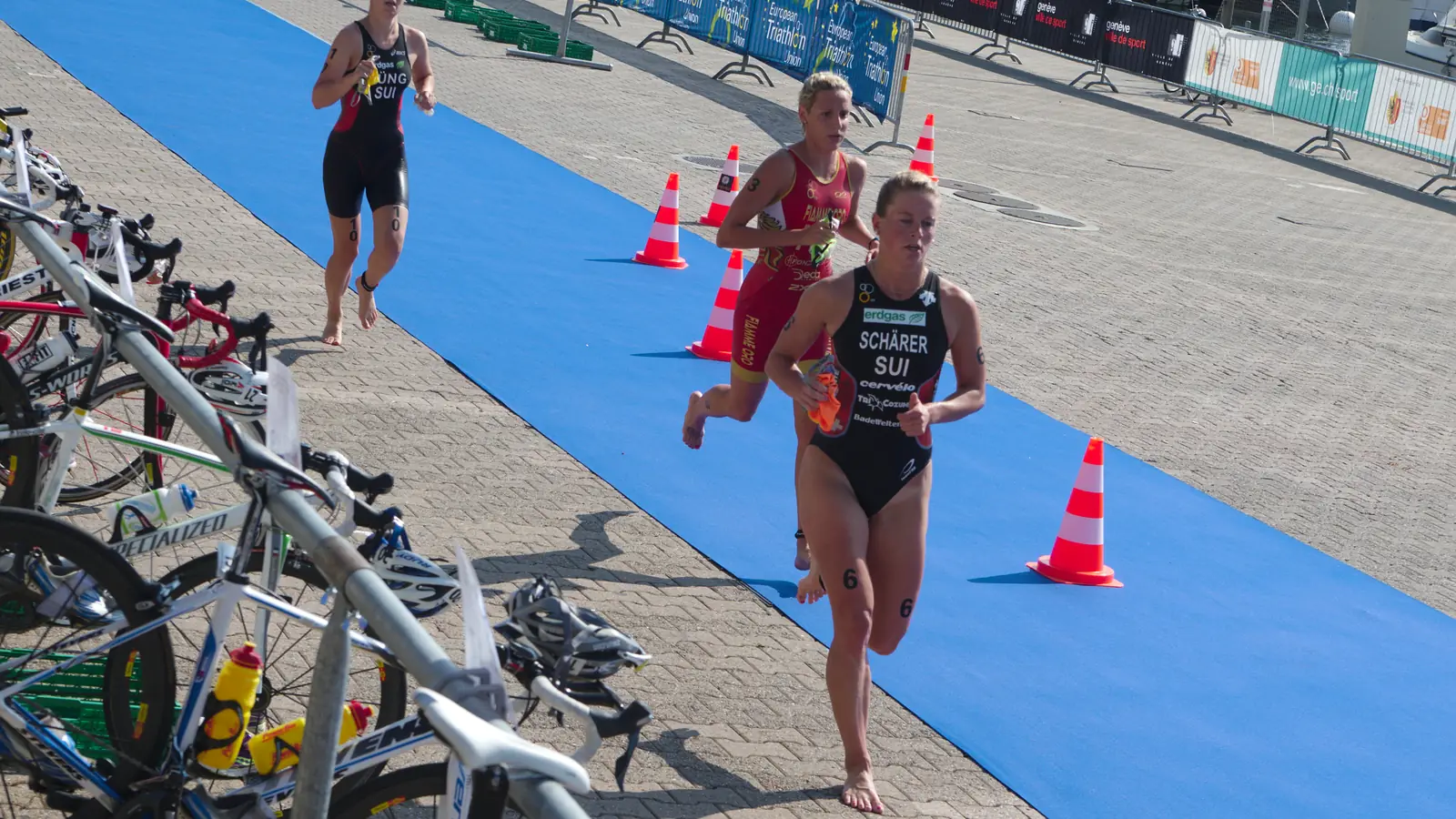
- The transitions: swim-to-bike and bike-to-run. Timed, and part of your result.
- Brick
- A training session combining two disciplines back to back, almost always bike then run. Named for how your legs feel.
- Drafting
- Riding close behind another cyclist to sit in their slipstream. Prohibited in most age-group racing and permitted in some elite formats, which is why the answer is always event-specific.
- Sighting
- Lifting your eyes to check direction during the swim. Nobody needs it in a pool, everybody needs it in a lake, and without it you swim a considerably longer race than the one you entered.
- Age group
- The amateur competition structure, banded by age. Age-group racing is the sport for almost everybody in it, and qualifying for a championship as an age-grouper is a genuine achievement.
- Sprint / standard / middle / long
- The distance ladder. Standard is also called Olympic. The branded long-distance events are a separate commercial ecosystem with their own naming.
- DNF
- Did not finish. Common, unremarkable, and much better than the alternative when something is wrong.
Multi-sport racing has scattered antecedents, but the modern sport is usually traced to southern California in the 1970s, where the format of swim-bike-run was assembled by clubs looking for a change from running races. It spread quickly because it was easy to organise and unusually welcoming to adults who were not going to be good at any single one of the three.
The long-distance branded events arrived shortly afterwards and did most of the work of making the sport famous, which had a lasting and slightly distorting effect: the public image of triathlon is an extreme endurance event, while the overwhelming majority of participation is at sprint and standard distance on a Sunday morning. The sport also professionalised fast at the top, and Olympic inclusion in 2000 gave it a standard distance and a governing structure that filtered down into how amateur racing is organised.
Paratriathlon followed a similar path and joined the Paralympic programme in 2016, with a classification system covering wheelchair users, ambulant athletes and visually impaired athletes racing with a guide. It is a fully developed branch of the sport rather than a recent addition to it.
- Do I need an expensive bike?
- No, and this is the most persistent myth in the sport. Any roadworthy bike with working brakes and a helmet will complete a sprint triathlon, and plenty of people finish their first race on a hybrid or an old road bike. The rider makes far more difference than the machine at every level a beginner will meet. Race first, then buy what you have discovered you actually want — which is a much better-informed purchase than the one the shop would have sold you in January.
- What if I cannot swim well?
- Then that is where the training goes, and it is worth being blunt: the swim is the leg most likely to end a first race, and it is not primarily a fitness problem. Start by finding out how far you can swim continuously in a pool, build that steadily, and then — separately — get into open water with supervision, because the two are not the same skill. If the swim is a genuine barrier rather than a challenge, duathlon is a full sport in its own right with the same racing and none of the water.
- Is the open-water swim actually dangerous?
- The risk is real, concentrated and manageable. Entering cold water causes an involuntary gasp and a surge in breathing rate that is a reflex rather than a matter of nerve or fitness, and it peaks in the first minute or two — which in a mass start coincides with being jostled. Races are covered by kayakers and marshals for exactly this reason. Get in before the start rather than diving in, let the first minute pass with your face in the water, start wide or at the back, and roll onto your back and float if your breathing runs away. Repeated open-water sessions genuinely reduce the response, which is the argument for practising it rather than avoiding it.
- Am I allowed to draft on the bike?
- Usually not, but you must check your specific event. Most age-group racing is non-drafting; some elite and some specific formats are draft-legal, which is why televised racing shows packs of riders that would be illegal in the race you entered. The drafting rule, the permitted distances and the penalties are set by the governing body and the organiser and are revised, so the answer that matters is in your entry pack and race briefing rather than on any general page including this one.
- How long does it take to train for a sprint?
- For somebody with reasonable general fitness who can already swim, three to four months of consistent training — perhaps four to six sessions a week across the three disciplines — is a realistic and unhurried preparation. If the swim needs building from a low base, give it longer and put the extra time there. The training constraint for most adults is not physiology but logistics: a pool, a bike and daylight rarely line up conveniently, and a plan that ignores that fails in week three.
- Do I need a wetsuit?
- For most British open-water racing, yes, and hire one for your first race rather than buying. Triathlon wetsuits are built for shoulder mobility and buoyancy rather than warmth alone, so a surfing wetsuit is a poor substitute, and fit is critical enough that one badly fitting suit will make you miserable for an entire swim. Whether a wetsuit is permitted, compulsory or the swim is shortened depends on the measured water temperature on the day against thresholds set by the governing body and the event.
Guides
Longer answers to questions this page can only summarise.
- Transitions: the fourth discipline, and the only one nobody trainsWhat actually happens in T1 and T2, the rules that catch first-timers, and how to lay out a transition area so the sequence runs itself when you are too oxygen-starved to think.
- Getting better at triathlon after the first oneWhat actually produces improvement once you have finished a race — where the time is, why the bike leg and transitions are the cheapest gains, and the traps of the second season.
Within this activity
Disciplines, variants and techniques that sit inside it.
Variants
- Duathlon — Run, bike, run — triathlon without the swim, and a common way in.
- Cross triathlon — Swim, mountain bike and trail run — triathlon moved off the road entirely.
If you like this
Each of these is here for a stated reason, not because it is also a hobby.
Progresses to
- Cycling — The bike leg is the longest of the three, so cyclists arrive with the discipline already half-built and a swimming problem to solve.
- Half marathon — Where the running becomes one third of the problem, with a fourth skill in the transitions and an equipment bill an order of magnitude larger.
- Marathon running — The obvious next endurance project, and a genuinely different one: three disciplines, a fourth skill in the transitions, and an equipment bill an order of magnitude larger.
- Running — Two more disciplines bolted onto the one you already have, and a way to keep training while a running injury heals.
- Wild swimming — The obvious competitive destination for open water swimmers, and the reason many people start swimming outdoors in the first place.
Similar to
- Ski touring — Both are endurance sports with a genuinely large equipment bill, and both make a trained skill of the transition — changing state quickly, in the cold, without dropping anything.
- Wing foiling — Kit-heavy, weather-bound and expensive to get wrong, with the same tendency to spend on equipment what would have been better spent on coaching.
Goes well with
- Indoor cycling — Triathletes were the earliest serious adopters, because a controllable bike leg that never needs a road fits a three-sport week better than anything outdoors does.
- Indoor rowing — Winter training that keeps the engine without the road, and a familiar way to hold fitness through the months when outdoor volume is unattractive.
Sources for this section
- Physical activity guidelines for adults aged 19 to 64 (opens in a new tab) — NHS · Institutional · read — supports the claim
- Cold shock (opens in a new tab) — National Center for Cold Water Safety · Institutional · read — supports the claim
- Open water swimming safety (opens in a new tab) — Royal National Lifeboat Institution · Institutional · corroborated indirectly
Comprehensive
Last reviewed 2026-08-15. Cost, time and difficulty figures on this page are HobbyHQ estimates — see how we work. Something here wrong or out of date? Tell us.