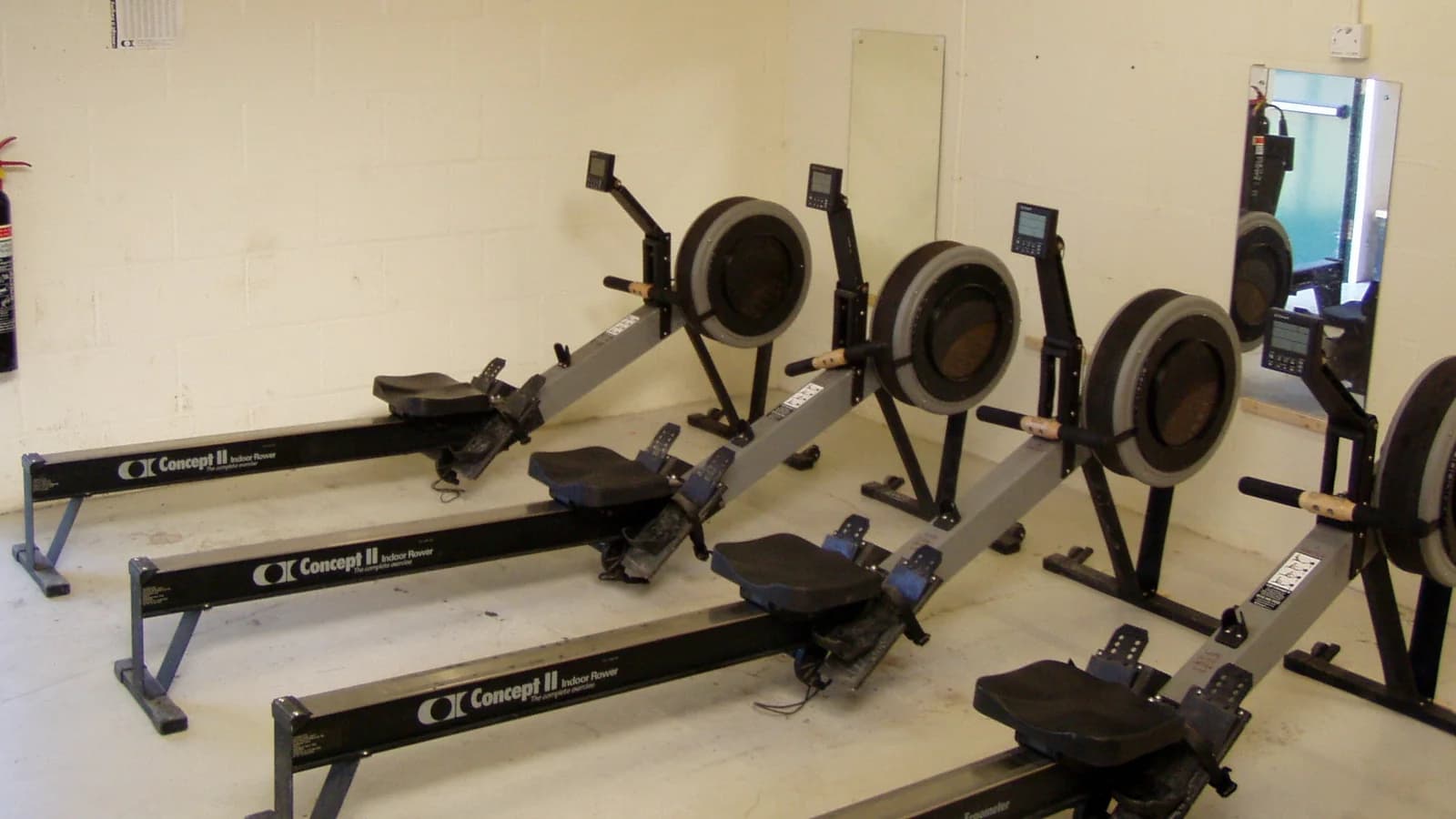
Endurance & fitness
Indoor rowing
The rowing machine is the most honest piece of equipment in a gym: it reports exactly what you did, in watts, and it cannot be cheated. That makes indoor rowing a real competitive sport with world records and a season, and it also makes it unusually easy to hurt yourself with — because the machine will happily let you row badly, hard, for an hour. This page covers the stroke, the numbers, and the one piece of governing-body guidance the machines are never sold with.
Also known as erging, ergometer, rowing machine, concept2.
An ergometer measures the work you do against a flywheel and reports it as a pace per 500 metres, a power in watts, and a stroke rate. Those numbers are directly comparable between machines, between people and between years, which is why the sport has meaningful world records for a piece of equipment that goes nowhere.
The stroke is a sequence and the sequence is the technique. Drive with the legs, then swing the body, then draw the arms; recover in exactly the reverse order — arms, body, legs. Governing-body guidance puts roughly 60% of the power in the legs, 30% in the body and 10% in the arms, and nearly every fault a beginner has comes from doing those in the wrong order or from pulling with the arms first, which both feels harder and produces less.
What the machine is genuinely bad at is stopping you. It offers no feedback about how you are moving, only about how much you produced, so a rower with a collapsing back gets the same encouraging numbers as one without — right up until the point where they do not. That asymmetry is why the safety section below leads with volume rather than with effort.
- The sequence
- Legs, body, arms — then reverse
- Where the power comes from
- About 60% legs
- What the monitor cannot see
- Your back
- A good second-hand machine
- £400–£700
Step 1: Set the damper between 3 and 5 and leave it
It is not a difficulty setting. Most competitive rowers train in this range because it approximates a boat, and a beginner on 10 is loading their back at the catch to no benefit.
You will know it worked when: The machine is set up the way the sport actually uses it.
Step 2: Learn the sequence before doing any volume
Legs, body, arms on the drive; arms, body, legs on the recovery. Practise at a low rate where you can watch yourself do it — the order is the technique and rushing it embeds the fault you will spend a year undoing.
You will know it worked when: A stroke that happens in the right order without thinking.
Step 3: Row short, several times
Four blocks of five minutes with a rest beats twenty minutes continuous, especially at the start. It keeps the stroke intact, and it matches what the governing-body guidance implies about long unbroken sessions.
You will know it worked when: Twenty minutes of rowing, none of it done badly.
Step 4: Meet the numbers
Split is your pace per 500m, rate is strokes per minute, and the relationship between them is the whole sport. A lower rate at the same split means more work per stroke — that is what improving looks like.
You will know it worked when: You can read your own monitor.
Step 5: Take a benchmark you will repeat
2,000m is the standard distance and it is genuinely unpleasant. 500m or 5,000m are equally valid starting benchmarks. The point is having a number to beat in three months, not the specific distance.
You will know it worked when: A time on the board.
Step 6: Get somebody to watch your back, once
A coach, a club session or a video from the side. You cannot see your own lumbar spine, the monitor cannot either, and one look catches the fault that would otherwise take a year and an injury to find.
You will know it worked when: Confirmation that what you feel matches what you do.
The erg stroke is given a technique section here — unusually for this catalogue, which normally refuses to teach hand skills in text — because it is not a hand skill. It is a fixed sequence with a published power distribution, performed identically every time on a machine that does not move, and describing it accurately is genuinely useful in a way that describing a graver cut or a golf swing is not. What text cannot do is tell you whether you are actually doing it, which is why the last step below is somebody watching.
Step 1: The catch: compressed, shins vertical, arms straight
Knees bent, body leaning slightly forward from the hips rather than rounded from the spine, arms long. Shins should be roughly vertical — driving from further forward than that adds nothing and loads the lower back at the worst moment.
You will know it worked when: A start position you could hold still.
Step 2: Drive with the legs alone
Push the footplate away with the body angle unchanged and the arms still straight. Roughly 60% of the power is here and it is the part beginners cut short. The handle moves because the seat moves, not because you pulled.
You will know it worked when: The legs are nearly flat before anything else has moved.
Step 3: Swing the body open
Now the hips open and the torso swings back past vertical, contributing about 30%. Doing this before the legs finish is the single commonest fault in the sport and it is the one that makes backs ache.
You will know it worked when: A body swing that starts after the legs, not with them.
Step 4: Draw the arms to the ribs
Last, and worth about 10%. The handle comes in a straight line to just below the ribcage, elbows past the body. Drawing high to the chest loads the shoulders and shortens the stroke.
You will know it worked when: The finish: legs flat, slight backward lean, handle at the ribs.
Step 5: Recover in exactly the reverse order
Arms away first, then the body pivots forward, and only then do the knees bend to let the seat travel. Bending the knees early makes the handle climb over them, which is the visible signature of a rushed recovery.
You will know it worked when: A recovery slower than the drive.
Step 6: Let the recovery take longer than the drive
Roughly twice as long at low rates. Rate rises by shortening the recovery, never by hurrying the drive — which is why a higher stroke rate with a worse split means you are working harder for less.
You will know it worked when: A rhythm rather than a scramble.
Step 7: Have somebody watch you from the side
Once, early. Every point above is invisible to you and to the monitor, and a coach, a club session or a phone propped sideways catches in one minute what self-assessment misses for a year.
You will know it worked when: Confirmation that the sequence you feel is the sequence you do.
- Legs
- About 60% of the power
- Body
- About 30%
- Arms
- About 10%
- Recovery
- Roughly twice the drive
The first stage is the stroke, and it should be learned at a rate low enough to be boring. Legs, body, arms, then the reverse, with the damper somewhere in the middle and sessions broken into short blocks. Almost every back complaint in this sport traces back to a sequence learned wrong under load in the first month.
The second is training rather than exercising: knowing what a session is for, how a long easy piece differs from intervals, and reading your own splits and rate together instead of just totalling metres. This is where the machine's honesty becomes an advantage — the numbers are precise enough that a training plan produces visible results, which is rare in amateur endurance sport.
Beyond that the branches are competition or accumulation, and both are complete answers. Racing means a 2K time, an age-graded score and a season, either online or at an event, and the sport is unusual in that a fifty-year-old and a twenty-year-old can compete meaningfully on the same list. Accumulation means distance challenges over months and years, which is how a large part of the community uses the machine and is no less serious. Some people also move to water, where they discover that being strong on an erg is roughly a third of the problem.
- An air-resistance machine, if you want the numbers to mean anything — Air machines with a proper monitor are what the sport is run on: their outputs are comparable across machines and are the ones races, leagues and rankings accept. £900–£1,200 new. If you have any interest in competing, comparing, or knowing whether you improved, this is not a preference but a requirement.
- Or a second-hand one, which is the better buy — £400–£700 for a good example, because these machines last decades and the market is deep. Check the lifetime metres on the monitor, look for a smooth chain and an intact seat rail, and be aware that a machine that has done ten million metres has been used properly rather than abused.
- What cheap machines are not — Hydraulic and magnetic machines at £200–£400 are a different object rather than a worse version of the same one. The stroke feels different, the monitors are not comparable to anything, and no league or record recognises their figures. Fine for general fitness, useless for the sport.
- Two metres of clear floor — The requirement that stops more home purchases than money does. Even folding machines need the full run when in use, and a low ceiling matters if you row on a rack.
- A heart rate strap — £30–£70, and the only accessory that adds information the machine does not already have. Chest straps are more reliable than wrist optics for this, particularly at high effort.
- A mat, for the floor and the neighbours — Reduces noise transmission and protects flooring. In a flat this is not optional — the flywheel rush and the seat travel both carry through a building.
- What you do not need — Gloves, which mask a grip problem rather than fixing it; rowing-specific shoes, since the machine has footplates; and any subscription, since the machine's own monitor already holds the data that matters.
- Work it out — Rowing split converter
- Your lower back aches and your legs do not — The classic sequence fault: opening the body before the legs have finished driving. The back is doing the legs' work. Slow the rate right down and rebuild the order.
- Split gets worse as the rate goes up — You are rushing the recovery and shortening the drive. Higher rate with less work per stroke is slower, and it is the commonest way beginners waste effort.
- Hands or forearms fail before your legs do — Gripping the handle too hard. It should hook in the fingers, not be squeezed — the arms are 10% of the power and should be doing 10% of the work.
- The seat rattles or catches — Dirty rail or worn rollers. Both are cheap to fix and both change how the stroke feels enough to be mistaken for a technique problem.
- The chain is noisy and rough — Wants oiling, and it is the one maintenance item on the machine. A few minutes every few hundred kilometres.
- You are much slower than the online rankings — Check the machine type first. Numbers from hydraulic or magnetic machines do not correspond to air-machine figures at all, and a great many people conclude they are unfit when they are simply on a different instrument.
- Everything hurts after every session — Volume, not weakness. Erging is non-impact and easy to over-apply precisely because nothing stops you, and the guidance on long unbroken sessions exists for this reason.
And the ordinary mechanical points:
- The damper is not the difficulty — It changes how the air enters the flywheel, not how hard you must work — that is set by how hard you pull. Beginners put it on ten believing it is a resistance dial, which loads the back heavily at the catch for no training benefit.
- Feet too high in the footplate — Forces the back to do what the legs should. A common setup error and one of the easiest things to correct.
- The handle path — A straight line to just below the ribs. Drawing high into the chest loads the shoulders and is the second commonest technical fault.
- Fingers and the chain — The one acute injury risk on the machine, and it is entirely avoidable by not letting the handle go on the recovery.
- Ergalso: ergo, ergometer
- The machine, and also the act of using it. Short for ergometer, which literally means work-measurer, which is exactly what it is.
- Split
- Your pace expressed as time per 500 metres. The number everyone quotes and the one that makes performances comparable across distances.
- Ratealso: stroke rate, spm
- Strokes per minute. Lower rate at the same split means more work per stroke, which is generally what getting better looks like.
- Damper
- The lever controlling airflow into the flywheel, changing the feel of the stroke rather than the difficulty. Most training happens between 3 and 5.
- Drag factor
- The machine's actual measured resistance, unlike the damper number which varies with dust and altitude. The setting serious rowers use to make machines comparable.
- Catch
- The compressed position at the front of the stroke where the drive begins. The moment where a badly set damper or a rounded back does the most harm.
- Drive and recovery
- The working half of the stroke and the return. Legs, body, arms on the drive; arms, body, legs coming back — the reversal is the part beginners get wrong.
- 2K
- The 2,000 metre test, the standard benchmark of the sport, and by consensus deeply unpleasant. The number rowers ask each other for.
- Age-graded
- A scoring adjustment letting performances be compared across ages, which is what makes competition meaningful into the seventies and beyond.
- Fixed-seat rowing
- Rowing with the seat locked, using the trunk and arms only. An established adaptive discipline with its own competition classes rather than a modification.
- Setting the damper to 10 — It is not a resistance dial. It loads the catch heavily, teaches a slow grinding stroke, and is the first thing a coach changes.
- Rowing an hour straight because the machine invites it — Sessions of more than thirty minutes without a break are associated with increased back pain risk in the sport's own guidance. Breaking the session up costs nothing.
- Pulling with the arms first — Reverses the power sequence, produces less, and feels harder. Legs, then body, then arms — always.
- Chasing stroke rate — A high rate with a short drive is slower and more tiring. Work per stroke is what moves the split.
- Buying a cheap machine expecting comparable numbers — Hydraulic and magnetic machines do not produce figures that mean anything outside themselves. Fine for fitness, irrelevant to the sport.
- Never being watched — The monitor cannot see your spine and neither can you. One session with a coach or one video from the side is worth more than a year of self-assessment.
- Working through back pain because it is non-impact — The guidance is explicit that a first episode raises the risk of another. Non-impact does not mean unloaded.
Racing it, which you can do without leaving the room
Indoor rowing is one of the few sports where the machine in your spare room is the same machine the world championship is contested on, and where competing remotely is a governed format rather than a consolation.
- Virtual racing is a defined format, not an approximation — World Rowing’s indoor rules recognise three kinds of competition. In-person, where everybody is in one hall. Virtual, where "competitors are not in the same location but compete either in real time or in specified time frames". And hybrid, where the two race against each other in the same event. That is unusual: in most sports the remote version is a training substitute, and here it is a category in the rulebook.
- What a race is measured in — Three formats are named: fixed distance ranked by order of finish, fixed time ranked by the distance rowed, and calories burned. Which one applies is published in the competition notice rather than fixed by the sport, and it varies event to event. The distances people actually train for — 2,000m above all — are convention rather than rule.
- Lightweight, and the number that defines it — For in-person and hybrid international competition the limits are 75.0 kg for a lightweight men’s event and 61.5 kg for a lightweight women’s event. You are weighed "wearing only their racing uniform on tested scales not less than one hour and not more than two hours before their first race of each lightweight event", every day of the competition. For virtual events the weigh-in process is set by the competition notice instead.
- No lightweight events below 19 — The rule is explicit and it exists for a reason worth understanding before anybody in a household starts training for one: "There shall be no lightweight events for any age categories below category 19-20. No competitor who is under the age of 19 shall be permitted to enter a lightweight event in any category."
- Everybody races the same machine — "All competitors in a race shall use identical make and model of rowing machines, the intention being that each competitor shall have equal racing conditions with all other competitors." No attachments or connections may be added without the jury president’s approval. This is why the sport is dominated by one manufacturer at championship level, and it is a fairness rule rather than a commercial one.
- What the rulebook does not say, and what people assume it does — There is no drag factor rule, no damper setting rule and no calibration rule anywhere in the indoor rowing rules of racing. Drag factor matters a great deal to how a piece feels and to comparing your own sessions, and the widely repeated idea that there is a legal or standard setting for racing is not in the document. Where a specific event sets one, it will be in that event’s competition notice.
Sources for this section
- Indoor Rowing Rules of Racing, 2026 edition (opens in a new tab) — World Rowing (FISA) · Governing body · read — supports the claim
- Indoor racing — A real competitive season with national and world championships, held on banked rows of machines with the results on screens. Distinct from water rowing and taken seriously on its own terms.
- Online leagues and virtual racing — Live racing against other machines anywhere in the world, which the comparable-output design makes genuinely fair. The most accessible competition in this catalogue — you need no venue and no travel.
- Water rowing — The parent sport, and the erg is its training tool rather than its substitute. Boat handling, balance and crew timing are entirely different skills and none of them are learned on a machine.
- Fixed-seat and adaptive rowing — Arms-and-trunk or arms-only classes, with their own competition structure. A genuine discipline rather than a modification, and one reason this sport is unusually open.
- Ski erg and bike erg — The same measurement philosophy applied to different movements. Common in mixed-modal fitness competition and a way to keep training when a back needs a rest from the rowing stroke.
- Million-metre challenges — Long-horizon distance targets over a year, which is how a large part of the community actually engages with the machine — accumulation rather than racing.
- Still deciding — Indoor cycling vs indoor rowing
- Still deciding — Indoor rowing vs running
- How long should a session be?
- Shorter and more often than the machine invites, especially at the start. World Rowing's guidance reports that ergometer sessions of more than 30 minutes without a break are associated with an increased risk of back pain — an association rather than a limit, but a useful one, because breaking a long piece into blocks with short rests costs nothing in training effect. The same guidance notes that fatigue and poor technique produce more spine flexion during the stroke, which is exactly what happens in the second half of a long session while the monitor keeps rewarding you.
- What should the damper be set to?
- Between 3 and 5, and then left alone. It is not a resistance dial — it controls how much air enters the flywheel, changing the character of the stroke rather than how hard you have to work, which is set by how hard you pull. Beginners routinely put it on 10 believing higher is harder, which loads the back heavily at the catch and teaches a slow grinding stroke for no benefit.
- Why does my lower back ache after rowing?
- Most often the power sequence: opening the body before the legs have finished driving, so the back does the legs' work several thousand times an hour. Check the damper setting and the footplate height too, both of which push you into the same fault. Get somebody to watch you from the side once, because you cannot see your own spine and the monitor cannot either. If pain is stopping you training, the sport's own guidance is to talk to a physiotherapist or doctor rather than to work through it — a first episode makes another more likely.
- Is a cheap rowing machine good enough?
- For general fitness, often yes. For the sport, no — and the reason is not quality but comparability. Hydraulic and magnetic machines produce numbers that mean nothing outside themselves, so you cannot compare with other people, enter online leagues, or tell whether you improved relative to anything. A second-hand air machine at £400–£700 is the better buy in almost every case, because they last decades and the market is deep.
- Is indoor rowing a real sport or just cardio?
- Both, and it is a real sport by any ordinary test: world records, world championships, national teams, age-graded categories and a competitive season. The comparability of the output is what makes it work — a performance in a garage and one on a championship floor are the same measurement, which is true of almost nothing else. It is also excellent general cardiovascular exercise, and the two uses coexist happily.
- Will this make me good at rowing on water?
- It will make you fit for it, and that is roughly a third of the problem. Boat handling, balance, blade work and crew timing are not on the machine at all, and strong ergometer scores in someone who has never been in a boat are a well-known phenomenon in clubs. Treat the erg as the training tool the sport treats it as, or take it up as its own sport — both are legitimate, and conflating them is what leads to disappointment on the water.
If you like this
Each of these is here for a stated reason, not because it is also a hobby.
Similar to
- Running — The same measurable endurance training structure, at the other end of the impact scale — which is exactly why rowers run and runners row.
- Swimming — Non-impact, whole-body, and decided by technique more than by effort. Both punish the assumption that working harder is the same as going faster.
Goes well with
- Bodybuilding — The posterior-chain endurance work the sport’s own guidance recommends is resistance training, and the two schedule around each other naturally.
- Triathlon — Winter training that keeps the engine without the road, and a familiar way to hold fitness through the months when outdoor volume is unattractive.
Sources for this section
- Guide for managing low back pain in rowers (opens in a new tab) — World Rowing (FISA) · Governing body · read — supports the claim
Substantial
Last reviewed 2026-08-16. Cost, time and difficulty figures on this page are HobbyHQ estimates — see how we work. Something here wrong or out of date? Tell us.