Outdoor & adventure
Scrambling
Scrambling is where a walk starts using its hands. It is the most natural progression in British hillwalking and it is also, counter-intuitively, more serious than roped climbing at the upper grades — the governing body says so plainly, and the reason is simply that people do it with less protection or none. Understanding the three grades is not trivia. Each one is a statement about what equipment the route assumes you have.
Also known as hands-on hillwalking, ridge scrambling.
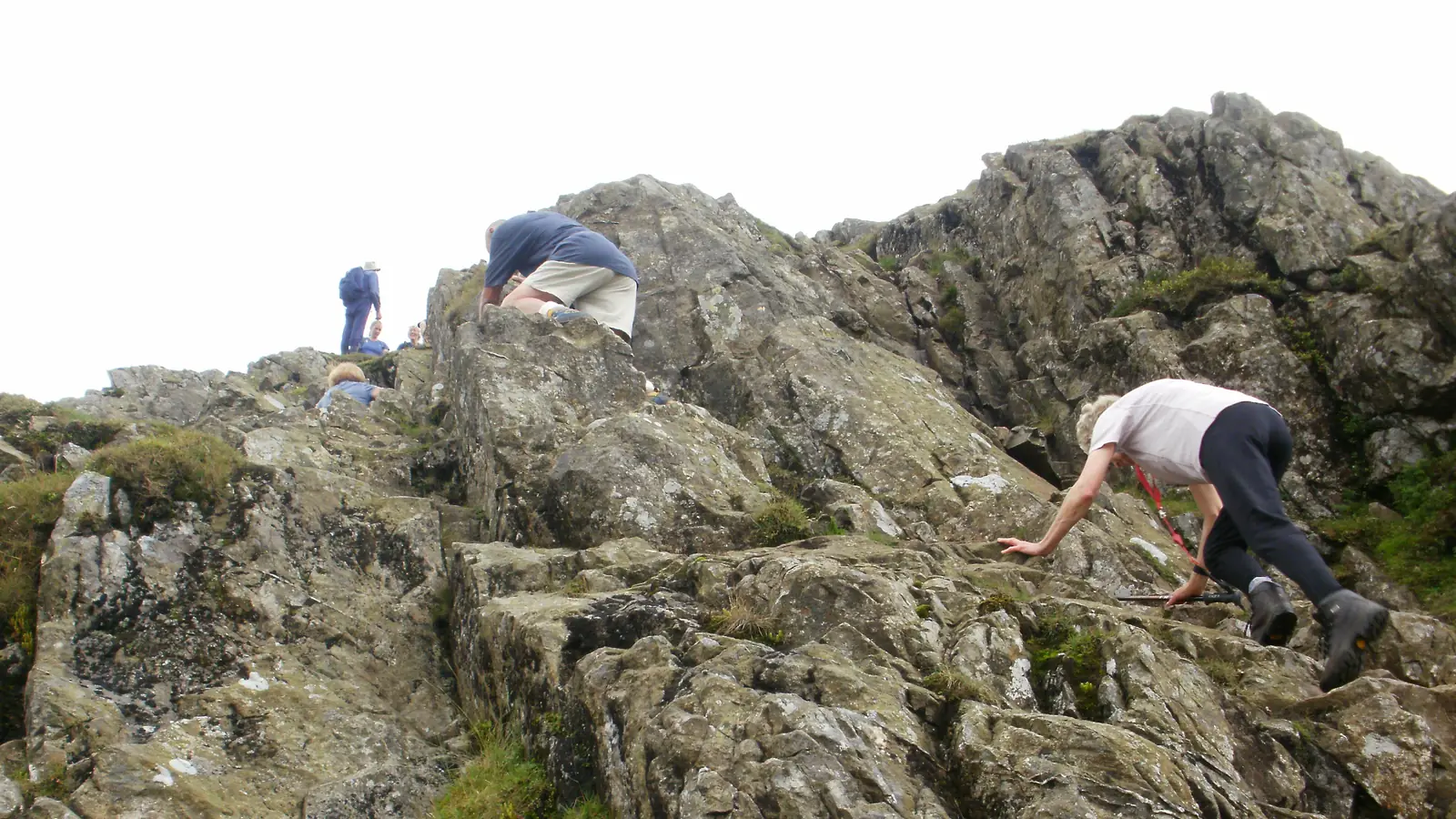
Scrambling is what happens when a hill route gets steep enough that you use your hands. The BMC describes it as covering "the middle ground between walking and climbing", noting that all scrambles "require a degree of rock climbing as both hands and feet are being used" — and calls it, memorably, "essentially easy rock climbing, travelling through stunning mountain scenery".
That middle position is the whole subject. A scramble is not a hard climb; the moves at grade 1 and 2 would be trivial three feet off the ground. What makes it serious is where they are: on exposed ground, often with a long drop, usually without a rope, frequently a long way from help and with weather that changes underneath you. The difficulty is low and the consequence is high, which is an unusual combination and the reason scrambling deserves its own page rather than a paragraph on the hiking one.
It divides by grade, and the grades are the useful structure rather than an afterthought. British scrambles run 1 to 3, and each grade is a statement about what protection the route assumes. Beyond grade 3 the activity is called climbing and the guidebooks say so.
- What makes it serious
- Consequence, not difficulty
- Grade 1
- An exposed walking routeTypically attempted without ropes or protection.
- Grade 3
- Easiest climbing, in a guidebookA rope is to be expected on several sections.
- Best first move
- A guided day
- Still deciding — Scrambling vs hiking
- Still deciding — Mountaineering vs scrambling
Step 1: Confident on grade 1 in good conditions
A season of classic ridges in summer. Route-finding becomes automatic and exposure stops being the whole experience.
You will know it worked when: The grade feels like walking with hands.
Step 2: Grade 1 in less good conditions
Damp rock, wind, shorter daylight. The same routes, considerably more judgement. This is where competence actually accumulates.
You will know it worked when: Conditions become a variable you assess rather than avoid.
Step 3: Rope skills, then grade 2
A course first, then grade 2 with somebody experienced. The order matters and is the whole safety argument of this page.
You will know it worked when: You can protect a section rather than hope.
Step 4: Grade 3, or towards climbing
Grade 3 sits in climbing guidebooks at the easiest climbing grade, so many people find that learning to climb properly is the natural next step rather than a diversion.
You will know it worked when: A real choice between two directions.
Step 5: Winter, taught separately
Winter mountaineering is a different discipline with its own equipment and its own course. Not a progression so much as a second apprenticeship.
You will know it worked when: The Scottish hills in their best condition.
- Go deeper — Moving up from hill walking
Step 1: Be a competent hillwalker first
Navigation in poor visibility, honest pace judgement, weather reading and the habit of turning round. Scrambling adds exposure to hill days; it does not replace the skills that make hill days safe, and every one of them matters more when you are committed to a ridge.
You will know it worked when: The foundation the grades assume you already have.
Step 2: Do a guided or club grade 1 day
The single most useful thing on this list. Somebody experienced watching you on exposed ground will tell you more about your own tolerance in four hours than a season of reading, and exposure tolerance is the variable that decides whether this hobby is for you.
You will know it worked when: An honest answer about whether you like it.
Step 3: Pick a classic grade 1 in good weather
Dry rock, long daylight, a popular route with people about and a known descent. Popularity is a feature at this stage rather than a compromise.
You will know it worked when: A real scramble with the variables minimised.
Step 4: Learn the descent before the ascent
Read it, find it on the map, and know where it leaves the ridge. This is the habit that separates comfortable days from epics, and it costs ten minutes the night before.
You will know it worked when: A route you can finish rather than one you can only start.
Step 5: Get rope skills before grade 2, not equipment
Moving together, placing protection, belaying on ledges and rigging a short abseil are taught on a course and cannot be self-taught safely from text. Owning a rack without those skills adds weight and false confidence.
You will know it worked when: The competence the higher grades assume.
- Boots with an edge — A stiffer sole and a defined edge hold small footholds in a way soft trail shoes do not. This is the one item where hillwalking kit is genuinely not adequate.
- Helmet — Primarily against rockfall from parties above. Cheap, light, and the item most often left in the car by people who then walk under a busy ridge.
- A small pack that does not pull you backwards — Load and shape matter more than volume. A tall pack levers you off the rock on steep ground.
- Guidebook and map — Scrambles are not waymarked and route-finding is part of the difficulty. Knowing which line you are on is what keeps you at the grade you chose.
- Rope and rack, from grade 2 — A 30m rope, harness, slings and a few pieces of protection. Listed last deliberately: this equipment is only useful with the training to place and use it, and a course is the prerequisite rather than an optional extra.
- What does not help — Via ferrata sets, which are for fixed cable and not for British rock, and climbing shoes, which are wrong for the walking either side of the scramble.
- Go deeper — Boots and crampons: the compatibility rules
- Go deeper — Layering, and why the system matters more than the garments
- Go deeper — What goes in the pack on a winter mountain day
- Work it out — Hiking time estimator
- The descent is where people get caught out — Down-climbing is harder than climbing up and much harder to reverse a decision on. Know the descent route before you commit to the ascent, and treat "we will work it out at the top" as a plan that has already failed.
- Weather changes rock — Dry rock and wet rock are different surfaces. A route that is a pleasant grade 1 in June can be genuinely unpleasant in a drizzle, and Welsh and Lakeland rock in particular gets slick rather than merely damp.
- Winter is a different sport — A summer scramble under snow or ice is a winter mountaineering route requiring an axe, crampons and the training to use them. The grade on the page no longer applies, and this is one of the more reliable ways for competent summer scramblers to get into serious trouble.
- Helmets are for what falls on you — Rockfall, from parties above or from the route itself, is the hazard a helmet actually addresses on a scramble. Popular ridges in summer have people above you.
- Everyone in the party is committed — A scramble is a poor place to discover a companion is frightened of exposure, because retreat may be harder than continuing. Have that conversation at the car park.
The BMC participation statement applies here as much as anywhere in mountaineering: these activities carry a risk of personal injury or death, and participants should be aware of and accept those risks and be responsible for their own actions. This page describes what the grades mean and how the activity is organised. It does not teach movement on rock, rope work or protection placement, and it should not be read as a substitute for instruction in any of them.
Sources for this section
- What is scrambling? (opens in a new tab) — British Mountaineering Council · Governing body · read — supports the claim
- BMC Participation Statement (opens in a new tab) — British Mountaineering Council · Governing body · read — supports the claim
- Exposure
- The felt consequence of the drop beneath you, as distinct from the technical difficulty of the moves. The variable that decides whether somebody enjoys scrambling, and it is largely independent of fitness.
- Grade 1 / 2 / 3
- The British scrambling grades. Each describes not just difficulty but what protection the route assumes — from none expected at grade 1 to a rope expected on several sections at grade 3.
- Moving together
- Roped travel where both people climb at the same time with gear between them. Fast, and it demands real judgement because a fall affects both. A course skill, not a text skill.
- Spike
- A rock projection a sling can be dropped over for protection or a belay. The most common natural anchor on a British scramble.
- Down-climbing
- Reversing ground on the way down. Harder than ascending because you cannot see the holds, and the reason descents deserve planning.
- Escape routealso: bail-out
- A way off the route part-way along. Some scrambles have several; some ridges have effectively none once committed, which is a property of the route worth knowing in advance.
- Greasy
- Rock made slick by damp, algae or polish from thousands of boots. Popular routes get polished, which makes classics harder in the wet than their grade suggests.
The British scrambling grades are quoted here rather than summarised, because a grade is a promise about what equipment a route expects you to have and a loose paraphrase of that promise is how people end up somewhere they did not intend to be. These are the BMC’s own descriptions.
- Grade 1 — In the BMC’s words, "essentially an exposed walking route", where "most tend to be relatively straightforward with many difficulties avoidable". These "can typically be attempted without ropes and protection". This is the grade a competent hillwalker progresses into, and the classic British ridges sit here.
- Grade 2 — These "blur the line between scrambling and rock climbing, usually including sections where a nervous scrambler would want a rope to protect them". The leader "must feel confident moving over exposed, yet relatively easy climbing terrain, and the use of protection (climbing gear) becomes more advisable". The word doing the work is *leader* — at this grade somebody in the party is making rope decisions.
- Grade 3 — These "often appear in climbing guides as ‘Moderately’ graded climbing routes (the easiest climbing grade), and should only be tackled by the confident". Use of the rope "is to be expected for several sections". A grade 3 is a climb that happens to be listed in a scrambling book.
Two things the grades do not tell you. They describe the route in good summer conditions on dry rock, and wet rock, wind or a greasy descent can change the experience by more than a full grade. And they say nothing about the descent, which on many classic scrambles is the part that actually causes trouble — a committing route with a hard walk-off is a longer day than the grade suggests.
Sources for this section
- What is scrambling? (opens in a new tab) — British Mountaineering Council · Governing body · read — supports the claim
- Drifting onto harder ground — The commonest scrambling incident is not a fall from a hard move — it is being one gully too far left, on ground a grade or two above what you chose, with retreat now awkward. Route-finding is the skill, and stopping to check is the habit.
- Treating grade as difficulty rather than commitment — Grade 2 does not mean "slightly harder moves". It means the route expects somebody who can protect it. That is a different question from whether you can do the moves.
- Carrying a rope nobody can use — A rope in the sack without the skills is reassurance rather than protection, and reassurance is what persuades people onto ground they should not be on.
- Ignoring the forecast for the rock rather than the walk — A forecast that is fine for a hill day can be poor for a scramble. Wet rock, wind on a narrow ridge and reduced visibility all matter more here.
- Going with somebody whose limits you do not know — Exposure tolerance varies enormously and is not predictable from fitness or confidence elsewhere. Find out on grade 1, not halfway along a ridge.
- Not planning the descent — Repeated deliberately because it is the single most common cause of a scramble becoming an epic. Many classic routes finish somewhere with a long or complicated walk-off.
Scrambling as a named activity is a British invention and largely a Victorian one. The early alpinists and their domestic imitators worked out that the ridges of Snowdonia, the Lake District and Skye offered climbing-like days without the apparatus of climbing, and the classic routes — the Cuillin ridge, Crib Goch, Striding Edge — were being done for pleasure well before rock climbing existed as a separate sport.
The grading system arrived much later and from the guidebooks rather than from any committee. Writers needed a way to warn readers that some routes in a scrambling book were really climbs, and the 1 to 3 scale emerged as that warning, which is why it maps onto protection rather than onto move difficulty. It is a British scale and does not travel: continental systems grade the same ground differently.
The modern tension is popularity. A handful of classic scrambles absorb very large numbers of people, which polishes the rock, increases rockfall from parties above and produces a steady stream of rescues involving walkers who arrived on a grade 1 by accident. Spreading out is better for the ground and usually a better day, and the guidebooks that only ever name the famous routes are part of the problem.
- Is scrambling dangerous?
- More than it looks, and the governing body is direct about why. The BMC states that scrambling "can be actually be more serious than rock climbing, particularly in the higher grades, mainly because people typically attempt it with less protection or none at all". The moves are easy; the exposure is not, and an unroped slip has climbing consequences. That is manageable rather than prohibitive — pick a grade honestly, know the route and the descent, go in good conditions, and turn round when it stops feeling right.
- What do the grades mean?
- They describe what protection a route assumes, which is more useful than difficulty alone. Grade 1 is "essentially an exposed walking route" and can typically be done without ropes or protection. Grade 2 routes "blur the line between scrambling and rock climbing", usually with sections where a nervous scrambler would want a rope, and protection "becomes more advisable". Grade 3 routes often appear in climbing guides as Moderate climbs and a rope "is to be expected for several sections". Note that all of that describes dry summer conditions.
- Do I need a rope?
- Not for grade 1 in good conditions, which is where you should start. From grade 2 upwards the answer is really about skills rather than equipment: the route assumes somebody who can place protection, build a belay and move together safely, and none of that is learnable from writing. If you are considering grade 2, book a course before buying a rack — gear you cannot use is weight and, worse, it is confidence you have not earned.
- Can I go straight into scrambling from hillwalking?
- Into grade 1, yes, and that is the normal path — it is the natural progression from rough British hill days. What does not transfer is exposure tolerance, which is a separate thing from fitness or hill competence and varies enormously between people who are otherwise similar. The efficient way to find out is a guided or club day on a classic grade 1, where somebody experienced can watch how you move and tell you honestly what you should do next.
- What about winter?
- Treat it as a different sport, because it is. A summer grade 1 under snow and ice becomes a winter mountaineering route requiring an ice axe, crampons and the training to use both, and the summer grade no longer describes it. This is one of the more reliable ways for competent summer scramblers to get into serious difficulty, and the answer is a winter skills course rather than an extrapolation from summer experience.
- Where should I do my first one?
- Somewhere popular, on a classic grade 1, in settled summer weather, with a descent you have read about in advance. Popularity is genuinely a feature at this stage: there will be people around, the line is obvious from wear, and help is closer. Snowdonia, the Lake District and Glen Coe all have well-documented grade 1 classics, and any decent scrambling guidebook will make the grade and the descent explicit.
Guides
Longer answers to questions this page can only summarise.
- Reading a mountain weather forecastWhy a mountain forecast says different things from a normal one, what the freezing level actually tells you, and how to turn a forecast into a decision.
- Planning a mountain dayThe time budget, the turnaround time, the escape options and the descent — the four things that determine how a day goes, all decided the night before.
Where people actually do this
Area character, access and how to arrive. No routes and no distances — see the page for why.
If you like this
Each of these is here for a stated reason, not because it is also a hobby.
Progresses to
- Hiking — Scrambling is where competent hill days start using their hands, and it assumes every hillwalking skill underneath it — navigation, pace judgement, and the willingness to turn round, all of which matter more once you are committed to a ridge.
- Mountaineering — Scrambling is the step between walking and mountaineering, and it is the one that teaches comfort on steep rock without adding snow, ice or a rope. The BMC makes the point that harder scrambles can be more serious than climbing of the same grade, because people do them unprotected — which is exactly the judgement mountaineering then asks for.
- Traditional climbing — Grade 3 scrambles appear in climbing guidebooks at the easiest climbing grade, so learning to climb properly is less a change of sport than the next step in the same one — and it supplies the rope skills the higher grades already assume.
Similar to
- Packrafting — Both take a walking day and add a medium that needs its own competence, and both have the same failure mode: hill judgement that does not transfer to the new bit.
- Ski touring — The same mountains, the same weather judgement and the same habit of turning round — and both are the point at which walking becomes mountaineering by degrees rather than by decision.
Outdoor alternative
- Bouldering — The same hands-on-rock movement in the mountains, with far less equipment and much more consequence to a fall.
Sources for this section
- What is scrambling? (opens in a new tab) — British Mountaineering Council · Governing body · read — supports the claim
- BMC Participation Statement (opens in a new tab) — British Mountaineering Council · Governing body · read — supports the claim
- Map reading — beginner guides (opens in a new tab) — Ordnance Survey · Institutional · read — supports the claim
- The Countryside Code (opens in a new tab) — Natural England and Natural Resources Wales · Governing body · read — supports the claim
Comprehensive
Last reviewed 2026-08-15. Cost, time and difficulty figures on this page are HobbyHQ estimates — see how we work. Something here wrong or out of date? Tell us.