Endurance & fitness · Outdoor & adventure
Bikepacking
Bikepacking is three hobbies that have to agree with each other: riding, camping and packing. The riding is the part people prepare for and the packing is the part that decides whether the trip is any good, because every item goes up a hill with you. The genuinely useful knowledge is not about bags — it is that your first trip should be one night, close to home, on a route you could abandon at any point.
Also known as bike touring, bicycle touring, bike packing.
Bikepacking is a discipline of Cycling — Cycling with the luggage and the sleeping arrangements attached, which turns a ride into a journey and makes weight the governing constraint.
Bikepacking is riding a bicycle somewhere far enough that you sleep on the way. That is the whole definition, and everything else — the bags, the routes, the arguments about tyre width — follows from the constraint that you are carrying your accommodation up every hill.
It splits mainly by surface and by how much you carry. Road touring on tarmac with panniers is the oldest form and still the most comfortable, and it opens up distances the others do not. Off-road bikepacking on gravel, bridleways and trails is what the modern word usually means: soft bags strapped to the frame rather than racks, lighter loads, rougher ground. Credit-card touring carries almost nothing and stays in accommodation, which is a genuine version rather than a compromise. Ultra-distance racing is a small, intense corner of the sport where people ride enormous routes largely without sleeping, and it is a different activity wearing the same bags.
The thing beginners consistently get wrong is scale. A first trip does not need to be ambitious to be good, and the failure mode is almost never fitness — it is discovering at nine in the evening that the sleeping mat is uncomfortable, the stove does not work and there is nowhere legal to camp. One night, close to home, on a route with escape options, teaches all of that at the cost of an evening.
- Start with
- One night, near homeThe overnighter is the single most useful trip in the hobby.
- What actually limits you
- Weight, then daylight
- Bike required
- The one you ownTyre clearance matters more than the frame.
- The legal question
- Where you may sleepAnd it differs by nation, sharply.
Step 1: Do an overnighter fifteen miles from home
Ride out in the afternoon, sleep, ride back for breakfast. This is not a training exercise for a real trip — it is the trip, in miniature, and it surfaces every equipment and comfort problem you have while you are still close enough to walk home.
You will know it worked when: You know what is missing before it matters.
Step 2: Load the bike you already own
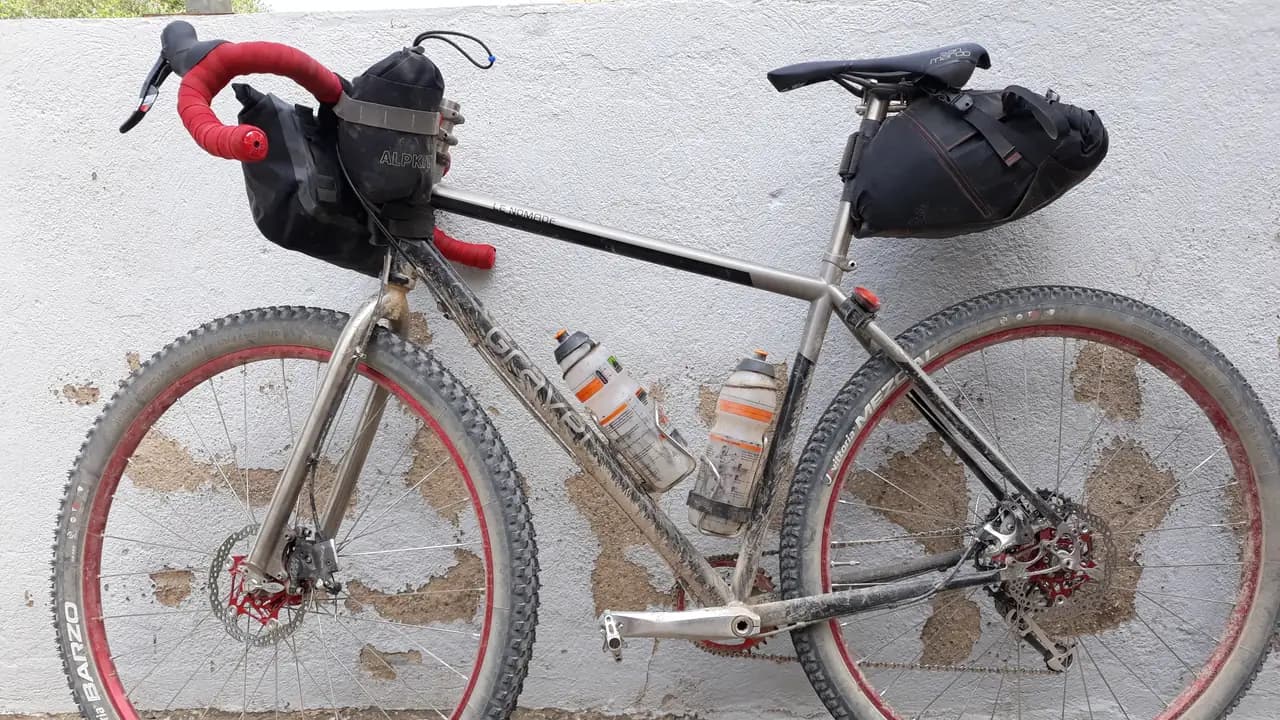
Strap a dry bag to the bars and another to the saddle rails. It will not be elegant and it will work. Buying bags before you know how you pack is how people end up with a frame bag that fits nothing they carry.
You will know it worked when: A loaded bike, at no cost, this weekend.
Step 3: Ride the loaded bike before you go anywhere
A loaded bike steers differently, brakes later and behaves oddly at low speed. Ten miles around home with the full load tells you whether the weight is in the wrong place, which is almost always too high and too far forward.
You will know it worked when: No surprises at the first junction.
Step 4: Plan around water, food and daylight rather than distance
Distance is the number people plan with and the least useful one. Where you can refill water, where you can buy food on a Sunday evening, and what time it gets dark are what actually shape a day. Fifty kilometres on a loaded bike off-road is a full day; the same on tarmac is a morning.
You will know it worked when: A plan that survives contact with the route.
Step 5: Settle the sleeping question properly
Campsite, hostel, or wild camping — and the last is a legal question with different answers in different parts of Britain. Decide before you leave rather than at dusk, because the version of this decision made at dusk is always worse.
You will know it worked when: Somewhere to sleep that you are entitled to be.
Step 6: Then go somewhere that needs a train
Once the overnighter is boring, the constraint stops being equipment and starts being imagination. Book a train, ride away from the station, and come back from a different one.
You will know it worked when: The trip that makes the hobby stick.
- Go deeper — Planning a first bikepacking overnighter
Step 1: The local overnighter, repeated
The same trip a few times, changing one thing each go. Boring, and it is how the kit gets sorted.
You will know it worked when: A setup you stop thinking about.
Step 2: A long weekend on a waymarked route
Three days on something like a national trail or a canal route, where navigation is easy and the challenge is consecutive days.
You will know it worked when: You learn what your body does on day three.
Step 3: Off-road and self-navigated
Bridleways, gravel and a route you plotted. Slower, more absorbing, and where the hobby stops resembling cycling.
You will know it worked when: Route-finding, surface judgement and real remoteness.
Step 4: A week or more, or abroad
Logistics become the skill — flights, trains, bike boxes, resupply across a fortnight. A different kind of planning entirely.
You will know it worked when: The trip you talk about for years.
Step 5: Ultra-distance events, if that appeals
Self-supported races over enormous routes with minimal sleep. A small and intense corner of the sport, and genuinely not what most bikepackers want.
You will know it worked when: A direction, for a certain kind of person.
- Bags before bike, always — A saddle pack, a frame bag and a handlebar roll will fit almost any bicycle and cost a fraction of a new one. The bike you own is nearly always adequate; the bags you do not own are the actual gap.
- Panniers versus soft bags — Panniers carry more, load lower, and are far easier to pack and unpack — they are better for tarmac and for anybody who values comfort. Soft strapped bags are lighter, quieter and survive rough ground where a rack can break. This is a genuine trade rather than an upgrade path.
- Sleep system — Bag, mat and shelter, in that order of importance to how the night goes. A cold sleeper on a thin mat will be miserable in an expensive tent; the mat is the item beginners under-buy most consistently.
- Shelter — Tent, tarp or bivvy. A bivvy is lightest and least pleasant in rain; a tarp is versatile and takes practice; a small tent is heaviest and the one that makes a wet evening survivable. Start with whatever you already own.
- Cooking, or not — A stove is a pleasure and it is optional. Cold food for one night is entirely reasonable and removes fuel, ignition and washing up from the first trip.
- Spares that matter — Tubes, a pump, a multitool, a chain link, a spare set of lights and a way to charge a phone. On a multi-day trip the failure that ends the trip is nearly always the one you had no part for.
- What to leave behind — A second set of clothes, a book, a chair, anything "just in case" that weighs more than a hundred grams. Weight is the whole constraint and it is invisible on the kitchen floor.
- Go deeper — Building a bicycle maintenance kit, in the order you will need it
- Work it out — Bikepacking day planner
- Work it out — Base weight calculator
- The bike handles strangely when loaded — Weight too high or too far forward, which makes the steering vague and the front wheel wander at low speed. Check where the heaviest items sit: they belong low and central, in a frame bag rather than on the bars. Repack before you set off rather than after the first descent.
- You are running out of daylight every day — Planning by distance rather than by hours. Check your actual moving average against what you planned — loaded off-road is often half of unloaded road pace. Plan in hours, add time for resupply and photographs, and build in a bail-out.
- Bags rubbing, rattling or sagging — Straps working loose over rough ground, which they always do. Check every strap at each stop for the first day. Tape or foam where a strap crosses paint, and cinch the saddle pack tight enough that it does not sway under pedalling.
- Cold at night despite a decent sleeping bag — Almost always the mat rather than the bag. Check the mat's insulation value rather than its thickness — ground conducts heat away far faster than air. Wearing damp riding clothes to bed is the other common cause.
- A mechanical you cannot fix, hours from anywhere — The trip becomes a logistics problem rather than a repair one, and that is fine if you planned for it. Check your route for stations, roads and towns before you leave. Carry the parts for the failures you can actually fix — tubes, a chain link, a spare brake pad — and treat everything else as a phone call and a train.
- Go deeper — Getting home: fixing a bike at the roadside
Two separate questions, and the answer to each is set where you are riding rather than by anything general about the activity. Riding access and overnight access are governed by different rules, often by different bodies, and a country that is permissive about one is not necessarily permissive about the other.
The pattern worth carrying is that overnight access falls into a small number of shapes. It may be a public right you already hold; it may be permitted on land a public agency manages, under that agency’s conditions; it may need a permit; it may be restricted to designated campsites; or it may rest entirely on the landowner’s permission. Which shape applies is the single thing to establish before a trip, and it is usually answered on the website of whoever manages the ground.
Two examples of how far apart the arrangements sit — illustrations, not a survey, and neither is the world’s rule. In Scotland a statutory right of responsible access covers most land and inland water and extends to lightweight camping; it is conditional on behaving responsibly and is qualified by local byelaws and seasonal restrictions. On public land managed by the Bureau of Land Management in the United States there is no such public right, and dispersed camping is instead broadly allowed unless an area is posted closed, generally for up to fourteen days in any twenty-eight, with the detail set by state and field office rather than nationally.
A public right you already hold, and a permission granted by whoever manages the ground: two different mechanisms producing a superficially similar freedom. That is why the question to ask is not whether wild camping is legal, but who decides here.
- Riding access and walking access are different questions — A route you may walk is not automatically a route you may ride, and the distinction exists in most jurisdictions in some form. Establish it from the map or the land manager rather than from the presence of a path.
- Lighting is a legal duty almost everywhere, and the specifics are local — Multi-day trips involve riding at dusk far more often than day rides do, and most road-traffic codes require lights after dark. Find out what your jurisdiction requires, and carry a spare set regardless — a dead light two days from home is a stop, not an inconvenience.
- Leave no trace is the condition, not the courtesy — Arrive late, leave early, one tent, no fire, and take everything out including the things that were there when you arrived. Where access is a right it is usually a right conditional on exactly this behaviour; where it is a tolerance, this is what keeps the tolerance alive.
- Trains and buses carry bikes on their own terms — Reservations, quotas and outright bans vary by operator and by individual service almost everywhere, and a full bike space is a stranded rider. Check and book when you book the ticket, not at the platform.
Sources for this section
- Land Reform (Scotland) Act 2003, section 32 (opens in a new tab) — The National Archives (legislation.gov.uk) · Governing body · read — supports the claim
- The Act and the Access Code (opens in a new tab) — NatureScot · Governing body · read — supports the claim
- Camping on Public Lands (opens in a new tab) — Bureau of Land Management (U.S. Department of the Interior) · Governing body · read — supports the claim
Bikepacking is not a dangerous activity, and its risks are the ordinary ones of riding and of being outdoors overnight — concentrated by distance from help and by tiredness. The things that go wrong are dull, which is why they are worth planning for.
- Tiredness is the underrated one — Judgement degrades over consecutive days, and the classic bikepacking incident is a rider making a poor road decision on the afternoon of day three. Plan shorter days than you can ride.
- Getting cold and wet at the end of a day — Riding generates a great deal of heat and stopping removes it very quickly. Dry clothing that never gets ridden in, kept in a dry bag, is the single most useful safety item on the list. In a wet wind, hypothermia is a summer risk on an exposed hill as much as a winter one.
- Riding loaded on roads — Larger margins than you would take unloaded, particularly at junctions and on descents. Why the bike behaves that way, and how to pack so it behaves better, is under trip problems below.
- Being alone somewhere without signal — Tell somebody your route and your expected return, the same discipline as a hill day and for the same reason. Mobile coverage in the places worth riding to is patchy by definition.
- Water — Refill points are a planning problem anywhere the map is emptier than the road network suggests. Carrying capacity for a dry stretch matters more than carrying capacity generally, and treating water from a stream is a decision to make deliberately rather than at the point of thirst.
- Planning a distance rather than a day — The same number means two different days loaded and unloaded, on tarmac and on a rough track. Plan by hours of daylight and by where water and food are.
- Buying bags before packing anything — How you pack is personal and it emerges from one trip. Bags bought first are bags that do not fit what you actually carry.
- Carrying too much water and too little food — Water is heavy and frequently refillable; calories are light and the shops shut. Beginners reliably get this the wrong way round.
- Never riding the loaded bike before leaving — The first place to discover the difference should not be a gravel descent with luggage on the bars.
- Assuming wild camping is fine because somebody did it — The legal position differs by country and often by locality, and "people do it" describes tolerance rather than entitlement. Knowing which you are relying on is the difference between relaxed and furtive.
- Treating the first trip as a test of endurance — The overnighter that seems too easy is the one that teaches most, because everything that fails is recoverable. Ambition is cheap later.
Bikepacking covers everything from one night out to riding across a continent, and the useful distinctions are terrain, self-sufficiency and whether the clock matters. Almost all published gear advice is written for one combination of those three, which is why it appears to contradict itself.
- The overnighter — Out after work, one night, home the next morning. The single best way to start, because the consequences of getting the kit wrong are one uncomfortable night rather than a ruined week.
- Credit-card touring — Riding between accommodation, carrying almost nothing. Frequently sneered at and entirely legitimate: it removes the heaviest kit and lets you cover ground, and it is a good route in for people not ready to camp.
- Off-road bikepacking — Trails, bridleways and gravel, with soft luggage strapped to the frame rather than racks and panniers. The style the modern word usually means, and the one where tyre choice and bike fit matter most.
- Road touring — Surfaced roads, racks and panniers, more weight carried more comfortably. Better for long distances with a lot of kit, and much easier on a body that dislikes rough ground.
- Expedition touring — Months rather than days, remote regions, and a bike chosen for repairability over speed. Logistics and self-reliance become the sport.
- Ultra-distance racing — Self-supported races over hundreds or thousands of kilometres against a clock. A demanding minority pursuit with a strong culture, and the branch where sleep management is a real skill.
- Where to start
- A local overnighterOne night, close to home, on the bike you own. Everything else is a variation on it.
- What decides the luggage
- Terrain, not distanceRacks and panniers on rough ground shake apart; soft luggage on smooth roads carries less for no reason.
- The most common first mistake
- Too much kit, too farA heavy bike over an ambitious distance is how a first trip becomes a last one.
- Still deciding — Road cycling vs bikepacking
- Still deciding — Bikepacking vs wild camping
- Still deciding — Thru-hiking vs bikepacking
- Overnighteralso: S24O, sub-24-hour overnighter
- A single-night trip, usually leaving after work and returning the next morning. The foundational trip of the hobby and the one most worth doing first.
- Credit-card touring
- Riding between hotels, hostels or B&Bs carrying almost nothing. A full version of the hobby, not a lesser one, and by far the cheapest to start.
- Frame bag
- A bag filling the main triangle of the frame. Carries weight low and central, which is the best place for it, and is the bag most worth having made to fit.
- Bivvyalso: bivvy bag, bivouac
- A waterproof bag you sleep in without a tent. Lightest and least pleasant in sustained rain.
- Rig
- The whole loaded setup — bike, bags and how it is packed. People talk about their rig rather than their bike because the packing is most of it.
- Bail-outalso: escape route
- A planned way of ending the day early — a station, a road, a town. The thing a good first route has several of.
- Resupply
- Where you next get food and water. On a British route this is usually a village shop with awkward opening hours, which is why it drives the plan.
Loaded bicycle travel is as old as the safety bicycle. Cycle touring was a mass pursuit in Britain well before mass car ownership, and the club structure that supported it — the Cyclists’ Touring Club, founded in the 1870s and now Cycling UK — predates almost every other outdoor organisation in the country. The image of the touring cyclist with steel racks and canvas panniers is a real historical form, not a nostalgic one.
What changed in the 2000s was the bags. Riders wanting to take loaded bikes onto singletrack found racks and panniers unsuited to it, and a generation of soft frame-mounted luggage appeared, initially home-made. That produced the word "bikepacking" as distinct from "touring", and the distinction is genuinely about surface and luggage rather than about seriousness.
The other change is mapping. Plotting a route across bridleways, byways and gravel used to require local knowledge or a great deal of paper; digital mapping with surface data made it possible to plan an off-road route through country you have never seen. That has opened up a lot of Britain to a hobby that previously followed roads, and it is why the sport grew as fast as it did.
- Do I need a special bike?
- Almost certainly not for your first trips. Tyre clearance matters more than anything else — room for something around 35mm or wider opens up most unsurfaced tracks — and mounting points are convenient rather than necessary, because straps work. A hybrid, an old mountain bike or a touring bike will all do multi-day riding perfectly well. Buy a bike once you know what surfaces you actually enjoy riding, which takes a season to find out and cannot be answered in a shop.
- Is wild camping legal?
- Only where the law where you are says so, and the arrangements differ far more than people expect — a public right in some countries, a land manager’s permission in others, designated sites or permits elsewhere again. The access section above sets out the shapes and where to check. Until you have established the position for the specific ground you are riding, plan on a campsite.
- How far should I ride in a day?
- Less than you think, and plan in hours rather than distance. A loaded bike on tarmac covers ground at roughly the pace of an unloaded bike on a hilly day, and off-road it can halve. Plan around the things that actually run out — daylight, water, resupply and your own appetite for being on the bike — rather than a headline number, because the same figure means two different days on tarmac and on a rough track.
- What does it cost to start?
- Nothing, if you own a bike and any camping equipment — strap a dry bag to the bars and go, which is the honest answer for a first overnighter. Beyond that the order of magnitude matters more than any figure: a set of bags is the smallest step, camping kit the next if you own none, and a purpose-built bike is far and away the largest and the one worth deferring longest. Prices and what is available vary by market, so price the three steps where you live rather than working from somebody else’s total. The running costs are genuinely low: sites, food and tyres.
- Can I do this alone?
- Yes, and many people prefer it — the pace, the route and the stopping are all yours. What changes riding alone is not the list of precautions but the margin: a mechanical you would laugh about in company is a long walk on your own, so bias the first solo trips towards routes with more ways off them than you think you need.
- What if something breaks miles from anywhere?
- Carry the parts for the failures you can actually fix — tubes, a pump, a multitool, a spare chain link, a spare brake pad set on a long trip — and know how to use them before you leave. A puncture and a broken chain are the two that will strand you and both are learnable in an evening. Everything beyond that is a phone, a train station and a bail-out route, which is why a good first route has several.
Guides
Longer answers to questions this page can only summarise.
Within this activity
Disciplines, variants and techniques that sit inside it.
Disciplines
- Ultra-distance cycling — Self-supported races of several hundred to several thousand kilometres, ridden with almost no sleep.
If you like this
Each of these is here for a stated reason, not because it is also a hobby.
Similar to
- Fastpacking — The same self-supported multi-day logic on wheels, carrying more for less effort over greater distance.
- Hiking — The same problem — carrying what you need through country you have to navigate — solved at four times the speed and a quarter of the climbing effort. Hikers usually find the planning familiar and the descents alarming.
- Thru-hiking — The same trip shape on wheels, with resupply intervals stretched and the logistics correspondingly easier.
Goes well with
- Packrafting — Bikerafting is a real and growing branch: the bike goes on the bow and solves the walk-out, and the two kit lists overlap almost completely.
- Recumbent cycling — Long days carrying luggage is what recumbents are best at, and a machine that never hurts changes what a multi-day route is worth attempting.
- Wild camping — The sleeping half of a bikepacking trip is wild camping with a bicycle parked next to it, and the legal position on where you may sleep is identical — which is why getting it wrong spoils the same evening in both.
Sources for this section
- The Countryside Code (opens in a new tab) — Natural England and Natural Resources Wales · Governing body · read — supports the claim
- Land Reform (Scotland) Act 2003, section 32 (opens in a new tab) — The National Archives (legislation.gov.uk) · Governing body · read — supports the claim
- Map reading — beginner guides (opens in a new tab) — Ordnance Survey · Institutional · read — supports the claim
Comprehensive
Last reviewed 2026-08-15. Cost, time and difficulty figures on this page are HobbyHQ estimates — see how we work. Something here wrong or out of date? Tell us.