Endurance & fitness · Outdoor & adventure
Recumbent cycling
Recumbents are written about as a speed choice for enthusiasts, and that is not why most people are on one. Sitting in a seat rather than perching on a saddle removes load from the hands, wrists, neck, shoulders and perineum, and a trike removes the need to balance at all. For a large number of riders that is the difference between cycling and not cycling. This page is about that decision — two wheels or three, and what you are actually buying.
Also known as recumbent bike, recumbent trike, bent riding, laid back cycling.
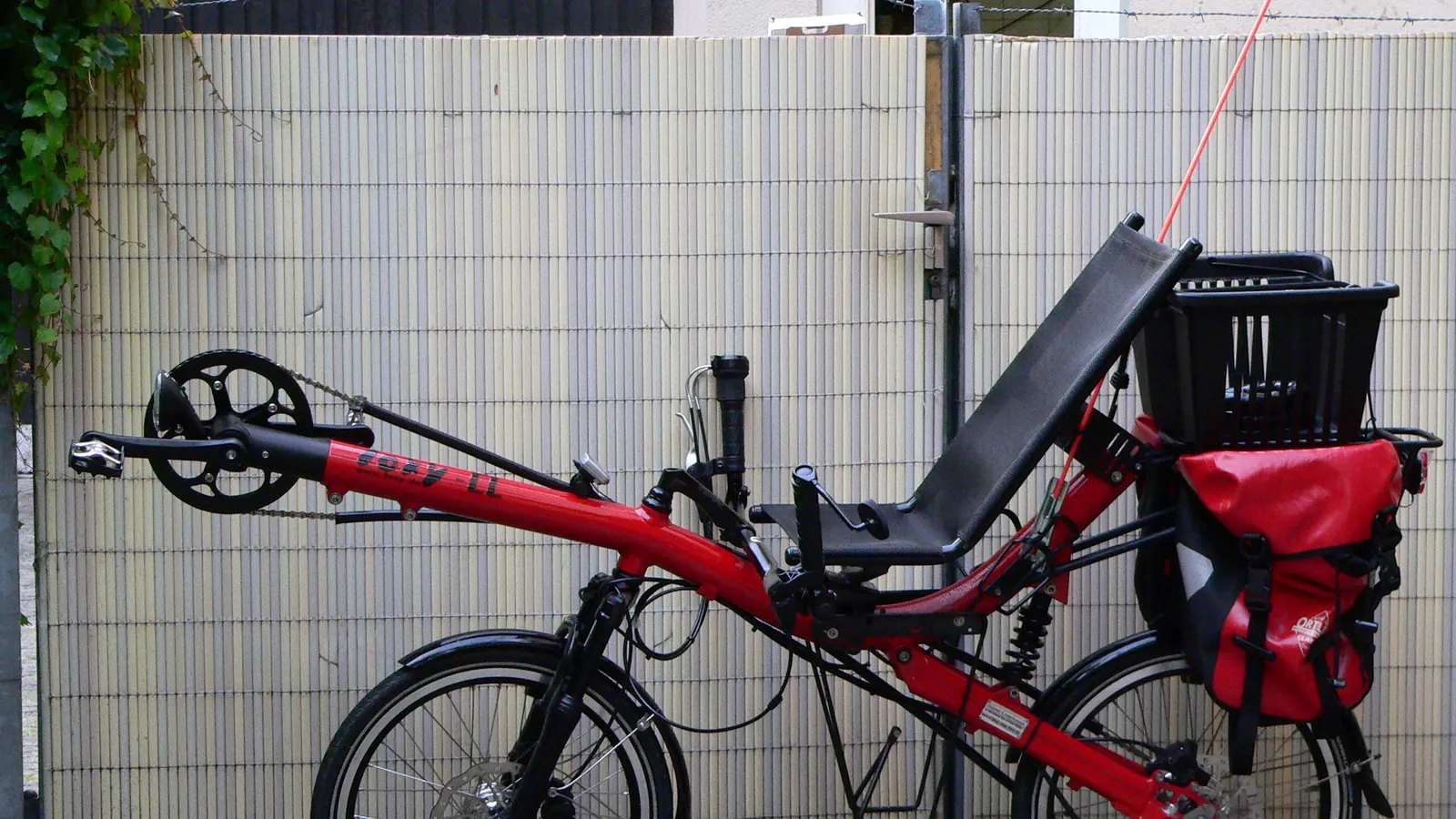
A recumbent puts you in a seat with your legs out in front, rather than perched on a saddle with your weight on your hands. That single change removes essentially all the contact-point problems of upright cycling: no saddle pressure, no weight through the wrists, no load on the shoulders or neck from holding a bent-over position. It also removes the ability to stand on the pedals, changes how you climb, and makes you lower and less visible.
The choice that matters is two wheels or three. A two-wheeler is lighter, narrower, faster and requires balance, with a genuine learning period of a few hours. A trike does not need balance at all, is stable at any speed including a standstill, and is heavier and wider. Almost everything else — seat angle, wheel size, above or below seat steering — is preference, and almost every buying guide leads with it anyway.
The honest summary of who ends up on one: people who want to keep cycling and have found an upright bike has stopped working for their hands, neck, back or balance. Faster riders exist and recumbents are genuinely quicker on the flat, but treating speed as the headline misdescribes the sport.
- The real decision
- Two wheels or three
- What it removes
- Saddle, wrist, neck and shoulder load
- Learning to ride a two-wheeler
- A few hours
- Where they are slower
- Climbing
Step 1: Ride one before deciding anything
Specialist dealers and recumbent clubs both expect this and both will put you on several machines in an afternoon. Given the prices and the thin second-hand market, a day spent testing saves far more than it costs.
You will know it worked when: You know whether it is two wheels or three.
Step 2: Test the neck position specifically
It is the one thing a recumbent can make worse rather than better. Ride a low two-wheeler for long enough to know how your neck feels holding your head up, and try a higher seat angle for comparison.
You will know it worked when: The one contraindication ruled in or out.
Step 3: Buy used if you can find the right thing
£700–£1,800 for a good machine, and they last because the frames are over-built. The market is thin, so be prepared to travel and to wait rather than to take whatever is nearest.
You will know it worked when: A machine that fits, at half the new price.
Step 4: Learn on a two-wheeler somewhere empty
A quiet car park, a wide flat path. Start pedalling before you try to steer, keep the speed up because slow is harder, and expect a couple of foot-downs. Most people are riding within an hour and comfortable within a few.
You will know it worked when: You can start, stop and turn without thinking.
Step 5: Build the leg strength deliberately
You cannot stand on the pedals, so climbing uses different muscles and it takes weeks. Ride shorter routes with hills rather than long flat ones, and gear low enough that you never have to grind.
You will know it worked when: Hills stop being the reason to turn back.
Step 6: Ride with a group once
Recumbent clubs are small, welcoming and full of people who have solved the transport, visibility and gearing problems already. It is the fastest way to skip a year of working things out alone.
You will know it worked when: You know what other people ride and why.
The first stage is short and mostly about the machine: learning to start and stop, finding a gear range that makes hills possible, and sorting the flag, mirrors and lights that make the road workable. On a trike this is nearly instant; on a two-wheeler it is a few hours of riding and a few weeks of confidence.
The second is distance, and it is where the point of the thing appears. Because nothing hurts — no hands, no saddle, no neck if the seat suits you — riders routinely find they can go considerably further than they could upright, and long days become the normal use rather than an ambition. This is also where the leg adaptation completes and hills stop being the limiting factor.
Beyond that the branches diverge. Touring is where most people stay, often with luggage and often abroad. Velomobiles are the enthusiast end, fast and weatherproof and expensive. A smaller number go racing, in a separate scene that exists because recumbents are excluded from mainstream cycle sport. And a good number end up building — the machines are simple, the community is technical, and a home-built bent is a well-trodden path rather than an eccentricity.
- Trike, if balance is any part of why you are here — Three wheels, stable stopped and moving, and it removes the balance question entirely. Heavier, wider, harder to store and transport, and the right answer for most people arriving from a balance, confidence or neurological reason. £2,000–£5,000 new.
- Two-wheeler, if it is about comfort and speed — Lighter, narrower, faster and easier to store. It does need learning — expect a few hours before it feels natural — and low-speed manoeuvring stays harder than on an upright indefinitely. £1,500–£3,500 new.
- Seat height, which decides more than seat angle — Higher seats are easier to get in and out of, easier to see over traffic from and easier to be seen in. Lower seats are faster and more stable. For a first machine, err high — the aerodynamic gain is worth less than the daily practicality.
- Above-seat or under-seat steering — Under-seat is relaxing, keeps the hands low and out of the wind, and suits shoulder problems. Above-seat feels more familiar and is easier in tight spaces. Genuinely preference, and a test ride settles it in ten minutes.
- A flag and daytime lights — Not optional. You sit below the sightline drivers scan, and being seen is managed with equipment and road position rather than assumed. £30–£60 and the first thing to buy.
- A mirror, and probably two — You cannot easily turn to look behind from a reclined seat. On a recumbent a mirror is primary equipment rather than an accessory, which surprises people coming from upright bikes.
- Low gears, lower than you think — You cannot stand up to climb, so everything is done seated and geared. A range that would look absurd on a road bike is normal here and is the difference between enjoying hills and walking them.
- Somewhere to put it — Check transport and storage before buying. Most will not fit a standard bike rack, and a trike takes roughly the space of a small motorbike.
- Your neck aches on a low machine — You are holding your head up against gravity to see ahead. A more upright seat angle, a headrest, or a trike. This is the fault that does not improve with fitness.
- Climbing is much harder than expected — You cannot stand, so it is all seated power. Partly gearing, partly weeks of adaptation, and partly a permanent fact — recumbents are slower uphill and faster on the flat.
- Numb or hot feet — Your feet are raised, which changes blood flow. Looser shoes, a slightly lower bottom bracket if adjustable, and stiffer soles all help. Common, fixable, and alarming the first time.
- Wobbling at low speed — Normal on a two-wheeler and it improves. Keep pedalling — power through the cranks stabilises the machine — and give yourself more room at junctions than an upright needs.
- The chain is filthy and wearing fast — It is two to three times the length of a normal chain and runs through idler wheels. Clean it more often, expect to replace it more often, and check the idlers when the drivetrain gets noisy.
- Drivers do not seem to see you — They may genuinely not. Flag, daytime lights, and road position further out than feels polite. This is the one risk that is meaningfully higher than on an upright and it is managed rather than eliminated.
- It will not fit on the car — Very few standard racks take one. Most owners fold a trike into an estate boot or use a trailer, and it is worth solving before the purchase rather than after.
- Go deeper — Getting home: fixing a bike at the roadside
The smaller ones, which are equipment rather than judgement:
- Mirrors are primary equipment — You cannot turn and look behind from a reclined seat the way you can on an upright. One mirror minimum, two is common, and it changes how safe the road feels.
- Trikes tip in fast corners — Three wheels are stable stopped and not immune to lifting a wheel under speed and steering. Slow into corners rather than out of them until you know the machine.
- Low-speed manoeuvring on two wheels — Junctions, tight turns and starting on a hill all stay harder than on an upright. Give yourself more room rather than more confidence.
- Ground clearance and potholes — You sit low and hit things at a different angle, and a trike cannot lift a wheel over an obstacle. Scan further ahead than upright habit suggests.
Most of a recumbent is ordinary bicycle, serviced in ordinary ways, and the bicycle maintenance page covers all of it. Three things are genuinely different and they are the ones that surprise people who arrive from an upright.
- The chain, which is two to three times as long — More links, more surface, more dirt, and it runs closer to the ground for part of its length. Expect to clean it more often than you are used to and to replace it sooner. Buy chain by the box rather than the length — a standard chain will not reach.
- Idler wheels, which do not exist on other bikes — The small pulleys routing the chain around the seat are wear parts. When a drivetrain starts sounding rough and the chain is clean and the cassette is fine, check the idlers before anything else — it is the fault an upright-trained eye never looks for.
- Chain tubes, if fitted — Plastic tubes that stop the chain marking your legs and the frame. They wear through from the inside, quietly, and a worn one is a source of drag people spend weeks blaming on the drivetrain.
- The seat and its mesh — A mesh seat carries your whole weight and its lacing stretches. Check the tension and the fixings periodically; a hard-shell seat instead needs its pad checked for compression rather than its tension.
- Three sets of everything, on a trike — Three tyres, three tubes, and on most tadpole trikes two front brakes that need balancing against each other. Not difficult, just more of it than a bicycle owner expects.
- Boom adjustment, which changes the chain length — Moving the boom to fit a different rider alters how much chain is needed. Do the two together, or discover it on the first hill.
- Bent
- What riders call a recumbent, and what they call themselves — bentriders.
- Tadpole and delta
- The two trike layouts: tadpole has two wheels at the front, delta two at the back. Tadpole is more stable in corners and more common; delta is easier to get into and turns tighter.
- Seat angle
- How far back you recline. More reclined is faster and harder on the neck; more upright is easier to see from and slower.
- Above-seat and under-seat steeringalso: ASS, USS
- Handlebars in front of the chest or down beside the hips. A comfort preference rather than a performance one.
- Idler
- A small pulley routing the long chain around the seat. A wear part unique to recumbents and the usual source of new drivetrain noise.
- Boom
- The forward tube carrying the bottom bracket and pedals, adjusted in or out to fit leg length instead of moving a saddle.
- Recumbent butt
- The community’s name for the leg fatigue of early riding, from using seated power without the option to stand. It passes in a few weeks.
- Velomobile
- A fully enclosed recumbent trike with a shell. Very fast, very weatherproof, very expensive, and its own branch of the hobby.
- Highracer and lowracer
- Two-wheelers with both wheels large and a high seat, or with a very low seat between them. Highracers see better in traffic; lowracers are faster.
- Buying without riding several — The machines differ enormously and the prices are high. A day of test rides is the cheapest part of this hobby.
- Choosing a low seat for speed on a first machine — Practicality beats aerodynamics for the first few years. Seeing over traffic and getting in and out easily matter every single ride.
- Gearing it like a road bike — No standing means no way to muscle up a hill. Gear far lower than feels necessary.
- Riding without a flag and daylight lights — You are below the height drivers scan. This is the one place where equipment genuinely substitutes for luck.
- Judging it on the first hour — The first ride is wobbly and the first hills are miserable, and both change within weeks. People who quit almost all quit here.
- Ignoring transport and storage until afterwards — A machine you cannot get to a ride is a machine you will not ride.
- Expecting it to fix a neck problem — It fixes hands, wrists, shoulders and saddle pressure. Necks can get worse on a low machine, and that needs testing rather than hoping.
Where you can race one, and the law that applies on the road
The defining rule of this hobby is one made somewhere else: mainstream cycle sport does not admit these machines, which is why recumbent racing is a separate discipline with a very short rulebook of its own.
- Recumbents are not raced in mainstream cycle sport — A recumbent cannot be entered in the road and track racing governed by the international cycling federation, whose technical regulations specify the form a racing bicycle must take. This is the single fact that shapes the hobby: the machines are faster on the flat and in a straight line, and that speed has no competitive outlet inside the sport most people mean by cycling. It is also why a recumbent rider is rarely in a club run and often in a club of a quite different kind.
- The discipline that does admit them, and why it declines to specify them — Human-powered vehicle racing, organised in Britain by the British Human Power Club, exists precisely to remove that constraint, and the club says so as policy rather than as an accident: it "aims to foster the development of Human-Powered Vehicles, free from the constraints of arbitrary technical specifications. Therefore we have very few rules governing the construction of race machines. There are a few rules, however, regarding safety." The eligibility test for the main class is one sentence — "If it’s human powered and conforms to the safety rules, it’s in." The design freedom that mainstream regulation removes is the entire premise of this one.
- What it does regulate: the machine’s ability to hurt somebody — Helmets: "All riders must wear (on your head) a helmet approved by a recognised national standards authority (e.g. Snell, ANSI, TUV, etc.)" — with one exception, for a faired machine where the rider’s head is enclosed, in which case "any helmet designed to protect the head (such as a leather “hairnet” type helmet) may be used". Brakes are set by venue rather than by specification: none required on a velodrome "if and only if a fixed-wheel is used", at least one effective brake on closed tracks, and two independent systems for anything on a public road. The chainring "must be covered by either a fixed shield or by a strong rotating chainguard", and the club enforces it — "Competitors who fail to do this will be warned; a second warning will mean you will not be permitted to compete." Open-ended tubes get their own note, and their own description: "think apple-corer".
- Classes divide the machine and the rider separately, and you can be in several at once — Machines are classed by construction — Open, Part-faired, Unfaired, Multitrack, Faired Multitrack, and Street for road-usable cycles, where side fairings and "bags" are disallowed as unsuitable for the highway. Riders are classed separately and non-exclusively: Women, Women Part-faired, Juniors, Arm-powered ("Arm-powered riders do not have to have a physical impairment"), and Car-free, for anyone who "travelled to the race without using a private motor vehicle". Classes inherit, so an unfaired machine also scores in Part-faired and in Open, and one entry can place in four tables at once. It is why a home-built trike and a streamliner are not really competing against each other, and why the sport is enterable on the machine you already own.
- The points system, and what it tells you about the club — A win is 1000 points and "the points decrease by 10% for each position below 1st, rounded to the nearest whole point", which means everybody who finishes scores at least five. Only your best eight events count, stated openly as "an attempt not to give an undue advantage to riders who attend more events". And a rider who starts but does not finish is placed rather than struck out, on an average speed worked from their completed laps and the last finisher’s time. Three small rules, all of them pointed the same way: at keeping the person who came once in a shed-built machine in the same competition as the person who comes to everything.
- On the road: the same law as any other bicycle, and one part of it that bites harder — A recumbent is a pedal cycle in law and the Highway Code applies to it unchanged, including the road positioning rules — the centre of the lane on quieter roads, at least half a metre from the kerb on busier ones. Lighting is where the difference is felt. The Road Vehicles Lighting Regulations require the fitted lamps to be "kept lit and unobscured" in darkness, and on a machine whose lamps sit low, are easily masked by a fairing or a seat, and are at an unfamiliar height to a driver, meeting that duty takes more thought than bolting on the same lights an upright uses. The safety section on this page covers being seen, which is the practical half of the same problem.
- What this page does not tell you — The conditions of entry for any particular race, which live in that event’s own regulations. The rules above were read from the club’s current published pages in August 2026; they replaced a 2018 championship document this page previously relied on, which had gone quietly out of date on helmets, classes and scoring while remaining perfectly reachable. We were also unable to read the international cycling federation’s own technical regulations directly — its site does not serve the documents to an automated request — so no article number or wording from it is quoted anywhere above, and none should be inferred.
Sources for this section
- How to Race with BHPC — Safety (opens in a new tab) — British Human Power Club · Governing body · read — supports the claim
- BHPC Race Classes (opens in a new tab) — British Human Power Club · Governing body · read — supports the claim
- BHPC Scoring (opens in a new tab) — British Human Power Club · Governing body · read — supports the claim
- The Highway Code — rules for cyclists (59 to 82) (opens in a new tab) — UK Government (Department for Transport) · Governing body · read — supports the claim
- Road Vehicles Lighting Regulations 1989, regulations 18 and 24 (opens in a new tab) — The National Archives (legislation.gov.uk) · Governing body · read — supports the claim
- Touring trikes — Stable, comfortable for very long days and able to carry serious luggage. The largest single use, and the reason many recumbents exist.
- Velomobiles — Fully faired trikes, extremely fast and weatherproof, and priced like a small car. A distinct and slightly obsessive branch with its own long-distance records.
- Lowracers and racing — The speed end, with its own events, because recumbents are excluded from mainstream cycle racing under the sport’s equipment rules. That exclusion is why a separate racing scene exists at all.
- Handcycles and adaptive cycles — A related but separate field with its own provision, classification and competition. Anyone whose needs are not met by a conventional recumbent should be looking there.
- Home-built recumbents — A real and active tradition of building from tubing and donor bikes, sitting next to the bicycle building already in this catalogue.
- Electric assist — Increasingly common and a natural fit, because it addresses the one genuine weakness — climbing — without touching what recumbents are good at.
- Still deciding — Recumbent vs upright road bike
A small, technical, unusually welcoming crowd
A hobby whose community is defined by having been excluded from another one, and which has spent forty years being cheerfully odd about it.
Recumbent riders are a small population who mostly found their way here alone, having discovered that the machine solved a problem — wrists, neck, saddle, hands — that an upright bicycle had not. That shared route in produces a community that is technical, tolerant and disproportionately willing to explain things, because almost everybody in it remembers a stranger explaining it to them.
- The home-build tradition is still alive, and it is the point — Human-powered vehicle racing exists precisely because mainstream regulation specifies what a bicycle may be. The culture that grew in that space celebrates the shed-built machine, the modified trike and the fairing made of coroplast, and it is genuinely unbothered about whether your machine is fast. What it will ask is how you made it.
- You will be stopped and asked about it — Constantly. Every recumbent rider develops a thirty-second answer for the person at the traffic lights, and the community norm is to give it warmly rather than to be irritated by it. This hobby recruits almost entirely by pavement conversation.
- Waving is compulsory — Not really, but the recumbent wave is a real convention and one of the small pleasures of the thing. Two people on unusual machines passing on a road nod at each other in a way two people on road bikes generally do not.
- Nobody expects you to race, and racing does not expect you to be fast — The competitive side is a handful of weekends a year on closed circuits, and the class structure is built so that a heavy home-built trike is not measured against a streamliner. There is a class for people who arrived without a car and a class for riders using arms alone. It is a scoring system that has thought about who it wants there.
- The second-hand market is small, slow and conducted by conversation — There is no volume trade in recumbents. Machines move through forums, club noticeboards and word of mouth, often between people who know each other, and often with the seller helping fit it. Expect to wait, expect to travel, and expect the transaction to include an hour of advice.
- Being seen is a shared preoccupation, not a personal anxiety — Every rider has thought about it and most have opinions about flags, lighting height and lane position. It is the standing conversational topic of the hobby, and a newcomer asking about it will get more considered answers than on almost any other subject.
- Two wheels or three?
- Three if balance is any part of why you are considering one — a trike is stable at any speed including stopped, which removes the question entirely and is why most riders arriving from a balance or confidence problem end up there. Two if it is about comfort and speed: lighter, narrower, faster, easier to store, and needing a few hours to learn. Everything else in the specification is preference; this is the decision.
- Are recumbents actually faster?
- On the flat and downhill, yes, meaningfully, because you present a much smaller frontal area. Uphill, no — you cannot stand on the pedals, so climbing is all seated power and recumbents are slower. The net effect on a typical British ride depends entirely on the terrain. Speed is also the wrong headline: most riders are on one because nothing hurts, not because of the numbers.
- Is it harder to learn?
- A trike needs no learning at all — sit down and pedal. A two-wheeler takes a few hours to feel natural and a few weeks to feel automatic, and low-speed manoeuvring stays harder than on an upright permanently. The trick is to keep pedalling, because power through the cranks is what stabilises the machine, and slow is harder than fast.
- Are they safe in traffic?
- The specific risk is real and it is visibility: you sit below the height at which drivers scan, particularly over parked cars and at junctions. It is managed with a flag, daytime running lights and road positioning further out than feels polite, and riders who do those things ride in traffic routinely. Against that, a recumbent puts you feet-first rather than head-first in a collision and you are already low. Treat visibility as equipment rather than as luck.
- Why are they so expensive?
- They are made in small numbers by small manufacturers, with almost nothing mass-produced and very little parts commonality. New is £1,500–£3,500 for a two-wheeler and £2,000–£5,000 for a trike. Second-hand is the sensible route at £700–£1,800; the market is thin, so expect to travel and to wait for the right machine rather than buy the nearest one.
- Will a recumbent fix my back or neck pain?
- It very often helps backs, and it reliably removes hand, wrist, shoulder and saddle problems, because the seat carries you and nothing is loaded through your arms. Necks are the exception and can be made worse: on a low, reclined machine you hold your head up against gravity to see ahead. A more upright seat angle, a headrest or a trike all address it — but test it on a real ride rather than assuming, because it is the one thing this bike can make worse.
If you like this
Each of these is here for a stated reason, not because it is also a hobby.
Similar to
- Road cycling — The same roads, the same distances and the same Highway Code positions, from a seat instead of a saddle.
Goes well with
- Bikepacking — Long days carrying luggage is what recumbents are best at, and a machine that never hurts changes what a multi-day route is worth attempting.
Shares equipment with
- Bicycle maintenance — Ordinary bicycle components on an unusual frame, plus a chain three times the length and a pair of idlers to keep clean.
Sources for this section
- The Highway Code — rules for cyclists (59 to 82) (opens in a new tab) — UK Government (Department for Transport) · Governing body · read — supports the claim
Comprehensive
Last reviewed 2026-08-17. Cost, time and difficulty figures on this page are HobbyHQ estimates — see how we work. Something here wrong or out of date? Tell us.