Wild camping · Highland and Aberdeenshire, Scotland
The Cairngorms
Most British wild camping is done quietly, late, and in the knowledge that you have no legal right to be there. The Cairngorms is the great exception, and it is the reason so many people learn to wild camp in Scotland: the right to camp is part of the ordinary right of responsible access, written into statute and explained in a code that anybody can read. What the law gives, though, the ground takes back. This is the coldest, most exposed and least sheltered high country in these islands, and the same freedom that makes it welcoming in June makes it unforgiving in February.
Also known as Cairngorms National Park, Am Monadh Ruadh.
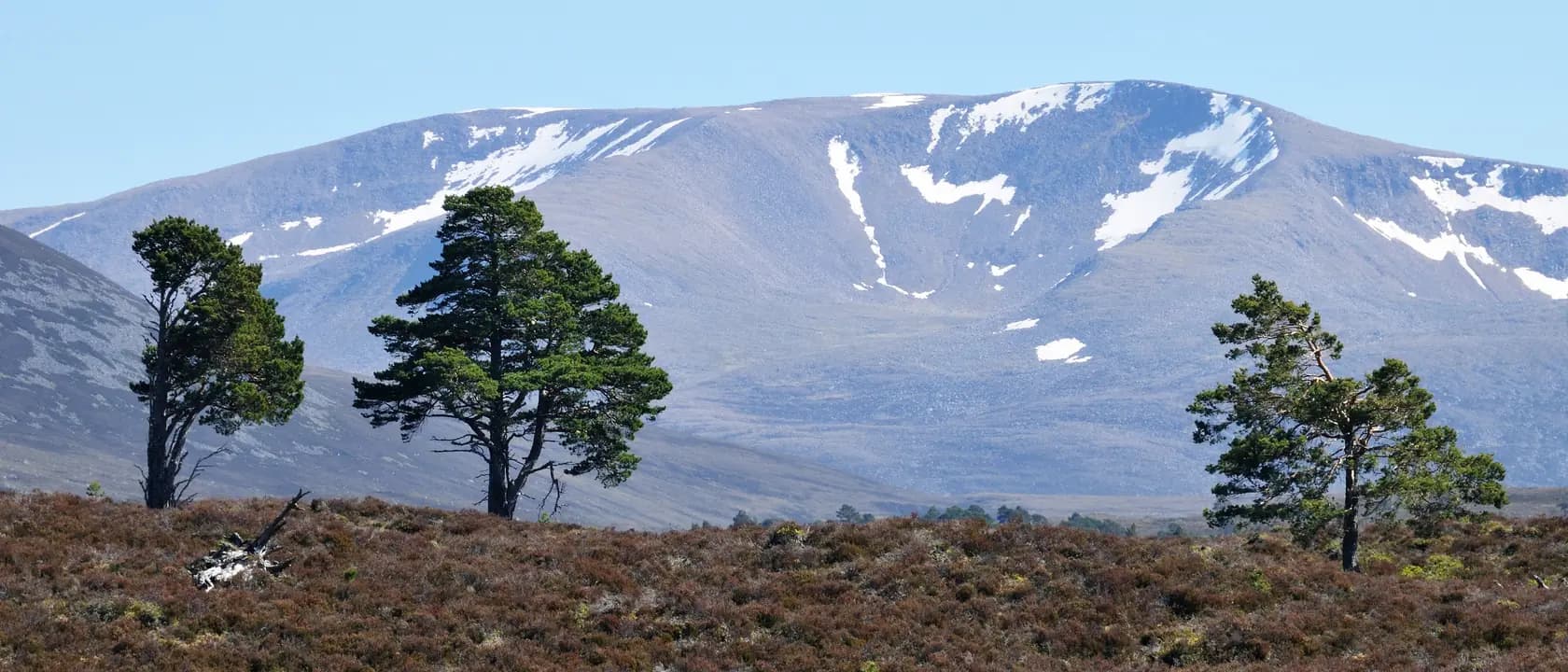
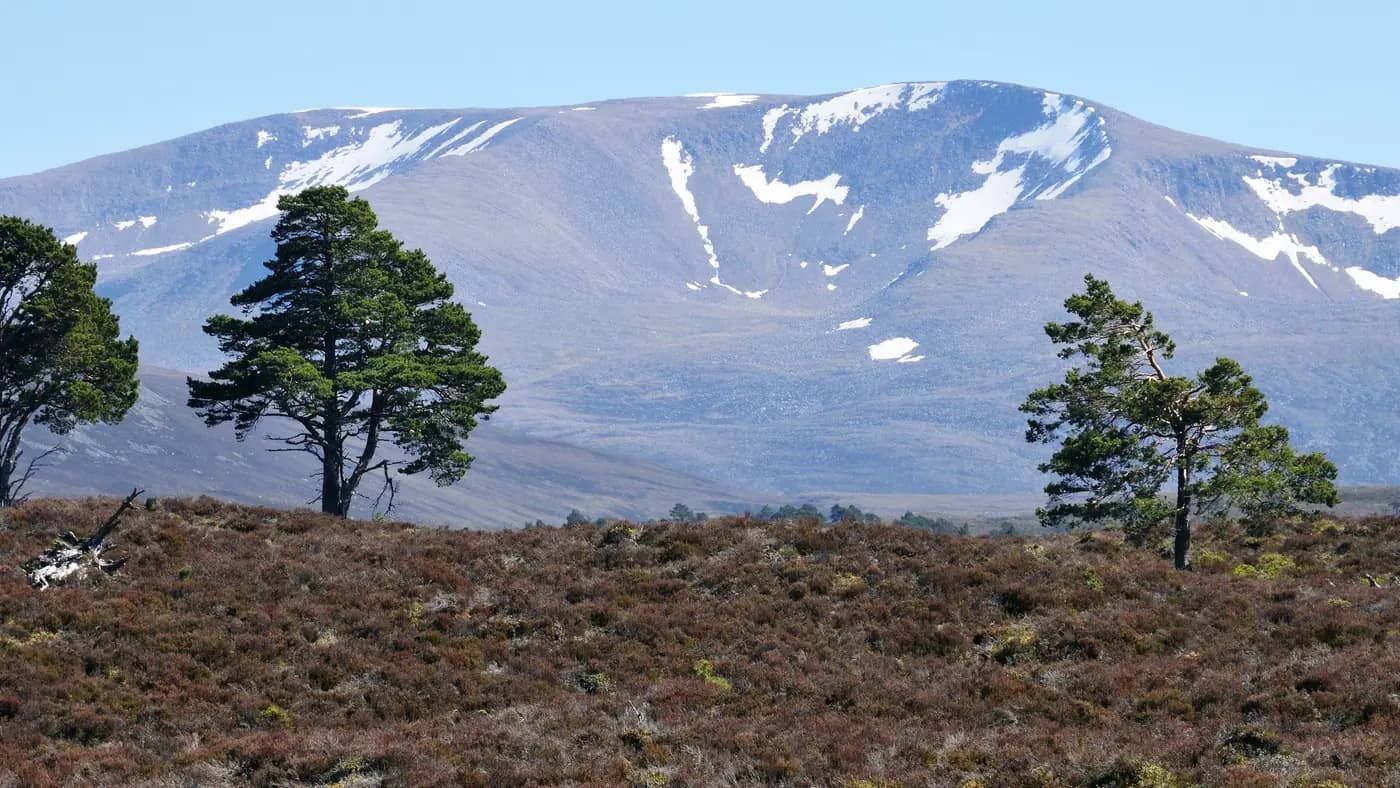
The Cairngorms are not a range of peaks so much as an enormous rolling plateau split by a few very deep glacial troughs. From below, the effect is undramatic — broad grey-brown whalebacks rather than spires. From on top it is entirely different: mile after mile of granite gravel, moss and boulder field at over a thousand metres, with the ground falling away suddenly into corries that hold snow well into summer.
This is the closest thing Britain has to a sub-arctic environment, and it behaves like one. The plateau has its own weather, which is routinely violent when the glens are calm. There are no trees, no walls and no natural shelter at all across large parts of it, so a tent is genuinely the only shelter available — which is a very different proposition from camping in a valley where you could walk out in an hour.
Lower down it is some of the best of Scotland: remnants of the old Caledonian pine forest in Rothiemurchus and Glen Feshie, rivers running clear over pink granite, and long approaches through woodland that make the walk in part of the point. Much of the finest camping is here rather than on the tops, and experienced people choose it deliberately.
It is also busy in places and empty in others, and the difference is measured in miles rather than in hours. The corries above the ski centre carry a great many people; the interior does not, and the interior is a long way from a road in any direction.
Scotland has a statutory right of responsible access, created by the Land Reform (Scotland) Act 2003 and explained in the Scottish Outdoor Access Code published by NatureScot. Unlike the England-and-Wales position, that right explicitly includes lightweight camping: you may camp on most unenclosed land, on foot, in a small tent, for a short period. This is the single biggest legal difference between the two countries for anybody who camps, and it is why the phrase "wild camping" means something slightly different on each side of the border.
The right is a right to behave responsibly, not a right to do as you like, and the Code is specific about what that means. Camp away from buildings, roads and historic structures. Stay a night or two and move on. Take everything away, including everything you buried. Do not damage the ground, and do not camp in enclosed fields of crops or livestock. Mountaineering Scotland publishes the same framework in the form hill users tend to need it, with camping treated as its own topic rather than as a footnote.
Fire is the provision that matters most here and the one most often ignored. The Code asks people not to light open fires where there is any risk of damage, and on the dry peat, heather and pine litter of this park that risk is real and recurrent. A stove is the answer, and in practice a stove is what nearly everyone experienced actually carries.
Some specific areas within Scotland carry seasonal camping byelaws that override the general position. The Cairngorms is not currently one of them, but that is a fact about now rather than about always, and it is the kind of thing to check with the authority rather than to assume from a page.
The park is reachable by public transport in a way most Scottish hill country is not. The Highland Main Line runs through it, and Aviemore, Kingussie, Newtonmore and Blair Atholl all have stations; the east side is reached from Aberdeen. That makes a multi-day trip possible without a car, which for camping is worth more than it sounds, because a linear walk finishing somewhere other than your vehicle is otherwise a serious planning problem.
The National Park Authority publishes visitor information for the whole park, and its pages are where anything current lives — access notices, path work, seasonal restrictions and the state of facilities. Ranger services operate on the ground in several estates.
For anybody going onto the plateau in winter, the Scottish Avalanche Information Service issues daily forecasts for the Northern Cairngorms and Creag Meagaidh through the season, and Mountaineering Scotland publishes standing guidance on avalanche awareness. Both are live services. This page reproduces neither and points at both.
It carries no routes, no distances and no ascent figures, and there is nowhere in this catalogue to put them. That is a refusal rather than an omission: HobbyHQ has no authoritative, lawfully reusable source for them, and a figure we worked out ourselves would look exactly like a figure somebody had walked. On ground where the nearest road can be many hours away, that failure mode is not an embarrassing correction.
It says nothing about conditions, and nothing here means that anywhere is currently safe, open, passable or suitable for you. The Cairngorm plateau in winter is a serious mountaineering environment with avalanche risk, sustained sub-zero temperatures and navigation that defeats experienced people in whiteout; the same ground in July is a walk. Neither this page nor any static page can tell you which one you are about to meet.
It also does not teach camping, cold-weather skills or navigation, and it is not a substitute for the Access Code, which is short and worth reading in full before relying on any summary of it — including this one. What this page is for is deciding whether this is the kind of place you want to camp, and knowing what you would be camping in.
Who owns the current picture
Anything that changes — closures, conditions, parking, grazing — lives with these, not here.
- Cairngorms National Park Authority
Visitor information, access notices and anything current about the park
- Scottish Outdoor Access Code
What the statutory right of responsible access actually permits, including camping
- Scottish Avalanche Information Service
The daily winter avalanche forecast, which is a live service and not a season-long fact
- Mountaineering Scotland
What access rights and responsibilities mean in practice on the hill
Worth reading first
From the rest of the catalogue, rather than written again here.
Safety · Fell running
“what goes wrong in fell running”
When it goes wrong on the fells
The incidents in fell running are a short and predictable list, and almost all of them are decisions made an hour earlier rather than accidents.
7 min read
Care and maintenance · Thru-hiking
“what repair kit should I carry on a thru hike”
Looking after kit on a long walk, when there is no shop
On a thru-hike the maintenance happens in the evening, in a tent, with what you are carrying. This is what wears out, what you can actually fix, and what to carry to fix it with.
4 min read
Equipment · Ski touring
“ski touring skins keep falling off”
Skins: choosing them, trimming them, and keeping the glue alive
Skin glue is the commonest equipment failure in the sport and almost all of it is preventable at home, in a warm room, the week before.
5 min read
Calculator · Fastpacking
“What is my base weight, and which three things are actually making it heavy?”
Base weight calculator
Adds a kit list up the way the sport defines the terms — base weight excluding consumables, pack weight including them, worn weight separate — and names the heaviest items.
Gives you Base weight, Pack weight, Total carried and more
Calculator · Hiking
“How long will this route take me — not an average walker, me?”
Hiking time estimator
A Naismith-style estimate in which both constants are your inputs rather than a Victorian assumption, so it can be calibrated against walks you have actually done.
Gives you Estimated total time, Moving time, Time attributable to ascent
Other things the same ground is good for
Subjects this catalogue covers that people do on the same hills.
Hiking
SportHobbyWalking longer distances over rougher ground — the cheapest way into the outdoors, and the one whose risks are most underestimated.
£100–£300 to startOutdoorsModerate effort
Ski touring
SportClimbing under your own power on skis and descending away from lifts — mountaineering with a fast way down, and the avalanche knowledge that makes it possible.
Over £1,000 to startOutdoorsVery demanding
Scrambling
SportAscending steep ground where hands are needed but ropes usually are not — the middle ground between hillwalking and climbing.
£100–£300 to startOutdoorsDemanding
Birdwatching
HobbyFinding, identifying and recording wild birds — a hobby you can start from a kitchen window.
£25–£100 to startOutdoorsGentle
- The Act and the Access Code — NatureScot
- Things to do — Cairngorms National Park — Cairngorms National Park Authority
- Access rights — Mountaineering Scotland
- Land Reform (Scotland) Act 2003, section 32 — The National Archives (legislation.gov.uk)
- Scottish Avalanche Information Service — Scottish Avalanche Information Service (sportscotland)