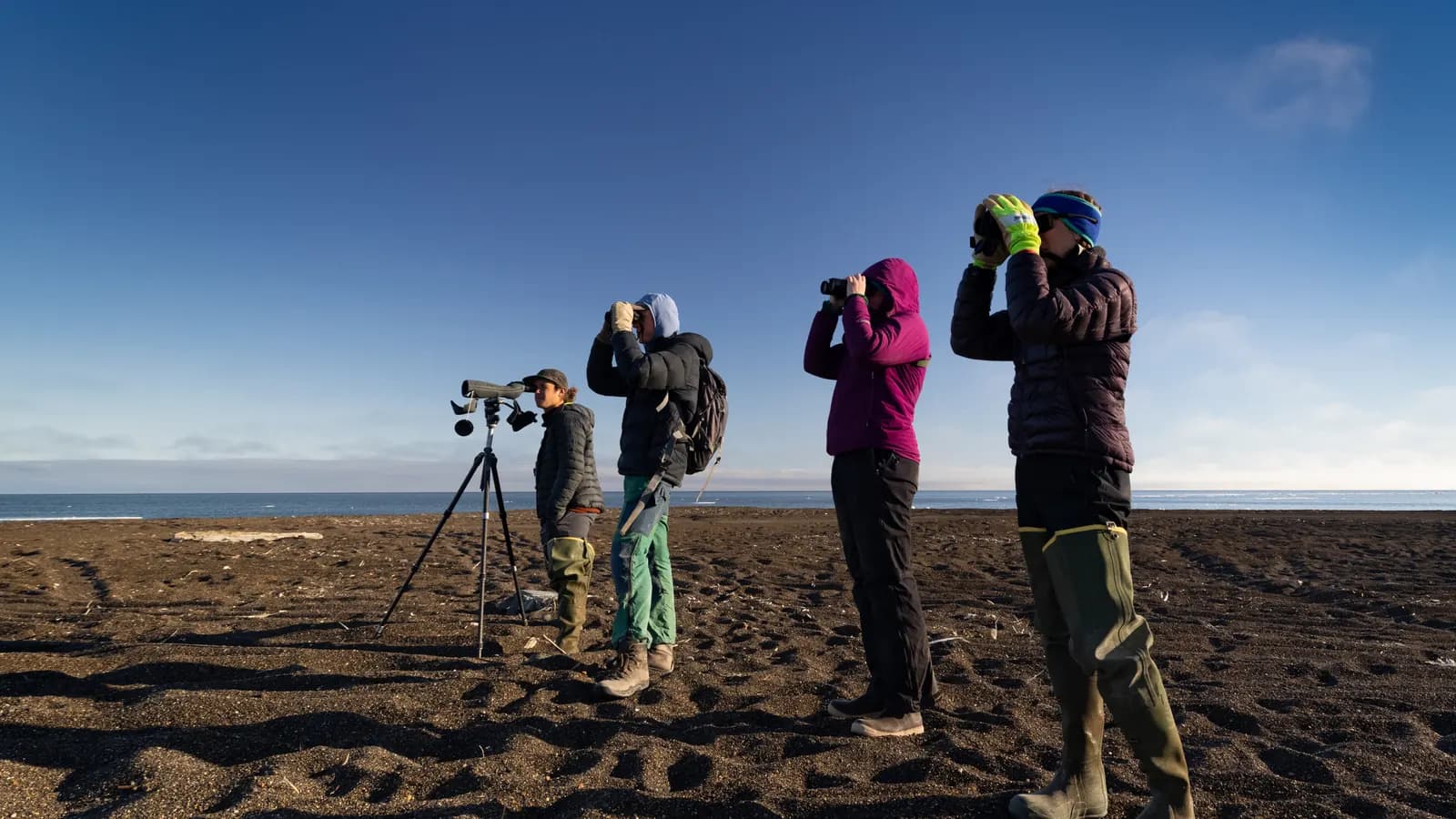
Nature & wildlife · Outdoor & adventure
Birdwatching
Birdwatching has the gentlest entry of any serious hobby and one of the deepest ceilings. You can begin with no equipment and no knowledge, and still be learning something new about it thirty years later. What follows is what actually matters at the start, what to buy in which order, and the fieldcraft that separates people who see birds from people who look for them.
Also known as birding, bird watching, twitching.
Birdwatching is the practice of finding wild birds and working out what they are. That sounds trivial and it is not: a small brown bird in a hedge, seen for two seconds in poor light, is a genuinely hard problem, and the skill of solving it is what the hobby consists of.
It splits into several quite different pursuits that share equipment. Patch birding means visiting one local site repeatedly until you know it well enough to notice when something is unusual. Listing means keeping records — of a garden, a county, a year, a life. Twitching means travelling to see a specific rare bird that somebody else has found. Survey work means contributing structured counts to national monitoring. Most people do some of all four without ever deciding to.
What holds them together is that birds are the most visible wildlife in Britain, they are everywhere, and they change with the season. The hobby has no closed period and no venue.
The honest summary:
- First useful session
- ImmediatelyYou will identify something on day one, even if it is a blackbird.
- Time to feel competent
- One to two yearsRoughly the point at which common species stop needing the book.
- Realistic entry cost
- £80–£150
- Ceiling
- None in practiceIdentification, behaviour, migration, survey methodology, sound recording.
- Still deciding — Birdwatching vs wildlife photography
- Still deciding — Mycology vs birdwatching
- Sound — Learning song and call properly roughly doubles what you detect, particularly in woodland where most birds are heard and never seen.
- Survey work — The BTO runs structured national surveys — Breeding Bird Survey, Wetland Bird Survey, Garden BirdWatch — that turn ordinary birdwatching into data used in real population science. This is the point at which the hobby starts contributing rather than only consuming.
- Ringing — A licensed, formally trained activity with a long apprenticeship under a qualified trainer. Not something to be taken up casually, and the closest most people get to handling wild birds legally.
- Ageing and sexing — Moult sequences, feather generations and the logic of how a bird’s plumage records its age. This is where identification stops being lookup and becomes reasoning.
- Scarcity and vagrancy — Understanding *why* a Siberian warbler turns up in Norfolk in October — weather systems, migration routes, and the geography of where to look.
Sources for this section
- Bird Ringing Scheme — training to ring (opens in a new tab) — British Trust for Ornithology · Scientific · corroborated indirectly
Getting started
Four steps, in this order. The order matters more than the equipment.
Step 1: Learn the twenty birds in your garden or street first
Not the rare ones. House sparrow, blue tit, great tit, blackbird, robin, dunnock, wood pigeon, collared dove, magpie, carrion crow, starling, goldfinch, chaffinch, wren, long-tailed tit, greenfinch, jackdaw, herring or black-headed gull, mallard, and whatever local speciality you have. These are the reference set against which everything else is judged.
You will know it worked when: You can name what is outside without thinking about it, and you notice immediately when something is not on the list.
Step 2: Get binoculars before anything else
A field guide without binoculars is close to useless, because you cannot see the features the guide describes. See the equipment section for what to buy — the short version is 8×42, around £100, tried in your own hands before you buy if at all possible.
You will know it worked when: You can see a bird’s eye ring, wing bars and leg colour from thirty metres.
Step 3: Go somewhere with a lot of birds and stand still
A local nature reserve, a reservoir, an estuary, a mixed wood. Beginners walk too much and too fast. Standing in one good place for twenty minutes will show you more than an hour of walking, because you stop being the most disturbing thing in the landscape.
You will know it worked when: Birds resume normal behaviour around you, which is when the interesting things happen.
Step 4: Start writing things down
A notebook or BirdTrack. What, where, when, how many. This is not administration — it is the mechanism by which you notice patterns, and after a year your own records will teach you more about your local birds than any book.
You will know it worked when: You know when the swifts arrive, and you know when they are late.
Sources for this section
- Bird Ringing Scheme — training to ring (opens in a new tab) — British Trust for Ornithology · Scientific · corroborated indirectly
- RSPB (opens in a new tab) — Royal Society for the Protection of Birds · Institutional · read — supports the claim
Equipment
Two purchases matter. The rest is optional for years.
What you need:
- Binoculars, 8×42 — The first number is magnification, the second is objective lens diameter in millimetres. 8×42 is the default recommendation for good reason: 8× is steady enough to hold by hand without a wobble that obscures detail, and 42mm gathers enough light for dawn, dusk and woodland. 10× sounds better and is harder to hold still; 8×32 is lighter and dimmer. Budget £100–£150 new.
- A field guide with illustrations, not photographs — Counterintuitive but well established: a painted plate can show the diagnostic features of a species in a standard pose and light, which a photograph of one individual cannot. Photographic guides are attractive and worse to identify from.
- A sound app or recording — Song and call do more identification work than plumage in woodland and reedbed. Automatic sound-ID apps are useful and are wrong often enough that you should treat them as a suggestion rather than an answer.
- A notebook, or BirdTrack — BirdTrack is the BTO’s free recording platform. Your casual records genuinely feed national monitoring, which is unusual for a hobby.
What to buy later, or never:
- A telescope and tripod — Transformative for estuaries, reservoirs and seawatching; useless in a wood. £400 upwards, plus a tripod that costs more than you expect. Buy after a year, when you know whether you are an open-water birder.
- A camera with a long lens — This is a different hobby that happens in the same places. It is expensive, and it will change how you birdwatch — usually towards getting closer than you should.
- Camouflage clothing — Almost never necessary. Birds respond to movement and outline far more than to colour. Quiet fabric matters more than pattern.
Sources for this section
- Bird Ringing Scheme — training to ring (opens in a new tab) — British Trust for Ornithology · Scientific · corroborated indirectly
- RSPB (opens in a new tab) — Royal Society for the Protection of Birds · Institutional · read — supports the claim
- Go deeper — Choosing your first binoculars
- Work it out — Telescope & eyepiece calculator
- Work it out — Hobby startup cost estimator
- Work it out — Binocular specification comparison
Beyond the law, the conventions that experienced birders keep:
- The bird comes first — Above the record, the photograph and the list. If your presence is changing the bird’s behaviour, withdraw.
- Playback is for winter, sparingly, or not at all — And never for a scarce breeding species.
- Access before enthusiasm — A rare bird on private land is not a right of entry. Rare-bird information services publish access arrangements for exactly this reason.
- Report scarce breeders carefully — Publishing a precise location for a nesting rarity can attract both crowds and, for some species, egg collectors, who still exist.
Experienced birders do not identify birds by leafing through a book. They run a fast, mostly unconscious sequence, and it is learnable deliberately.
The sequence, in order of reliability:
Step 1: Size and shape
Compare against a known bird rather than in absolute terms: sparrow-sized, blackbird-sized, pigeon-sized. Then shape — bill length and depth, tail length, leg length, overall bulk. Shape survives bad light and distance in a way that colour does not.
Step 2: Behaviour
How does it move? Treecreepers spiral up trunks; nuthatches go down head-first. Wagtails walk, sparrows hop. Flight action — bounding, direct, flickering, soaring — often identifies a bird before any plumage is visible.
Step 3: Habitat and season
A bird’s address rules out most of the book. Reedbeds, high moor, mature woodland, estuary mud and suburban garden each hold a distinct and fairly small cast. Add the month and the list shortens again.
Step 4: Sound
Song is the male’s advertisement and is usually distinctive; calls are used year-round by both sexes and are harder but more useful. Learn calls of the twenty commonest birds first so that everything else stands out as unfamiliar.
Step 5: Plumage detail, last
Wing bars, eye stripe, rump colour, leg and bill colour. These settle the final choice between two or three candidates — they rarely open the question.
The other half of fieldcraft is not disturbing the bird. Move slowly, avoid a hard silhouette against the sky, keep to the edge of cover, and stop when a bird looks at you — an alarm-calling bird is one you have already got too close to, and it is telling every other bird within fifty metres that you are there.
Sources for this section
- Seven top tips on how to ID birds (opens in a new tab) — Royal Society for the Protection of Birds · Institutional · read — supports the claim
- Bird Ringing Scheme — training to ring (opens in a new tab) — British Trust for Ornithology · Scientific · corroborated indirectly
- Go deeper — How to identify a bird you do not recognise
- Jizzalso: giss
- The overall impression of a bird — shape, posture and movement combined — that allows identification before any detail is visible.
- Patch
- A local site a birder visits repeatedly and knows in detail, usually within easy reach of home.
- Twitch
- A journey made specifically to see a rare bird already found and reported by somebody else.
- Lifer
- A species seen for the first time ever, and so added to a life list.
- Superciliumalso: eyebrow stripe
- The stripe running above a bird’s eye, from the bill backwards. One of the most-used identification features.
- Primaries
- The outermost flight feathers of the wing, attached to the "hand". Their projection beyond the tertials is diagnostic in several tricky groups.
- Eclipse plumage
- The dull plumage male ducks adopt in late summer while flightless during moult, which makes drakes briefly resemble females.
- Vismigalso: visible migration
- Visible migration — watching birds actively migrating overhead, usually at dawn in autumn.
- Seawatching
- Watching from a coastal headland for seabirds passing offshore, typically in onshore winds.
- Dip
- To travel to see a reported bird and fail to find it.
Beginner mistakes
The predictable ones, in the order beginners make them.
- Buying cheap binoculars — A £25 pair is not a smaller version of a £250 pair; it is dim, unsharp at the edges and often out of collimation, so it gives you a headache. This is the single purchase that determines whether the hobby sticks.
- Reaching for the rare bird first — Almost every unfamiliar bird is a common species in unfamiliar plumage, light, or posture. Juveniles, moulting adults and winter plumages account for the overwhelming majority of "what on earth is that". Work through the common options before the exciting one.
- Identifying from a single feature — "It had a red breast" gets you robin, bullfinch, redstart, chaffinch and a very washed-out linnet. Identification is the intersection of size, shape, behaviour, habitat, season and sound — plumage is only one input, and often the least reliable.
- Walking too much — Covering ground feels productive and is usually the opposite. Birds settle around a stationary observer within minutes.
- Playing song recordings to draw birds in — It works, which is the problem. Repeated playback pulls a bird off territory and away from feeding or brooding, for your convenience. During the breeding season it is genuinely harmful, and for Schedule 1 species it can be an offence.
- Not writing anything down — A year of unrecorded birdwatching leaves you with impressions. A year of records leaves you with a baseline.
Most birdwatching frustration is one of three things: you are in the wrong place, you are there at the wrong time, or you are looking rather than listening. All three are fixable and none of them is about equipment, which is where beginners reliably look first.
- You saw almost nothing all morning — Time of day, most likely. Activity is concentrated in the first two or three hours after dawn and again before dusk, and the middle of a still, bright day is genuinely quiet. Wind is the other reliable killer — birds sit tight in it and you will hear nothing over it. Neither is bad luck.
- Everybody else is finding things and you are not — Almost always sound. Experienced birdwatchers are locating by call and then looking, which is why they appear to see more; they are hearing more. This is the single largest step in the hobby and it is learnable — start with the five commonest species where you live rather than with a recording of everything.
- You cannot get the bird in the binoculars — Find it with your eyes, keep looking at it, and bring the binoculars up to your eyes rather than moving your head to them. Almost every beginner does the reverse and loses the bird in the process. Practise on something stationary.
- The view is dim, or you see two circles — Eyecups and interpupillary distance. Roll the eyecups down if you wear glasses and up if you do not, and set the barrel spacing until the two circles merge into one. Then set the dioptre once, with your dominant eye, and leave it. A great many people use binoculars badly adjusted for years.
- Everything fogs up — Condensation on cold glass in warm damp air, and it clears. Persistent internal fogging is a seal failure and is a repair rather than a technique problem.
- You saw it well and still cannot identify it — Normal, and the fix is to change what you record rather than to look harder. Note size against a bird you know, shape, behaviour and habitat before colour — colour is the least reliable feature in poor light and the one beginners fixate on. An unidentified bird written up honestly is worth more than a guess.
- The birds left when you arrived — Movement and skyline. Approaching along a hedge rather than over it, stopping frequently, and sitting still for ten minutes will produce more than walking for an hour. A hide works for the same reason and is not cheating.
- Your garden feeders are ignored — Usually position rather than food. Feeders need cover within a few metres for birds to escape to, and an exposed feeder in the middle of a lawn is a place nothing feels safe. Give it weeks rather than days.
- You are seeing the same twenty species and want more — Habitat, not effort. A patch of one type produces its own list and then stops adding to it. Adding water, a wood or a coast to your rotation changes the list overnight, which is why patch birders keep several.
How birders behave towards each other
The birds’ interests are covered above. This is the other half of the code — the part about people, which decides whether your first hide feels welcoming or baffling.
- A hide is a quiet carriage with windows — Open and close the flaps slowly and hold them rather than letting them drop — the bang is what puts a hundred waders up. Sit rather than stand in front of seated people. Conversation is normal and welcome at the volume you would use in a library. The code names this directly as the ‘crowd effect’: the cumulative disturbance of many people each being individually reasonable.
- Sharing what you can see is the default — "Marsh harrier, quartering, far left over the reeds" is how a hide talks, and it is aimed at everybody in it. If you cannot get on to something, say so — somebody will walk you on to it by landmark. This is the single most reliable way to learn, and it costs nothing but admitting you cannot see it yet.
- The equipment is not the entry fee — Worth quoting, because the assumption is so common and the code is so blunt about it: "Optics, guides and specialist knowledge do not make a birder; the common ground shared by all birders is finding enjoyment and meaning in engaging with birds." Nobody worth listening to is checking what your binoculars cost.
- Found something rare? Landowner first, recorder second, internet last — That is the published sequence, and the reasoning is practical rather than precious. Tell the landowner or the reserve warden; contact the county bird recorder or an experienced birder to confirm the identification; and only then consider whether "the site can cope with a large number of visitors". For a rare *breeding* bird the advice is not to publicise the location at all unless it is somewhere wardened and protected — egg collectors have not gone away.
- Answer the person who asks what you are looking at — An explicit instruction in the code, and one of very few codes of conduct anywhere that asks you to be an ambassador rather than merely to be careful. "Your enthusiasm could start a lifetime’s interest." Most birders can name the person who did it for them.
- Send your records somewhere — A sighting in a notebook is a memory; the same sighting submitted to the county recorder or a national recording scheme is data. The distribution maps, the population trends and the conservation arguments built on them come almost entirely from ordinary people submitting ordinary records.
There is a real cultural split between twitching — travelling to see a rare bird somebody else found — and patch birding, which means working one local site relentlessly for years. The codes now nudge towards the second on carbon grounds, but the better argument is that a patch teaches you far more: you learn what is normal in a place, which is the only way to notice what is not. Almost everybody does some of both, and nobody serious sneers at either.
Sources for this section
- The Birders’ Code (opens in a new tab) — British Trust for Ornithology · Scientific · read — supports the claim
For most of the nineteenth century, studying birds meant shooting them. Identification was done in the hand, collections were made of skins and eggs, and the phrase "what’s hit is history, what’s missed is mystery" was a working principle rather than a joke.
Two things changed it. Optics improved to the point where field identification became genuinely possible, and a conservation movement grew up in reaction to the plumage trade — the organisation that became the RSPB was founded in the 1880s by women campaigning against the use of feathers, and particularly egret plumes, in millinery. Watching birds rather than collecting them became first respectable and then normal.
The organised recording culture followed. The British Trust for Ornithology was founded in the 1930s specifically to harness amateur observers for research, an arrangement that turned out to be unusually productive: British bird populations are among the best-documented wildlife datasets anywhere, and almost all of that data was gathered by people doing it for pleasure.
Egg collecting, once a mainstream schoolboy activity, was progressively outlawed and is now a criminal offence. It is the clearest marker of how completely the hobby’s ethics inverted within a century.
Sources for this section
- RSPB (opens in a new tab) — Royal Society for the Protection of Birds · Institutional · read — supports the claim
- Bird Ringing Scheme — training to ring (opens in a new tab) — British Trust for Ornithology · Scientific · corroborated indirectly
- Wildlife and Countryside Act 1981 (opens in a new tab) — UK Government (legislation.gov.uk) · Governing body · read — supports the claim
- Do I really need binoculars to start?
- You can start without them and you will stop within a fortnight. The distinguishing features that field guides describe — an eye ring, a wing bar, leg colour — are simply not visible to the naked eye at the distances birds allow. Binoculars are the hobby’s one genuinely necessary purchase, and buying a decent pair once is cheaper than buying a poor pair twice.
- What magnification should I buy?
- 8×42 for a first pair, unless you have a specific reason not to. Higher magnification amplifies hand shake as much as it amplifies the bird, and a 10× image that will not hold still shows you less detail than a steady 8× one. The 42mm objective matters most in woodland and at dawn and dusk, which is when birds are most active.
- Is it a hobby you can do in a city?
- Yes, and cities are better than their reputation. Reservoirs, gravel pits, cemeteries, parks with mature trees, and any patch of scrub near water all hold birds, and urban sites concentrate migrants because there is nowhere else for them to stop. Peregrines nest on buildings in most large British cities.
- How long before I can identify things without the book?
- For the twenty or so species you see most often, a few weeks. For confident identification of the common British breeding birds across their plumages, one to two years of regular watching. For gulls, waders in winter plumage and autumn warblers, considerably longer — those groups defeat experienced birders regularly, and anyone who tells you otherwise is not looking hard enough.
- Is birdwatching expensive?
- It has a modest one-off cost and almost no running cost, which is an unusual shape. After binoculars and a guide, the hobby is free unless you choose to travel for it or buy a telescope. Compared with almost any equipment sport it is very cheap.
- What is the difference between birdwatching and birding?
- Nothing formal, and the distinction is largely one of self-description. "Birding" tends to signal a more active, identification-focused, list-keeping approach and "birdwatching" a more contemplative one, but the boundary is soft and nobody polices it. "Twitching" is genuinely different: it means travelling specifically to see a particular rare bird somebody else has found.
Within this activity
Disciplines, variants and techniques that sit inside it.
Disciplines
- Breeding bird surveying — Walking a fixed transect and recording every bird, feeding a long-running national dataset.
Variants
- Urban birding — Birdwatching in cities and industrial edgeland, which has its own species list and its own patience.
If you like this
Each of these is here for a stated reason, not because it is also a hobby.
Similar to
- Astronomy — Both are observational hobbies built on patience, optics and learning a large named catalogue — and birders already own usable binoculars.
- Geocaching — Both turn an ordinary walk into a search with a purpose, and both work equally well alone or with children.
- Mycology — The same hobby in a different kingdom — go out, find, identify, record, submit — and birders who move across find the recording culture familiar and the identification considerably less forgiving.
- Plant identification — The same skill in a different domain: learning to name things in the field using features, habitat and season.
Goes well with
- Angling — Sitting still by water for hours is the best hide anybody ever built, and the fieldcraft of moving slowly and staying off the skyline is one skill serving both.
- Film photography — The same habit of waiting and the same optics budget, pointed at the same subjects from the same hides.
- Fly fishing — Standing still by water for hours already puts you in the best possible hide, and the fieldcraft of moving slowly and staying off the skyline is the same skill in both.
- Sea fishing — Hours standing still on a shoreline at dawn is the same posture from either hobby, and estuaries reward both at the same states of tide.
- Butterfly watching — Same habitats, same recording culture, and a summer season that fills exactly the months when bird activity drops off.
- Moth trapping — Runs overnight in a garden and needs no travel, so it complements a hobby that otherwise depends on getting somewhere at dawn.
Progresses to
- Wildlife photography — Most wildlife photographers started as birdwatchers, and the fieldcraft transfers directly — the camera is the expensive part, not the skill.
Sources for this section
- Bird Ringing Scheme — training to ring (opens in a new tab) — British Trust for Ornithology · Scientific · corroborated indirectly
- RSPB (opens in a new tab) — Royal Society for the Protection of Birds · Institutional · read — supports the claim
- Wildlife and Countryside Act 1981 (opens in a new tab) — UK Government (legislation.gov.uk) · Governing body · read — supports the claim
- The Countryside Code (opens in a new tab) — Natural England and Natural Resources Wales · Governing body · read — supports the claim
Comprehensive
Last reviewed 2026-08-13. Cost, time and difficulty figures on this page are HobbyHQ estimates — see how we work. Something here wrong or out of date? Tell us.