Music & performance
Harp
The harp has a real adult-beginner tradition and almost no honest beginner writing, and the gap costs people money. Nearly everything published assumes the pedal harp — the large one in an orchestra, with seven pedals and a five-figure price — and an adult starting today in Britain is overwhelmingly likely to want the lever harp, which is a different instrument with its own repertoire, its own teaching tradition and a tenth of the cost. Getting that decision right is most of what a beginner needs, and it is the decision every other source skips. This page covers which harp and why, what the money actually is, how the lever mechanism works and why it constrains what you can play, how people learn, and the physical realities nobody mentions until your fingers are sore.
Also known as celtic harp, lever harp, clarsach, pedal harp, folk harp.
Almost every problem a beginner harpist has starts with not knowing that "harp" refers to two substantially different instruments. They share a shape and a technique and they are not interchangeable in cost, repertoire, portability or teaching tradition.
The pedal harp is the orchestral instrument: 47 strings, seven pedals that each change one note across the whole range, and the ability to play in any key and to modulate mid-piece. It is what you have seen in a concert hall, it is what most published beginner material assumes, and it costs more than a car.
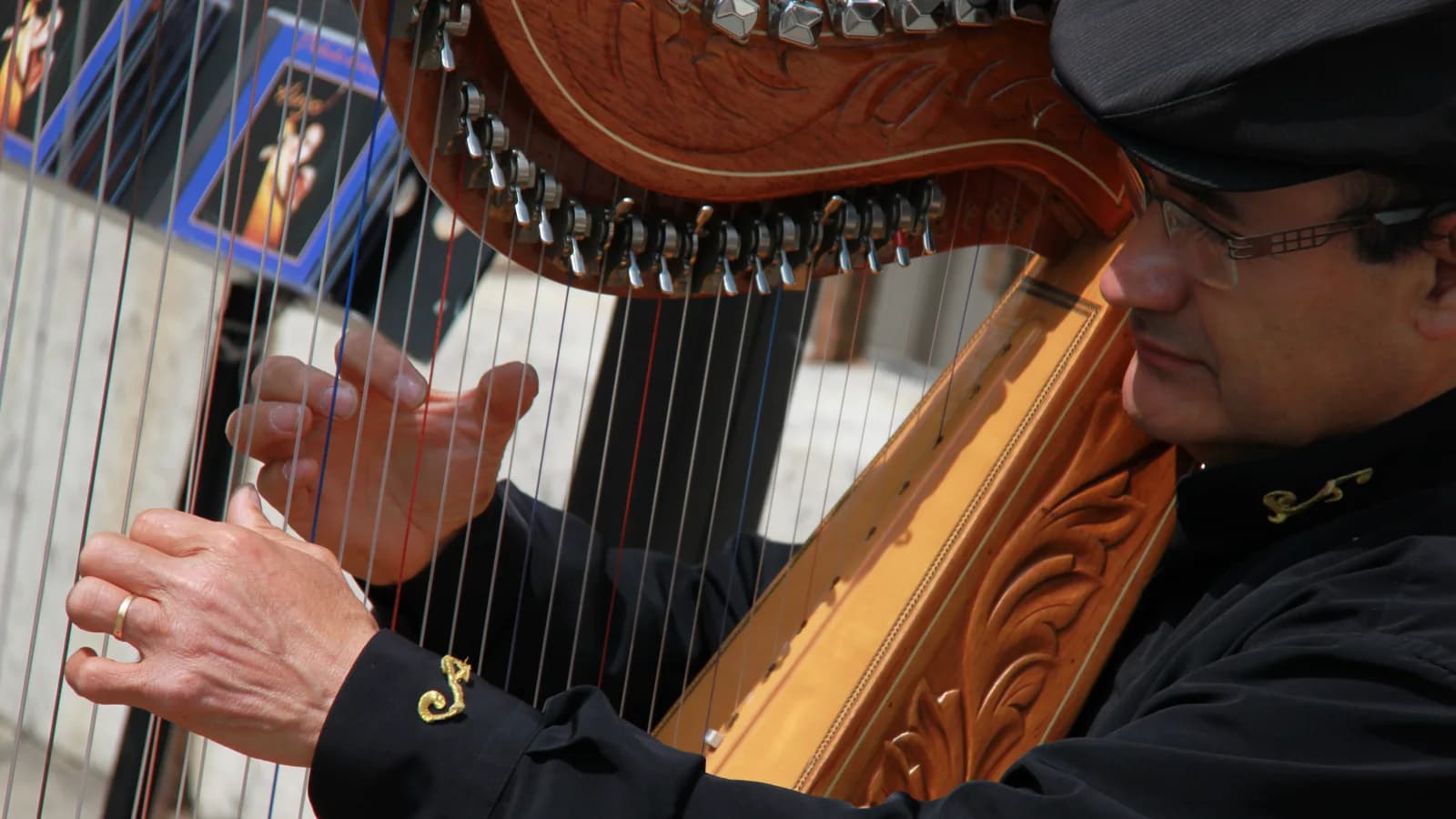
The lever harp — also called the Celtic harp, the folk harp, or in Scotland the clàrsach — has 22 to 38 strings and a small lever at the top of each one that raises it by a semitone when you flip it. You set the levers for the key before you play and change individual ones with a spare hand during the piece. It is the instrument of the folk tradition, it is what adult beginners in Britain overwhelmingly learn on, and it is affordable.
The blunt version: unless you already know you want to play in an orchestra, you want a lever harp. Everything below assumes that unless it says otherwise.
- The adult beginner’s instrument
- Lever harp, 26–34 strings
- What it costs
- £1,000–£3,000, or rent at £30–£80 a month
- What makes it hard
- Two hands, two staves, and the levers
- What makes it easy
- It sounds good on your first day
Step 1: Go and put your hands on one
Harp shops and makers expect this and most harp teachers will let you try theirs in a first lesson. Thirty minutes with a real instrument settles the lever-versus-pedal question and the size question better than any amount of reading, including this.
You will know it worked when: You know which instrument you actually want.
Step 2: Find a teacher before you find a harp
This inversion is deliberate. A teacher will tell you what to rent, will often know of a second-hand instrument, and will stop you buying something unplayable. Harp technique is unusually specific — which fingers, which part of the finger, how the hand leaves the string — and habits formed alone in the first months are genuinely hard to undo.
You will know it worked when: Somebody knowledgeable is steering the purchase.
Step 3: Rent for three to six months
Long enough to find out whether the daily reality suits you, short enough that stopping costs a few hundred pounds rather than a few thousand.
You will know it worked when: You know whether this is a hobby or a phase, cheaply.
Step 4: Learn to tune it yourself, immediately
A harp goes out of tune constantly — every string is under tension against a wooden frame that responds to temperature and humidity — and tuning all 34 of them is a five-minute job you will do before every practice. This is not a chore to postpone; it is part of playing the instrument and it trains your ear.
You will know it worked when: You can make the instrument sound right without help.
Step 5: Buy, once you know what you want
By now you know the size, whether you want full levers, and probably which maker you like. This is the point at which spending real money is an informed decision rather than a hopeful one.
You will know it worked when: An instrument chosen rather than guessed at.
The harp gives an unusually generous first hour. Every string is already a note in the key you have set, so almost anything you play sounds pleasant — which is why people fall in love with it in a shop. What follows is harder than that hour suggests, and knowing where the difficulty sits helps.
The things that are genuinely difficult, roughly in the order you meet them:
- Four fingers, not five — The little finger is not used. It is too short to reach the string cleanly and it is left out entirely, which feels wrong for weeks and then stops registering.
- Placing rather than reaching — Harp technique places the fingers on the strings ahead of playing them, so the hand is prepared rather than grabbing. This is the single largest difference from piano and it is the thing a teacher fixes fastest and self-teaching gets wrong for longest.
- Two staves, two hands, no keyboard — You are reading the same notation a pianist reads, on an instrument where you cannot see the strings you are playing without leaning round the soundboard. Players learn to find strings by feel and by the coloured C and F strings, which is why those colours exist.
- The levers — The lever harp’s defining constraint and its defining skill. Set them before the piece for the key; change one mid-piece with whichever hand is free, at a moment the music allows. Arranging music for a lever harp is partly the craft of finding those moments, and it is a real and satisfying part of the hobby.
- Your fingertips — They will hurt. Twenty minutes is a long first session and this is a physical limit rather than a lack of application. Calluses build over a couple of months and the problem then disappears permanently.
| Lever harp | Pedal harp | |
|---|---|---|
| Strings | 22–38 | 47 |
| Changing key | Flip levers by hand, set before you play | Seven pedals, changeable mid-piece |
| Price, new | £1,000–£3,000 | £10,000–£30,000 |
| Weight | 5–15kg — one person carries it | 35kg and up — two people and a trolley |
| Repertoire | Folk, early music, song accompaniment, a growing modern literature | The orchestral and classical solo repertoire |
| Teachers | Widely available, including online | Fewer, and concentrated near conservatoires |
| Maintenance | Tuning, strings, occasional lever adjustment | All of that plus specialist regulation every few years |
How to choose the size, which is the decision within the decision:
- Under 22 strings — A lap harp. Cheap, portable, delightful, and limited — you will meet the bottom of the range quickly and much written music will not fit. Good as a deliberate second instrument or for a child; frustrating as an only harp.
- 26 to 29 strings — The practical minimum for a serious start. Enough range for most folk repertoire, still light enough to carry to a session, and the size a lot of teachers recommend for an adult beginner.
- 34 to 38 strings — A full-size lever harp. Almost everything written for the instrument fits, it is what you would eventually want, and it is heavy enough that moving it is a considered act rather than a casual one.
- Full levers or partial — Cheaper instruments sometimes have levers only on some strings, usually the Cs and Fs. Avoid this if you can. It saves a few hundred pounds and permanently limits which keys you can play in, which is the constraint you will meet soonest.
The harp has an unusually flat middle. The first weeks are rewarding, the next few months are the technique grind that every instrument has, and then it opens into a long stretch where you can play a great deal of real music and improve slowly and pleasantly for decades. There is a graded examination route if you want structure, and a large part of the community ignores it entirely.
The two things that most reliably keep adult learners going are playing with other people and having something to play towards. Harp circles, folk sessions, summer schools and the traditional-music festival circuit all exist and are unusually welcoming, partly because harpists are thin on the ground and are pleased to find each other. Playing for other people — even badly, even once — is what turns practice into a hobby rather than a chore.
- Tuning, every time — Before every practice, all of it, with a clip-on tuner and a tuning key. A new harp or a new set of strings will need it more than once a day while everything settles.
- Strings break, and it is normal — Usually the thin high ones, usually with a bang that is more alarming than it is serious. Keep spares for at least the top octave. Replacing one is a five-minute job and a new string will go flat repeatedly for a week while it stretches.
- A full restring is a maintenance event — Every few years, £80–£250 depending on the instrument, and it transforms a dull-sounding harp. Done gradually rather than all at once, so the frame is never suddenly unloaded.
- Humidity and temperature — A wooden instrument under several hundred kilos of aggregate string tension does not enjoy a radiator, a conservatory, or a car boot in August. A stable room is most of the care it needs.
- Levers need occasional attention — A lever that does not produce a true semitone can be adjusted, usually by a technician and occasionally by a confident owner. Worth checking when buying second-hand, because it is the commonest fault on an old instrument.
Harpists spend a surprising amount of the first year unable to tell whether a problem is theirs or the instrument’s, and it is a genuinely hard distinction on an instrument that goes out of tune constantly and has thirty-four things that can buzz. Most of it is mechanical and cheap to settle.
Read each entry as symptom → likely class → what you can safely check → what to do next. Nothing here is a substitute for a teacher on the hand-position questions, and the page says which those are.
- Class 1
- Tuning and strings — yours, and constant
- Class 2
- Levers and mechanism — yours to spot, a technician’s to fix
- Class 3
- The instrument itself — rare, and serious
- Class 4
- Hands and technique — a teacher’s
- It will not stay in tune for an hour — Normal, if the strings or the harp are new. New strings stretch for weeks and a new instrument settles for months. Check the room first — a harp beside a radiator or in a conservatory will never hold. If the instrument is old, the strings are old and the room is stable, a single string that alone will not hold is usually a slipping pin, which is a technician’s job.
- One note buzzes when you play it — Levers, most likely. A lever slightly engaged, or one that has drifted out of adjustment, will buzz against the string. Flip it fully both ways and listen. If it buzzes with the lever clearly disengaged, look for the string touching the bridge pin or a neighbouring string, and then for a loose fitting somewhere on the soundboard.
- A lever does not give a true semitone — Mechanism, and it is adjustable. Levers are regulated and drift over years. Check it against a tuner: engage the lever and see whether the note is genuinely a semitone up. Some owners adjust their own; most do not, and it is a small job for a technician. Worth checking on any second-hand instrument before buying, because it is the commonest fault on an old harp.
- The whole instrument sounds dull and lifeless — Strings, and it is age. Strings lose brightness gradually over years and the decline is invisible from inside — people adapt and conclude the harp was always like this. A full restring transforms a tired instrument, and the difference startles almost everybody who does it for the first time.
- A string broke with a bang — Normal, and it is nearly always a thin high one. Not a fault and not your fault. Replace it, expect it to go flat repeatedly for a week while it stretches, and keep spares for the top octave. If strings keep breaking in the same place on the harp, look at the bridge pin or eyelet for a sharp edge — that one is a technician’s.
- There is a new buzz that moves around, or the soundboard looks different — Stop playing and get it looked at. A harp is under several hundred kilograms of aggregate string tension. Cracks in the soundboard, a soundboard that has begun to belly noticeably, or a neck that looks to be pulling forward are structural rather than cosmetic. This is the one class on this page where continuing to play makes it worse, and it is a luthier or harp technician question rather than an owner one.
- Your fingertips hurt after twenty minutes — Normal for the first couple of months. Calluses build and the problem then disappears permanently. Shorter sessions more often beats one long one, and playing through real soreness costs you the next three days rather than buying you anything.
- Your hand or forearm aches, or a finger tingles — Stop, and this is a different thing from sore fingertips. Aching that persists between sessions, or any tingling or numbness, is a technique or a medical question rather than conditioning. Harp technique is unusually specific about wrist and arm position, bad habits formed alone are genuinely hard to undo, and this is the clearest possible signal to get in front of a teacher.
- A passage is impossible no matter how slowly you take it — Technique, and often the lever plan rather than the fingers. On a lever harp, an unplayable passage is frequently one where a lever change has to happen at a moment neither hand is free. Look at the music for the key change before assuming your hands are the problem — rearranging where the change happens is part of the craft rather than a workaround.
The habit worth building is to tune before deciding anything is wrong. An out-of-tune harp sounds bad regardless of how well it is played, it goes out of tune every day, and a genuinely large share of "something is wrong with my playing" in the first year is an instrument nobody has tuned since Tuesday.
- Scottish and Irish traditional — The clàrsach in Scotland and the Irish harp tradition, both with active teaching structures, competitions and summer schools. Much of it is taught by ear and by tune, and it is the largest amateur community in Britain and Ireland.
- Welsh triple harp — A distinct historical instrument with three rows of strings and no levers or pedals, chromatic by having every note strung. A specialist tradition with a strong Welsh institutional base, and not a beginner’s route in.
- Early music — Renaissance and baroque harps, gut-strung and often played with historical technique. Overlaps heavily with the wider early-music scene and tends to attract people already in it.
- Classical and orchestral — The pedal harp’s territory, with a conservatoire route, a graded examination pathway and orchestral positions at the end of it. A different commitment and a different budget.
- Therapy and community playing — A genuine and growing strand — playing in hospitals, hospices and care settings, usually on a small lever harp, with its own training and its own etiquette. Worth naming because a lot of adult learners find it is what they actually wanted.
- Assuming you need a pedal harp — The single most expensive mistake available in this hobby, and the one almost every published beginner source encourages by omission.
- Buying the cheapest harp on the internet — Under about £400, most new instruments are ornaments. They will not hold tune, and they convince people the problem is them.
- Buying before finding a teacher — A teacher will steer the purchase, often knows of a second-hand instrument, and will stop the technique habits that are hardest to undo.
- Practising until it hurts — Fingertips are the limit for the first couple of months. Twenty minutes twice a day beats an hour once, and it beats a sore hand and a week off.
- Skipping partial levers as a saving — An instrument without full levers is permanently limited in which keys it can play. The saving is a few hundred pounds and the cost is the whole life of the instrument.
- Not learning to tune it early — A harp that is out of tune sounds bad regardless of how well you play, and waiting for somebody else to fix it means practising on an instrument that discourages you.
- Lever harp
- A harp with a semitone lever at the top of each string, set by hand. Also called Celtic, folk or — in Scotland — clàrsach. The adult beginner’s instrument.
- Pedal harp
- The 47-string orchestral instrument with seven pedals, each changing one note across the whole range, allowing key changes mid-piece.
- Soundboard
- The flat face the strings pass through, which does the amplifying. It is under enormous load and its condition is the main thing to assess on a second-hand instrument.
- Placing
- Putting the fingers onto the strings before playing them, so the hand is prepared. The defining element of harp technique.
- Clàrsach
- The Scottish Gaelic name for the harp, used for the lever instrument and for the tradition around it.
- Harp circle
- An informal group meeting to play together. The commonest social structure in the hobby and the usual answer to how somebody keeps going.
- Regulation
- The specialist adjustment a pedal harp needs every few years to keep its mechanism producing true pitches. A recurring cost that does not exist on a lever harp.
- Which harp should I actually buy?
- A lever harp of 26 to 34 strings, with levers on every string, rented first. That is the answer for the large majority of adult beginners in Britain and it is what a teacher will tell you. The pedal harp is the right answer only if you already know you want the orchestral and classical route, and it costs roughly ten times as much.
- Do I need to be able to read music?
- It helps a great deal and it is not compulsory. A substantial part of the folk tradition is taught and played by ear, several respected teaching approaches start there, and plenty of good harpists read slowly. The harder skill is not reading but reading two staves while unable to see the strings, and that comes with time either way.
- How heavy is it, really?
- A small lap harp is a few kilograms and goes on a passenger seat. A 34-string lever harp is roughly 8–15kg and one person can carry it awkwardly for a short distance. A pedal harp is 35kg and up, needs a trolley and usually a second person, and this is a genuine consideration rather than a detail — it decides whether you ever take it anywhere.
- How often will I be tuning it?
- Every time you play, and it takes about five minutes once you are practised. A new instrument, or one with new strings, will need it more than once a day for a while. This is normal for the instrument rather than a fault, and most players stop noticing it as a cost.
- Is it too late to start as an adult?
- No, and the harp is a better late-start instrument than most. It is played seated, it makes a rewarding sound almost immediately, there is no breath or embouchure to fight, and the amateur community is largely made up of people who started as adults. What it asks for is regular short practice rather than youth.
- Can I learn online?
- Partly, and better than for many instruments — there are good online harp teachers and the lesson format works over video. What is hard to get remotely is somebody adjusting your hand position in the first months, which is where harp technique is either built or has to be rebuilt later. A few in-person lessons at the start, then online, is a common and sensible compromise.
If you like this
Each of these is here for a stated reason, not because it is also a hobby.
Similar to
- Fiction writing — Both are solitary daily practices with a long slow gradient, no external schedule, and a community that meets to share work rather than to compete. The discipline that sustains one sustains the other.
- Journaling — Short regular sessions, done alone and indoors, valued as much for what the practice does to the day as for what it produces. Both are among the few things in this catalogue you can do for twenty minutes and feel the benefit of.
Goes well with
- Luthiery — A harp is a wooden box under enormous string tension, and understanding what the soundboard is doing changes both how you assess a second-hand instrument and how you look after one.
- Songwriting — An instrument to write at rather than to perform on, and the lever harp’s constraint of setting a key before you start is the sort of thing that shapes what somebody writes.
Substantial
Last reviewed 2026-08-18. Cost, time and difficulty figures on this page are HobbyHQ estimates — see how we work. Something here wrong or out of date? Tell us.