Textiles & fibre
Knitting
Knitting is harder to start than crochet and produces better garments, and both of those follow from the same fact: a whole row of stitches is live at once. That is the source of the dropped stitch, the drape, the stretch and the reason a jumper is knitted rather than crocheted. Get past the first fortnight and it becomes one of the most portable, absorbing crafts there is.
Also known as knit, hand knitting.
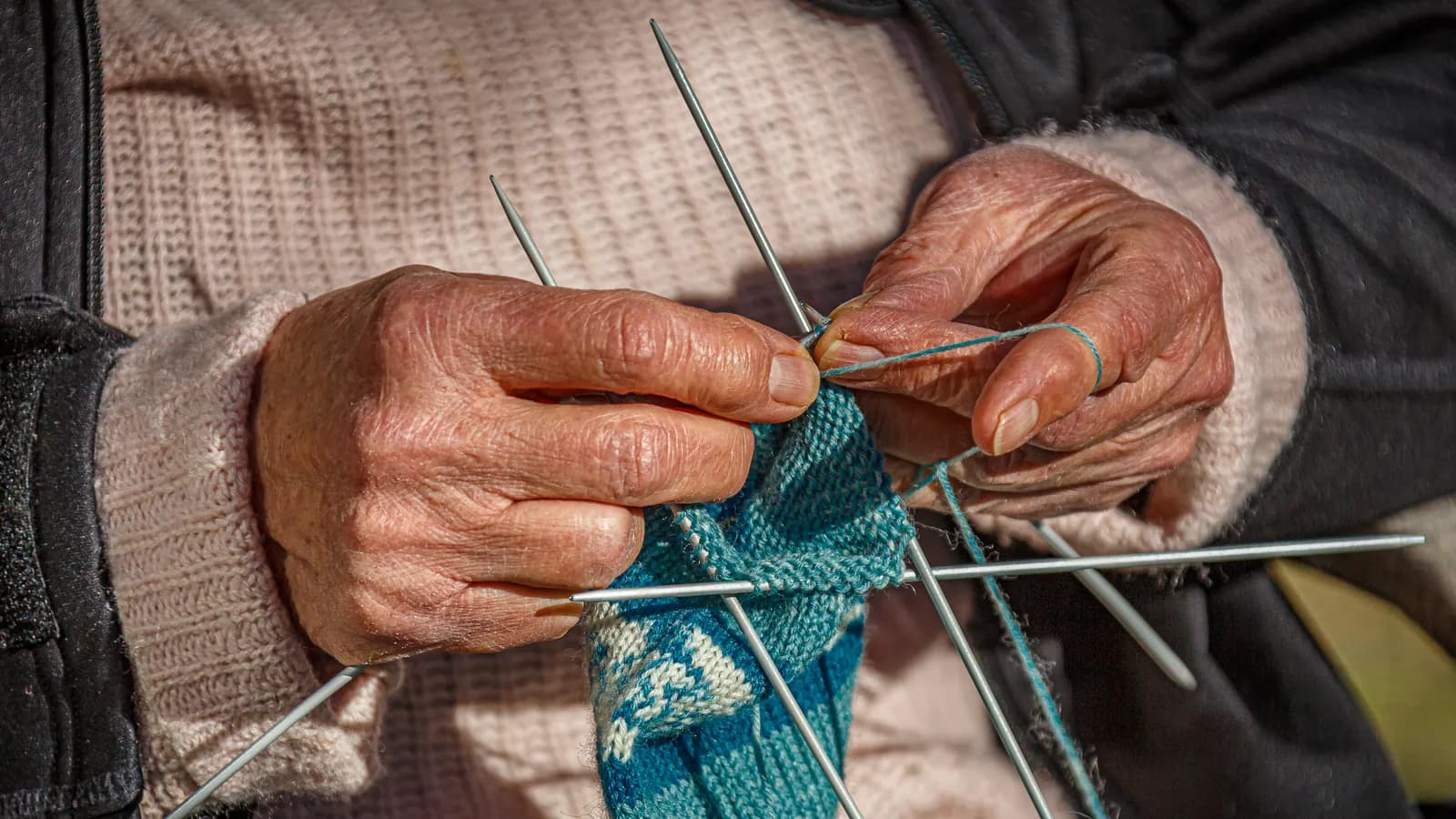
Knitting builds fabric by pulling loops through loops with two or more needles, holding an entire row of live stitches at once. Everything distinctive about the craft follows from that one structural fact.
It is why knitted fabric stretches and drapes: the loops can move relative to one another in a way a crocheted stitch cannot, which is why jumpers, socks and anything that must follow a body are knitted. It is also why a dropped stitch runs, why work must be secured before it goes in a bag, and why the craft is slightly harder to start than crochet.
The trade is real and worth understanding before choosing. Crochet is easier for the first fortnight and produces firmer fabric; knitting is slower to learn, uses roughly a quarter less yarn for the same area, and makes clothes that fit. Most people who do both use each for what it is good at.
Explore knitting
Knitting is learned by making things, so this starts with things to make. Every pattern here is original to HobbyHQ, written out in full, with the gauge and the finished measurements checked against each other.
Patterns to knit
All 5Things to make, with the full instructions.
First make
Garter-stitch dishcloth
A square cotton cloth in garter stitch — one row, repeated, until it is square.
Worsted yarn · 4.5mm · 2–4 hours (estimated)
First make
Two-by-two ribbed headband
A stretchy band worked flat and joined into a ring. The first thing that has to fit.
DK yarn · 4mm · 3–5 hours (estimated)
First make
Garter scarf with a slipped edge
A long garter rectangle with one small change: the first stitch of every row is slipped, which gives it a proper edge.
Aran yarn · 5.5mm · 10–16 hours (estimated)
Straightforward
Moss-stitch blanket square
A 15cm square in moss stitch, sized so that a set of them makes a blanket without arithmetic.
DK yarn · 4mm · 1–2 hours (estimated)
Straightforward
Chunky ribbed cowl, worked in the round
A tube of two-by-two rib on a circular needle. The first project with no seam and no wrong side.
Chunky yarn · 6mm · 4–7 hours (estimated)
Stitches and technique
All 4One skill at a time, explained properly.
- Crochet gauge and tension, properly explainedWhy patterns come out the wrong size, how to swatch so the answer is reliable, and when gauge genuinely does not matter.3 min read
- Casting on and casting offThe two edges of every piece of knitting, why there is more than one way to make each, and the tension mistake that ruins both.2 min read
- Knit and purl, and reading the fabricThe two stitches are the same stitch from opposite sides, and understanding that explains garter, stocking stitch, rib and why stocking stitch curls.2 min read
- How to read a knitting patternThe abbreviations, the asterisks, the brackets, the sizing convention, and the two lines at the top that decide whether the rest of it will work.2 min read
Starting out
The first session, the first purchase, and what not to buy yet.
Yarn and needles
All 4What the kit does, and how the pieces work together.
- Understanding yarn: weight, fibre and what the ball band is telling youThe hook is bought once; yarn is bought for every project. Weight, fibre and ply each change something real, and only one of them is what the pattern names.4 min read
- Which knitting needles to buyStraight, circular, double-pointed; wood, metal, plastic. What each is for, why circulars are the general answer, and why the beginner set is a trap.2 min read
- Blocking: what it does and when it mattersWetting and pinning finished knitting changes it permanently in wool and barely at all in acrylic — and knowing which you have is most of the decision.2 min read
- Washing and storing knitted thingsHow to wash wool without felting it, why hand-knitted things are dried flat, what actually causes pilling, and the one thing that ruins stored knitwear.2 min read
Fixing mistakes
Reading the symptom back to the cause.
- Knitting: reading the fabric to find the mistakeAlmost every knitting fault is visible in the fabric several rows before you notice it, and the repair is nearly always local — which means the disaster people fear, ripping everything out, is rarely the right answer.6 min read
- Dropped stitches, and the other recoverable disastersWhat a dropped stitch actually is, why it runs, how to stop it, and the three other things that look fatal and are not.2 min read
Calculators
The arithmetic, done for you, with the working shown.
““My gauge does not match the pattern. How many stitches do I actually chain to get the width I want?””
Crochet & knitting gauge calculator
““The recipe says 15% alum and 50% madder. Fifteen per cent of what, and how much do I actually weigh out for this skein?””
Dye bath calculator
““How many balls do I need for a blanket this size, in this yarn?””
Yarn quantity estimator
““The pattern says work 60 rows. My row gauge is not the pattern’s — how many rows do I actually need for 21cm?””
Knitting row and length calculator
Choices
The decisions people get stuck on, settled.
- Crochet vs knittingCrochet is easier to start and cannot drop a stitch; knitting produces better fabric for clothes. The right answer depends almost entirely on what you want to make.
- Knitting vs dressmakingKnitting is portable, cheap to start and slow to finish. Dressmaking needs a machine, a table and space to cut, and produces a garment in a weekend — with a fit problem knitting largely avoids.
- A knitting machine vs hand knittingIt is a different hobby, not a faster version of the same one. The machine turns an evening into a garment and replaces the portable, absorbing part with a technical setup problem and forty-year-old equipment.
- Knitting vs sewingKnitting makes the fabric as it makes the object, slowly, from a bag of yarn and two sticks. Sewing assembles an object from fabric somebody else made, quickly, with a machine that has to be bought and set up.
Step 1: Smooth, pale, medium-weight yarn and 5mm needles
The same rule that governs crochet, for the same reason: you have to be able to see the stitch structure to learn it. Black, fluffy, textured or variegated yarn hides exactly what you need to look at. Aran or chunky weight in a plain light colour, in ordinary acrylic or a smooth wool.
You will know it worked when: You can see what your hands are doing.
Step 2: Learn four things, in this order
Cast on, knit stitch, purl stitch, cast off. That is a complete craft: knit every row makes garter stitch, alternating knit and purl rows makes stocking stitch, and alternating within a row makes rib. Everything else is a variation on those two stitches.
You will know it worked when: You can make a scarf, a dishcloth, a hat and a blanket.
Step 3: Choose a style and stick with it long enough to judge
English style throws the yarn with the right hand; Continental picks it with the left. Continental is generally faster and involves less hand movement, and is often much kinder to sore wrists. Neither is correct — but switching every few days means never becoming fluent in either.
You will know it worked when: Your hands stop thinking about each stitch.
Step 4: Make a swatch, and actually count it
Cast on 24 stitches, knit 30 rows in stocking stitch, measure the middle. This teaches even tension, teaches you to read your knitting, and produces the gauge measurement everything fitted depends on.
You will know it worked when: You know your own tension, which no pattern can tell you.
Step 5: Finish something small before starting something large
A dishcloth, a simple hat, a cowl. The half-finished jumper started in week two is the commonest way knitting gets abandoned, and hats are the ideal second project — small, fast, useful and they teach knitting in the round.
You will know it worked when: A finished object, and the appetite for the next.
Gauge — tension, in British patterns — is the number of stitches and rows in a 10cm square. A pattern is written to a gauge, not to a needle size: the needle quoted is only what produced that gauge in the designer’s hands, and two knitters with the same yarn and needles routinely differ by 10 per cent or more.
The correction is mechanical and it is the needle, not your hands. More stitches per 10cm than the pattern means your fabric is tighter, so go up a needle size; fewer means looser, so go down. Hand tension is not reliably adjustable by deciding to adjust it.
| CYC category | Common British name | CYC needle size | Typical UK convention |
|---|---|---|---|
| 0 — Lace | 2-ply, lace | 1.5–2.25mm | 2–2.5mm |
| 1 — Super fine | 4-ply, fingering, sock | 2.25–3.25mm | 2.75–3.25mm |
| 2 — Fine | Sport, baby | 3.25–3.75mm | 3–3.5mm |
| 3 — Light | DK | 3.75–4.5mm | 4mm |
| 4 — Medium | Aran, worsted | 4.5–5.5mm | 4.5–5mm |
| 5 — Bulky | Chunky | 5.5–8mm | 6–7mm |
| 6 — Super bulky | Super chunky | 8–12.75mm | 8–10mm |
| 7 — Jumbo | Jumbo | 12.75mm and larger | 12mm and larger |
The right-hand columns are close but not identical, and the divergence is wider in crochet than in knitting. The Craft Yarn Council standard is American; British patterns follow a slightly different convention, and neither states which it is using. When a pattern found online feels stiff or loose at the stated needle size, this is often why. Your own swatch settles it, and the ball band is the tie-breaker.
One further trap specific to knitting: row gauge is a separate problem from stitch gauge, and it is harder to match. A pattern worked to a stated length rather than a stated number of rows sidesteps it, which is why well-written patterns say "knit until it measures 40cm" rather than "knit 120 rows".
Sources for this section
- Standard Yarn Weight System (opens in a new tab) — Craft Yarn Council · Standards body · read — supports the claim
Knitting is one of the cheapest crafts to start and one of the easiest to start badly, because the obvious beginner purchases — cheap acrylic and a pair of short straight needles — make the first project harder than it needs to be.
What to buy first:
- Needles, and the type matters more than the size — A circular needle on a flexible cable works for flat knitting and in the round, holds the weight of a project in your lap rather than on your wrists, and cannot be dropped down the side of a sofa. Straight needles are traditional and worse for almost everything. Bamboo and wood grip the yarn and suit beginners; metal is faster and drops stitches more readily.
- A smooth, light-coloured wool or wool blend in double knit or aran weight — Dark yarn hides your stitches, fluffy yarn hides your mistakes until they are unfixable, and cheap acrylic squeaks and splits. A plain light DK is the yarn that lets you see what you have actually done, which is the whole difficulty at the start.
- A tape measure and a needle gauge — For gauge, and for identifying unlabelled needles. Both cost a few pounds and both get used constantly.
- Stitch markers — Rings that sit on the needle to mark a repeat, a raglan line or the start of a round. Loops of contrasting yarn do the same job for nothing.
- A blunt darning needle — For sewing in ends and seaming. Blunt, so it goes between plies rather than through them.
- Blocking equipment — A towel and some pins is enough. Wet blocking evens out uneven stitches and opens up lace, and it is the step that most visibly separates a finished object from a knitted one.
The upgrade worth making early is an interchangeable circular set — tips in every size with a range of cables, usually £40–£90 — which replaces a drawer full of single needles and means the right size is always to hand. It is the only piece of knitting equipment where buying once and buying well saves real money.
- A dropped stitch — The one that frightens beginners and is genuinely simple. The stitch runs down as a ladder; a crochet hook picks it back up rung by rung. Do it immediately — a stitch dropped twenty rows ago is a longer job.
- Tinking — Un-knitting stitch by stitch, one row or less. "Tink" is "knit" backwards, which tells you the level of ceremony involved.
- Frogging — Pulling the work off the needles and unravelling several rows or more. Named for "rip it, rip it".
- A lifeline — A length of smooth contrasting thread threaded through a whole row of live stitches, left in place as you continue. If something goes wrong you can rip back to it and pick up a known-good row. Standard practice in lace and worth the two minutes on anything complicated.
- A twisted stitch — A stitch worked through the wrong leg sits crossed at its base. Usually cosmetic, occasionally deliberate — read your knitting and decide whether it matters.
- Curling stocking stitch — Not a mistake. Stocking stitch curls by nature; a border of garter stitch, rib or seed stitch stops it, and blocking helps.
Step 1: Even fabric
Knit and purl at a consistent tension, cast on and off without a fight. Tension evenness comes before speed and before everything else.
You will know it worked when: A stocking stitch swatch has no visible tight or loose rows.
Step 2: Shaping and reading your knitting
Increases, decreases, and being able to see what row you are on without a counter. This is the skill that lets you fix mistakes instead of unravelling.
You will know it worked when: You can drop back a few stitches to correct an error rather than pulling out the row.
Step 3: In the round and fitted garments
Sleeves, yokes, and the discovery that gauge decides everything. A garment is where knitting stops being decorative.
You will know it worked when: A jumper fits the person it was knitted for.
Step 4: The plateau
Colourwork and cables both look like the wall and neither is. The genuine plateau is finishing — seaming, blocking and picking up stitches, which is where good knitting is separated from good-looking knitting.
Step 5: Where it branches
Lace, stranded colourwork, brioche, spinning your own yarn, or designing. Spinning changes the hobby completely by putting you upstream of the material.
Step 6: When a class helps
For finishing, and for continental versus English style if speed or wrist strain matters.
- Casting on too tightly — The commonest first-project problem. A tight cast-on edge will not stretch, which ruins a hat or a cuff. Cast on over two needles held together, or use a stretchy method like long-tail.
- Accidental yarn-overs — Bringing the yarn to the front for a purl and leaving it there for the next knit stitch creates an extra stitch and a hole. If your stitch count is growing mysteriously, this is why.
- Splitting the yarn — Pushing the needle through the plies rather than through the loop. Blunter needle tips and a smoother yarn both help.
- Not counting stitches — A stitch gained or lost every few rows produces a trapezoid you notice twenty rows later. Count at the end of each row until it stops happening.
- Skipping the swatch on anything fitted — An hour of swatching against forty hours of jumper that does not fit. For a scarf it genuinely does not matter.
- Ignoring row gauge — Matching stitch gauge and not row gauge produces a garment the right width and the wrong length. Work to measurements where a pattern allows it.
- Not blocking — Wetting and pinning finished work to shape transforms it — it evens out tension, opens lace, and flattens curling stocking stitch. Skipping it makes good knitting look amateur. Note that acrylic will not block, because there is nothing in it to relax.
- Buying a needle set first — Needle material makes a real difference — bamboo grips, metal is fast and slippery, and which suits you is personal. Try a pair of each before buying thirty.
- Flat and in the round — The structural fork everything else sits on. Flat knitting produces pieces that are seamed; knitting in the round produces a tube with no seam and no purl rows. Most modern garment patterns are written for the round, which is why an older flat-knitting education can feel oddly out of step.
- Colourwork — Stranded knitting in the Fair Isle tradition, where two colours run in a row, and intarsia, where blocks of colour are worked with separate yarns. Two different problems: stranded work is about tension across floats, intarsia is about managing tangles.
- Lace — Deliberate holes, made by pairing an increase with a decrease. Rewards concentration and a lifeline more than it rewards dexterity, and it is the branch where blocking transforms the finished object rather than tidying it.
- Cables and texture — Stitches crossed out of order to make raised patterns. Visually the most impressive return for the least difficulty in the whole craft, which makes it the usual second project after a scarf.
- Brioche and double knitting — Reversible fabrics built from slipped stitches and paired yarns. A small, intense specialism with a reputation for being unforgiving to unpick, which is deserved.
- Sock and small-circumference knitting — Its own culture, its own yarn weight, its own arguments about the heel. Portable, endlessly repeatable, and the reason a great many knitters never make a garment at all.
- Garment knitting — Where fit, gauge and ease stop being abstractions. The gauge calculator on this site exists for this branch specifically, and it is where the craft becomes dressmaking-adjacent.
- Machine knitting — A separate craft with its own page here. The gauge maths is shared, which is why the same calculator serves both, and almost nothing else is.
- Knit and purlalso: k, p
- The two stitches. Everything in knitting is a combination of them.
- Garter stitch
- Knit every row. Lies flat, stretches sideways, and is the usual first fabric.
- Stocking stitchalso: stockinette
- Knit one row, purl the next. The smooth "V" fabric of a shop-bought jumper. Curls at the edges.
- Cast on / cast off
- Putting the first stitches on the needle, and securing the last ones. American patterns say "bind off".
- Gauge / tension
- Stitches and rows per 10cm. British patterns say tension; American say gauge. Same thing.
- Increases and decreases
- Adding or removing stitches to shape the fabric. Common abbreviations: k2tog, ssk, m1, yo.
- Circular needles
- Two tips joined by a flexible cable. Used for knitting in the round and, increasingly, for flat knitting because they take the weight off the wrists.
- DPNs
- Double-pointed needles, used in sets for small circumferences such as socks and hat crowns.
- Blocking
- Wetting or steaming finished work and pinning it to shape while it dries. Evens tension and opens lace. Does not work on acrylic.
- Frogging
- Unravelling work — from "rip it, rip it".
- Tinking
- Un-knitting stitch by stitch. "Knit" backwards.
- Lifeline
- A contrasting thread run through a row of live stitches so you can rip back to a known-good point.
- Continental and English
- The two main styles: yarn held in the left hand and picked, or in the right and thrown.
- WIP and stash
- Work in progress, and the accumulated unused yarn that for most knitters substantially exceeds yarn used.
Knit night, and what knitters are firm about
A quiet craft with a large, loud, extremely online community, and a set of conventions worth knowing before you post a photograph of your first sock.
- Knit night is the institution — A pub, a café or a library, a regular evening, no membership and no skill requirement. It is the most effective teaching mechanism the craft has: you sit down with the thing you have ruined, somebody puts down their own work, and twenty minutes later you understand short rows. The one convention is that you bring work — turning up empty-handed to watch is fine but unusual.
- Patterns are paid work and copying them is not sharing — Independent designers make their living from single-pattern sales. Passing a PDF around a knit night, or putting one in a group chat, is the community’s clearest breach of norms, and people will say so directly. Test knitting — working a pattern before release and reporting errors — is the accepted way to get patterns for nothing, and it is real work.
- Gauge is a moral question — Not really, but it is treated as one, because the entire craft’s advice culture rests on it. Somebody who asks why their jumper came out enormous will be asked whether they swatched before anything else, every time, by everybody. The swatch is the community’s shibboleth.
- Yarn substitution is expected, and the ball band is how you do it honestly — Nobody is required to buy the yarn the designer used. The convention is to match weight and fibre behaviour rather than colour, and to say what you substituted when you show the result — because the next person choosing that pattern is reading your project notes to find out whether it works.
- A stash is a joke and an anxiety — Every knitter has more yarn than time, everyone jokes about it, and there is a real and rather serious counter-culture of stash-busting, yarn diets and finishing what you started. Both attitudes are held sincerely, often by the same person.
- Nobody wins — Worth stating because so many hobbies are not like this. There is no ranking, no grade, no competitive ladder outside of agricultural shows, and the community actively resists the idea that a beginner’s garter-stitch scarf is worth less than a colourwork yoke. What is admired is finishing things and being honest about how they went.
The political and historical texture is closer to the surface than in most crafts, and you will meet it quickly. Knitting has been a wartime obligation, a suffrage-era organising activity, a symbol of domestic confinement and a deliberate reclaiming of it; the phrase "radical knitting" is not a marketing invention. None of this is required knowledge and none of it will be tested on you at a knit night, but it explains why a craft this gentle has such a strong sense of itself.
Knitting is genuinely old and its origins are less certain than confident accounts suggest. The earliest surviving true knitted items are usually identified as cotton socks from Egypt dating to somewhere around the eleventh to fourteenth centuries; earlier fragments often cited as knitting are more likely nålbinding, a related single-needle looping technique that predates it substantially. Anyone stating a precise date of invention is going beyond the evidence.
What is well documented is the medieval and early modern European trade. Knitting guilds operated across Europe from the fifteenth century, and hand-knitted stockings were a significant export industry in parts of Britain — the Yorkshire Dales, Norfolk and the Channel Islands among them. The regional traditions that survive as heritage crafts, including Fair Isle colourwork, Shetland lace and the gansey patterns of the fishing ports, come out of that working economy rather than out of leisure.
The stocking frame, invented by William Lee in Nottinghamshire in 1589, began the mechanisation that eventually moved production off hands entirely — and hand knitting became a domestic and then a leisure activity over the following centuries, with revivals in both world wars driven by wool shortages and knitting-for-the-forces campaigns.
The current revival dates from the early 2000s and is substantially an internet phenomenon: pattern databases, a large online community and independent dyers restored access to variety that the commercial yarn trade had narrowed. Participation research from the Crafts Council places textile crafts among the most widely practised in the UK.
- Should I learn knitting or crochet first?
- It depends entirely on what you want to make. Crochet is easier for the first fortnight — one live loop, nothing to drop, mistakes pull straight out — and its firmer fabric suits blankets, bags, baskets and toys. Knitting takes longer to become comfortable and produces fabric that stretches and drapes, which is why garments and socks are knitted. If your goal is a jumper, learn knitting and accept the slower start.
- What should I buy to start?
- A pair of 5mm or 6mm needles and one or two balls of smooth, pale aran or chunky yarn — under £15. Not a needle set, because material preference is personal and you do not know yours yet, and not the beautiful textured yarn, because you cannot see the stitches in it. Bamboo needles grip the yarn and are usually easier for a first project than slippery metal.
- What happens if I drop a stitch?
- It runs down the fabric as a visible ladder, and you pick it back up with a crochet hook, one rung at a time. It looks alarming and it is a two-minute fix. Do it as soon as you notice — the further it has run, the longer the repair. Using a lifeline on anything complicated means a mistake costs you a few rows rather than the project.
- English or Continental style?
- Whichever your hands take to. Continental holds the yarn in the left hand and picks it, involves less movement per stitch and is generally faster; it is also often much kinder to sore wrists, and it makes stranded colourwork easier. English throws with the right hand and many people find it more intuitive to learn. The one thing not to do is switch every few days, because fluency comes from repetition.
- Do I have to block my knitting?
- For a scarf, no. For anything fitted, lace, or worked in pieces to be seamed, yes — blocking evens out tension, opens lace patterns, flattens curling stocking stitch and makes the difference between homemade and handmade. One caveat: acrylic does not block in the same way, because there is no fibre memory to relax. Wool blocks beautifully.
- Why does my pattern come out the wrong size?
- Gauge. A pattern is written to a number of stitches per 10cm, not to a needle size, and your tension will differ from the designer’s. Work a swatch, measure the middle, and change needle size — up if you have too many stitches per 10cm, down if too few. Row gauge is a second and harder problem, which is why good patterns tell you to knit to a measurement rather than a row count.
Within this activity
Disciplines, variants and techniques that sit inside it.
Disciplines
- Sock knitting — Knitting socks in the round — heels, gussets and toes at a small gauge.
Techniques
- Colourwork knitting — Stranded and intarsia knitting in several colours at once, where tension across the float is everything.
If you like this
Each of these is here for a stated reason, not because it is also a hobby.
Easier way in
- Machine knitting — The hand version of the same fabric, far cheaper to start, portable, and forgiving of skipping the swatch — which the machine emphatically is not.
Similar to
- Crochet — The other yarn craft, and the usual second one. Knitted fabric drapes better and suits garments; crochet is faster to learn, cannot drop a stitch, and its firmer fabric suits bags and blankets.
- Dressmaking — The other route to making your own clothes. Knitting builds the fabric and the garment at once and needs no machine; dressmaking starts from cloth and is far quicker per finished item.
- Weaving — Another way of turning yarn into cloth, with a fixed structure instead of a looped one and a much faster route to a finished length of fabric.
Goes well with
- Natural dyeing — Dyeing your own yarn and then knitting it closes a loop that almost every dyer eventually wants closed, and knitters already own the fibre the craft is easiest on.
Progresses to
- Hand spinning — Knitters who start caring about the yarn itself end up making it, and handspun is far more commonly knitted than crocheted.
- Sock knitting — The standard next challenge: small gauge, working in the round, and heels and gussets that teach shaping properly.
Sources for this section
- Standard Yarn Weight System (opens in a new tab) — Craft Yarn Council · Standards body · read — supports the claim
- Standards & Guidelines for Crochet and Knitting (opens in a new tab) — Craft Yarn Council · Standards body · read — supports the claim
- Crafts Council (opens in a new tab) — Crafts Council · Institutional · could not be reached
Comprehensive
Last reviewed 2026-08-13. Cost, time and difficulty figures on this page are HobbyHQ estimates — see how we work. Something here wrong or out of date? Tell us.