Textiles & fibre
Crochet
Crochet is the cheapest serious craft to start and one of the easiest to abandon in the first hour, for a single reason: almost everyone begins with the wrong yarn. Get the first three purchases right and the rest of it — the stitches, the patterns, the shaping — is genuinely straightforward.
Also known as crocheting.
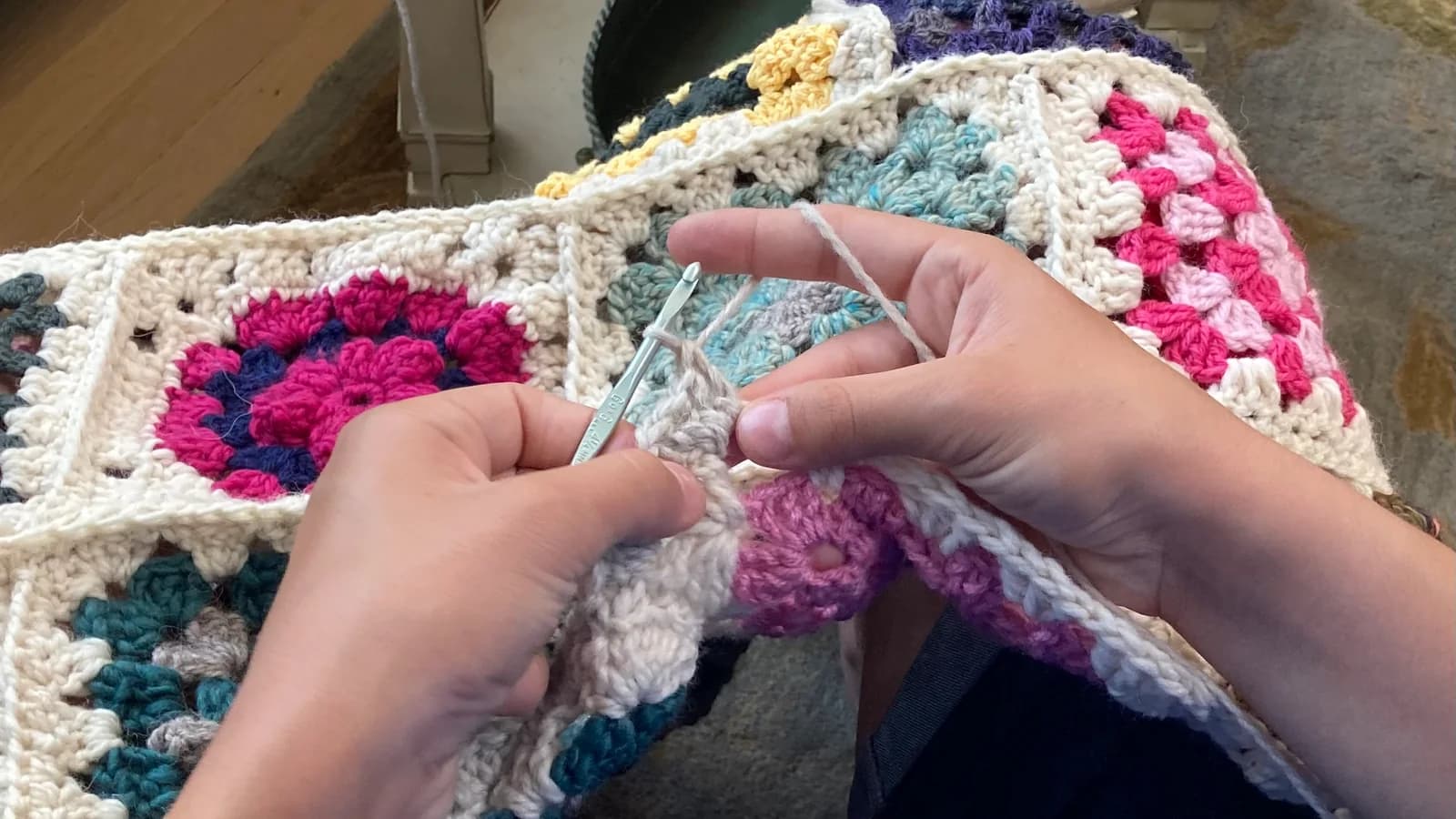
Crochet builds fabric by pulling loops of yarn through other loops with a hook. Only one loop is ever live, which is the fundamental difference from knitting and the source of most of its practical advantages: you can put it down mid-stitch, it cannot unravel by accident, and undoing a mistake is a matter of pulling the yarn rather than rescuing dropped stitches.
The resulting fabric is denser, firmer and less stretchy than knitted fabric. That makes crochet excellent for bags, blankets, baskets, toys and anything that should hold a shape, and less naturally suited to close-fitting garments — which is why the two crafts have divided the territory the way they have.
It is worth knowing early that crochet has an unusually deep amateur culture and an unusually shallow professional one. There is no crochet machine: every crocheted item in existence was made by hand. That is not sentiment, it is a mechanical fact about the stitch, and it is why crocheted goods are expensive and why the craft has stayed a hand craft.
- Still deciding — Crochet vs knitting
Step 1: Buy smooth, light-coloured, medium-weight yarn
DK or aran weight, in a plain pale colour, in plain acrylic. This matters more than anything else on this page: you must be able to *see* the stitches to learn them, and black, fluffy, variegated or novelty yarns hide the stitch structure completely. Almost everyone who says "I tried crochet and could not do it" started with the wrong yarn.
You will know it worked when: You can see where the hook goes.
Step 2: Buy one hook, sized for the yarn
A 4mm hook for DK, or 5–6mm for aran, is the usual British starting point — note that American patterns following the Craft Yarn Council standard will suggest a size larger, which is a real difference in tradition rather than an error in either. The ball band is the tie-breaker. A single good hook beats a set of forty.
You will know it worked when: Fabric that is neither rigid nor holey.
Step 3: Learn four things, in this order
Slip knot, chain, single crochet, double crochet. That is enough to make a blanket, a scarf, a bag or a dishcloth. Everything else in the craft is a variation or a combination of these.
You will know it worked when: You can make an actual object within a week.
Step 4: Make a swatch and count the stitches
Chain 21, work 20 stitches per row for 20 rows. This teaches consistent tension, teaches you to count, and produces the swatch you will need to understand gauge.
You will know it worked when: Even edges, and a sense of what your natural tension is.
Step 5: Make one small finished thing
A dishcloth, a granny square, a simple bag. Finishing something is what makes the craft stick, and a half-finished blanket is where most beginners stall.
You will know it worked when: A completed object, and a reason to make the next one.
Sources for this section
- Standards & Guidelines for Crochet and Knitting (opens in a new tab) — Craft Yarn Council · Standards body · read — supports the claim
- Go deeper — Which crochet hook to actually buy, and why the cheap set is a trap
- Work it out — Crochet & knitting gauge calculator
- Work it out — Hobby startup cost estimator
- Work it out — Dye bath calculator
- Work it out — Yarn quantity estimator
- Work it out — Knitting row and length calculator
Almost every crochet problem a beginner has — a piece that grows or shrinks, a row that ends in the wrong place, a pattern that stops making sense at row four — is the same problem: not being able to look at the fabric and see what is there. Counting stitches is not the skill. Recognising them is.
This is a section rather than a video for a specific reason. The stitch is not moving. It is in your hand, you can turn it over, and you can look at it for as long as you like — which is exactly the situation where a labelled reference beats a demonstration that goes past at somebody else’s pace. Everything below is checkable against the thing you are holding right now.
The parts of a stitch, and what each one is for:
- The top V — Two loops lying across the top of every finished stitch, forming a V when viewed from above. This is what you normally work into, and counting Vs along a row is how you count stitches.
- The front loop and the back loop — The two halves of that V. Patterns saying "front loop only" or "back loop only" mean working under one of them instead of both, which produces a ridge — the whole basis of ribbing in crochet.
- The post — The vertical body of the stitch below the V. Post stitches wrap around it from the front or the back instead of going through the top, which is how cables and basketweave textures are made.
- The space between stitches — The gap either side of a post. Working into the space rather than the V is a different instruction and gives a different fabric, and confusing the two is why a granny square and a solid block behave so differently.
- The turning chain — The chain worked at the start of a row to bring the yarn up to the height of the stitches that follow. Whether it counts as a stitch varies by pattern and is stated at the top — and the disagreement about it is the single commonest reason a row ends up one stitch out.
How to actually read a row, with the work in front of you:
Step 1: Find the Vs along the top edge
Lay the work flat and look along the last row you made. Each stitch presents one V. If the edge looks like a wavy line rather than a row of Vs, the work is twisted — untwist it before counting anything.
You will know it worked when: You can see individual stitches rather than a texture.
Step 2: Count in fives and mark them
Stitch markers every five or ten stitches, especially on a first project. Recounting a row of sixty is how a mistake gets missed twice.
You will know it worked when: A miscount is found within five stitches rather than at the end.
Step 3: Identify the first and last stitch of the row
These are where errors concentrate. The last stitch of a row often hides against the turning chain and is the one most often skipped; the first is the one most often worked into twice.
You will know it worked when: The two positions responsible for most edge drift are under attention.
Step 4: Check the count against the pattern before turning
Every row, at first. It is thirty seconds, and it is the difference between unpicking one row and unpicking nine.
You will know it worked when: Errors are caught while they are cheap.
| What you can see | What it means | Where the error is |
|---|---|---|
| The piece is getting wider | Stitches are being added | Almost always the first stitch of the row, worked into twice, or a turning chain counted when it should not be |
| The piece is getting narrower | Stitches are being lost | Almost always the last stitch of the row, hidden against the turning chain and missed |
| One edge straight, one ragged | The error is happening on one side only | The ragged edge is the end of the row — check the last stitch, not the first |
| Fabric curls at the bottom | Foundation chain worked too tightly | Not a row error at all. Chain with a larger hook, or work a foundation row instead |
| Holes appearing mid-row | Worked into a space rather than a V | The stitch before the hole — the pattern wanted the top of the stitch, not the gap beside it |
| Ridges appearing unintentionally | Working one loop instead of both | The V is being split; go under both loops unless the pattern says otherwise |
- Go deeper — Crochet gauge and tension, properly explained
- Go deeper — How to read a crochet pattern
Gauge — called tension in British patterns — is the number of stitches and rows in a 10cm square of fabric. It is the single most misunderstood thing in crochet, and it is the reason a jumper made exactly to a pattern comes out three sizes too big.
A pattern is written to a gauge, not to a hook size. The hook size quoted is only the designer’s starting point: your hands are not their hands, and two people using the same hook and yarn routinely produce fabric that differs by 15% in width. If your gauge is looser than the pattern, every measurement scales up.
The fix is mechanical. Work a swatch at least 15cm square in the pattern stitch, measure the middle 10cm rather than the edges, and count. Too many stitches per 10cm means your fabric is tight — go up a hook size. Too few means it is loose — go down. Change the hook, not your hand tension, which is not reliably adjustable.
Gauge matters enormously for anything fitted and barely at all for a blanket or a scarf. Knowing which project you are making tells you how much to care.
The Craft Yarn Council standard, and where British practice differs from it:
| CYC category | Common British name | CYC hook size | Typical UK convention |
|---|---|---|---|
| 0 — Lace | 2-ply, lace | 1.4–2.25mm | 1.5–2.5mm |
| 1 — Super fine | 4-ply, fingering, sock | 2.25–3.5mm | 2.5–3.5mm |
| 2 — Fine | Sport, baby | 3.5–4.5mm | 3–4mm |
| 3 — Light | DK | 4.5–5.5mm | 4mm |
| 4 — Medium | Aran, worsted | 5.5–6.5mm | 5–6mm |
| 5 — Bulky | Chunky | 6.5–9mm | 6.5–9mm |
| 6 — Super bulky | Super chunky | 9–15mm | 9–12mm |
| 7 — Jumbo | Jumbo | 15mm and larger | 15mm and larger |
The two right-hand columns disagree, and that is the point. The Craft Yarn Council standard is American and its recommended hooks run a size or so larger than British workshop convention — a UK pattern will routinely call for a 4mm hook with DK where the CYC standard suggests 4.5–5.5mm. Neither is wrong. They produce different fabrics: the CYC sizing gives a looser, drapier result, and the British convention a firmer one.
This matters because British and American patterns are freely mixed online and neither states which convention it is following. If a pattern feels stiff and slow at the hook size given, and it came from a UK source, that is the tradition rather than your tension. Your own swatch settles it either way, and the ball band is the tie-breaker.
HobbyHQ published a single blended table here until August 2026, attributed to the Craft Yarn Council. It did not match the CYC standard, and reading the standard is what caught it.
Sources for this section
- Standards & Guidelines for Crochet and Knitting (opens in a new tab) — Craft Yarn Council · Standards body · read — supports the claim
- The piece curls at the edges — Tension too tight, or too few stitches for the shape. Check gauge against the pattern before assuming the pattern is wrong — a curling flat circle usually needs more increases per round.
- Ruffling or waving at the edges — The opposite problem: too many stitches. Check your increase count per round against the pattern; a wave means you are adding faster than the shape needs.
- The finished item is the wrong size — Gauge, almost always. Check by making a swatch in the actual yarn and hook and measuring it — hook size is a starting suggestion rather than an instruction.
- Stitch counts drift over rows — Usually a missed or doubled stitch at the turn. Check the first and last stitch of each row specifically, and use a marker in the first stitch until it becomes automatic.
- Holes appearing where they should not — Working into the wrong part of the stitch, or accidental yarn overs. Check where your hook is entering — under both loops unless told otherwise.
Step 1: A square that stays square
Chain, double crochet, treble, and counting stitches at the end of every row without thinking about it.
You will know it worked when: Your edges stop drifting and the count comes out right three rows running.
Step 2: Working in the round
Amigurumi, hats, anything circular. Increases and decreases stop being a rule to follow and start being a shape you can predict.
You will know it worked when: You can make a flat circle that lies flat and a sphere that closes.
Step 3: Reading patterns and gauge
Following a written pattern in a yarn the designer did not use, and swatching first. This is the step that turns crochet from a craft into a repeatable one.
You will know it worked when: A garment comes out the size it was meant to be.
Step 4: The plateau
Almost everybody stalls at garments — flat pieces are easy and shaped, fitted things are not. The fix is one simple garment made properly with a swatch rather than five more blankets.
Step 5: Where it branches
Fine thread and lace, Tunisian crochet, freeform, or designing your own patterns. Designing is the one that changes how you see everything else.
Step 6: When a class helps
Rarely at the start — crochet is unusually well served by video. It helps most for garment fitting, which is where written instruction is weakest.
Crochet has two incompatible naming systems for the same stitches, and a pattern that does not say which it uses will produce a completely different fabric if you guess wrong. This catches every beginner exactly once.
| US term | UK term | What it is |
|---|---|---|
| Slip stitch (sl st) | Slip stitch (sl st) | Joins without adding height |
| Single crochet (sc) | Double crochet (dc) | The shortest working stitch |
| Half double crochet (hdc) | Half treble (htr) | One and a half times the height |
| Double crochet (dc) | Treble (tr) | Twice the height |
| Treble (tr) | Double treble (dtr) | Three times the height |
The practical tell: if a pattern uses "single crochet" anywhere, it is US terminology. There is no single crochet in UK terms. If a pattern starts with "double crochet" and never mentions single crochet, it is probably UK. Most online patterns are US; most British printed books are UK.
- Chain (ch)
- The foundation row, and the stitch used to move sideways or make holes.
- Yarn over (yo)
- Wrapping the yarn over the hook — the action that builds every stitch.
- Turning chain
- Chains worked at the end of a row to bring the hook up to the height of the next row’s stitches.
- Magic ringalso: magic circle
- An adjustable loop used to start work in the round with no hole in the centre.
- Frogging
- Pulling out work to undo it — from "rip it, rip it".
- Blocking
- Wetting or steaming finished work and pinning it to shape while it dries. Transforms lace and flattens curling edges.
- Granny square
- A worked-in-the-round motif in clusters, joined to others to make larger pieces.
- WIP
- Work in progress.
- Stash
- Yarn bought and not yet used, which for most crocheters substantially exceeds yarn used.
Sources for this section
- Standards & Guidelines for Crochet and Knitting (opens in a new tab) — Craft Yarn Council · Standards body · read — supports the claim
- Starting with black, fluffy or variegated yarn — The mistake that ends more crochet attempts than all others combined. You cannot learn a stitch you cannot see.
- Working into the wrong part of the stitch — Each stitch has two loops at the top; unless a pattern says otherwise you work under both. Working under one loop only produces a ridged, stretchy fabric — useful deliberately, confusing accidentally.
- Losing or gaining stitches at the row ends — The commonest structural error, producing a trapezoid instead of a rectangle. It is almost always the turning chain: either being counted as a stitch when it should not be, or not being counted when it should. Count every row until it stops happening.
- Crocheting too tightly — Beginners grip. A tight fabric is hard on the hands, hard to work into and stiff. Go up a hook size rather than trying to relax.
- Skipping the swatch on a fitted garment — An hour of swatching against forty hours of jumper that does not fit.
- Buying a 40-piece hook set — You need one hook to learn. The set costs more and includes thirty-eight sizes you will not touch for years.
Yarn shops, pattern ethics and the gift problem
A hobby with almost no rules and a surprisingly firm set of conventions, most of them about other people’s work and other people’s time.
- A pattern is somebody’s copyrighted work, and the community treats it that way — The strongest norm in the craft, and the one most likely to get a newcomer told off. Sharing a bought PDF, photocopying a pattern for a group, or reposting one you liked is regarded as theft rather than as sharing, because independent designers are individuals and a pattern is often their income. Making and selling items *from* a pattern is a separate question, and the answer is whatever that designer’s licence says — many explicitly permit small-scale selling and ask for a credit, which is why people check.
- Yarn shops sell help, and the price of the yarn includes it — The reason a local yarn shop charges more than an online warehouse is that somebody in it will fix your tension, find where you dropped a stitch, and tell you honestly that the yarn you have chosen will not do what you want. Buying yarn online and then bringing the problem into the shop is the one thing that genuinely irritates owners.
- Nobody asks how long it took, and everybody wishes you would not — The standing joke and the standing grievance. "How long did that take?" is usually followed by an offer to buy one at a price that works out below minimum wage. Experienced makers deflect it, and there is a whole genre of gentle community writing about why.
- Gifting has an etiquette, and a curse — Handmade gifts are given without strings and without expectation that they will be treasured, because they frequently are not. The community’s standing warning — half joke, wholly meant — is against making a large, time-expensive garment for a partner early in a relationship. Make hats.
- Groups meet, and they are not skill-graded — Crochet groups in libraries, cafés and pubs are one of the most reliable ways into the craft, and they run on the assumption that somebody at the table can do the thing you are stuck on. Bring the project you have ruined. That is what it is for.
- Terminology is a genuine transatlantic trap, and people are kind about it — US and UK stitch names are offset by one — a US single crochet is a UK double — and every pattern states which it uses. Getting this wrong once is a rite of passage rather than an embarrassment, and the standard response in any group is to laugh and hand you the other conversion chart.
Underneath the etiquette is a culture that gives an enormous amount away for free. Vast numbers of good patterns are published at no charge, technique videos are made by people with nothing to sell, and stitch dictionaries are maintained collaboratively. That generosity is exactly why the community is so firm about the paid patterns: the free layer only survives if the designers who choose to charge are not undercut by people passing their work around.
Crochet is surprisingly recent. Unlike knitting, weaving and embroidery, which have archaeological evidence going back millennia, crochet as we know it appears in the European record in the early nineteenth century, and the absence of earlier crocheted textiles or hooks is striking enough that most textile historians treat it as genuinely new rather than merely unrecorded.
It spread quickly as an imitation of expensive needle and bobbin lace, which it could reproduce far faster. Its most consequential episode came during the Great Famine in Ireland from the 1840s, when crochet lace production was organised as famine relief and became a significant source of income for women in the west of Ireland; Irish crochet lace developed into a distinct and technically demanding tradition of its own and was exported widely.
Because there is no crochet machine — the stitch structure cannot be reproduced mechanically at scale — the craft never went through the industrialisation that displaced hand knitting and hand weaving. It stayed a hand craft continuously, which is unusual, and is why commercially sold crocheted goods remain either expensive or, more often, made by very poorly paid hand labour.
Sources for this section
- Crafts Council (opens in a new tab) — Crafts Council · Institutional · could not be reached
- Is crochet easier than knitting?
- For most beginners, yes — and for a specific structural reason rather than a vague one. Crochet has one live loop, so nothing can be dropped, work cannot unravel while you carry it, and undoing a mistake means pulling the yarn rather than rescuing stitches from a needle. Knitting produces more drapeable fabric and is faster once learned, and knitted garments fit better. Neither is objectively harder; crochet has the gentler first hour.
- What should I buy to start?
- One 4mm hook, one ball of smooth pale DK acrylic, and a blunt darning needle. Under £10 in total. Not a kit, not a hook set, and not the beautiful fluffy yarn — that comes after you can see what you are doing.
- How long before I can make something real?
- A dishcloth or a granny square in the first week; a scarf within two; a simple blanket or bag within a month. Crochet has an unusually fast path from nothing to a finished object, which is much of why people stick with it.
- Why does my rectangle keep turning into a triangle?
- You are losing or gaining a stitch at the end of each row, and it is almost certainly the turning chain. Different patterns treat it differently: some count it as the first stitch of the row, some do not. Pick one convention, count your stitches at the end of every row for a while, and the problem disappears.
- Do I have to swatch?
- For a blanket, a scarf or a bag, no — the size can be whatever it turns out to be. For anything worn and fitted, yes, and skipping it is the reason most badly fitting handmade garments exist. The swatch takes an hour and the jumper takes forty.
Guides
Longer answers to questions this page can only summarise.
- Understanding yarn: weight, fibre and what the ball band is telling youThe hook is bought once; yarn is bought for every project. Weight, fibre and ply each change something real, and only one of them is what the pattern names.
- Blocking: what it does and when it mattersWetting and pinning finished knitting changes it permanently in wool and barely at all in acrylic — and knowing which you have is most of the decision.
Within this activity
Disciplines, variants and techniques that sit inside it.
Disciplines
- Amigurumi — Crocheting small stuffed creatures worked in tight continuous spirals.
Variants
- Tunisian crochet — Crochet worked with a long hook, holding many loops at once for a dense woven-looking fabric.
If you like this
Each of these is here for a stated reason, not because it is also a hobby.
Similar to
- Journaling — The two cheapest, most portable hobbies here, both doable in five-minute fragments and both used by many people to wind down.
- Knitting — The other yarn craft, and the usual second one. Knitted fabric drapes better and suits garments; crochet is faster to learn, cannot drop a stitch, and its firmer fabric suits bags and blankets.
- Macramé — Cord worked by hand into structural fabric, with no needles, an even lower entry cost and a much shorter learning curve.
Progresses to
- Amigurumi — Once single crochet in the round is comfortable, amigurumi is the obvious next project type and needs nothing new.
- Hand spinning — Crocheters who become interested in the yarn itself end up making it, which is a craft with its own long apprenticeship.
- Tunisian crochet — A different hook and a different fabric, reached from ordinary crochet without learning a new craft.
Sources for this section
- Standards & Guidelines for Crochet and Knitting (opens in a new tab) — Craft Yarn Council · Standards body · read — supports the claim
- Crafts Council (opens in a new tab) — Crafts Council · Institutional · could not be reached
Substantial
Last reviewed 2026-08-13. Cost, time and difficulty figures on this page are HobbyHQ estimates — see how we work. Something here wrong or out of date? Tell us.