Music & performance · Digital hobbies · Technical & maker
Music production
The equipment problem was solved about fifteen years ago: a laptop and a £100 interface will make a record that sounds fine. What replaced it is a harder problem, which is that a blank project is not a limitation you can buy your way out of. This page is organised around that — what the pieces are and what each actually does, what order to learn them in, and which of the things beginners agonise over turn out not to matter.
Also known as DAW, music producer, beat making, home recording, bedroom producer.
The activity is making a piece of recorded music from start to finish on a computer: capturing or programming the parts, arranging them into something with a shape, balancing them so they can all be heard, and finishing to a level where it sounds right on somebody else’s speakers. That whole chain used to be four jobs done by four people in a building that cost money by the hour. It now happens on a laptop, and the interesting consequence is that the bottleneck moved from access to judgement.
It splits, roughly, into two working styles that share almost all the same tools. One starts from recorded audio — a guitar, a voice, a room — and is closer to traditional engineering. The other starts from a grid and a sound library, and is closer to composition. Most people end up doing both, but which one you begin with determines what you should buy first, and a great deal of the beginner advice online assumes the opposite one to the one you are doing.
What makes the middle hard is that the skills are not sequential even though tutorials present them that way. A mix problem is very often an arrangement problem — two parts occupying the same register, so no amount of equalisation will separate them — and the fix is to change the arrangement rather than to reach for another plugin. Learning to tell those apart is most of what improving consists of, and it is the reason the answer to "which compressor should I buy" is almost always "none of them".
- Cheapest genuinely workable setup
- A laptop, a free DAW, headphonesNothing on this list is a compromise you will need to undo later.
- The purchase people make too early
- Monitor speakersThey tell you the truth about your mix and lies about your room.
- What actually limits a beginner
- Finishing thingsThe commonest failure is a hard drive of eight-bar loops.
- Typical session
- 1–4 hours, and it disappears
- Still deciding — Music production vs DJing
The single most useful decision at the start is to pick one piece of software and stop evaluating. Every mainstream option is capable of finishing a professional record, the differences are in how they want you to work rather than in what they can do, and the time spent comparing them is time not spent learning any of them. Switching later is normal and costs less than people fear.
A sequence that gets you to a finished piece rather than to a large plugin collection:
Step 1: Install one DAW and leave it installed
Take a free one or the cut-down version of a paid one. The reduced track counts and instrument lists in entry-level editions will not constrain you for months, and by the time they do you will know what you are choosing between.
You will know it worked when: You have somewhere to work and no ongoing decision to make.
Step 2: Learn to record or program one part, and to move it
Get a sound into the project — a loop, a soft synth line, a phone recording of you singing — and then cut it, move it, duplicate it and delete it. These four operations are ninety per cent of the editing you will ever do and they have keyboard shortcuts worth learning on day one.
You will know it worked when: The software stops being in the way.
Step 3: Finish something terrible
Two minutes, an intro, a middle and an end. It will be bad. Finishing is a separate skill from making, it is the one that atrophies if untrained, and nobody ever got better at it by starting a ninth project.
You will know it worked when: You have done the whole loop once, which reframes everything after it.
Step 4: Listen to it somewhere else
In the car, on a phone speaker, on cheap earbuds. The gap between what you heard while making it and what it sounds like in the kitchen is the most educational thing available to you and it costs nothing.
You will know it worked when: You learn what your headphones are hiding.
Step 5: Do it again, changing one thing
Deliberately: this time write the drums last, or start from a chord progression, or limit yourself to four tracks. Constraints are how you find out what your defaults are.
You will know it worked when: A second finished piece and a first opinion about method.
The pieces, and what each one is genuinely for:
- Digital audio workstation (DAW) — The program everything happens inside — recording, editing, arranging, mixing and exporting. It is the only thing you cannot do without, and the only piece where the choice affects how you think rather than how things sound.
- Audio interface — Converts a microphone or an instrument into something the computer can record, and converts the computer’s output into something a speaker can play. If you are not recording anything from outside the computer, you do not need one — a common and expensive misunderstanding. If you are, it also supplies phantom power for condenser microphones and is what gets latency low enough to play in time.
- Headphones — The first purchase that matters. Closed-back for recording, because they do not leak into the microphone; open-back for mixing, because they present the stereo image more honestly. A £100 pair of either is a serious tool.
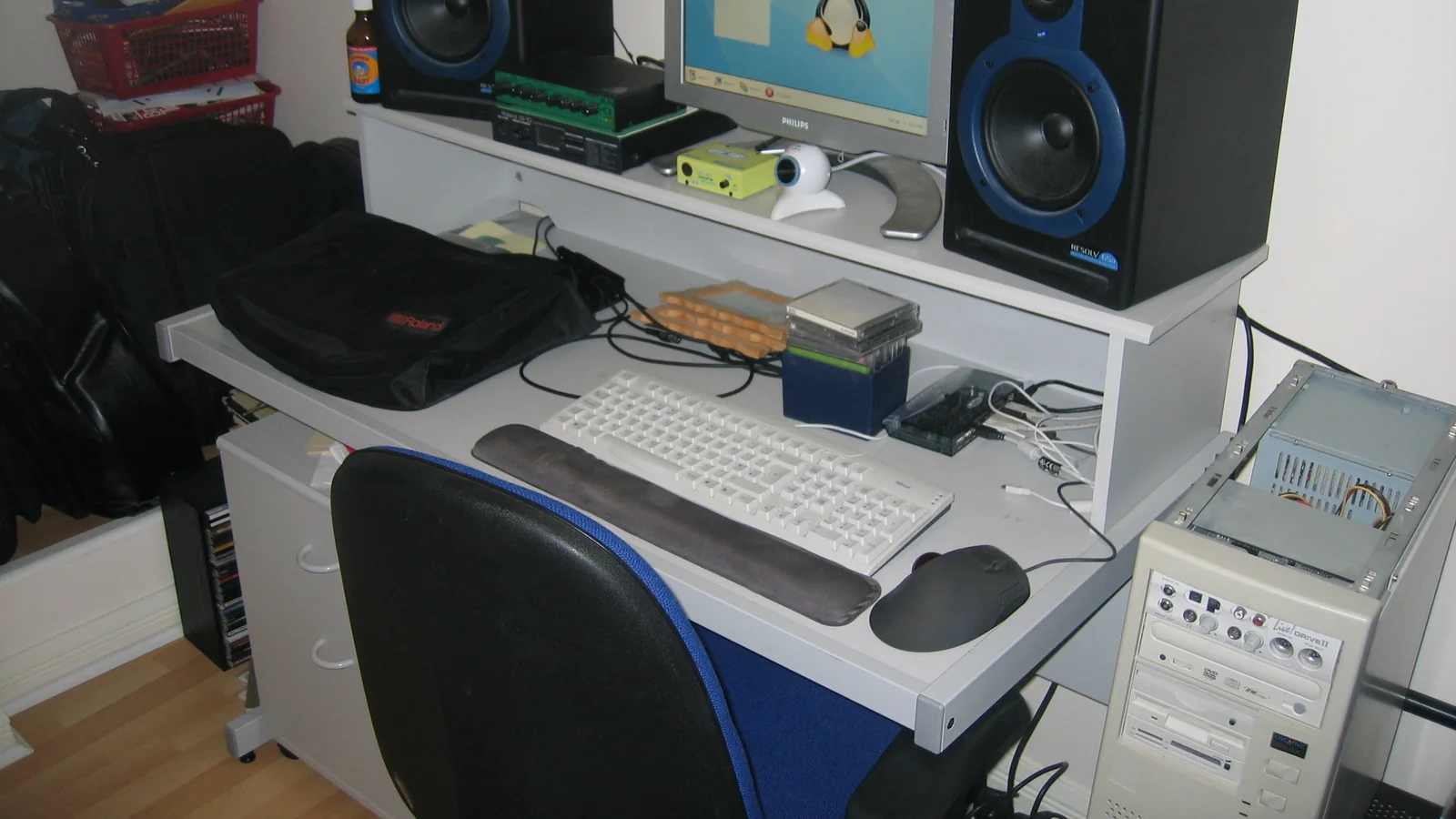
- Monitor speakers — Deliberately unflattering speakers, designed to reveal problems rather than to sound pleasant. Their weakness is that you hear the room as much as the speaker, and an untreated bedroom will lie to you about bass in a way headphones do not.
- MIDI controller keyboard — Sends performance data, not sound. Useful because playing a part is faster than drawing it and produces timing and dynamics you would not have thought to type in. Twenty-five keys is enough to begin with and fits on a desk.
- Microphone — A dynamic microphone is robust, cheap, rejects room sound and suits loud sources and untreated rooms. A condenser is more detailed and more sensitive, which includes being sensitive to your neighbours. For a first microphone in a normal room, the dynamic is usually the better answer despite being the less prestigious one.
- Acoustic treatment — Absorption at the points where sound reflects off walls into your listening position. Cheaper than most plugins, more effective than any of them, and the least glamorous purchase in the hobby. Not the same thing as soundproofing, which stops sound leaving the room and is a building problem.
MIDI is worth understanding properly because misunderstanding it wastes months. It is a specification for exchanging performance information between instruments and devices — which notes, how hard, which program, what the expression controls are doing — and it carries no audio at all. A MIDI file of a piano part is a set of instructions; what it sounds like depends entirely on the instrument you point it at. That is why a track can be transformed by changing the sound and not a single note, and why "the MIDI sounds bad" is never quite the problem it appears to be.
- Work it out — Tempo, delay and modulation timing
Almost every confusing problem in a project is a signal flow problem: the sound is going somewhere other than where you think it is. A DAW is a set of channels, each carrying audio from a source, through an ordered chain of processors, to a destination. Understanding that one sentence properly resolves a startling proportion of the questions beginners ask.
The order in the chain is not decorative. Compression before equalisation and equalisation before compression give different results, because the compressor responds to whatever it is fed — cut the bass first and the compressor stops reacting to the bass. Neither order is correct in general; knowing that they differ, and why, is what lets you decide.
Sends and buses are the other half. A send takes a copy of a channel and routes it somewhere else, which is how one reverb can be shared by twelve tracks and how they end up sounding like they are in the same room. A bus collects several channels into one so they can be processed together. Both exist because doing the same thing twelve times separately is slower and sounds less coherent.
| Stage | What it is doing | The characteristic beginner error |
|---|---|---|
| Recording | Capturing a performance cleanly at a sensible level | Recording too hot, chasing the meter rather than the sound |
| Editing | Timing, tuning, removing noises, choosing takes | Correcting everything until the part stops sounding human |
| Arrangement | Deciding what plays when, and what does not play | Adding parts to fix a problem that removing a part would fix |
| Mixing | Balance, space and tone, so every part is audible | Soloing tracks and mixing things that sound great alone |
| Mastering | Final level, consistency across a release, format | Treating it as a repair stage for a mix that is not working |
| Symptom | Usual cause | What to try |
|---|---|---|
| Clicks and dropouts while playing | Buffer size too small for the processing load | Raise the buffer for mixing, lower it only while recording |
| Noticeable delay when playing a part in | Buffer size too large, or monitoring through the computer | Lower the buffer, or monitor directly from the interface |
| Nothing records although the meters move | Input armed on the wrong channel, or routed to the wrong input | Trace the signal path one stage at a time from source to track |
| Mix sounds muddy | Two or more parts occupying the same low-mid register | Mute parts one at a time to find the pair; fix by arrangement first |
| Mix falls apart on phone speakers | Balance carried by bass that a small speaker cannot reproduce | Check on the worst speaker you own, early and often |
| Vocal sits behind the track | Competing midrange, or too much reverb too early | Cut what competes rather than boosting the vocal |
| Everything distorts on export | Summed level exceeding full scale at the master | Pull the master down before export; do not fix it with a limiter |
| Project will not open on another machine | Missing plugins or samples that were never inside the project | Consolidate or freeze tracks before moving a project |
- Go deeper — Why your mix sounds wrong everywhere else
Roughly the order in which the skills become the thing holding you back:
Step 1: Operating the software without thinking
Weeks, not months, and it arrives by repetition rather than by study. You will know it has happened when you stop noticing the interface.
You will know it worked when: The idea and the execution stop being separated by a manual.
Step 2: Finishing consistently
The genuine wall, and it is psychological rather than technical. Most people accumulate dozens of promising fragments and complete none, because a fragment can still be brilliant and a finished piece is definitely flawed.
You will know it worked when: A body of work rather than a folder of beginnings.
Step 3: Hearing arrangement problems as arrangement problems
The point at which you stop reaching for an equaliser when two parts clash and start muting one of them instead. This is the largest single jump in quality available and it costs nothing.
You will know it worked when: Mixes that were muddy become clear without new tools.
Step 4: Mixing to translate
Making something that holds up on a phone speaker, in a car and on headphones, rather than sounding right in one place. Reference tracks — commercial releases you switch to constantly while working — are the standard method and the one that works.
You will know it worked when: Other people hear roughly what you heard.
Step 5: Developing a sound rather than copying one
Years, and it happens as a by-product of volume rather than as a project. The producers with recognisable sounds mostly got them by having strong habits and limited tools for a long time.
You will know it worked when: Your work is identifiable as yours.
Loudness deserves a note of its own, because the received wisdom on it is a decade out of date. For years a louder master genuinely was more competitive, which produced a long period of everything being squashed. Loudness is now measured rather than eyeballed: the broadcast recommendation, EBU R 128, normalises programme material to an average of −23 LUFS and pairs that with loudness range and true peak descriptors, and playback platforms generally apply normalisation of their own. The practical consequence is that making a master louder mostly makes it quieter later, minus the dynamics you gave up. Aim for a master that sounds good, not one that wins a level comparison it will never be in.
- Mixing in solo — A kick drum that sounds enormous alone is usually taking up room that the bass needs. Nothing on a record is ever heard alone, so nothing should be judged alone.
- Starting a new project when stuck — The new project is more exciting for about forty minutes. Being stuck is the work, and pushing through it once teaches you more than five fresh starts.
- Adding rather than removing — When something is not working, the instinct is another layer. The fix is more often a mute button. A part that is doing nothing is actively costing you space.
- Working too loud — Everything sounds better loud, which is precisely the problem — loudness flatters, so decisions made at high volume are made with a bent ruler, and it is also how you damage your hearing.
- Believing the room — An untreated bedroom has bass peaks and nulls of many decibels. Mixing bass on speakers in an untreated room is guesswork, and this is exactly what headphones and reference tracks are for.
- Chasing a template — Downloading a professional producer’s project template does not import their judgement, and starting from forty pre-labelled tracks is a good way to feel behind on bar one.
- Over-quantising — Snapping every note exactly to the grid removes the timing variation that made the performance feel like a performance. Some genres want that; most do not, and it is applied by default.
- DAWalso: digital audio workstation
- Digital audio workstation. The software the whole process happens in.
- Buffer size
- How much audio the computer processes at once. Small buffers mean low delay and more strain; large buffers mean the opposite.
- Latency
- The delay between playing something and hearing it. Tolerable above roughly ten milliseconds and increasingly impossible to play against beyond about twenty.
- Gain staging
- Keeping levels sensible at every stage rather than only at the end, so nothing is fed something it was not designed for.
- Send and return
- Routing a copy of a channel to a shared effect and bringing the result back, rather than putting the effect on the channel itself.
- Bus
- A channel that several other channels feed into, so they can be processed as a group.
- LUFS
- Loudness Units relative to Full Scale — the measurement loudness standards and playback platforms use, designed to track how loud something actually sounds rather than its peak level.
- True peak
- The highest level the signal will actually reach once converted back to analogue, which can exceed the highest sample value.
- Sidechain
- Feeding one signal into a processor so that it controls what happens to a different signal — most familiarly a kick drum ducking a bass part.
- Comping
- Assembling one good take from several imperfect ones.
- Freezing
- Rendering a track and its plugins to plain audio temporarily, to free up processing.
- Stem
- A submix of one element — all the drums, all the vocals — exported as a single file for mixing or performance elsewhere.
- VSTalso: plugin format, AU, AAX
- The commonest plugin format on Windows, and one of several. Others include AU on macOS and AAX in Pro Tools.
For most of the twentieth century recording was an industrial process, because the equipment was expensive, physically large and required people trained to operate it. Multitrack tape made overdubbing possible and turned the studio itself into an instrument, and the roles that developed around it — engineer, producer, arranger — reflected a division of labour that the technology enforced.
The change came from three directions at once rather than from a single invention. MIDI arrived in the early 1980s as a shared specification for exchanging performance information between instruments from different manufacturers, which meant a sequencer could drive a room full of machines. Digital sampling made recorded sound something that could be manipulated as data. And personal computers eventually became fast enough to do the recording, the processing and the mixing themselves, at which point the desk, the tape machine and the outboard rack all became software.
The cultural consequences are still being worked through, and the honest summary is that accounts of them disagree. What is not in dispute is that a great deal of influential music since the 1990s was made outside professional studios, in bedrooms and spare rooms, by people who learned the craft without apprenticeship. Which genres that mattered most for, and how much credit belongs to the technology rather than to what was happening around it, are arguments rather than facts, and this page does not settle them.
The community is enormous, generous with technical help, and structurally biased towards gear. Forums and video channels are funded, directly or indirectly, by people selling equipment, and the resulting centre of gravity is a conversation about tools rather than about music. This is not a conspiracy — a video about a new compressor is simply easier to make and easier to watch than a video about finishing things — but it does mean the free advice skews consistently in one direction.
Collaboration norms are worth learning early because they are unwritten. Sending someone a project file assumes they own your plugins; sending stems does not, which is why stems are the polite default. Credit conventions vary by scene and are a routine source of falling out, so agreeing who is credited as what before anybody starts is normal professional behaviour rather than a lack of trust.
The most useful cultural habit is also the least advertised: play your work to people who will tell you the truth about it, and do it before you think it is ready. Feedback from somebody who does not produce is often more useful than feedback from somebody who does, because they will tell you what they heard rather than what they would have done.
- Which DAW should I use?
- We are not going to name one, and it is worth saying why rather than being coy. Every mainstream option — the ones bundled free with an operating system included — is capable of a finished professional record, the genuine differences are workflow and habit rather than sound or capability, and any recommendation would be about our preferences and out of date within two release cycles. Try the free trials of two, pick whichever one annoys you less in the first hour, and stop thinking about it. The exception worth knowing is accessibility: if you use a screen reader, that narrows the field sharply and should decide it.
- Do I need an audio interface?
- Only if you are recording sound from outside the computer — a microphone, a guitar, a hardware synthesiser. If you are working with software instruments, samples and loops, the interface adds nothing you need and the money is better spent on headphones or on acoustic treatment. This is probably the most common unnecessary first purchase in the hobby, and it happens because interfaces appear on every beginner list regardless of what the beginner is doing.
- Should I buy monitor speakers or headphones first?
- Headphones, in almost every case. Monitors are more pleasant to work on and tell you more, but what they tell you includes a great deal about the room they are in, and an ordinary bedroom has bass peaks and cancellations of many decibels at the listening position. Headphones bypass the room entirely. Buy monitors when you have somewhere reasonable to put them and some absorption on the walls, and expect the treatment to improve them more than a price increase would.
- How loud should I master my track?
- Loud enough to sound good and no louder. The competitive loudness era ended when playback normalisation became standard: the broadcast recommendation EBU R 128 targets an average programme loudness of −23 LUFS, and streaming platforms apply targets of their own that turn a louder master down again. So squashing a mix now costs you dynamics and buys you nothing. Platform targets change and are not published as standards, so we do not quote a number to aim at — use your ears and a loudness meter, and check the master against a commercial reference you like.
- Can I do this without being able to play an instrument?
- Yes, and a large proportion of people do. Notes can be drawn into a grid with a mouse, sampled from records, played in badly and corrected, or generated from chords the software suggests. What you cannot avoid is developing musical judgement — knowing when something is working — and that comes from listening carefully and finishing things, not from technique at a keyboard. Playing a little does help, mostly because playing a part in gives you timing and dynamics you would never think to type.
- Why does my mix sound worse in the car than on my headphones?
- Because your headphones are one specific, unusually good playback system and the car is a normal one. Almost all mixes translate imperfectly at first, and the fix is not a plugin: it is to check your work constantly on the worst speaker you own, and to keep a couple of commercial tracks you know well in the project to switch to. If the problem is specifically that the bass disappears or overwhelms, that is the classic sign of mixing low frequencies in an untreated room or on headphones that flatter them.
Within this activity
Disciplines, variants and techniques that sit inside it.
Disciplines
- Generative music — Building systems that compose rather than composing directly, in patchers, code or hardware.
If you like this
Each of these is here for a stated reason, not because it is also a hobby.
Similar to
- Journaling — Both are solitary daily practices where the hard part is finishing rather than starting, and both reward a low bar and a regular time far more than they reward equipment.
- DJing — The same ear applied at a different scale: selection, transition and energy across an hour rather than construction inside three minutes. A great deal of equipment and vocabulary is shared.
Goes well with
- Luthiery — The instrument and what is done with it. Builders end up recording their own work to hear what changed, and producers end up wanting an instrument set up exactly their way.
- Songwriting — Production without material is arrangement in search of a song. Most people who stall after the first year stalled on writing rather than on mixing.
Progresses to
- Electronics — Where the interest in the sound becomes an interest in the circuit — modular synthesis, pedal building and repair are the usual next step for producers who like the hardware more than the software.
Shares equipment with
- Podcasting — Identical hardware and identical editing skills, aimed at speech instead of music. The microphone, the interface and the workstation all do the second job unchanged.
Sources for this section
- EBU R 128 — Loudness normalisation and permitted maximum level of audio signals (opens in a new tab) — European Broadcasting Union · Standards body · read — supports the claim
- MIDI 1.0 (opens in a new tab) — The MIDI Association · Standards body · read — partly supports
- Noise at work: the regulations (opens in a new tab) — Health and Safety Executive · Governing body · read — supports the claim
Comprehensive
Last reviewed 2026-08-14. Cost, time and difficulty figures on this page are HobbyHQ estimates — see how we work. Something here wrong or out of date? Tell us.