Racket & bat sports
Padel
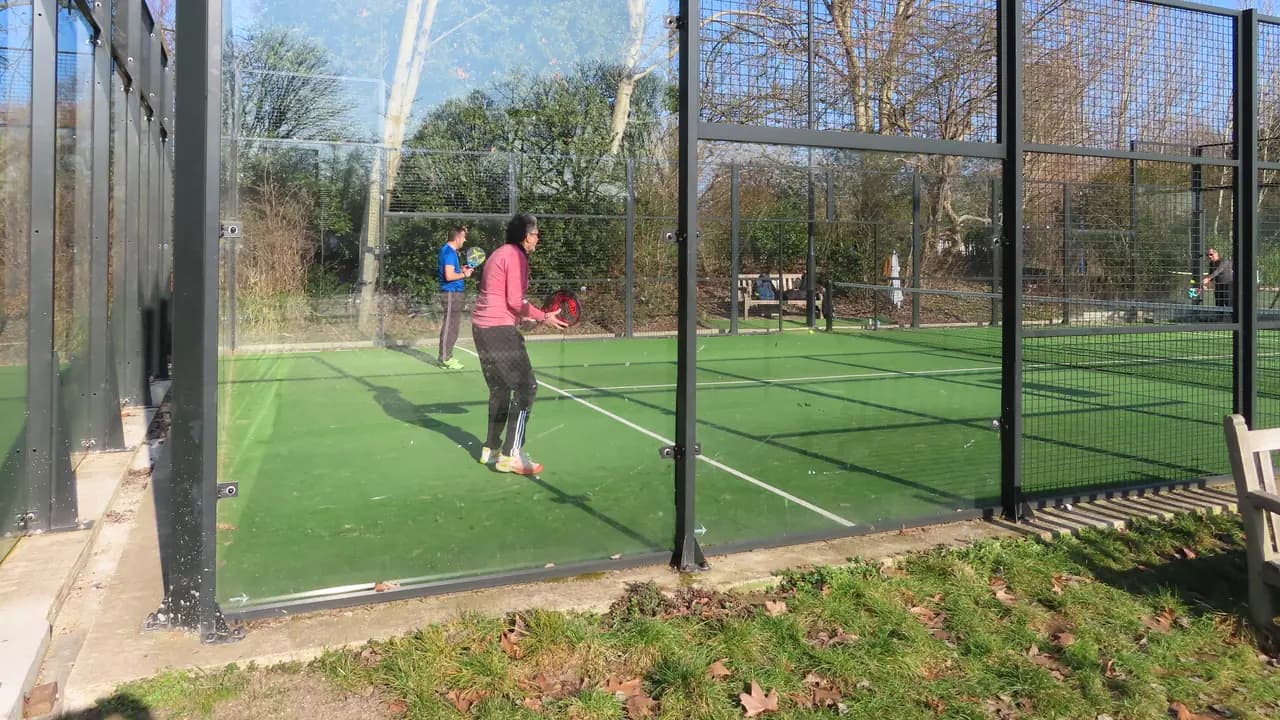
Padel is the fastest-growing racket sport in Britain and one of the few where a complete beginner can play a real rally in their first ten minutes. It looks like small-court tennis and plays nothing like it, because the back and side walls are in play — which turns a lost point into a retrievable one and rewards placement over power.
Also known as padel tennis.
Padel is played two against two on an enclosed court 20 metres by 10, about a third of the area of a tennis court, surrounded by glass and mesh walls. Scoring is identical to tennis. The racket is a solid, stringless, perforated bat, and the ball is a slightly lower-pressure tennis ball.
The wall is what makes it a different sport. After the ball bounces on your side of the court it may come off the back or side wall and still be returned — so a shot that would be a clean winner in tennis is often simply the start of the next phase. The result is far longer rallies, far more of the point spent thinking about position, and a game where power is a liability as often as an asset.
The other structural difference is that padel is always doubles. There is no singles game on a standard court, so it is inherently social, and the etiquette around finding a fourth is a large part of how clubs work.
- Still deciding — Padel vs pickleball
Step 1: Book a beginner session, not a court
Almost every padel venue runs introductory sessions with rackets provided and a coach who will pair you up. Booking a bare court with three friends who have also never played produces an hour of picking balls up.
You will know it worked when: You rally in the first ten minutes and understand the wall.
Step 2: Borrow a racket for the first three sessions
Rackets differ in shape and weight distribution in ways that matter, and you cannot judge which suits you until you have hit a few hundred balls.
You will know it worked when: You buy the right racket rather than the first one.
Step 3: Learn to let the ball come off the wall
This is the single technical hurdle. Every instinct from tennis says to intercept the ball early; padel says to let it pass, wait for the rebound, and hit it as it comes back towards the net. It feels wrong for about two sessions and then becomes the game.
You will know it worked when: You stop losing points you could have retrieved.
Step 4: Learn the lob
The most important shot in padel, and the one beginners neglect. A good lob pushes the opposing pair off the net and reverses the point.
You will know it worked when: You can win a point without hitting hard.
Step 5: Join a club WhatsApp group or ladder
Padel is doubles-only, so your ability to play depends entirely on knowing three other people at your level. Every club has an arrangement for this.
You will know it worked when: You get regular games.
Sources for this section
- Padel rules and how to get started (opens in a new tab) — Lawn Tennis Association · Governing body · corroborated indirectly
- The serve is underarm and diagonal — You bounce the ball behind the service line and strike it underarm into the diagonal service box. The federation rule is more precise than the usual "below the waist": contact must be at or below the iliac crest — the top of the hip bone — which sits lower than most people assume. Two attempts, as in tennis. There is no serve-and-volley advantage of the kind a tennis serve creates, which is why beginners can rally immediately.
- The walls are in play — on your own side — The ball must bounce on the floor first. After that it may hit your own walls and be returned. What you may not do is hit the ball directly onto your own wall to get it over the net.
- The ball may go out through the gaps — On courts with side openings the ball can leave the court and be played back in from outside, which produces the sport’s most spectacular points. This is legal at competition level and glorious to watch.
- A ball hitting the opponent’s wall directly from your shot is a fault — It must bounce on their floor first. This is the rule beginners break most often.
- Scoring is tennis scoring — 15, 30, 40, game; six games with a two-game margin for a set; best of three sets. Deciding-point (golden point) scoring at deuce is common in club and professional play.
| Feature | Measurement |
|---|---|
| Court | 20m long × 10m wide |
| Net height | 0.88m at centre, 0.92m at the posts |
| Back walls | 3m high (glass), with 1m of mesh above at the sides in the standard configuration |
| Service line | 3m from the back wall |
Dimensions and permitted court configurations are set by the international federation and adopted domestically; confirm current specifications against the rulebook before relying on them for anything that matters.
Sources for this section
- Rules of Padel (opens in a new tab) — International Padel Federation (FIP) · Governing body · corroborated indirectly
- Padel rules and how to get started (opens in a new tab) — Lawn Tennis Association · Governing body · corroborated indirectly
- Racket shape — Round rackets have the sweet spot in the centre and the most forgiveness — the correct beginner choice. Teardrop is the middle ground. Diamond rackets move the sweet spot towards the tip for power and are for players who consistently hit the middle.
- Weight and balance — Typically 350–390g. Lighter and lower-balanced is easier to manoeuvre at the net; heavier and head-heavy hits harder and tires the arm. Beginners should err light.
- Core — Soft EVA foam is forgiving and comfortable; harder cores transfer more power and more vibration. Cold weather stiffens foam noticeably.
- The wrist strap is compulsory — A padel racket released at speed inside an enclosed court is genuinely dangerous. Courts and competitions require the strap for this reason.
- Balls — Slightly lower pressure than tennis balls. They go dead faster than they look; a tube lasts a few sessions of serious play.
- Shoes — Clay-court tennis shoes or padel-specific shoes with a herringbone sole. They grip and release on sand rather than sticking, which protects knees and ankles.
- Work it out — Hobby startup cost estimator
- Work it out — Padel racket selector
Everything that makes padel a different sport from tennis is in the walls, and almost every beginner spends their first month fighting them. The instinct a tennis player brings — move towards the ball, take it early — is precisely wrong, and unlearning it is the fastest improvement available to anybody.
This is written down rather than demonstrated because what a beginner needs is not a swing to copy. It is the rule, and the rule is geometry: the ball rebounds off the back wall and comes *towards you*, so the shot is played after the bounce, from behind where you instinctively stood, moving away from the wall rather than into it.
What actually happens, in order, on a deep ball:
Step 1: The ball bounces on the floor first
It must. A ball reaching the wall without bouncing is out. Everything after this assumes the floor bounce has already happened.
You will know it worked when: You are watching the bounce, not the wall.
Step 2: It rebounds off the glass towards you
This is the moment the tennis instinct fires and must be ignored. Do not close on the ball; let it come.
You will know it worked when: You have not run into your own returning ball.
Step 3: You move back and across, not forward
Take a step towards the wall as the ball passes you, turn, and let it come off. The ball ends up in front of you, which is where you can hit it.
You will know it worked when: You are behind the ball rather than jammed by it.
Step 4: You hit it at a comfortable height on the way through
The rebound gives you time that a tennis court would not. Most beginners hit far too early and far too hard here.
You will know it worked when: A controlled shot instead of a defensive scoop.
| Ball into the back wall | What the rebound does | Where to be |
|---|---|---|
| Deep and hard, low bounce | Comes off long and fast | Well back and moving away — you have more time than instinct suggests |
| Deep and slow, high bounce | Drops close to the wall | Close in, low, and ready to lift it out. The hardest ball in the game for a beginner |
| Angled into the side wall first | Comes off across you, changing direction twice | Track the second contact, not the first — position off where it hits the back glass |
| Soft, dying near the glass | May not return at all | In and low immediately. This is the ball good players hit on purpose |
What beginners get wrong, in order of how often:
- Moving towards the ball — The tennis reflex. It jams you against your own returning ball and there is no shot from there.
- Hitting before the wall — Legal, and usually a wasted opportunity — the rebound would have given you a better position and more time.
- Standing too close to the glass — A metre and a half off the back wall is roughly right. Beginners stand with their back to it and have nowhere to go.
- Treating every rebound the same — The table above is the point: how the ball arrives at the wall determines everything about how it leaves.
- Watching the wall instead of the ball — Watch the ball onto the glass and off it. The wall does not move.
Padel has no belts and no formal ladder, and the levelling systems clubs use are local and inconsistent. What it does have is a fairly reliable order in which things become the limiting factor, and knowing that order is most of what stops a plateau feeling like a wall.
Step 1: Stop losing points to the wall
The first ceiling is entirely the glass. Until a deep ball off the back wall is a shot you look forward to rather than one you brace for, nothing else you learn will hold up in a game.
You will know it worked when: You play the rebound on purpose instead of reacting to it.
Step 2: Get to the net, and stay there
The second ceiling is position. The pair at the net wins the large majority of points at every level, so the skill that pays is the one that gets you there and the one that keeps you there when they lob.
You will know it worked when: You win points from position rather than from shots.
Step 3: Play with the same partner for a season
Padel is a pairs game and most of the improvement after the first few months is coordination rather than individual skill. Rotating partners every week keeps you a beginner for longer than anything else on this list.
You will know it worked when: You move as a pair without talking about it.
Step 4: Enter a club americano or a round robin
The low-commitment competitive format most clubs run: rotating partners, short sets, one evening. It is the cheapest way to find out what your game does under mild pressure, and nobody there is a professional.
You will know it worked when: You have played points that mattered slightly.
Step 5: Take a small number of lessons, late rather than early
Coaching is most valuable once you have a game to correct. A player who has been round the first two ceilings gets more from four lessons than a beginner gets from twenty, because the coach can work on the thing that is actually costing points.
You will know it worked when: You are working on a named fault rather than on everything.
Step 6: Play a graded league or a local tournament
The point at which the sport stops being exercise and starts being a competition. Grading is by club or by regional system and is worth asking about before entering, because the difference between two adjacent categories is larger than it looks.
You will know it worked when: You have a result, and something to improve for.
Almost every padel fault a new player has is one of three things wearing different clothes: a tennis instinct that has not been unlearned, a position on court that is losing the point before it is played, or a racket that is punishing a swing it was not sold to a beginner to punish. The symptoms below are grouped by what they usually turn out to be, and each ends with the cheapest thing to change first.
- Everything I hit comes back off the glass and they put it away — Likely a tennis instinct rather than a fault. Power is what does this: a hard ball reaches the back wall with enough left to rebound into open court, and you have handed the point over. Check whether your winners are landing deep and flat rather than high and short. Next, stop trying to hit through people for a session and play everything at half pace to the glass side. It feels like giving up and it is how the sport is actually won.
- I get lobbed and can never get back to the net — Likely position rather than speed. Standing tight to the net leaves the whole court behind you, and once you are turned and running the point is gone. Check where your feet are when the ball is on your opponents’ racket — a metre or so back from the net is the working position, not on top of it. Next, treat every lob as a signal to move back together as a pair rather than as an individual sprint. If you are consistently beaten by lobs from a sensible position, that is the point at which a coach earns their fee, because the answer is an overhead and this page does not teach strokes.
- The ball dies in the corner and I cannot do anything with it — Likely the double rebound, which is a geometry problem. A ball into the corner comes off two walls and changes direction twice, and standing where you would for one wall puts you in the wrong place. Check whether you are moving towards the corner or away from it — the answer is away, giving yourself room to play the ball after it has finished bouncing. Next, spend a session doing nothing but feeding balls into your own corner and letting them come out. It is dull and it is the single most useful hour a beginner can spend.
- I keep hitting the frame — Likely equipment before technique. A diamond-shaped, head-heavy racket has a sweet spot small enough that an accurate swing still misses it. Check the shape and the balance of the racket you are using, which is written on it or on the manufacturer’s page. Next, borrow a round racket with a low balance point for one session. If the frame shots stop, the racket was the problem; if they do not, it is timing and that is a coaching question.
- We win more points than the other pair and still lose — Likely the scoring rather than the play. Padel scores like tennis, so points are not equal — the ones at 30–40 and deuce decide games and the rest do not. Check whether you are losing the long games and winning the short ones. Next, nothing technical: play the important points more conservatively than the unimportant ones, which is the opposite of what most pairs do.
- My ankle rolls, or my knees hurt after a session — Likely footwear, and then a boundary. Padel is lateral movement on sand-dressed artificial turf, and running shoes are built to stop a foot moving sideways as little as possible. Check what is on your feet: a padel or clay-court sole is a herringbone pattern, not a running tread. Next, change the shoes. If pain persists in properly supported shoes, that is a clinical question rather than a technique one, and this page does not answer it.
- The ball is not bouncing properly — Likely the ball rather than you. Padel balls are slightly lower-pressure than tennis balls and go dead considerably faster, especially in the cold. Check the tube date and whether the ball is noticeably softer than a new one. Next, open a new tube. A dead ball changes how the whole court plays and is the cheapest variable on this list.
- Hitting too hard — The most common error, and it comes from tennis. Power sends the ball into the back wall and hands your opponents an easy return. Padel is won by placement, height and patience.
- Taking the ball before the wall — Beginners volley everything out of anxiety. Letting it pass and playing the rebound gives you more time, not less.
- Standing at the back — The net is the winning position in padel, much more decisively than in tennis. The pair at the net wins the large majority of points at every level.
- Ignoring the lob — Without it you have no way to dislodge a net pair, and the point is over before it starts.
- Buying a professional racket — Diamond-shaped, head-heavy rackets have a tiny sweet spot and are punishing for a beginner. A round racket with a low balance point is far more forgiving and will improve your game faster.
- Wearing running shoes — Padel is lateral, on sand-dressed turf. Running shoes give no lateral support and roll ankles.
- Bandejaalso: tray
- A controlled, sliced overhead played with a flat trajectory, used to hold the net position rather than to win the point outright. The defining intermediate shot in padel.
- Víbora
- A more aggressive sliced overhead than the bandeja, hit with sidespin to kick away off the side wall.
- Chiquita
- A soft, low shot dropped at the feet of the net players to force them to lift the ball.
- Globo
- The lob — the shot used to push an opposing pair back off the net.
- Salida
- A shot played after the ball has come off the back wall.
- Por tres
- Playing a ball that has left the court through a side opening, from outside the court.
- Golden point
- A single deciding point played at deuce instead of advantage scoring, standard in much of professional and club padel.
- Contrapared
- Using your own wall deliberately to return a ball, playing it against the wall so it travels back over the net.
A doubles game, and the social machinery around it
Padel is almost never played as singles, which makes finding three other people the actual skill — and the culture is organised around solving that.
- Americanos and mexicanos are how you get a game — The formats that define the social side. An americano rotates partners every few games so everybody plays with and against everybody, and points are individual; a mexicano re-pairs by standing after each round. Both exist because a doubles sport needs a way for four strangers to have a good afternoon, and both are the standard route in for somebody who knows nobody.
- Level, honestly stated, is the courtesy — Clubs and apps sort by a stated level, and over-claiming is the one antisocial act in the sport — it produces a match nobody enjoys, including you. Under-claiming is regarded as charming and gets corrected within a game.
- Court time is booked, paid and shared, and you come off on the hour — Courts are scarce and expensive, and the next four are standing behind the glass. Finishing the point and leaving promptly is the most visible etiquette at any club.
- Call your own lines, and give the point away when unsure — Almost all padel is unofficiated. The convention is that the receiving pair calls their own side, that a ball you are not certain about is in, and that nobody argues. The walls make some calls genuinely ambiguous and the sport has decided to solve that with generosity rather than with argument.
- Warn before you smash out of the court — The por tres — hitting the ball out of the enclosure and running round to play it — is a real shot and a real hazard to whoever is outside. Look first.
- It is a very new sport in Britain, and everybody there is new too — The most reassuring fact about walking into a padel club. Facility numbers have grown from almost nothing within a few years, which means the person on the next court has probably been playing for eight months. There is very little accumulated seniority to be intimidated by.
The tone of the sport is noticeably more sociable than tennis, and the reasons are structural rather than cultural: the court is small enough to talk across, the rallies are long enough to be fun at any standard, the ball comes off the glass in ways that make good players lose points to bad ones, and it is played four at a time. A great deal of padel is arranged in a group chat and ends in a bar.
Sources for this section
- Padel rules and how to get started (opens in a new tab) — Lawn Tennis Association · Governing body · corroborated indirectly
Padel is usually traced to Acapulco in 1969, where Enrique Corcuera built an enclosed court at his home, walled partly because of the space available. A Spanish friend, Alfonso de Hohenlohe, took the idea to Marbella in the mid-1970s, and from there it spread through Spain and, via Argentine visitors, to Argentina — the two countries that still dominate the professional game.
Britain came late. Courts existed from the 2010s but numbers were small until the 2020s, when growth became very rapid indeed, driven partly by the ease of installing courts on underused tennis and five-a-side sites. The Lawn Tennis Association became the recognised national governing body, which gave the sport a domestic competitive structure it had previously lacked.
That recent, rapid arrival is precisely why good beginner information in English is thin: much of the deep coaching material is Spanish, and much of the English-language content is club marketing. It is one of the clearer information gaps in British sport.
Sources for this section
- Padel rules and how to get started (opens in a new tab) — Lawn Tennis Association · Governing body · corroborated indirectly
- Do I need to be able to play tennis?
- No, and beginners often do better without it. Tennis players arrive with a full-swing habit and an instinct to take the ball early, both of which have to be unlearned. People with no racket background regularly rally sooner than tennis players do.
- Is padel just small tennis?
- No. The walls change it fundamentally: rallies are much longer, power is often counterproductive, and the tactical unit is holding or breaking the net position rather than hitting winners. The scoring is borrowed from tennis; almost nothing else is.
- How much does it cost to play regularly?
- Roughly £8–£15 per person per session for court hire split four ways, plus a one-off £60–£120 for a racket. Some clubs run membership schemes that reduce court fees. It is cheaper than most gym memberships if you play weekly, and much cheaper to start than tennis at a private club.
- Can you play padel singles?
- Not on a standard court — the court is dimensioned for doubles and singles is unplayable on it. Dedicated singles courts exist and are much narrower, but they are rare. In practice padel is a doubles sport.
- What racket should a beginner buy?
- Round shape, soft EVA core, at the lighter end of the 350–390g range, and low balance. That combination maximises the sweet spot and forgiveness. Spend £60–£120; a professional-specification diamond racket will make you worse, not better.
If you like this
Each of these is here for a stated reason, not because it is also a hobby.
Cheaper alternative
- Pickleball — Much cheaper to enter and far easier to find a court, with a similar short-court social doubles feel.
Progresses to
- Tennis — Padel players who want a bigger physical challenge and a full swing usually try tennis; the transition is harder than it looks.
Similar to
- Squash — The other enclosed-court racket sport where walls are in play, though squash is singles, far more punishing and much quicker to learn badly.
Sources for this section
- Rules of Padel (opens in a new tab) — International Padel Federation (FIP) · Governing body · corroborated indirectly
- Padel rules and how to get started (opens in a new tab) — Lawn Tennis Association · Governing body · corroborated indirectly
Substantial
Last reviewed 2026-08-13. Cost, time and difficulty figures on this page are HobbyHQ estimates — see how we work. Something here wrong or out of date? Tell us.