Racket & bat sports · Social & community
Pickleball
Pickleball is the most accessible racket sport there is: the court is small, the ball is slow, the serve is underarm, and a genuine rally happens in the first five minutes. Its rules contain two deliberate constraints — the kitchen and the two-bounce rule — that exist specifically to stop tall, strong players from dominating, and understanding them is most of learning the game.
Also known as pickle ball.
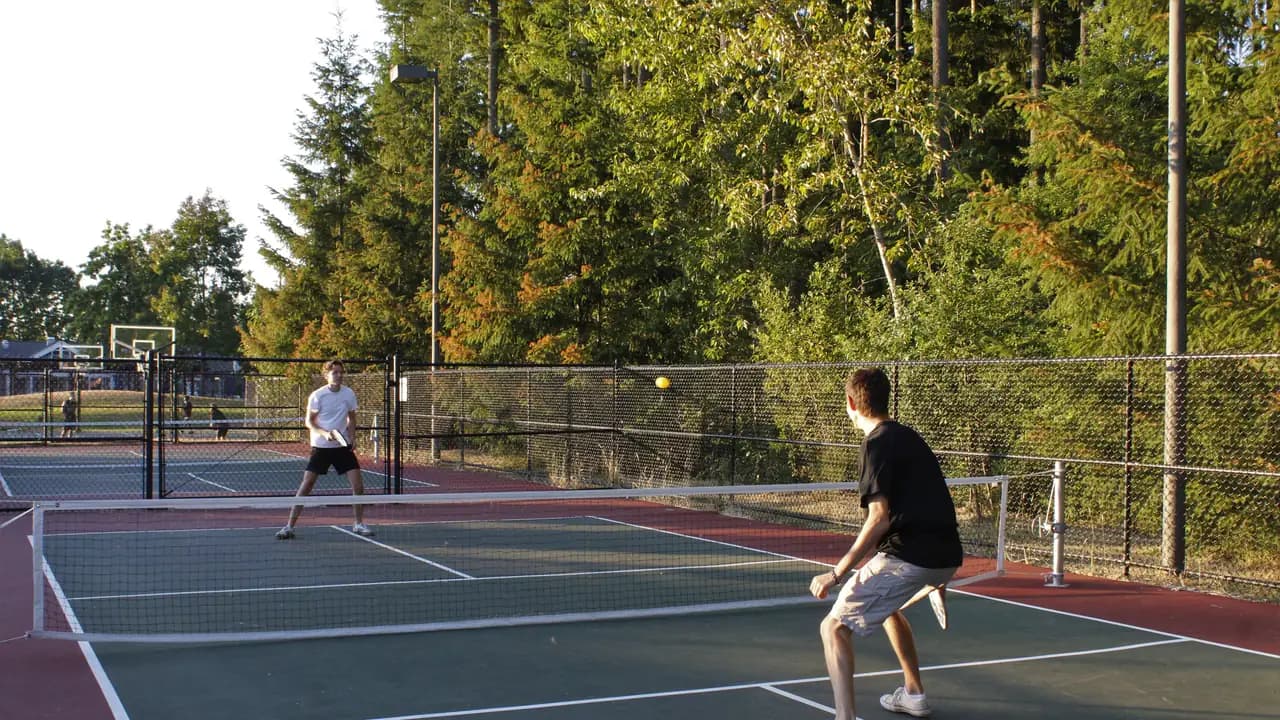
Pickleball is played, usually as doubles, on a court the size of a badminton court with a net a little lower than a tennis net. The paddle is solid and about twice the size of a table tennis bat; the ball is rigid perforated plastic and travels considerably slower than a tennis ball.
Two rules shape the entire game. The non-volley zone — universally called the kitchen — is a seven-foot strip either side of the net in which you may not volley. You may stand in it, but you may not hit a ball out of the air while any part of you is touching it. The two-bounce rule requires the serve to bounce, and the return of serve to bounce, before anyone may volley.
Together those rules prevent the sport from becoming a serve-and-smash contest. They force a soft, controlled phase of play at the net — the "dink" rally — that rewards touch and patience over reach and power, and they are the reason a physically ordinary player can beat an athletic one.
- Still deciding — Padel vs pickleball
Step 1: Find a club session with paddles to borrow
Pickleball’s culture is unusually welcoming to beginners — most sessions actively mix abilities and rotate players. Turning up alone is normal and expected.
You will know it worked when: You play a real game on the first night.
Step 2: Learn to call the score before you learn to hit
The three-number score confuses every beginner, and getting it wrong stops play more often than bad shots do. Say it out loud before every serve.
You will know it worked when: The game flows.
Step 3: Get to the kitchen line and stay there
The single biggest tactical fact in pickleball: the team at the non-volley line wins the overwhelming majority of points. Beginners hover in the middle, which is the worst place on the court.
You will know it worked when: You are in the winning position by default.
Step 4: Learn the dink
A soft shot that drops just over the net into the opponents’ kitchen, giving them nothing to attack. Dink rallies are where points are actually decided at every level above beginner.
You will know it worked when: You stop giving away easy smashes.
Step 5: Learn the third-shot drop
The serving team’s third shot of the rally, played softly into the kitchen so they can advance to the net. It is the hardest shot in the sport and the one that separates ability levels.
You will know it worked when: You can win points on your own serve.
Sources for this section
- Pickleball England (opens in a new tab) — Pickleball England · Governing body · corroborated indirectly
- The serve is underarm and diagonal — Struck below waist level with an upward motion, from behind the baseline, into the diagonal service court. It must clear the kitchen and its line.
- The two-bounce rule — The serve must bounce before it is returned, and the return must bounce before the serving side plays it. Only after those two bounces may anyone volley. This is the rule that stops the serving side rushing the net.
- The non-volley zone — You may not volley while touching the kitchen or its line, and momentum from a volley must not carry you into it afterwards — which catches people who hit the shot legally and then step in.
- Scoring — Traditionally, only the serving side scores. Games are to 11, win by 2. The score is called as three numbers: your score, their score, and which server you are (1 or 2). Rally scoring, where every rally scores, is used in some formats.
- Faults — Ball out, ball into the net, kitchen violation, volleying before the two bounces, and serving illegally.
| Feature | Measurement |
|---|---|
| Court | 20ft × 44ft (6.10m × 13.41m), the same as a doubles badminton court |
| Net height | 36in at the posts, 34in at the centre |
| Non-volley zone | 7ft from the net on each side |
| Ball | Perforated plastic; indoor and outdoor balls differ in hole count and hardness |
These figures follow the published rulebook; the rules are revised periodically, and anything competition-critical should be checked against the current edition rather than against this page.
Sources for this section
- Official Rulebook (opens in a new tab) — USA Pickleball · Governing body · read — supports the claim
- Paddle material — Wood is cheap, heavy and dead — playable, and the reason many people think their shots have no control. Composite and graphite paddles at £40–£70 are the sensible first purchase and will last years.
- Paddle weight — The main variable. Around 200g gives control and quick hands at the kitchen line; 230g and above gives power and puts more load through the elbow. Start mid-weight, and go lighter rather than heavier if you have any history of tennis elbow.
- Grip size — Too small a grip makes you squeeze, which is the direct cause of most elbow trouble in the sport. A larger grip, or an overgrip added to build it up, is the cheapest injury prevention available.
- Indoor and outdoor balls — Genuinely different, and not interchangeable. Indoor balls have fewer, larger holes and are softer and slower; outdoor balls are harder with more, smaller holes to cope with wind. Using an indoor ball outdoors produces a ball that goes nowhere.
- Shoes — Court shoes with lateral support. The characteristic pickleball injury is to the Achilles or the ankle, caused by sudden lateral push-off, and running shoes offer no support in that direction at all.
- Eye protection — Increasingly common and worth considering. At the kitchen line, players are around four metres apart and a hard-driven ball reaches the face very quickly.
Pickleball has an unusually explicit ladder, because the sport runs on a numeric rating system that most clubs and every tournament use. That makes progression legible in a way it is not in most racket sports, and it also makes it easy to chase a number instead of a game. The order below is the order in which things actually stop you.
Step 1: Stop losing points to the two rules
The kitchen and the two-bounce rule are where beginners lose points without knowing why. Until neither costs you a rally, nothing else is the limiting factor.
You will know it worked when: You stop faulting, and you stop volleying serves.
Step 2: Get to the kitchen line and stay there
Doubles is won at the non-volley line, and the pair that gets there first wins most rallies. The skill that pays is getting forward after the return rather than anything you can hit.
You will know it worked when: You are at the line by the third shot most rallies.
Step 3: Learn to slow the ball down
The characteristic pickleball skill and the counter-intuitive one: a soft ball into the kitchen is worth more than a hard one anywhere. This is where players who came from tennis plateau, and where they break through.
You will know it worked when: You can end a fast exchange on purpose rather than by winning it.
Step 4: Play organised social sessions rather than only friends
Most clubs run open-play rotations by rough level. Playing people slightly better than you every week is the cheapest improvement available, and it costs nothing beyond turning up.
You will know it worked when: You have played against a range rather than a habit.
Step 5: Get rated, and treat it as information
Self-rating and then club or tournament rating give you a number. It is useful for finding the right games and it is not a score to defend — the players who improve fastest are the ones who play up and lose.
You will know it worked when: You know what level of game to look for.
Step 6: Enter a local tournament, in doubles
The competitive format the sport is built around, and the point at which strategy stops being optional. Age and rating brackets mean the entry level is genuinely accessible.
You will know it worked when: You have played points that mattered, with a partner.
- Standing in no man’s land — Between the baseline and the kitchen is where balls land at your feet. Be at the back or at the line, not between them.
- Hitting everything hard — The ball is slow and the court is short; a hard shot arrives back faster than you can recover. Soft, low and unattackable beats fast and returnable.
- Stepping into the kitchen on the follow-through — Momentum faults are legal shots that become faults because of what happens next. Land your weight before you swing.
- Ignoring the two-bounce rule — Rushing the net on your serve is the most common beginner fault and gives the point away instantly.
- Buying a wooden paddle — £15 and heavy, dead and slow. A composite paddle at £40 is a much better first purchase and lasts years.
- Not warming up the shoulder and Achilles — The sport looks gentle and involves a great deal of sudden lateral pushing off. Achilles injuries are the characteristic pickleball injury, particularly in players returning to sport after some years.
Pickleball is unusual among racket sports in that most of what goes wrong for a beginner is a rule rather than a stroke, and rules are the one class this page can help with. The kitchen and the two-bounce rule between them account for the large majority of points a new player loses without understanding why, and both are checkable against a diagram rather than diagnosed from the outside.
Read each entry as symptom → likely class → what you can safely check → what to do next. Several classes can produce the same lost point, so eliminating the rule question first is what stops somebody concluding they cannot play when what they cannot do is stand in the right place.
- Class 1
- A rule — yours, and settled by reading it
- Class 2
- Position — yours, and visible on a court plan
- Class 3
- Equipment — yours, and cheap
- Class 4
- Technique — a coach’s
- Your winning volley keeps being called a fault — The non-volley zone, and probably the follow-through. The rule catches people who hit the shot entirely legally and then step in, because momentum from a volley must not carry you into the zone or onto its line afterwards. Check where your feet finish rather than where they started. The fix is to volley from further back rather than to volley less.
- You rush the net after serving and lose the point immediately — The two-bounce rule. The serve must bounce and the return must bounce before anybody may volley, which means the serving side physically cannot take the net on the first two shots. This is the rule that exists to stop exactly what you are trying to do. Stay back until the return has bounced, then move in.
- Your serve keeps being called out or short — Rules. The serve is struck below waist level with an upward motion from behind the baseline into the diagonal service court, and it must clear the non-volley zone and its line. Three separate things can fail there. Ask which one — a partner watching for one game will identify it faster than any amount of self-diagnosis.
- You are always stretching and never comfortable — Position. The commonest positional error is standing in the middle of the court, which is too far back to volley and too far forward to cover the baseline. The court is small enough that the answer is nearly always to be at the non-volley line with your partner, having got there when the rules allowed it.
- Everything you hit hard comes straight back faster — Position and pace, together. The ball is slow and the court is short, so power gives an opponent time rather than taking it away. This is why the soft game at the net rewards patience over reach, and it is a habit rather than a fault — a physically ordinary player beating an athletic one is the sport working as designed.
- The ball behaves differently indoors and out — Equipment. Indoor and outdoor balls genuinely differ in hole count and hardness, and an outdoor ball indoors is fast and lively while an indoor ball outside is blown about. Check which you have before concluding anything about a session. Balls also crack and go soft, and a cracked ball is a dead ball.
- Your paddle feels heavy and unresponsive — Equipment. A wooden paddle is playable but heavy and dead, and it is the commonest false economy in the sport. A mid-range composite is a genuine step and it is the one purchase worth making early. If the paddle is already composite, this is not the answer.
- The same shot fails the same way every time — Technique, and this page stops. A repeating fault at a specific moment is a coaching question. What is useful is describing it precisely — "the third shot drop always goes long, only from the backhand side" — which is something a coach can work with in one session.
- Your shoulder or Achilles hurts — Stop, and this page has nothing further to offer. Pain that persists between sessions is a medical question. The sport’s accessibility makes it easy to play more than your body has adapted to, and that is the commonest way a new player gets injured.
The habit worth building is to settle the rule question first. The kitchen, the two-bounce rule and the serve take a minute between them, they account for most early frustration, and eliminating them is what separates "I do not understand this game" from a genuine question about how you play it.
Pickleball has a genuine and well-documented noise issue. A rigid plastic ball striking a rigid composite paddle produces a sharp, high-frequency crack that carries much further than a tennis ball’s thud and is more intrusive at the same measured volume because of its impulsive character.
This has become the main planning obstacle to new outdoor courts in Britain, and objections from neighbouring residents are common and often successful. Some manufacturers now make quieter paddles and lower-noise balls, and several clubs impose distance or hours restrictions.
It matters to a beginner for one practical reason: it is why so much British pickleball is played indoors in sports halls at awkward hours, and why the sport’s growth is constrained by venue availability rather than by demand.
- Kitchenalso: non-volley zone, NVZ
- The non-volley zone — the seven-foot area either side of the net where volleying is prohibited.
- Dink
- A soft shot dropped just over the net into the opponents’ kitchen, designed to be unattackable.
- Third-shot drop
- A soft shot played by the serving team on the third shot of the rally, allowing them to advance to the net.
- Two-bounce rulealso: double bounce rule
- The serve and the return of serve must each bounce before anyone may volley.
- Erne
- A legal manoeuvre in which a player jumps around the outside of the kitchen to volley near the net without touching the zone.
- Stacking
- A doubles positioning strategy in which partners line up on the same side after the serve so each plays their preferred side.
- Poach
- Crossing into your partner’s side to intercept a ball.
- ATP
- Around the post — returning a wide ball around the outside of the net post rather than over the net, which is legal.
Pickleball was improvised on Bainbridge Island, Washington, in 1965, by three fathers whose children were bored. They had a badminton court, no shuttlecocks, and a perforated plastic ball, so they lowered the net and made paddles from plywood. The non-volley zone and the two-bounce rule were added deliberately, to keep the game from being dominated by whoever could smash hardest.
The name’s origin is disputed within the founding families — one account attributes it to a "pickle boat" crewed from leftover oarsmen, another to a dog named Pickles. The dog existed; the chronology is argued about.
The sport grew slowly for decades in the United States, largely among older players, then extremely quickly from around 2020, becoming by several measures the fastest-growing sport in that country. British growth followed a few years behind and remains constrained by court availability rather than interest. Its demographic reputation as a retirement sport is increasingly out of date — the competitive game is young and fast — but its genuine cross-age playability remains its most distinctive quality.
- Is pickleball only for older players?
- No, though the reputation has a real origin — it grew for decades among older American players before the recent boom. The professional game is young, athletic and extremely fast. What is true, and unusual, is that the rules genuinely allow a wide age range to compete in the same game, because touch matters more than power.
- How is it different from padel?
- Almost entirely. Pickleball has no walls, a much smaller and cheaper court, a rigid plastic ball, and a solid paddle; padel has glass walls in play, a pressurised ball, and a stringless racket. Pickleball is quicker to learn and much cheaper to enter; padel has longer rallies and a higher ceiling. If you only want to try one, pickleball is the lower-commitment first step.
- What paddle should I buy?
- A mid-weight composite or graphite paddle at £40–£70. Weight is the main variable: lighter paddles (around 200g) give control and quick hands at the net, heavier ones (around 230g+) give power and are harder on the elbow. Start mid-weight. Avoid the £15 wooden paddles sold in sets.
- Do I need a court?
- A badminton court works with a portable net, which is how most British club sessions run. Many sports halls already have badminton lines marked, which is why indoor pickleball has grown much faster than outdoor here.
- Why does everyone shout numbers before serving?
- The score is called as three numbers — serving score, receiving score, and server number. Because only the serving team can score in traditional scoring, and because each side gets two servers per turn, the third number tells everybody where you are in the rotation. Calling it aloud is required, and it prevents most disputes.
Guides
Longer answers to questions this page can only summarise.
If you like this
Each of these is here for a stated reason, not because it is also a hobby.
Cheaper alternative
- Padel — Much cheaper to enter and far easier to find a court, with a similar short-court social doubles feel.
Indoor alternative
- Table tennis — The same quick-hands paddle feel in a fraction of the space, available almost anywhere and unaffected by weather — pickleball is close to the version you play standing up.
Shares equipment with
- Badminton — Played on the same court markings in the same sports halls, which is why most British pickleball happens where badminton does.
Sources for this section
- Official Rulebook (opens in a new tab) — USA Pickleball · Governing body · read — supports the claim
- Pickleball England (opens in a new tab) — Pickleball England · Governing body · corroborated indirectly
Substantial
Last reviewed 2026-08-13. Cost, time and difficulty figures on this page are HobbyHQ estimates — see how we work. Something here wrong or out of date? Tell us.