Aviation & flight · Technical & maker
FPV drone flying
FPV is flying from inside the aircraft: a camera on the nose, a video link to goggles, and a machine that does what you tell it rather than what it thinks you meant. It is the most involving form of model flying there is and it is also the one most often practised illegally, for a single reason that almost nobody is told. Goggles do not count as seeing your aircraft — the CAA lists video goggles among the things that do not satisfy the requirement to keep it in direct sight — so flying FPV lawfully in the Open category means somebody stands next to you and watches it for you. That is not a technicality to work around; it is the whole legal basis of the hobby, and this page is organised around it, along with the registration you need, the simulator that will teach you far faster than a real quad, and the honest state of the kit.
Also known as drone racing, first person view flying, fpv freestyle, quad flying.
An FPV aircraft carries a camera pointing forward and a transmitter that sends live video to goggles on your head. You are not watching a drone fly; you are looking out of it. That single difference changes what the hobby is: a camera drone is a flying tripod that holds position for you, and an FPV quad is an aircraft you are actively piloting every millisecond, which is why it can do things a camera drone cannot and why it falls out of the sky when you stop concentrating.
The other thing that separates it is that most of them are built rather than bought. The parts are standardised — a frame, four motors, four speed controllers, a flight controller, a video transmitter, a receiver — and the ecosystem assumes you will assemble, repair and modify them. This is a hobby with a soldering iron in it, and a large part of the appeal for many people is the building rather than the flying.
It is also, in Britain, a two-person activity by law rather than by preference, and that is the fact worth settling before anything else on this page. It changes when you can fly, who you need, and whether it fits your life at all.
- What you look through
- Goggles, which are not "seeing" in law
- Who else must be there
- An observer, every flight
- Where the learning happens
- A simulator, for weeks
- What you will do a lot of
- Repairs
Almost everybody who gives up early did these in the wrong order:
Step 1: Buy a radio, and nothing else yet
A transmitter is the one component that survives every aircraft you will ever own and that plugs into a simulator. £60–£200 buys something you will still be using in five years. Buying the quad first and the radio later is the classic inversion and it is how people end up with two radios.
You will know it worked when: You own the thing you will actually learn on.
Step 2: Fly a simulator until you are bored of it
This is not a warm-up for the real thing; it is where the flying is learnt. A simulator costs a few pounds, has no consequences, resets instantly, and lets you crash several hundred times in an evening. Every experienced flyer will tell you the same thing and beginners consistently underrate it. Ten to twenty hours before your first real flight is normal advice and it is not excessive.
You will know it worked when: You can hold a hover and turn without thinking about it.
Step 3: Get your Flyer ID and Operator ID
Free and quick, and both are legal requirements rather than formalities. Do this before buying an aircraft rather than after, because it is also the fastest way to learn the rules you are about to be bound by.
You will know it worked when: You are registered and the aircraft can be labelled.
Step 4: Find a club before you find a field
This is the step that does the most work and is the one most often skipped. A club gives you a site that is legal to fly from, insurance, people who will lend you a spare battery and tell you what you just broke, and — the part the law requires — somebody willing to stand next to you and be your observer. Not having an observer is the commonest practical reason people stop flying.
You will know it worked when: You can fly lawfully, with somebody watching.
Step 5: Buy or build a quad, and expect to repair it
A ready-to-fly 5-inch machine gets you flying sooner; building from parts costs about the same and teaches the repair skills you will need within a fortnight either way. Whichever you choose, buy spare propellers in quantity, because you will go through them and it is not a sign that anything is wrong.
You will know it worked when: You are flying, and you can fix what you break.
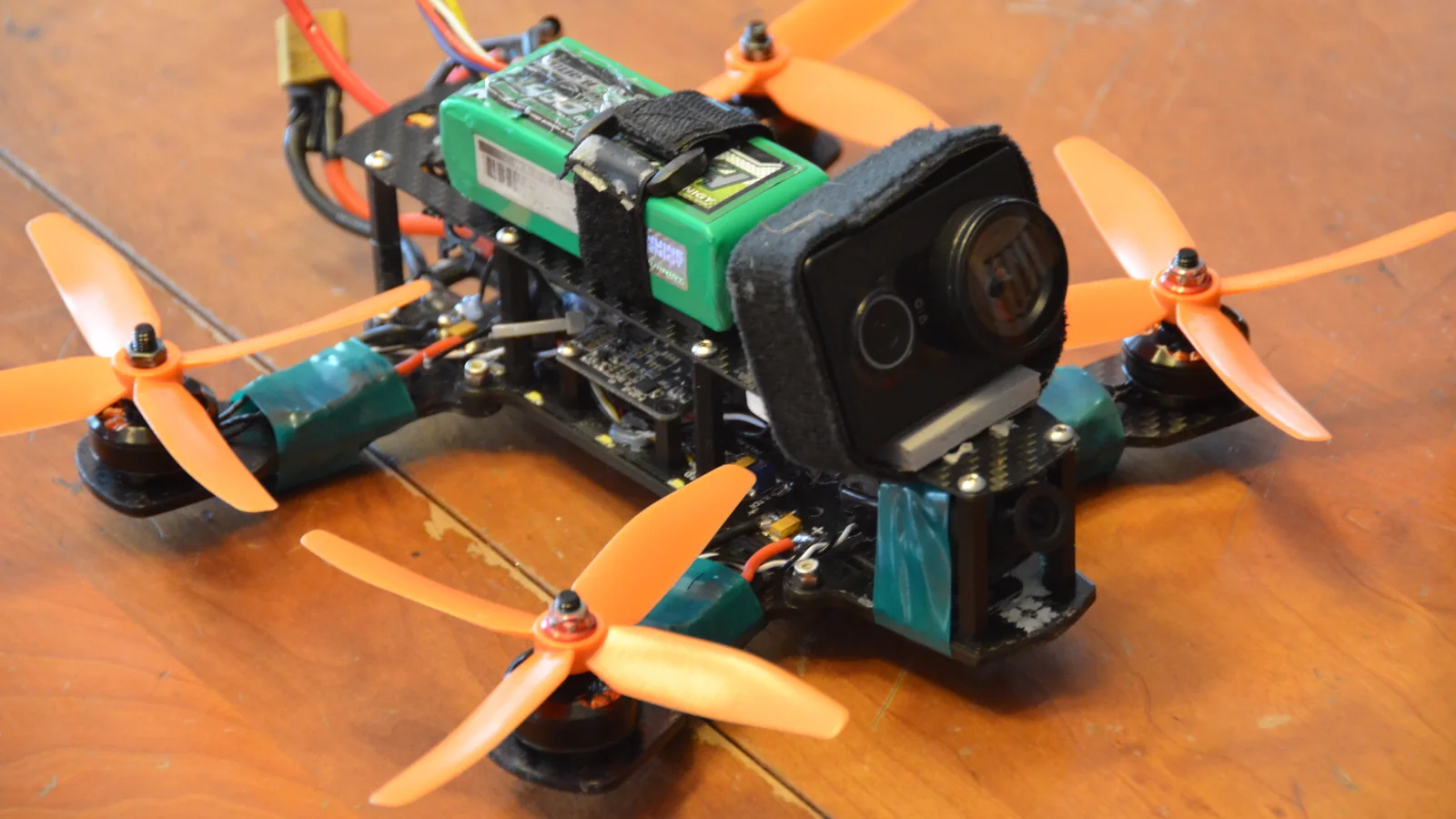
The reason FPV kit looks intimidating is that it is sold as components rather than as a product. It is worth learning the pieces even if you buy something assembled, because every conversation in the hobby and every repair assumes you know them.
What is in a quad, from the outside in:
- Frame — Carbon fibre, described by the propeller size it takes — 5-inch is the standard for freestyle and racing, 3-inch and smaller for tighter spaces, 7-inch and up for efficiency and endurance. The frame is what breaks in a crash and it is the cheapest thing to replace.
- Motors and speed controllers — Four brushless motors, each driven by an electronic speed controller. Modern builds usually put all four controllers on one board. This is the part that turns battery power into thrust and it is where most of the weight sits.
- Flight controller — The small board with the gyroscope on it that turns your stick movements into four different motor speeds, hundreds of times a second. It runs open-source firmware — Betaflight is the common one — and configuring it is a real part of the hobby rather than a setup step.
- Video transmitter and camera — The camera and the link that gets its picture to your goggles. Analogue is cheap, low-latency and degrades gracefully into static; digital systems are far clearer and cost more, and they fail more abruptly when the link goes. Both are legitimate choices and the argument between them is the hobby’s longest-running.
- Radio receiver — Separate from the video link and on a different frequency. This is the control link, and losing it triggers the aircraft’s failsafe rather than merely losing your picture.
- Goggles — The single most expensive item and the one that lasts longest across aircraft. Box goggles are cheaper and bulkier; low-profile goggles cost more and fit better. Try somebody else’s before buying, because fit and focus are individual.
- Batteries and a charger — Lithium-polymer packs, typically four to six for a session because each gives only a few minutes of flight. They are consumables, they degrade over a season, and they are the one component on this list that is genuinely hazardous — see the safety section.
Almost everything that goes wrong in FPV is one of four things, and the four have completely different fixes — which matters because the symptoms overlap badly. A quad that drops out of the sky looks identical whether the video link died, the control link died, a motor failed or the battery gave up, and the first instinct is nearly always to blame the wrong one.
Read each entry as symptom → likely class → what you can safely check → what to do next. Nothing here identifies a unique cause. What it does is separate the classes, because eliminating the cheap ones is what turns a mystery into a repair.
- Class 1
- Video link — you lose the picture
- Class 2
- Control link — the aircraft stops obeying
- Class 3
- Power — motors, ESCs, battery
- Class 4
- Configuration — it never flew right
- The picture breaks up as you fly away, then comes back — Video link, and almost certainly antennas. This is the ordinary behaviour of a marginal link rather than a fault. Check the obvious in order: is the aircraft antenna damaged or bent, are the goggle antennas fitted and pointing the right way, and is anything between you and the quad — a building, a hill, your own body. Analogue degrades into static gradually and digital holds a clean picture and then drops abruptly, so the same underlying problem looks different depending on your system.
- The picture goes and the quad keeps flying — Video link only. The control link is separate and on a different frequency, so the aircraft is still yours. This is why knowing roughly where it was pointing matters: a gentle turn back towards yourself often recovers the picture. Panicking and cutting the throttle turns a recoverable moment into a crash.
- The quad stops responding and then behaves oddly on its own — Control link, and the failsafe doing what you told it to. Losing the receiver link triggers whatever failsafe is configured — usually motors off, sometimes an attempted return. Check that the failsafe is actually set the way you think, because the default is not always what you want and this is the setting people discover the value of exactly once.
- One motor is hot after a flight and the others are not — Power, and check it before flying again. A motor noticeably hotter than its neighbours usually means a bent shaft, a damaged bearing, a prop out of balance, or an ESC working harder than it should. Spin each motor by hand with the battery out and feel for grit or resistance. Flying on a failing motor is how a repairable fault becomes a crash.
- It flips over immediately on take-off — Configuration, and it is nearly always motor direction or prop order. The classic first-build fault: a motor spinning the wrong way, or props fitted in the wrong positions. Both are checkable on the bench with props off, and both are configuration rather than damage. If the build flew before, suspect a repair that put something back in the wrong place.
- It drifts steadily in one direction in a hover — Configuration, then physical. Check the obvious first — the aircraft was calibrated on a level surface, and no trim is applied at the radio. If both are fine, look for a bent arm or a motor mount sitting proud after a crash, which tilts the thrust without looking obviously wrong.
- Flight times have dropped noticeably — Battery, and it is age rather than a fault. Lithium packs lose capacity over a season and the decline is gradual enough to be blamed on the weather. Compare a suspect pack against a newer one on the same aircraft and the same flying. A pack that has puffed, or that arrives warm and stays warm, is a pack to retire.
- It fell out of the sky with no warning at all — Power, most often. An abrupt total loss is usually a battery disconnecting on a hard manoeuvre, a broken solder joint, or an ESC failing. Check the battery strap and the connector first — a pack that shifts under load and unplugs itself is the commonest cause and the cheapest fix.
- A pack is puffed, hot, or damaged in a crash — Stop, and this page has nothing further to offer. Retire it. What to do with it after that — how to discharge, store or dispose of it — is specific to the chemistry and the cell count in your hand and belongs to the manufacturer documentation and to somebody experienced at your club, not to a web page.
The habit worth building is to check the link classes before the hardware. Video and control are separate systems on separate frequencies, telling them apart takes one question — did it keep flying? — and that question routes you to the right half of the aircraft before you take anything apart.
FPV maintenance is unusual in that the aircraft is a consumable and the expensive parts are not. Frames, props and motors are cheap and get replaced; goggles and the radio last for years. So the routine is not about preserving the quad — it is about catching the small faults that turn into crashes, and about the batteries, which are the one component where neglect is a hazard rather than an inconvenience.
Before every flight, and it genuinely takes a minute:
- Props — Look along each blade for nicks, and flex it gently. A chipped prop is out of balance, and an out-of-balance prop vibrates the flight controller, which produces flight behaviour people spend evenings trying to tune out. Props are the cheapest part on the aircraft and the one most worth being fussy about.
- Prop nuts and screws — Motor screws back out with vibration. A quick check by hand costs nothing and a motor leaving mid-flight costs the aircraft.
- Arms and frame — Carbon fibre cracks rather than bends, and a hairline crack in an arm is the failure that arrives two flights later. Look at the arm roots, which is where they go.
- The battery strap and connector — A pack that shifts under load can unplug itself, which is the commonest cause of an aircraft simply stopping. Strap tight, connector fully home.
- Antennas — Both the video antenna and the receiver antennas. A damaged or crushed antenna is the usual explanation for a link that used to be fine.
After a crash — which is a normal event rather than an incident:
- Disconnect the battery before touching anything — A quad that has landed in a hedge with the battery connected can arm. Props off before working on it is the flightline rule and it applies in the field as much as at the bench.
- Check the pack before the aircraft — A pack that took the impact, is warm, or has any deformation is retired rather than reused. This is the one check where the answer is binary.
- Spin each motor by hand — Grit, resistance or a wobble means a bearing or a bent shaft. Motors are cheap; flying on a damaged one is not.
- Look for pulled solder joints — Impacts flex boards. A joint that looks fine and has cracked underneath is the classic intermittent fault, and it is why an aircraft that crashed once sometimes falls out of the sky a week later for no visible reason.
- Re-check motor direction after any motor swap — Because the flip-on-take-off fault is nearly always this, and it is free to verify with props off.
The framework is the CAA’s Drone and Model Aircraft Code, published as CAP2320. Most leisure flying sits in what the Code calls the Open category, which it describes as low-risk, simple flying, and within that in one of three sub-categories defined by how close to people you may go. What follows is orientation rather than a reproduction of the Code, and the Code itself is short, free and the thing to read before flying.
The registration you need before you fly anything, which depends on weight and on whether there is a camera:
- A Flyer ID, for anything 100g or above — It shows you have passed the CAA’s theory test and it is free to sit. An FPV quad has a camera by definition, so in practice every FPV aircraft above 100g needs one.
- An Operator ID, for anything 250g or above — or 100g or above with a camera — This is the one that gets labelled on the aircraft. Because FPV aircraft carry cameras, the 100g threshold is the one that applies to almost all of them, including the very small ones people assume are exempt. You must be 18 or over to hold an Operator ID; a younger flyer registers under a parent or guardian.
- Neither, below 100g — but the rest of the rules still apply — Sub-100g aircraft exist and are genuinely useful for learning indoors. The Code recommends taking the test anyway, and every other rule on this page applies to them regardless.
| Limit | What the Code says |
|---|---|
| Height | Never more than 120m (400ft) from the closest point of the earth’s surface — so flying over ground that rises means adjusting the flight path |
| Distance from people | A minimum 50m horizontal distance, described as a no-fly cylinder rising to the height limit. Aircraft below 250g, and UK0/UK1/C0 class, may go closer |
| Crowds | Never over people crowded together, no matter what size of aircraft |
| Built-up areas | At least 150m from residential, recreational, commercial and industrial areas, unless the aircraft is below 250g or UK0/UK1/C0 class |
| Aerodromes | Most airports, airfields and spaceports have a Flight Restriction Zone. Never fly in one without permission from the airport, airfield or spaceport |
| Class marks | New models placed on the market from 1 January 2026 carry a UK class mark, UK0 to UK6. A European C class mark may be flown as the corresponding UK class until 31 December 2027 |
The practical consequence for a self-built quad is worth spelling out, because it is where a lot of people get it wrong. A privately built aircraft has no class mark, and under the Code a privately built aircraft under 25kg flies in the Far from People (A3) sub-category — 50m from uninvolved people and 150m from built-up areas. That is most of the reason organised flying sites exist, and it is why "I will fly it in the park" is usually not available.
Everything above is the Code’s account of ordinary leisure flying, and it is not the whole of aviation law. This page gives no route or location advice, publishes nothing about operating outside these limits, and describes no method for extending range beyond what an observer can see. Those are not gaps — flying beyond visual line of sight, entering a restricted zone, or defeating a manufacturer’s geographic limits are all matters where the answer is an authorisation from the CAA or is simply an offence, and neither is something a web page hands out.
Sources for this section
- The Drone and Model Aircraft Code (CAP2320) (opens in a new tab) — UK Civil Aviation Authority · Governing body · read — supports the claim
- Where you can fly (opens in a new tab) — UK Civil Aviation Authority · Governing body · read — supports the claim
The risk profile of this hobby is not what people expect. The aircraft themselves are light and the injuries they cause are cuts from spinning propellers, which are real and are prevented by not arming near people. The two things that actually deserve attention are the batteries and the airspace, and only one of them is about flying.
The rest of it, in the order it matters:
- Propellers — Sharp, fast and the only part likely to injure anybody. Props off when working on a quad, and never arm with somebody within reach. This is the one universal rule of the flightline and it is enforced socially rather than legally.
- Airspace — The genuine third-party risk, and the reason the observer requirement exists. An aircraft you cannot see is an aircraft you cannot avoid something with — and the Code is explicit that things like air ambulances, police helicopters and low-flying military aircraft operate below your height limit.
- Privacy — A camera in the air is a camera, and pointing it into gardens and windows is both the fastest way to lose a flying site and a matter with its own law. This is the commonest reason the public complains about the hobby and it is almost entirely avoidable.
- Fire, in the field — A crashed quad with a damaged pack in dry grass is a real scenario. Recovering the aircraft promptly is part of the reason somebody watches where it went down.
- Freestyle — Flipping, rolling and flowing around obstacles for its own sake, usually filmed. The largest branch by participation and the one most people mean by FPV. A 5-inch quad and an open field or a disused structure you have permission to be at.
- Racing — Timed laps round a marked course against other pilots, with a formal competition structure that runs to national and international level. Faster, lighter, more fragile machines, and the branch with the most organised club scene.
- Cinematic — Smooth, deliberate flying for footage, often with a heavier quad carrying a separate high-quality camera. Closer in spirit to camera-drone work but with the control authority FPV gives, and it is where a lot of professional work now sits.
- Tiny whoop and indoor — Very small ducted quads flown indoors and in tight spaces. Cheap, quiet, sub-100g in many cases, and the branch that lets you practise in a living room in February. Genuinely the best value entry into the hobby.
- Long range — Larger, more efficient aircraft flown for distance and endurance. Worth naming honestly because it is where the legal boundary bites hardest: distance is limited by what your observer can see, not by what your video link can do, and the Open category has no version of this that goes beyond visual line of sight. Doing it lawfully at any real distance means an operational authorisation from the CAA rather than better equipment.
- Still deciding — FPV flying vs drone photography
The learning curve in FPV is unusually steep at the start and then unusually generous. The first few hours are genuinely hard because the aircraft has no self-levelling in the mode everybody eventually flies in, and then it opens out quickly once the basic orientation stops taking conscious effort.
Roughly the order in which things stop being the limiting factor:
- Orientation — Knowing which way the aircraft is pointing without thinking. This is the wall, it is why the simulator exists, and it goes away suddenly rather than gradually.
- Throttle control — In the mode most people fly, the throttle controls thrust rather than height, so holding an altitude is an active skill. The second wall and the smaller one.
- Repairs — Becomes the limiting factor around the point flying stops being one. A pilot who cannot solder flies on the days their quad happens to be working.
- Tuning — Configuring the flight controller so the aircraft feels the way you want. Optional for a long time and then suddenly interesting, and it is where the hobby’s technical depth actually lives.
- The thing you are flying for — Footage, lap times, or the flying itself. Most people find this out several months in and it changes what they buy next.
In most hobbies a club is a convenience. Here it is close to a requirement, and for three separate reasons that stack: a legal flying site, third-party insurance, and a person to be your observer. The model-flying associations administer club membership and insurance, and most organised FPV flying in Britain happens under that structure rather than outside it.
The culture is unusually generous with technical help and unusually strict about the flightline. Expect somebody to tell you to take your props off, expect somebody to lend you a battery, and expect a great deal of unsolicited opinion about analogue versus digital video. Racing has a formal competitive ladder running to international level; freestyle has an entirely informal one built on published footage.
The hobby also carries a reputational problem it did not entirely earn and has to manage anyway. A small number of people flying over crowds, near airports and into other people’s gardens has shaped how the public and the press see every person with goggles on, and the community’s response has largely been to be visibly careful in public. That is worth knowing before your first flight in a field with dog walkers in it.
- Assuming the goggles are your eyes — The single most consequential misunderstanding in the hobby, and the reason a great deal of British FPV flying is unlawful without the flyer realising. Goggles are named in the Code as not counting.
- Buying the quad first — The radio and a simulator are the first two purchases. A quad bought before either is a quad that gets destroyed in the first ten minutes.
- Skipping the simulator because it is not real flying — It is exactly real flying, minus the consequences. Nothing else in the hobby returns as much per pound.
- Flying in a public park — A self-built aircraft flies in the A3 sub-category, which means 150m from built-up areas and 50m from uninvolved people. Most urban green space cannot accommodate that.
- Charging batteries unattended — The behaviour behind most lithium fires in this hobby, and the easiest one to stop doing.
- Buying digital video first — Excellent, and expensive, and it will not make you a better pilot. Analogue is a completely legitimate long-term choice and many experienced flyers prefer its failure behaviour.
- Not labelling the aircraft — The Operator ID goes on the aircraft. It is a legal requirement, it takes a label maker two minutes, and it is the first thing anybody official will look for.
- Acro / rate mode
- The flight mode with no self-levelling, where the sticks command rotation rather than angle. What almost everybody eventually flies in, and the reason the first hours are hard.
- Angle mode
- Self-levelling: let go of the sticks and the aircraft returns to level. Where beginners start and where most camera drones permanently live.
- Failsafe
- What the aircraft does when it loses the control link — typically cut motors or attempt a return. Configured by you, and worth understanding before you need it.
- VTX
- Video transmitter. The thing that sends the picture to your goggles, and separate from the radio link that carries your control inputs.
- Betaflight
- The open-source flight-controller firmware most builds run. Configuring it is a genuine part of the hobby.
- Whoop
- A very small ducted quad, usually flown indoors. Often under 100g, which changes what registration applies.
- Observer
- The person legally required to be beside you when flying FPV, keeping the aircraft in direct sight and watching the airspace. Not a helper — a legal condition of the flight.
- FRZ
- Flight Restriction Zone. The controlled area around most airports, airfields and spaceports, which you may not fly in without that aerodrome’s permission.
- Do I really need someone with me every time I fly?
- Yes, if you are flying by looking through goggles. The CAA’s position is unambiguous: "If you want to fly using First Person View, you must have an observer with you when you fly." The observer stands next to you, you must be able to talk to each other throughout, and one of you must keep the aircraft in direct sight with a full view of the surrounding airspace. They need no qualification, but you must brief them on what to watch for and you remain responsible for the flight. If you fly line-of-sight without goggles, this does not apply — but then you are not flying FPV.
- Can I fly it in my local park?
- Usually not, and the reason is the sub-category rather than the park. An aircraft you built yourself has no class mark, and a privately built aircraft under 25kg flies in Far from People (A3) — which means staying at least 50m from people not involved in what you are doing and at least 150m from residential, recreational, commercial and industrial areas. Very few urban parks give you that. This is most of the reason organised flying sites and clubs exist, and finding one is the practical answer.
- How long does a battery last?
- Far less than people expect — a few minutes of hard flying on a 5-inch quad, and somewhat longer on an efficient long-range machine flown gently. That is why a session means four to six charged packs rather than one, and why battery cost is the recurring expense of the hobby rather than the aircraft.
- Is it expensive to keep going after the first purchase?
- Moderately, and it is consumables rather than upgrades. Propellers break routinely and cost a few pounds a set. Batteries degrade over a season and are £15–£30 each. Frames and arms break in crashes. What does not recur is the goggles and the radio, which is why spending well on those two and modestly on the aircraft is the standard advice.
- Do I have to build it myself?
- No — ready-to-fly machines are good now and there is no shame in one. But you will have to repair it, because crashing is a normal part of learning rather than a failure, and the skills are the same. Most people who stay in the hobby end up building, because after the third repair you already own the tools and know the parts.
- Can I fly further if I get a better video link?
- Not lawfully in the Open category. Range in Britain is limited by what your observer can see, not by what your equipment can transmit — and the CAA states plainly that "Using FPV equipment does not mean you can fly Beyond Visual Line of Sight (BVLOS) in the Open Category." Genuine long-range operations need an authorisation from the CAA rather than better hardware, and this page publishes nothing about operating outside the visual-line-of-sight limits.
If you like this
Each of these is here for a stated reason, not because it is also a hobby.
Similar to
- Model railways — Both are model-engineering hobbies where the building is at least half the point, both are dominated by the choice of a standard to commit to, and both have a club structure that supplies the space an ordinary house does not have.
- Robotics — Power, control and drive as a system you assemble and tune yourself, with open-source firmware in the middle of it and a community that assumes you will modify things.
Goes well with
- Astrophotography — Two hobbies whose real constraint is the weather and a suitable site rather than the equipment, and which attract the same appetite for a technical stack that has to be got right before anything happens.
- Film photography — The cinematic branch is photography with a different tripod, and the compositional instincts transfer directly. What does not transfer is that one of them is governed by aviation law.
Shares equipment with
- Microcontroller projects — A quad is a microcontroller with motors on it, and the soldering iron, the multimeter and the willingness to flash firmware are the same. A great many FPV pilots arrived from here.
Sources for this section
- The Drone and Model Aircraft Code (CAP2320) (opens in a new tab) — UK Civil Aviation Authority · Governing body · read — supports the claim
- First Person View (FPV) flying (opens in a new tab) — UK Civil Aviation Authority · Governing body · read — supports the claim
- Where you can fly (opens in a new tab) — UK Civil Aviation Authority · Governing body · read — supports the claim
Comprehensive
Last reviewed 2026-08-18. Cost, time and difficulty figures on this page are HobbyHQ estimates — see how we work. Something here wrong or out of date? Tell us.