Technical & maker
Robotics
Hobby robotics is not one activity, and pretending otherwise is why so much of the available advice is unhelpful. A line-following robot, a battling machine and a walking quadruped share a toolkit — mechanics, electronics, code — and almost nothing else about what they demand. This page describes the toolkit, names the branches honestly, and is specific about the two hazards that are genuinely different from ordinary making: solder fume and lithium batteries.
Also known as hobby robotics, robot building, amateur robotics.
A robot, for the purposes of a hobby, is a machine that senses something, decides something and moves. Remove the sensing and you have a remote-control vehicle; remove the moving and you have an electronics project. Both are worthwhile and neither is quite this.
That definition explains why the hobby demands three skills rather than one. Mechanics is structure, drive and the transmission of force, and it is where most first robots actually fail. Electronics is power, motor control and signals, and it is where most first robots fail expensively. Code is the part beginners expect to be hardest and it is usually not — the sensing and control loop is conceptually tidy, and the frustrating parts are the physical ones.
The honest thing to say about the subject is that it is very broad and the branches barely overlap in practice. Somebody building a competitive combat robot and somebody building an autonomous rover are solving unrelated problems with a shared vocabulary. Advice that does not say which branch it is about is usually the reason something did not work.
- What makes it a robot
- Sense, decide, move
- Where first builds fail
- Mechanics, not code
- Cheapest real start
- Microcontroller and two motors
- The two real hazards
- Solder fume and lithium cells
Step 1: Buy a documented kit rather than assembling a parts list
A chassis kit with motors, driver, microcontroller and instructions is £100–£250 and removes the entire class of problem where nothing works and you cannot tell which of six unfamiliar things is wrong. The parts-list route is cheaper and is a much worse first month.
You will know it worked when: You have a complete set of parts known to work together.
Step 2: Make one motor turn, and stop there
Board, driver, motor, power. Nothing else connected. This is the smallest complete system in the hobby and getting it working teaches the thing that matters most — that power and logic are separate concerns.
You will know it worked when: A motor turns on command and the board does not reset when it does.
Step 3: Add one sensor and close the loop
Read it, print the value, and only then make the motor respond to it. Watching the number before trusting it is the habit that separates debugging from guessing.
You will know it worked when: The robot changes behaviour because of something it sensed.
Step 4: Build a line follower
The canonical first robot for good reason: it needs sensing, a control loop and drive, it is achievable in an evening, and it fails in instructive ways that are all about tuning rather than about mystery.
You will know it worked when: It follows a line, badly, and you know why.
Step 5: Go to a club or an event before your second project
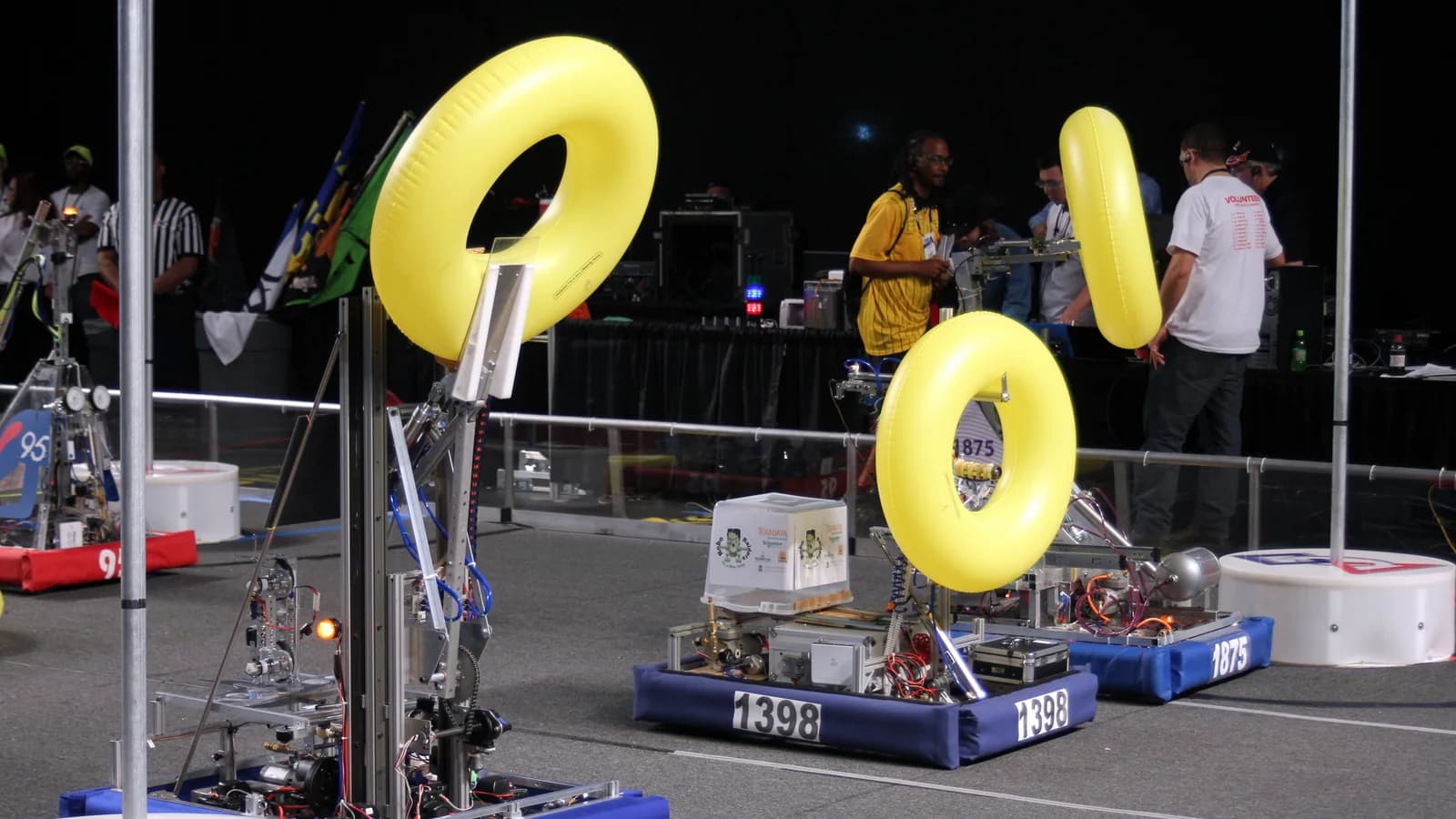
Robotics has an unusually good in-person culture and an unusually large amount of tacit knowledge — what a motor should sound like, why a chassis flexes. A pit area at a competition is the fastest learning available in the hobby.
You will know it worked when: You have seen other people's machines and asked how they did something.
- A microcontroller board — The brain, and the cheapest part of the whole thing. The ecosystem matters far more than the chip: choose one with documentation and a community, because your first twenty problems are all things somebody else has already solved and written up. Boards capable of far more than a first robot needs cost a few pounds.
- Motors, and the driver between them and the board — A microcontroller pin cannot drive a motor — it switches a signal, not power — and the motor driver is the component beginners omit and destroy a board learning about. Geared DC motors for drive, servos for jointed movement, steppers where position must be known without a sensor.
- A power source chosen for the motors — The commonest first mistake in the whole hobby is powering motors from the same supply as the logic and wondering why the board keeps resetting. Motors draw hard and sag the supply; the fix is separate supplies or proper decoupling, and it is a design decision rather than a bug.
- Sensors, starting with two — Reflectance sensors for line following, ultrasonic or time-of-flight for distance, an inertial measurement unit for orientation. Start with the minimum the behaviour needs — most beginner projects fail from too many inputs and no clear control loop, not too few.
- A temperature-controlled soldering iron and fume extraction — The iron is the tool that most repays spending on, because a cheap uncontrolled one makes joints that fail intermittently — which is the worst kind of fault to diagnose. Buy the extractor at the same time rather than later.
- A multimeter, and a bench supply eventually — The multimeter is how you find out what is actually happening rather than what you believe is happening, and it is the difference between debugging and guessing. A current-limited bench supply saves components by refusing to deliver enough power to destroy them.
- A 3D printer, sooner than you expect — Close to standard equipment once you want anything the catalogue does not sell — brackets, mounts, chassis parts. It is what turns "I could design that" into a part on the bench, and it changes the hobby more than any other single purchase.
- Work it out — Robot battery runtime calculator
- The board resets whenever the motors start — The single most common fault in hobby robotics. Motors sag the supply below what the microcontroller needs. Separate the supplies or decouple properly — it is a design problem, not a faulty board.
- It works on the bench and not on the floor — Usually load. A drivetrain spinning free draws a fraction of what it draws moving a robot, and the difference is where undersized drivers and supplies reveal themselves.
- Intermittent faults that move when you touch the wiring — A dry joint or a marginal connector, and the reason a temperature-controlled iron is worth the money. Intermittent is always harder to find than dead.
- The sensor reads nonsense — Print the raw value before doing anything with it. A surprising proportion of "the algorithm is wrong" turns out to be a sensor that was never reading correctly.
- It oscillates instead of settling — Control gain too high, or a loop running too slowly for the response. The classic line-follower wobble, and the point at which control theory stops being abstract.
- The chassis flexes and the geometry changes under load — A mechanical fault presenting as an electronic one. If the wheels are not where the code thinks they are, no amount of tuning will fix it.
And the ordinary workshop hazards, which are ordinary but not absent:
- Motors that are stronger than they look — A geared drive motor will take a finger into a belt or a wheel arch without noticing. Power down before working on a machine, and get into the habit early rather than after the first surprise.
- Bench power supplies and mains — Low-voltage DC is forgiving; the mains side of a supply is not, and neither is a large capacitor after the power is off.
- Lead solder and hand-to-mouth transfer — Lead-free is standard now and lead solder is still around. The exposure route that matters for hobbyists is hands to food, which is solved by washing them.
- Eyes — Snipped component legs travel at surprising speed, and anything with a spinning part deserves the same respect as any other workshop machine.
- Combat classes, which are a different category — Powered weapons are managed by event safety rules — arenas, link removal, activation procedures — and those rules are the authority. Nothing here substitutes for the ruleset of the event you are entering.
- Line following and maze solving — The classic entry point and a genuine competitive discipline at the top end. Cheap, tabletop, and unusually good at teaching control loops because the failure is always visible and always about tuning.
- Combat robotics — Machines built to disable each other in an arena, in weight classes from a few hundred grams up. Mechanically brutal, dominated by drive reliability and armour rather than by cleverness, and governed entirely by event safety rules. The most expensive branch, because it works by breaking things.
- Autonomous rovers and navigation — Machines that find their way without being driven, which is where the interesting software lives — sensor fusion, mapping, path planning. The branch with the most direct overlap with professional robotics.
- Walking and legged robots — Quadrupeds and hexapods. Mechanically demanding and servo-hungry, and the branch where a 3D printer stops being optional. Enormously satisfying and correspondingly fiddly.
- Robot arms and manipulation — Static rather than mobile, and about precision, repeatability and kinematics. Sits closest to the CNC and machining world, and appeals to people who want a machine that does a job rather than one that moves around.
- Educational and competition formats — School and youth leagues with fixed rules and standard kit. Worth knowing about even for adults, because the resources produced for them are among the best documentation in the hobby.
- Still deciding — Robotics vs 3D printing
- Microcontrolleralso: MCU
- A small computer on a single chip, with pins that read and switch signals directly. The brain of nearly every hobby robot, and among the cheapest parts in it.
- Motor driveralso: H-bridge
- The component between the microcontroller and the motor, switching real power in response to a signal. Omitting it is how beginners destroy their first board.
- PWM
- Pulse-width modulation — switching power on and off very fast so the average delivered is what you want. How motor speed and servo position are actually controlled.
- Servo
- A motor with built-in position feedback, commanded to an angle rather than a speed. What joints and steering are usually made of.
- Stepper
- A motor that moves in fixed increments, so position can be known by counting without any sensor. The basis of most machines that need repeatable precision.
- IMU
- An inertial measurement unit — accelerometers and gyroscopes in one package, reporting orientation and motion. What a balancing or legged robot is built around.
- Control loop
- The cycle of read a sensor, compare against a target, adjust an output, repeat. The idea that turns a machine that moves into a machine that behaves.
- Brownout
- The supply voltage sagging low enough to reset the microcontroller, characteristically when motors start. The commonest fault in the hobby and almost always a design issue.
- LiPo
- Lithium polymer battery — high energy for its weight, which is why robots use it and why it needs the handling discipline in the safety section.
- Kinematics
- The geometry of how a mechanism moves. Forward kinematics asks where the end of an arm is given its joints; inverse asks what the joints must be to put it somewhere.
- Powering the logic and the motors from one supply — The defining beginner mistake. It works on the bench, fails under load, and presents as a software fault for as long as you let it.
- Starting with an ambitious build — A humanoid as a first project is a way of failing at six things simultaneously with no way to tell which. A line follower teaches the same fundamentals in an evening.
- Blaming the code — Most first-year faults are mechanical or electrical. If the wheels are not where the code thinks they are, the code is not the problem.
- Buying parts individually before knowing the ecosystem — Components that each work and do not work together is the worst possible first month. A documented kit costs more and is much cheaper in time.
- Soldering without extraction because it is only occasional — Sensitisation accumulates and does not reverse. A fume extractor costs less than most single components on the bench.
- Charging a pack unattended — The one with consequences beyond the project. Hard surface, present, and not overnight.
- No version control on the firmware — The robot worked yesterday and nobody can say what changed. Costs nothing to start and is the cheapest debugging tool in the hobby.
Robotics has an unusually good in-person culture for a subject that could plausibly have stayed online. Clubs, makerspaces and university groups host most of the activity, and competition pit areas function as open workshops where people will show you the inside of a machine they have spent a year on and explain why the second version is different. The tacit knowledge — what a motor should sound like, how much a chassis is allowed to flex — transfers almost entirely by being in the room.
The open-source norm is strong and load-bearing. A great deal of the hobby runs on freely published designs, libraries and build logs, and the expectation that you publish what you learned is genuine rather than decorative. It is also the reason the documentation quality for youth competition formats is so high, and why adults are well advised to read it.
Combat robotics is culturally somewhat separate, with its own events, safety officials and weight classes, and it is more of a spectator sport than the rest of the hobby. It is also where the engineering is most ruthlessly tested, because a design flaw is revealed by something hitting it.
- Do I need to be able to program?
- You need to be willing to learn, and it is usually not the hard part. The sensing-and-control loop is conceptually tidy and there are enormous quantities of published example code. What surprises most beginners is that the mechanics and the electronics cause more failures than the software does — if the wheels are not where the code thinks they are, no amount of programming will fix it.
- What should I build first?
- A line follower, from a documented kit. It needs everything the hobby is made of — sensing, a control loop, drive — it is achievable in an evening, and it fails in instructive ways that are about tuning rather than mystery. A humanoid or a drone as a first project is a way of failing at six things at once with no way to tell which one is wrong.
- Why does my robot keep restarting when it moves?
- Almost certainly a brownout: the motors are drawing enough current to sag the supply below what the microcontroller needs, and it resets. It is the commonest fault in the hobby and it is a design issue rather than a faulty board — separate the motor and logic supplies, or decouple properly. It characteristically works fine on the bench with the wheels off the ground, which is what makes people look at the software first.
- Is soldering actually dangerous?
- The fume is worth taking seriously in a way that hobbyists generally do not. HSE describes rosin-based solder flux fume as a top cause of occupational asthma, which is a sensitisation — it builds with repeated exposure and, once established, small amounts can set it off. Their controls are simple: use extraction, keep your head out of the plume, and do not overheat the iron. A basic fume extractor costs less than most of what is on the bench.
- How careful do I need to be with the batteries?
- Careful, and the reason is energy density rather than fragility. The London Fire Brigade notes that when lithium-ion batteries fail "they can ignite quickly and produce intense fires that spread rapidly" — their guidance is about e-bikes and e-scooters, but the failure behaviour is what transfers. Charge on a hard non-combustible surface, stay in the room, do not charge overnight, use the charger meant for that pack, and retire anything swollen or crash-damaged rather than hoping. This page gives no charge rates deliberately: those belong to the specific pack.
- Is it an expensive hobby?
- It starts very cheap and has no ceiling. A microcontroller, two motors and a breadboard is £40–£80 and is a real robot. Tooling is the first step change — a decent iron, a multimeter, eventually a 3D printer. Competitive combat is where it becomes genuinely expensive, because the sport works by breaking things and spares are not optional. Clubs and makerspaces exist substantially to share the costly tools, and joining one is usually cheaper than buying them.
Guides
Longer answers to questions this page can only summarise.
If you like this
Each of these is here for a stated reason, not because it is also a hobby.
Progresses to
- Home automation — Where the hobby goes once buying devices stops being satisfying — the same microcontrollers and the same sensors, with you writing the firmware rather than configuring somebody else’s.
- Microcontroller projects — Where a board goes once it drives motors and senses its way around. Robotics owns the drivetrains and the control loops; this is the layer underneath them.
Similar to
- CNC routing — Both are machines executing code on physical material, and both punish the belief that a problem in the output is a problem in the software.
- FPV drone flying — Power, control and drive as a system you assemble and tune yourself, with open-source firmware in the middle of it and a community that assumes you will modify things.
- Game development — Both are systems hobbies where the satisfaction is watching something you designed behave in a way you did not entirely predict, and both punish building systems instead of finishing things.
- Game mastering — An odd pairing that holds: both are systems-building hobbies where the satisfaction is watching a thing you designed behave in a way you did not entirely predict.
Goes well with
- 3D printing — The purchase that changes the hobby most — brackets, mounts and chassis parts stop being things you buy and become things you design in an evening.
Shares equipment with
- Model railways — The same motor control, the same low-voltage wiring and increasingly the same microcontrollers, approached from opposite ends — one wants prototypical behaviour, the other wants autonomy.
Sources for this section
- Solderer — asthma and rosin-based solder flux fume (opens in a new tab) — Health and Safety Executive · Governing body · read — supports the claim
- E-bikes and e-scooters: fire safety advice (opens in a new tab) — London Fire Brigade · Institutional · read — partly supports
Substantial
Last reviewed 2026-08-16. Cost, time and difficulty figures on this page are HobbyHQ estimates — see how we work. Something here wrong or out of date? Tell us.